
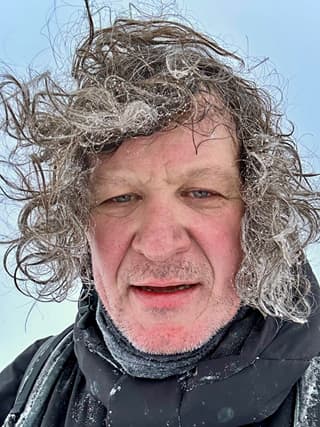
Photographer, conservationist, technology pioneer and a man who knows that sometimes the most interesting thing in a landscape is a rock.
Jon McCormack has had rather an unusual journey. From growing up on a remote farm in the Australian Outback to helping shape the camera in the iPhone, his career has taken him through some of the biggest tech names in technology. But alongside all those years in the world of computers and software, one thing has remained a constant: his fascination with photography and the natural world.
Jon grew up on a fifth-generation family farm in western Queensland, surrounded by the vast landscapes of the Australian Outback. It was a world shaped by the land, its beauty, its challenges and its unpredictable weather.
At 12, Jon received his first camera, an Olympus 35 Model IV, and began photographing the world around him. Processing meant a journey of around two hours, so he might only see his photographs months after taking them. In the meantime, he would sketch each scene and make notes about the settings he had used. It was an early lesson in patience, observation and thinking carefully before pressing the shutter.
His academic path took him in a rather different direction. Jon studied computer science at the University of Queensland, graduating with First Class Honours and a University Medal. What followed was a long career in technology, with senior roles at Oracle, Liberate Technologies, Yahoo, Openwave, Amazon, Google and HP, before joining Apple in 2018.
At Apple, Jon spent eight and a half years as Vice President of Software Engineering for Camera and Photos, leading teams responsible for the software behind Apple's camera and photography products. His work included computational photography research and the development of technologies such as Apple ProRAW and Apple Reference Image. In other words, he helped shape the camera experience used by millions of people carrying an iPhone in their pocket. Not a bad day's work!
Yet photography was never simply a hobby waiting for his technology career to finish. It developed alongside it, taking Jon to some extraordinary places and gradually helping him discover his own way of seeing. And that way of seeing is rather distinctive.
Jon is colour-blind, something that has influenced how he approaches photography. While many photographers are drawn first to colour, Jon has long been fascinated by patterns, textures, shapes and the hidden structures of the natural world. He might photograph a vast landscape, but just as easily find himself absorbed by a tiny detail in a rock or the unexpected shapes created by water, wind and light. As he puts it, rocks don't have a bad side!
That curiosity eventually came together in his first major photographic book, "Patterns: Art of the Natural World", published by Damiani in 2026. Bringing together photographs from all seven continents, the book explores the extraordinary visual patterns found throughout nature, from tiny details and mineral formations to aerial landscapes, ice, water and wildlife. It received the Best Nature Photo Book award at the 2026 International Photography Awards.
But Jon's connection with the natural world goes well beyond making photographs. He is a founding board member of SeaLegacy, the ocean conservation organisation founded by photographers Paul Nicklen and Cristina Mittermeier. He is also co-founder of The Kilgoris Project, an education initiative in Kenya that he and his wife Karen helped establish. What began with the construction of a school has grown into a project supporting around 2,400 children across several campuses, giving young people in the Maasai community access to education and opportunities for the future.
Jon is also a Fellow of the Royal Geographical Society and a member of The Explorers Club. His photographic work has been exhibited internationally and published in outlets including National Geographic, The Times and The Guardian.
After eight and a half years at Apple, Jon has now stepped away from his executive role, opening a new chapter in a life that has always had photography, curiosity and conservation running through it.
And perhaps that's what makes his story so interesting: a man who helped make photography more accessible to millions through technology, but whose own photographs often come from doing the opposite — slowing down, looking closer and noticing the things the rest of us might walk straight past. His singing voice though hasn't improved over the years.