

"They are way more important than my camera gear. I would happily go out of them any day of the week without any devices. And I don't know how many people can say that, that they can tolerate human beings without technology now. But yeah, these guys are really next level and I say I can't thank them enough."
Intro:
Dave: Spanning the globe to bring great photographers and their experiences directly to you. It's 08:00 p.m. In Japan, 01:00 p.m. In Spain, and high noon in our guests home in Folkstone, Kent in southeast England. That means it's time for the camera cafe show brought to you by photographers Tom Jacob and Dave Payne. Hello there, Tom, would you like to welcome our special guest and introduce her to our listeners?
Tom: Thanks, Dave, and welcome everyone with us. Today, an amazing, strong photographer, I can say in a way that she has a physical impairment which would be seen as making life harder as a photographer, but she went out and made it happen and that alone is just a fantastic story you want to hear, right, Dave?
Dave: Absolutely.
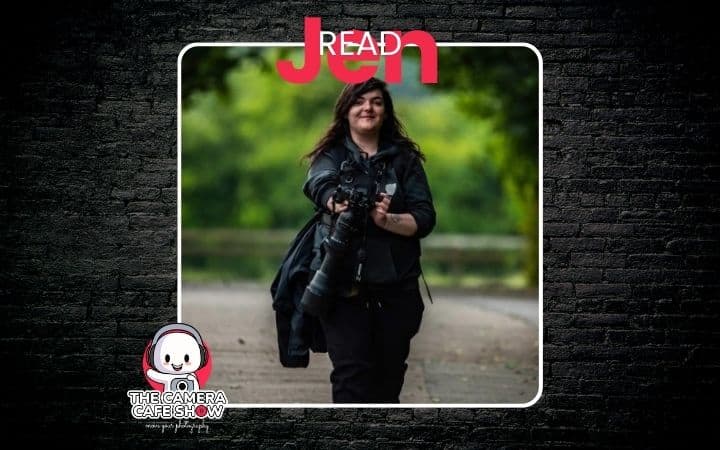
Tom: Today we talk with Jen Read from the UK and we will walk together through her journey. How she inspired despite her disability, became a great nature-art and pet photographer, and I hope she can inspire all of us. Let's get rolling.
Tom: Welcome to the show today Jen!
Jen: Hi there, guys. Thank you for having me.
Dave: It's our pleasure.
Jen, you mentioned in some of your descriptions that you are, quote, disabled but not unable, close quote. That really strikes close to home for me because I'm a fellow disabled photographer as well.
What you've achieved and what you're doing is really special. Can you tell us a little bit about how your disability hasn't stopped you and how you adapted your approach to photography to create your incredible images?
Jen: Well, first, I'm glad I could inspire you as well. We need to band together as a disabled community and, push out, obviously, to bigger, communities that we're still completely able to do everything else. I don't really know where to start with my animal photography and my disability, though. It's all the mindset, isn't it? If, you have a good mindset, good things will come. But of course, practice, practice, practice.
Dave: Tell us, Jen, a little bit about your disability and how you've adapted your approach. You've already got the great mindset. How did you adapt your approach to photography to get those images of yours?
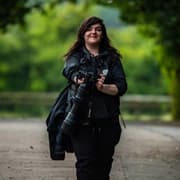
Jen: Okay, so I have a disability called phocomelia which mainly affects my right arm. It looks like a T-Rex arm for those trying to imagine it. But I call it my lucky fin. My main adaptions for my camera is one, finding the professional camera that has to be small enough to fit my only hand. And then secondly, I have a cable tie and some duct tape, which I use to get one of my fingers on my fin in so I can change my focal length because I can't grip the circular focus plane. And then I also have an adapter which is basically a blue stick. I line the subjects animals, plants in my frame using the notches on said stick. So there's four notches. If they're very small animals, like a kingfisher, then that would be on notch one. But if they're bigger like a lion or tiger, notch two. And that really helps me.
Tom: Wow, you got it all figured out there Jen, your working process.
Jen: Yeah, it took me a while to figure it out and sometimes I still struggle finding the animal in the frame. Not all of them have the one, or two notch rules. Sometimes it can be four. Three or four.
Tom: Let's go a bit back now, Jen. How you decided to become a pet and nature photographer?
Jen: I had a situation arise with my dog and that made me start photography in general. And then a few years later, we had our lockdown here in the UK and I gave my own pets the photography child syndrome, which every time I pulled up my camera, they were like, please Mum, no, no more. So I went out and started photographing wildlife instead. And now I juggle between both very happily.
Tom: What was the situation that triggered all this with your dog?
Jen: He nearly died. I won't get into details because trigger warning, of course, but it wasn't very pleasant. He thankfully is very much alive and he's healthy at six and a half years old now!
Tom: And you started making pictures of him from being afraid he would die and you had no good pictures of him afterwards?
Jen: Yes, when he was in the vets I had like a flash, basically like a life-before-your-eyes kind of flash. And I realized that although mobile phone selfies are incredible for capturing the moment, when you have a situation like this on your hands and you're trying to find a photo that really captures the true personality of what your pet is, I had nothing like that really.
That spoke to me and that broke my heart. My main goal in photography now is to capture your pet's personality to the fullest. So you never have to go through what I went through.
Tom: Amazing Jen. Also, I think you do free photo sessions for people who have animals who are in their last moments?
Jen: Yes, I do. Free end-of-life sessions for all animals, even your turtles and your fish, just to make sure that you do have that one photo on an emotional level for you and for people it's a very touching subject. I've had mixed opinions on this. It is very emotional on my behalf as much as owners, but that sadness and heartbreak does eventually turn into just pure magical love when they see the final result. I've had people wanting the photos within the week, and I've had other people that haven't wanted to see them for about a year. It all depends on, of course, where you stand in the emotional range. But I am there for you, however long it will take.
Dave: Jen, a question real quick, just so that our listeners are clear. You're doing wildlife photography and also pet photography, correct?
Jen: Yep. And I also do dog training, so I am busy, busy.
Dave: Wow.
Tom: Dave, I think she's the right person to ask to maybe give two or three tips on how I can make the best pictures of my dogs. They never sit still Jen.
Jen: Okay. So first, I would say if they're food orientated, use their dinner. A simple sit and stay. You only need 4 to 5 seconds to get their attention. So, if they're food orientated, use their food next to your camera, and as soon as they look over, there's your photo. If they're toy orientated, same thing, but you have to learn as well.
The second tip I'd give you is when and when not to use food or toys, because too much preys will bore them and get them uninterested, and not enough will also do the same thing. And my third tip would be, go eye level. If you can get eye level on any animal that brings an extra connection to the viewer of your photo. And if you have a chihuahua, then unfortunately you're going to have to go on the ground.
Dave: What if your pet is a snake?
Jen: Oh. Snakes are very cool to photograph! I also have a very strict rule with my business that I will not bring any animal, that lives in a tank, leave the tank. And like snakes that require a lot of heat, they do not like to come out of said heat source because it's not healthy for them. But snakes, yes, it's 50-50 you can get them on a good day.
But if you find someone especially that has, in a word, trained it to come out when they feed them, then yo have a chance. So every time there's food around, they can quite get quite snappy, if that's the right word to do it. If you find someone that has a snake that is really good with being handled, you can get some fantastic shots.
Tom: Well, this will be studio shots I suppose, but if you make pictures of let's say, dogs, Jen, you make outdoor shoots or you shoot them in a makeshift indoor studio?
Jen: I don't personally have my own studio. I make a makeshift one, either at their house or at my house. But yes, I would very much prefer them to be outside living their best life, sniffing all the leaves.
Tom: The outdoor pictures I can make with my dogs, but I have the problem with studio shots, they will just never sit still. I can do them one by one, but all the three together is very difficult!
Jen: Yeah, I can imagine.
Tom: Jen, let's go a bit to your wildlife side. You know, it gets obvious the more photographers Dave and I interview, they all start out in wildlife photography and they end up in nature conservation. Is that also the case for you, Jen? Are you active in it?
Jen: Yes, I was active in it before I became a photographer anyway. But now I am a photographer and I have a deeper respect for individual species on this planet. I am very much active in it these days. I'm in support of and donate to quite a few charities, the RSPB, the Royal Society of Birds in the UK. I'm part of Kent Wildlife Trust. I have memberships to my local wildlife conservation parks like the Aspinal foundation who are in Portland Zoo and Howlett Wildlife park. They are a key breeding partner for endangered species and they also release them into the wild.
Tom: Your main place to go shooting animal pictures Jen, is it in your backyard, in your town, or you go also out to zoos or wildlife areas?
Jen: I normally go to one of the wildlife parks with my friends every Saturday. We try to as best as we can and sometimes during the week if I have a free day. But usually I'm in either hive canal, which is about a 20 minutes bus journey from my town, or I'm in Kirsney Abbey, which is Dover, the other side of my town. If I'm not outside there then I am catching up on the local parks and the beach.
Tom: What's your favorite animal, Jen?
Jen: My favourite animal as a whole will always be a wolf. I'm not particularly picky on the species of wolf, but wolves in general. My favorite animal that I've personally photographed so far, would be the kingfisher.
Tom: What I find amazing is that most people say that you have to go to nature to make good pictures, but sometimes it's impossible to go or we just don't have these animals near us living in the wild.
So here are you making these incredible pictures and you show the people that even you can go to these places, you can see them there and you can make good pictures. I like this aspect very much Jen.
Jen: Thank you. it can be quite a challenge at the zoo to get a photo of the animals that don't look like they're in a zoo. Credit to the designers of their enclosures really. But, yes, definitely possible. But it adds that extra challenge to it. It's good to see an animal in their natural environment, even though it's kind of not their natural environment, if that makes sense.
Tom: Yeah, I understand. What equipment are you using now, Jen?
Jen: I currently have a Nikon Z6. And my Sigma 150 to 600 mm rarely ever leaves my camera. But I also have the Nikon 70 to 200mm f/2.8.
Tom: And you ever bought something photography-wise that you say 'Oh Boy, I, wish I hadn't bought that'!
Jen: I'd like to say my tripod. Because I have a really love hate relationship with it. But, yeah, flash gun and tripod, I wish I didn't invest in it. I work outside a lot and the tripod is solely because of my one arm. I have freedom just holding a camera, but when you add a tripod to it, it's like 6 pounds of weight total.
Dave: Jen, question for you.
You try to capture in your pet photography the pet's personality. How do you do that? Do you go to visit them and get familiar with them like a day before the actual shoot? Or how do you work to bring out their personality and capture it?
Jen: First things I do, is every single potential client I have, has to fill out a questionnaire. And that questionnaire gives me the basic information of their animal. So obviously what animal it is, what gender, are they new pets or afraid if we're in a busy area or not. So I know for what to keep an eye out. If they're in season, they are not being photographed until after.
And then I have more in depth questions, like, if they have any disabilities, if they've got a hip dysplasia, they're three legged, blind or deaf, etcetera. And then there's a little section at the bottom where I find out what their fun words are, where they love to be, what part of the day do they think that is the best or which one of the family members do they love the most? Although you'd love to think that dogs love everyone, there's always one individual person that they love more.
And then going by that questionnaire, if they are very nervous around new people, then I will actively meet them beforehand so they're comfortable with me. I never ask anything of any pets until at the end of our session, because then they're fully comfortable. They're tired because they've sniffed leaves and stuff. Everything ends in lots of treats, toys, all the good stuff that you could ask for, or nothing at all, if that's the type of their personality.
Dave: That's amazing. You've really got this figured out. Do you do pet portraits with the owner in the shot?
Jen: Yes, if they ask me for it.
Dave: Does that make..it's hard enough doing good portrait photography of a single person standing there or posing. What's it like shooting two portraits at the same time?
Jen: Yeah. It can be quite challenging because now I have to take into consideration the wind, especially if long hair, make sure they don't blink. And sometimes I have people that really do not want a portrait with their dog, so what I do instead is I get a close up of their dog's eye with their reflection in their dog's eye.
Dave: Oh, great solution.
Jen: Yeah. That is a lovely touch.
Dave: It's fascinating. I never would have thought there was so much to do it. You think of pets and they're around, you play with them, they play with you. You feed them, they snuggle up and fall asleep on you. End of story. But you've really got this figured out extremely well.
Jen: It's all about catching the moments of love when you add a person into the picture with their dog, and I do love those photos as well, but that moment where they turn around and smile at them, and the dog's looking at them with the utmost devotion, those moments come naturally, and you've just got to be there, ready and waiting.
Dave: Boy, that leads to a wonderful question. Could you share with our listeners two or maybe three of the most memorable personal moments you've experienced in shooting pets?
Jen: I photographed in a pet cemetery once for a client, so that was an extremely emotional and rememberable experience. So, at this point to be working in such a sacred area was definitely one of the top ones up there.
Another memorable experience was with my friend's staffy, bless his heart, who had to be put to sleep. His name was Blue. The week before we were going to have our session, he wasn't looking too good and we had doubts, obviously, that it would happen. And I managed to push it forward a few days with them. On that day that we went out, to do our session, he had this wonderful burst of energy, which I don't know if you're aware of this, but some dogs get very excitable just before they pass. I don't know the scientific name for it, but it is like a random burst of energy. He had the time of his life, and to see an old dog who had been waddling and very upset the last few days, just come to life in this last hour and a half before we went to the vet. I still kind of get teary over it now and it's been two years.
And to make that session even more magical, we're both massive fans of Marvel. So I edited his silhouette shot with his owner, with the dispersion edit. You know, when Thanos clicks his fingers and everything fades off. That's the image edit that I did for it. And it came together so perfectly because he did fade off, across that bridge.
Dave: Your client must have just been thrilled with that result.
Jen: They cried and then I cried. It's happy tears, but I was like, I don't want you crying, but you're making me upset.
Tom: Jen, if you want, send me that picture and we will put it on the episode cover.
Jen: That would be great.
Dave: Jen, what's one of your most memorable personal moments as a disabled photographer?
Jen: I would say, actually, it was kind of an iffy situation, if you will. But it was in Hive canal one time, and I was photographing dragonflies that was on the pond. And this guy came up to me, and he was very snotty. That's the only way I can really describe it. He took one look at my fin and one look at my camera, and at the time, I had a D5300. And, yeah, at first, he's very rude, honestly, one of the most rudest people I've ever met, actually. And then once he saw my portfolio, I've never seen a guy change so quick. That really hit home for me. I don't know why specifically this moment, because I'm normally pretty bomb proof with my disabilities, but, yeah, this one really had me. So not entirely a great memory, but one that's definitely helped me push forward to where I am now.
Dave: There's an old saying that really just came to mind perfectly with what you described. It's from the US Navy Seals, and they just do incredible things all the time. The saying is: You can give up, give in, or give it all you've got.
Jen: Yep. You've got to give it all you got.
Dave: That one is give it all you got is what you're describing. That is excellent. Jen.
Tom: Jen, I think the BBC...You have been with interviewed on the BBC last week or so?
Jen: Oh, yes, last Friday. I got shown on the BBC News on both the radio, social media and on the national tv. So I'm not going to lie I've been hiding since then and waiting for it to blow over.
Tom: But it came out already?
Jen: Yes, it has. It was shown Friday, the 20 something at 6.30pm, which is prime time for tv. I don't understand how I managed to get such big...I don't know what you call it...achievement, if you will. Yeah, it hasn't settled in yet in my head. Sorry if I'm rambling.
Dave: Yeah. You're looking at your television screen going, who's that person? That looks like me. Yeah, that looks like my camera!
Jen: Yeah! He even got my little key ring on the side of my camera, which is a lovely touch. It's a little dog bone, I love it so much. But not many people pick that out, and he spotted it straight. I was, ah, well, I am an animal photographer, so of course I've got to have it.
Dave: Amazing. Jen, there's one last question that I'd like to ask you. Just to kind of, pull things together for today's episode. For those people who are disabled but want to get into photography from your experiences, what is one thing you'd recommend they should start doing and one thing they should stop doing and why?
Jen: Firstly, you start by knowing it's okay to fail. It's okay to mess up and unfortunately you are going to miss those awesome shots. And it sucks, but it happens. But you keep going. I can't remember the name of the man who said the most legendary quote that your first 10,000 photographs are your worst. And that is very true, other than the golden tickets every so often.
And the thing I would recommend you don't do, is do not hang around with people that do not respect you enough. And I say that lightly because obviously everyone has a different relationship with everyone. But if they're not pushing you forward and inspiring you, then do not be around them because you don't want the negativity. Life is hard as a disabled person as it is, and life is hard enough as an artist. Now, you put them two together. With a bad support system you won't get very far. And it's heartbreaking because you do have to leave some people behind, but as I said in the beginning, mindset is everything and you need to be surrounding yourself with people who understand.
Dave: You just raised an excellent point. You talked about support system. How important is your support system and what makes it up?
Jen: Goodness me, I have the most fantastic friends. I'm emotional because I love them all so much, but I had a very bad year last year and they completely saved me in so many ways. I don't know if I'm allowed to say their names, but I'll say their first names, my friend Kate, Jason, Chris, Kevin, Anne, and my other disabled friend Natasha, who I love dearly, I would not be in the position I was today if I did not have them every day in a group chat cheering us all on, all helping each other.
And they're also the type of people that will tell you if you've missed something that's very bad. So it's a balanced criticism. You get all the good stuff and you also get the learning negative, which is better than just obviously negative, as we said earlier. But, yeah, but I can't fault my support system. So get yourself one and love them because they will do you great things.
Dave: So your support system, those people that are behind you, helping you, motivating you, challenging you to do better, that support system is as important as your camera gear?
Jen: They are way more important than my camera gear. I would happily go out of them any day of the week without any devices. And I don't know how many people can say that, that they can tolerate human beings without technology now. But, yeah, these guys are really next level and I say I can't thank them enough.
Dave: Well, that's excellent advice for disabled photographers and for people who want to get into the system.
It's interesting, one of your stories just triggered a memory real quick. I use a four wheel walker so that I can hold myself upright and move around. Then I'll sit down in the seat and shoot. And I had another photographer at a rose garden here who was just, the look on his face was, disdain is probably too polite a word for it, like, what are you doing here? You're taking up space.
You've seen that, no doubt. And I smiled at him in my pathetic japanese, which is only a little bit. I told him, I said, chotamate. Wait a second. And I whipped out my phone and I showed him some portfolio shots that I'd prepared in the phone just for roses and bees. It was macro. And he looked at it and the expression, not only on his face, but the expression of his personality just completely changed.
Jen: Yeah, I could imagine. So I bet he ate his own words when he got home.
Dave: It's amazing.
Jen: You never judge a book by it's cover.
Dave: Yeah. The support system is important from your friends, but you've also got to be strong enough to deal with those who don't understand your physical limitations or maybe are not respectful of them and just stay neutral and maybe show them your work.
Jen: That is the best thing you can do. Stay neutral, like you say.
Dave: Yeah, change people's thinking one mind at a time.
Jen: One at a time.
Dave: Yeah, it really does make a difference. And I've run into that photographer at that same location about two weeks later, and he walked up to me with a big smile and said, hello, and we ended up shooting next to each other for maybe 20 or 30 minutes. It was really special.
Jen: Oh, amazing. I'm glad to hear that. Thankfully, haven't met my dude from hive Canal again.
Dave: Well, it sounds like you've done some tremendous, tremendous stuff, Jen, and I, love your photography. I'm going to have to look up your BBC show. I'm going on the Internet when we get off.
Tom: Jen, send me the link to it if you can.
Jen: Yes, I'll send you the link Tom.
Dave: Oh, excellent. Thank you. That's a good idea. Can we put that in the show notes, Tom?
Tom: Yeah, we can put it inside, of course.
Dave: Oh, that'd be wonderful. Then our guests can see you as well as hear you on our show.
Tom: Jen, I was wondering, you ever give talks in schools about photography?
Jen: I haven't done anything for about a year and a half because I was ill last year. But yes, I have done it before and I'm always happy to answer any questions. So if anyone wants to message me, feel free because I do love a chat.
Tom: Okay, good. Now what is left to talk about is getting your next new tattoo on your arm Jen!
When are you going to put the logo from the podcast there?
Jen: Have you got the forms? I don't want any copyright issues!
Tom: I think Dave and I will sign it.
Dave: No problem!
Jen: Okay, absolutely. You're going to have to choose a tattoo artist though that you think will do your logo the best.
Tom: I think it will look great. We will discuss it.
Jen: Okay.
Dave: I might have to go out and get our show tattoo logo too. I mean, why not?
Jen: You might as well. You love photography and, you got your little headphones to rock it with as well.
Dave: Little free advertising. That works well.
Jen: That would be amazing.
Dave: Great idea, Jen.
This has really been an enjoyable conversation and a great learning experience. Is there anything else you'd like to add about your photography, your approach to life? To our listeners?
Jen: As a very broad subject, I'd say, just laugh a lot. I guess is probably the best more advice I can give you. Find some good humor, watch a good tv show. Just make sure you relax because it's very easy to get into impostor syndrome, even when starting as a professional, anywhere in any career, really. So make sure you look after yourself as much as you physically and mentally.
Dave: Great advice. Great advice.
Well, we'd like to thank Jen Read for her time today, her inspiring journey, and her wonderful insights that she shared with us. Jen, hope to hear more. I'm looking forward to seeing your BBC interview, so thank you again.
Jen: I hope you guys have a wonderful day.
Tom: Thanks for talking Jen. Bye!
Outro:
Tom: Wow, Dave, I love how joyful she sounds in our interview. I think it's amazing how people can be so strong to change their way of living in spite challenges that life has thrown against them in a way.
Tom: And I love her positive stories. To hear people like Jen explaining, full of passion, how they just thought one day, come on, I can do this. Let's give photography a go. And she has some amazing pictures and I'm sure we will hear a lot more about her in all these years to come.
Dave: I think your word joyful pretty well sums it up. Energy is just phenomenal and there's a drive you sense when you're listening to her and talking with her that there's nothing that's going to stop her and her photography.
Dave: Like you say, anyone who looks at her portfolio, you're going to be touched. I mean, she adds the special sauce so to speak, that I think only she can do like that. She's an inspiration. I mean, she makes me think about how I approach things, and I can do better. She's the way to do it.
Dave: Well, listeners will leave you with a quote from the renowned disabled Indonesian professional photographer Ahmad Zulkarnian, born without hands or legs, who said: 'I don't let my limitations limit my steps forward or limit my dreams.' Thank you so much for listening today. Now pick up your camera, get out there and follow your dreams.