

Greetings and welcome back to the show!
Sometimes a childhood dream takes you further than you could ever have planned.
For some, it starts with a National Geographic map on a bedroom wall... and leads to thirty years travelling the world for the magazine with a camera, and a lifetime of unexpected adventures.
I am Tom Jacob and this is The Camera Café Show.
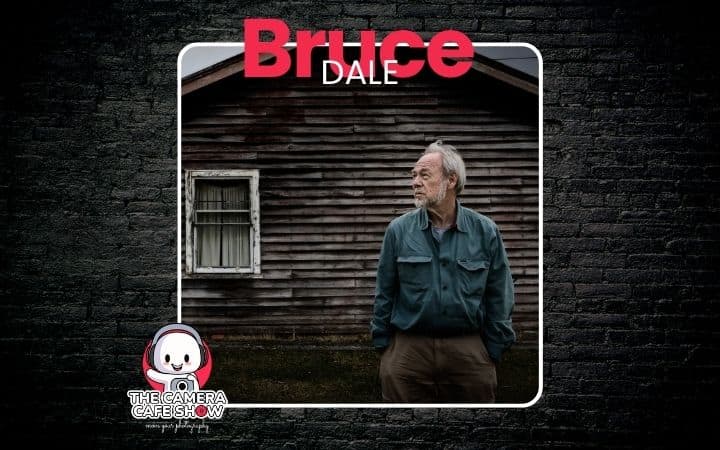
Today I’m joined by former National Geographic staff photographer Bruce Dale, an explorer, inventor, and wonderful storyteller whose curiosity has taken him across more than 75 countries—and occasionally into situations that no amount of planning could ever have predicted.
In this week’s first part of my conversation with Bruce, we travel back to his childhood in Ohio, where a National Geographic magazine first opened his eyes to a world far beyond his bedroom wall. From there, his journey followed an unexpected road through newspaper photography and into what Bruce calls the Platinum Years of National Geographic, where there was the time and the resources to turn wild ideas into great photography.
Along the way, you’ll hear why he once spent a night in jail after riding freight trains, how a job at National Geographic that was supposed to last no more than three years somehow became thirty, and what it was like working at a magazine where, if the equipment needed to make a photograph didn’t exist... they simply built it.
Of course, you’ll also hear some amazing stories behind some of Bruce’s most iconic photographs—and in this first part, we already line up quite a few, from bathing in the Ozarks to freezing a bullet in mid-air. In part two next week, we continue with even more behind-the-scenes stories, unexpected adventures, and a photograph that travelled much further than Bruce could ever have imagined—more than 15 billion miles away now, and counting.
Grab yourself a coffee, open your world map, and enjoy Part One of my conversation with the amazing Bruce Dale.
Tom: Greetings and welcome back, everyone. Today, we are joined by a photographer, an explorer, an inventor, a storyteller, and possibly the only person I know who can phone me and talk about a long-forgotten Kodak photographic process, and I wished I had recorded it. Over the years, his photographs have appeared in countless publication. He has been a staff photographer for National Geographic, traveled around the world, and one of his pictures actually left our solar system. But more as anything, he spent a lifetime following his curiosity wherever it happens to lead. Bruce, it's a pleasure to have you on the show tonight
Bruce: Thank you. It's good to be here.
Tom: Bruce, what is the best piece of photography advice you ever got in your life?
Bruce: Wow. Best piece of photographic advice. Holy smokes…I think probably I would have to quote Bob Gilka, who I worked for many years. He was my... The boss at the National Geographic, he once said, he used to say that there are a lot of really good photographers out there. He said, "Photographers are a dime a dozen. I can get good photographers. What I really need is people with good ideas. There are a lot of good photographers. What I really need are people with good ideas." So I guess that was one thing you, sticks with me, that, , there is a lot of competition, and so coming up with a good idea is sometimes difficult, but it's really m- the real challenge. And I like to think that I did come up with ideas. I... And Bob was the kind of guy that supported me, so if I said that, I have an idea. I wanna take my toy t- tank and turn it into a roadrunner and y- and see if I can bring up wild roadrunners and but I need to build this thing." "Sure. No, go ahead, try it." So no matter how wild or how, seemingly absurd things might be, he would say, "Yeah, go try it." He would, they were... it was a opportunity to really to do imaginative things that, without feeling about it later on. If they didn't work out, eh, it didn't work out.
Tom: Nice. Now, Bruce, I know you have been building those water sprinklers in your garden to scare away deer from not eating your flowers. This has worked out or not?
Bruce: I actually I did. I got one deer, and I got my girlfriend f- five times, and I got myself about eight or nine times. Yeah, it works fine. Yeah.
Tom: Okay. Haha
Bruce: And it's interesting I... The deer that I did get after th- was a few weeks ago, and they've never come back. I think they have a really good memory. they just they... I have a, I had a little video set up too, so I have a video of the deer setting off the sprinkler and having and turning around and racing across the street into the neighbor's yard, and I have never seen them come back. So I think they have good memories. I can't say the same for chipmunks.
Tom: I know somebody who also has a good memory, Bruce, because you have a lot of stories for us today
Bruce: I don't know about my memory but I’ll try!
Tom: Haha. Bruce, long before National Geographic, when you close your eyes and you go back to Ohio as a little boy, what's the very first image that pops up in your mind?
Bruce: I think I know what it must've been. It must've been, it must've been 1944, and I was in the first grade at a l- at a Catholic school in Lakewood, Ohio, and we were collecting newspapers for the war effort. I would go from neighbor to neighbor pulling, collecting newspapers, and I would drag them to school. And at school, the school was called St. Clement's, in the yard, it w- the play yard was asphalt, and every gl- grade had p- a big chalk mark marking off their territory, and so it was, there was a competition between grades. in our s- stack of... In the middle of the s- the bigger area was sectioned off for newspapers, and on the side were magazines. And I was looking at the magazines, and I found a National Geographic magazine. And I thought, "Wow," and I sat down on this, on these tied bundles of magazines, and I was reading this magazine, looking at these pictures in National Geographic magazine. I think I don't remember what the stories were. I tried to go back and figure it out, but
Tom: Haha.
Bruce: know which issue it was. But then, and the nun said, "Bruce, you can take that home if you want, but bring it back tomorrow." So I did. I took it home, and I went through there page by page. And when I brought it back, she gave me the map from the magazine. And so I took the map and I... I hung it on my wall, I j- all I could do was imagine all of those marvelous places all over the world. And I suspect that's probably had something to do with my direction in life. I j- I think it goes back to the, those magazines. I don't know what the... I have no idea. But I think there were some... It was during the war, and so they had a lot of stories from the Asia area, and it was probably one of those. I don't remember any of the typical naked women that... They were probably, The magazine was probably scanned beforehand by the nuns.
Tom: But now you say adventure, Bruce. I know you were also riding freight trains as a young man. This was also the urge to see what is around the the next corner?
Bruce: Haha, where did you hear that? Riding freight trains. Yeah, we used to, we had a railroad that went near our house, and we would get up there and hop on the trains and ride them a little ways, and then they'd stop, and we had a... was a sec- area where the where their tr- cars were stopped, and we used to take cigarettes up there, and we would sa- we would smoke. We, we each per- each one of the kids in my group would bring a different pa- different type of cigarettes, and so we'd write on the wall Marlboro, Camels. We had a collection. And we did that until one day I heard somebody yelling, "Come out with your hands up! Come out with your hands up!" And I stuck my head out the window, and there was a older man there with a pistol, and he was waving it at us, said, "Get them down. I've got you covered. Get down out there." And so I got arrested, along with a na- guy by the name of Bobby Begin. And if you were to research that, you'd find out that he had a lot... He became quite a m- anti-war character. He's the one that came to Washington and, along with a group of other priests... He became a priest. By, and by the way, it was embarrassing for him to get arrested with me because he was the nephew of a, of the bishop of Cleveland. And Bobby... I went to court. Bobby, I think Bobby got he got a... He did get caught. Yeah, he got caught too. Some most of the other kids just took off and ran. And that was, so that was part of that railroad thing.
It, that was the only time I smoked in my life too. I should add, I had an uncle that, why, that I, that r- helped raise me. In fact, he was a photographer for many years in, in the 1920s, 1930s. And and he once told me, he said, "Bruce, I s- I don't care if you smoke, but if you d- don't do it behind my back. And if you want my advice, don't ever smoke. It's a filthy, dirty habit, and you'll always regret it." And so I took his advice. His name was Charlie, Uncle Charlie I called him. And also had a trucking company. And he sold the trucking company and but h- having a trucking company, he knew how to pack. He could pack a truck so he could put three times as much stuff in a truck as you, anybody else could. And he taught me how to pack. So if I g- used to have these... any car I've ever owned, when I unpacked that trunk, you, it was impossible to think you could've gotten all that stuff in the trunk of that car, the k- photographic gear. So that's what my Uncle Charlie taught me, and also photography. He, he was a very early photographer. He told me that one time that his assignment was to photograph bodies at the morgue, and so he had to take them out of the, their little cells or their little tables, and st- he would stand them up against the wall photograph them.
So I don't know if that affected my photography or made it more interesting, I do remember that. Yeah, Charlie. And where were we talking about? How did we get off on a tangent? We were talking about something totally different I'm sure. Tr- trains, right? Yeah, trains.
Tom: Yeah. Haha.
Bruce: One of my early, early one of my favorite pictures is a nice picture of a steam engine in Cleveland with the old, their old terminal tower in the background. Yeah. in, down at a place called The Flats, which was where the Cuyahoga River went through on the rim where all the steel mills were.
Tom: If we talk about photography Bruce, how did the leap from school into your first professional photography job went?
Bruce: From that kindergarten the experience I guess the next serious step was probably several years later. I always had an interest in photography because of my aunt and uncle, but, probably around the sixth or seventh grade, I was with a neighbor down the street during the summer, we were talking about developing film, and he said his dad knew how to it. And we... So we went and asked his dad, and his dad said, "Go to the library and get a book." So we did that. And then we went to the local drug... at that time, at a pharmacy or a drugstore, you could buy all the chemicals for developing. So we bought all the chemicals came over, went over to my house, and my mother had a roll of film she wanted developed. So I said I'll develop it for you, Mom. I'll do it." we developed the roll of film. That was one of my first lessons, that w- that if it's wrapped in green paper, that means it's panchromatic. It can see all the colors, and so you can't use a red safelight. So I totally ruined that roll of film for her, and she never ever let me develop film for her after that. And then from there the ne- year or two later, I was in high school at Lakewood St. Ed's, and we had a camera club, which I joined, and it was run by a brother of Holy Cross who graduated from Brooks Institute of Photography. was m- more than the average photographer, and he taught me, gave me a lot of lessons, and I continued taking pictures all through high school. I, I worked at a studio. I worked at a camera store. I... By the time I got out of high school, I had about 50 pictures published in the local newspapers. These were pictures taken chasing fire engines or sirens or all of the football and basketball games at school. And so I had a pretty good portfolio. And when I got out of high school, I wound up working for a year at Cleveland Clinic Hospital.
I don't remember how I ever Why? Oh, I know how I got that job. It was a strange way. I had a really bad lisp at that time I learned about from a friend of mine who, I rescued him from a dilemma in his life, he got a fishing hook right through his ear, I happened to have a little in my fishing case, I had a pair of pliers, needle nose pliers, and I cut off the barb and I took the fishing hook right out of his ear. His name was Peter Yessif. I don't know whatever happened to Peter. But Peter says to me, "Bruce," he says, I really like you. I don't care if the kids laugh at the way you talk." And I'm thinking, "What? What are talking about?" He says you talk funny." I didn't know that. And then I learned I had a bad lisp. And how I picked it up, I don't know. I told my mother had a lisp, she said, "Oh, that's cute." And I thought, "Cute? Are you kidding?" I think maybe when I was really young, I wanted to be a ventriloquist, and so I was trying to put my tongue in a different part of the mouth. So I couldn't say S, the letter S. I would say S, I'd say S. So I th- so what is... My name is Bruce, and Cleveland Clinic had a really good department, or an audiologist, or speech therapist, and I heard about it, and so that's why I went there. Applied for a job. I worked there for a year in their, as a photographer. But they did a recording and then the said you're putting your tongue in the wrong place." He said, "You have to learn to say, 'She saw Sister Suzie sitting on the seashore selling seashells.'" Took me years to get over that. I would say, "She saw Sister Suzie sitting on the seashell selling seashells." it it's easy now, but it took a year to, to say that. So that's how I got the job at the Cleveland Clinic, where I worked with some incredible doctors. They, at that time, they were doing the leading research on heart transplants and heart machines I worked with a name by the name of Dr. Ethler, another doc- man by the name of Dr. Mason Sones. And I would sometimes, they would want to work late at night, and so I would work overtime late at night, and I would go out to dinner with Dr. Sones, and we went over to a little place called the Kewpee Hut. Many years later in life, I came across him in California where he had moved. And it came on to giving me access to, to, some I never could have made, because I knew him
Tom: Coincidence!
Bruce: One thing in life I guess you learn is no matter, be kind to everybody because no matter who you it is, you're gonna wind up
Tom: Yeah
Bruce: across them later in life or maybe even working for them. Who knows?
Tom: You never know.
Bruce: So that’s where I worked at Cleveland Clinic for a year. Biggest lesson I learned was ... Everything had to be... I worked for a man who was really, I hate to use the word anal, but boy he made me write down in a notebook exactly how I shot every picture. It, we had shot all the stuff in surgery and post-surgery with two and a quarter, three and a quarter film, and I had to hand process it. And I learned a, I learned a lot from him. And but then I left there finally. I g- just got to the point where I wanted to do other things. And from there that summer, it must've been , my sophomore year, I was visiting a friend of mine had a cottage on Lake Erie. And I was visiting him, , they happened to get a newspaper from the Toledo Blade, I was impressed and so on the next day I called the Blade and I for the photographic department and I said, "Look, I really love those pictures. I would love to know more about your photography." And the guy that answered the phone was Bruce Sinner, and they were his photographs. So talk about luck. He answered. He, and then he says, "Oh, wow," he said, "You've got..." I'm sure he was thinking, "Wow, he's got good taste." But anyways, he said, you're really lucky, we have a photographer that just quit this week." And that's true, there was a guy that quit. And so the next day I went there with my portfolio from pictures, and they hired me for temporary for a three m- three, for a few weeks, and then I wound up staying for seven years at the Toledo Blade, and where I spent every one of my summer vacations or breaks that I had, and every one was at some workshop, attending a workshop like the Syracuse University, a Missouri workshop,
Tom: Right.
Bruce: one in Miami. And so I guess I have one credit hour at each one of these universities. But at these workshops, I met people from National Geographic, at the University of Missouri workshop I was as- assigned to work under an editor named Bob Gilka, who shortly after that became the director of National Geographic, and then he asked me to do a first... The very first assignment, by the way, was the the Ambassador Bridge, which is now in the news. That's the bridge between Windsor and Detroit, Michigan, the one that Trump keeps trying to shut down and they keep opening it up. But that was my very first picture, and then I did a s- a short thing on on, they wanted me, they wanted pictures of Indiana Dunes State Park near Chicago, they said they'd pay me for a day to go up there. And so I went up there, but I spent three days. And I was up at dawn taking pictures on the on the dunes, and I found, people skinny-dipping in the water. I had those. And it, they, I think they were impressed with the number of pictures that I got in one day, but it really was three day, three days.
And then after that Bob asked me if I would do a story in the city of St. Louis. Which I said yes, but I'd have to do it in my vacation, and they said sure. So I working at the Toledo Blade was a, it was a union newspaper, and there was a clause in the contract that you were entitled to number of days for every year you'd been there, and I'd been there seven years, so I had an extra almost two weeks. So I went there a week of vacation, another couple weeks and and started a story on the city of St. Louis where I did some... i'd got, I had some plucky pictures. I had r- I did, got a room overlooking the arch, which was under construction, and I woke up one morning, and I do this all the time. I try to get a room that somehow might lead to a picture later on. But one morning, I woke up at this room overlooking the arch, and it was totally fog up for about halfway up And so , all you could see were the upper arch popping out of the clouds, like a, something like out of Jack and the Beanstalk. so I got that picture, and then I did some other things that unusual. I opened up a hole in the top of their planetarium and did an eight-hour time exposure looking down through the planetarium. And near the end they said, you've got a, we've got a great collection of pictures. We wanna do some more. Would you, can you stay longer?" And I said, "I'm sorry, but I can't." And they said how about working for us full time?" I thought, "Wow."
And I went home and talked it over with my wife. By then I was married and I had two children, and two boys, and Joyce had said, we talked about it, and I never met my father until I was 16 years old, and so I, I always regretted that, and I didn't want my kids to grow up like that. And so we talked it over and we decided we would do it for one years or three years at the most. I knew if I didn't do it, I'd be sorry the rest of my life. So I did it, and all of a sudden it was 30 years. But Bob Gilka was a great boss and there was never a time when couldn't come home for an important event, and I was able... he tolerated and never complained about me when I often took my boys with me. I had another son born after I joined, and often take the boys with me one at a time, which was nice because they realized I wasn't playing on these trips, that I was actually working, and it got a chance for me to bond with them one-on-one, and so I wasn't sharing them with their brother. So the kids were with me in Alaska Kenya, all over Europe Mexico, other places. So they traveled with me one at a time, which, which which in my case it worked out well. Yeah
Tom: Bruce, I know you refer to this era as the platinum years. What made it so special?
Bruce: Oh it w- it's, it... There's so many things that almost sound silly because they, they thought you... Some people would say you brat," but we were we had a, an infinite amount of time for a story and any equipment we needed. We... And if you, they, you couldn't buy it, we had a machine shop that would actually make stuff for us. And they, and we had the best lab in the country. We had an unlimited expense account. If you wanted to rent a helicopter, if you think it might be better if rent, go ahead and rent a helicopter. And if it doesn't look good in at sunset, try it in the morning. And if it doesn't look good in morning, average or two, try it again and try it again. And I remember doing that with a helicopter in Hong Kong when many years ago it was $500 an hour, and it was... I have, that's probably 4,000 now, today's money. But but all of this s- said, it didn't make my job any easier because there was never ever a reason to say you didn't get a picture. You can't say, "I didn't have the c- camera. I didn't have enough time." We had to get the picture. And we were treated nice. We weren't paid much. was not... When I left the Geographic and did advertising, I was making more in, in one day than I made in my first year at the Geographic. And We had a secretary. I had a private office. I had a camera equipment locker. I had a we had, we're given d- DoD cards. A DoD card is a Department of Defense card, which you rarely anybody could get. You... And that allowed you to go into military bases or or embassies anywhere in the world. That disappeared. We were given, I had not just business cards, but raised lettering cards, beautiful cards and stationery. And and all the travel at the beginning was first class, even if to Chicago. So it changed a lot from then to when I left there. It was how can you do it the cheapest? Can you... Is there anybody you can stay with? I stayed at the, one of the finest hotels in the world is the Peninsula. And when I w- worked in, I often, I stayed there for weeks at a time on occasions. We had a gr- we had our own travel department that would make all the arrangements for us. So had nice perks. We're not paid much at all, but we had... But the end result was that you had to get a picture, and they expected something than normal.
Tom: If you have months and months time to make a story, Bruce, how often did an assignment begin as a story and end up being or becoming something completely different?
Bruce: I don't remember it coming up completely different, but I remember a lot of stories you start with something and that winds up to becoming another story. So I've had at least 10 stories in the magazine that were stories that evolved out of one story. So I would be in Alaska and I'd say, "Wow, there's some really interesting work going on with timber up here. Let's do a story on timber." Or I was in the Ozarks photographing p- mountain people in the Ozarks, and I met a family. I'd say, "This would be this would make a great family picture." And I was doing a story on desert adaptations. And while doing the desert adaptations came across a roadrunner that befriended me, and I wanna... I said, "Let's do a story on roadrunners." And so they evolve into other stories. I had very few s- stories that where I worked on that did not get published. Sometimes when I would meet with Life Magazine photographers one of the saying, one of the comments that I could sometimes make was that when they're wrapping their garbage with your Life Magazine they're binding ours in leather. But but Life Magazine photographers I knew, they did a lot of stories that never got published. A lot of them.
The hard part about our stories the early stories was, first of all, we did not give a, we were not given a script to work from. were given an assignment and it was up to us to decide how to do it. And I don't know where the idea came from, the story on time, for example, but every single thing I researched about time was that we really don't know what time is. It was up to me to try to illustrate that and that led to, from one thing to another and Trying to stop time, a photographic pun to... for example, doing the Time story, I said to Bob Gilkey, I said, "I wanna..." I said, "I wanna do a photographic pun called Killing Time. I wanna photograph going through watches." "Sure, go ahead, try it." So we did that, it got published. For the Time story, I wanted to photograph our clocks of various types. And so I photographed a cesium atom from an atomic clock. I photographed a a most expensive watch I could find, some encrusted in diamonds, and I photographed our human heart, which is our ticker. And to do that I had to I wanted to photograph a heart transplant. And at that time Dr. Is it Dr. Bailey, I think? No, Dr.... Oh God, I can't remember his name. He was at, working at Loma Linda in California. And he let me come along to photograph a heart transplant in a baby, in a child. Baby, it was about, oh, six weeks old. Not even that, no, he was less than a month old, a couple weeks old. And and then I wound up going back and photographing her a year, at one year old, and five years old, and 10, and 15, and 20 years old. So I keep in touch with her. Those are the ideas and the, it's up to you to decide how to do it.
I had a story on automobiles. How do you photograph automobiles? And so you have to think of what... I decided that I would try to s- it into how people look how various countries look at cars. And in in France, they were interested in I d- I photographed the Peugeot's robots driving cars on bumpy roads. And in Italy, they make these hand-built cars at Rolls-Royce, so I went there and photographed them wedging wooden lasts like they're making a shoe, bending fenders. And in the US, I summed it up by u- advertising. And so I went out to Hollywood where they were doing this extravaganza photographic, ad for one of the magazines. In Germany, of course, the engineering. I photographed In Italy, the beautiful cars. I went to f- Pininfarina and I met was a, the great designer who's the guy that designed the Ferrar- one of the Ferraris
Tom: He's called Enzo, I think, but I'm not sure…
Bruce: He has appeared, yeah. But anyways, they, so it's up to me. What I'm getting at is got this story, how you do it is up to you. How you'd interpret it. So there s- and there was never a list of, "Oh, go here and photograph this person or that." Some of the stories were difficult because because of that. But the For example, in the c- city of this, one of the early stories I did on the Ozarks you wound up going there and almost it was like building a house and not knowing ahead of time whether you're gonna make a brick house or a straw house or a wooden house, and you wind up coming back with everything. And then the editor just says we're gonna make it a stone house, so you have all this garbage," that was difficult trying to... And a lot of that depended on the editor you were working with. Some were great. You're dependent on the editor you're working with because he's your, he stands up for you in the field. He's the one that's saying he's doing great or he's doing a lousy job or he's wasting time or something.
Tom: And if you take me, for example, to get an idea how you work, Bruce, to China, because you find yourself in places where the language is different, the cultures are different, the customs are different. How you are building trust with the people there?
Bruce: Oh, I spent about... I made at least 10 trips to China. one of the trips I had put together a a slideshow called American Mountain People, and it was about the American South the Ozarks, Rockies, Sierras and Appalachian Mountains. And the, in this there were sections on snake-handling churches, a section in the coal mines. There were pictures of places that most Americans have never been or maybe never even heard of. took this slideshow with me to China, which was not an easy task because I had... Back then it was multiple projectors, and you needed a tape. I had a quadraphonic tape recorder stereo speakers. I took all this with me. And I would show it to my hosts, and with the main purpose of trying to sp- say, "Look, I wanna show you parts of America that most Americans have never seen. And I want you to realize that when I'm out taking pictures, I'm really documenting an era. And please don't be ashamed to show me pictures or show, allow me to photograph places," which they were, and there were a lot of fights over whether I could photograph certain things or not.
Tom: Ok
Bruce: but that was one of the ways. I took lessons in Chinese, and at one point, I got to the point where I could understand what they were talking, which alarmed them greatly. And one of them confessed to me that one of the Chinese proverbs is, "Beware of foreign devils speaking Chinese." But most of all, I found the people genuine and really interesting and bit, of course, oversensitive to allowing, letting their country being seen a d- in a negative way. This was early. This was before most people were going to China, back in the late '70s.
Tom: What-- before we go on, Bruce, because you talked about luck. What role does luck play, in photography for you?
Bruce: certainly a great role. And I w- almost rather call it serendipity. And if I made a wr- wrong turn in the mountains I never took-- looked at it thinking damn it, I made a wrong turn." I would always kind of be an optimist and say I wonder what this is, what I'm gonna discover here." I don't think I ever went off on a a task to shoot something without an idea in mind. in reality, that is not the picture that I wanted. What I was really looking for was that serendipitous moment that would happen that I would never think of in 1,000 years, so serendipity. And luck luck is actually being prepared to... if you wanna get hit by lightning, you're not gonna get hit by lightning s- sitting here on my, at my desk. I've gotta go out on a rainy day with an steel rod in my hand. So you have to put yourself in places where luck is gonna happen if you want something to happen
Tom: And this is not a part of luck, but my next question would be when you were a young photographer, Bruce, did you ever imagine that maybe some of the people you photographed would still be part of your life 50 years later? And then I'm talking, I suppose about Shy Eyes, the picture.
Bruce: yeah. No, I didn't think of that when I shot it, although it just happens gradually. Certain things like that happen. I keep in touch with a lot of them, friends. and yeah, I'm always curious to know their life has taken them and how it may have, i- if, how, if any of them I may have affected their life. I do remember one girl that wrote to me about, gosh, it's gotta be 15 years ago now. I lost the letter. I, and I've always regretted that I didn't really frame it and follow through on it. And while I was doing the, an early story on the Ozarks, decided to ride in a school bus with it. And so I rode on the school bus up and down on the hills of the Ozarks where they picked up people. I did that to photograph them getting on and off the school, to see where they lived, who lived where, and I would go back sometimes to the farms and, or village or their houses and meet them later on. But stepping forward, that was back in the '60s, '60, '68, '69, '70, '72. In around, I guess it must be to me, 2015, I got this letter from somebody that said, "You don't know me, I was on that school bus you were riding one day in the Ozarks. And I was thinking, boy, wouldn't that be a neat way to make a living? And I decided to become a photographer, and I work for the so and so newspaper." And I lost that, and I tried forever to find out who she was, but I don't know. Maybe if she's listening to this someday she can get back in touch with me
Tom: Talk me a bit about Shy Eyes a moment before we go on.
Bruce: Oh, Shy Eyes is a lady that I met only a few weeks ago after not seeing her for over 50 years. It was 19... I guess it was 1970, around then. Her grandfather w- was a mailman in the mountains of Kentucky, a very rural area called Pippa Passes. I went there to photograph her grandpa delivering mail, and she was about six years old, and she would ride on the back of his pony while he was delivering mail. So I have these nice pictures of her riding on the back of her grandpa's pony, and also a picture I took of her peeking around the corner of a porch and really just sneaking a peek at me. And we published that picture, and we called her Shy Eyes. Anyways, she wrote to me several years ago, and she said, "I'm the little girl you call Shy Eyes, and also on the d- the back of my grandpa's pony." So we've been in touch. And recently, only a few weeks ago, I went back to see her in Pippa Passes, which I followed Google Maps to go there, and they took me on the shortest route, which included about a one-lane road about 10 miles through the mountains. And it was a very rural area, but it was a really nice day, and I'll see her again, I'm sure, somewhere. I met her, I met with her and her sister. We went back to the schoolhouse where they were went to school. We went back to their house where she was living back then, and we went and visited her grandpa's gravesite. He used to ride 17, he used to ride 17 miles a day on his pony delivering mail. And he told me, he said, "I had to draw a line." He said, "I no longer deliver mail order tires." Haha
Tom: Haha...Talking about kids, Bruce, before we move on to the picture part of our talk, what have photographs taught your own grandchildren, Bruce, about the world we live in?
Bruce: Wow. I, w- I would, not so much the pictures, but traveling with me and helping me on some of these assignments and made them realize that, for example, if they were with me and I'm working on my automobile story, they would say these people that are designing cars are just ordinary people. They're not... It's not magic. They're actually doing this." And I think all of my k- kids, my boys, ha- I have three boys they're all not afraid to take on a task no matter what it is. I'm proud of them and don't know whether they've learned anything from any specific picture, m- except maybe just traveling with me to realize that th- these are... Life of ordinary people just like you and I.
Tom: But Bruce, I was asking about your grandchildren, the ones you made the book for.
Bruce: Oh, the grandchildren. I thought you were talking about children. Great, you're going back another genera- or going forward another generation. wow. I'll have to ask them. I'm going to see some of them this summer, this, it next, next, n- this Friday, actually. They're coming up. My, my grandchildren are coming down the Boston area, and we'll spend a f- several days Hey, Kelly I have a grandson in Ohi- North Carolina that's super interested in all of my photography and really wants to know about all of my pictures. I don't remember any picture that I'm sure that they, they've heard all the stories about the pictures that, that I've done, and I'm They probably are interested in those stories, and but I don't remember any specific picture that might have affected them in any way.
Tom: Well, Bruce, they might know the stories, but we don't know them still. I picked five pictures. Let's see how far we get. First, let's start with one of your most famous photographs, The Woodcarver's Daughter. Take me back to that day in the Ozarks and how this picture came about.
Bruce: Okay, you're talking about the picture of Terry Denton, a woodcarver's... I call it The Woodcarver's Daughter. I was... This is another story that evolved. I was doing a story American mountain people and in the Ozarks this is a story that I... Oh, I'd heard about a family, a woodcarver, very well-known woodcarver by the name of Ivan Denton, lived in a part of the m- of the Boston Mountains of Arkansas, of of the Ozarks, and had four daughters. Then they're all... Everybody liked to carve with wood. So I decided to visit him and in- introduce myself. I flew out to Fort Smith, Arkansas on Airlines. On the way, oh, the stewardess passed out these jelly donuts, which to this day are, I think, were the most delicious jelly donuts I've ever had. I don't know. I made a comment to her and she said, "Oh, sure, here's another one." So she handed me an extra jelly donut, which I stuck in my camera case.
So I got off the plane. I drove to Arkansas, which is near Ivan's place, 30 miles north in the mountains. And y- I turned off the highway, drove about two miles down a hill into the woods, and then I turned off of there into a little one lane road, drove through a couple of Fords about a half a mile back to his house. And, Ivan was s- sitting there in front of his house that he built himself, a little stone house, and he was carving a horse that he had tied to a fence, to a rail fence. He wasn't expecting me, but it was just like, like he was expecting me. It was these... It looked, was a, looked like a Cecil Beaton mill setup already. And when I arrived and I introduced myself, and Ivan was the only person in the 30 years I've, I worked for the Geographic, he's the only one that said, "Can I prove it?" And so I had to pull out a pull out a pro- proof of identification. So he said okay. So we chatted, and it was a hot day, and we took pictures and of him carving, and he introduced me to his family. He had four daughters. Then he said, "Let- let's go down to the creek and go swimming." So all of us went down to the creek. In the meantime, I had a Halliburton case, a silver Halliburton case. And in, in there was a 500 millimeter mirror lens, a compact lens, and I wanted to use that lens. So I took it out of my Halliburton case to put it in my camera case, but there was no room because of the jelly donuts. So I took the jelly donut and put it in. It fit perfectly where the 500 millimeter lens was in my silver case. So I took it. went down to the creek, and I'm taking pictures of the family in the water, and Terry Denton is out in the water. She's a very pretty girl. She must've been about 19 or 20 at the time. And I'm taking pictures of her and she says, "What do you got in that silver case over there?" And I said those are my jelly donuts." And she said, "Oh, come on." And I said, "Sure, do you want one?" And she says yeah." And I opened up this case and pulled out a jelly donut. And that was when I made that picture of her with that funny expression. So that's my jelly donut story.
I went back often to visit them and friends of theirs, but I never went back to the farm... Even till today, when I go back there, I take along jelly donuts. Terry was excellent wood carver and, But she also suffered, She was undiagnosed at that time of, with depression she went, was diagnosed later and in, when she was 35 years old, she died of a, of an overdose of prescribed medicine. I I went back to the funeral and I helped carry her casket. It was a rare s- cold day for the Ozarks. It went to 17 below zero, while we were carrying the coffin, the trees shook violently And that night, her father's cabin burned down. And I failed to tell you that in the meantime be- after I met them, Ivan divorced his wife and remarried somebody else and built another cabin in that valley, which Terry hated. all this happened that day and I'm sure that would, was, would've been reveled in the drama of the, of that day. And they had a closed casket for her, and on the casket had that framed picture of her, and they said, "This is the way we want to remember her, and we want to remember her like this." Yeah. Sad story. I kept in touch with Ivan. I saw him a few years ago before he died, and I keep in touch with his, Grant, his other daughters
Tom: You still keep in touch with them now, Bruce?
Bruce: Yes. Yeah. Yeah, Laura is one of the, one that was I keep in touch with most. Laura, were, Laura was, is a very smart girl, and won a essay contest and once came to Washington and stayed with... I showed her around the city. Her name is Laura It was
Tom: You have some wood carvings from them?
Bruce: I have a couple, yeah
Tom: Yeah? Nice.
Bruce: Yeah Laura isn't carving as much as her sisters. Adina, the youngest one, who was a baby when I... She was in diapers when I photographed the, that river scene, the creek scene. Laura, she's a, teaches woodcarving. Or Janet, her older sister Janet is also a, the very accomplished woodcarver. They're all both in the Fayetteville, Arkansas area.
Tom: Just to know, Bruce, what kind of cameras were you using at that time? You remember?
Bruce: they're probably Nikons. Nikons. I-- When I went to work at the Geographic, I started with Leicas, and then the the, when I started there, they said, what do you want?" And I said, "What can I have?" And they said you can have anything you want within reason plus one thing without-- that's not within reason." But I started with Leicas. The head of that equipment department was some guy by the name of Bud Wishard he used to, If he had a direct phone line to the local camera store, so if you wanted something, he'd pick up the phone and it would... He'd say, " bring me over here a Leica, two Leica M3s, a black one if you've got one," and within 15 minutes it'd be del- it'd be over at the, would be at the Geographic. So I was using Leicas, and it was Bud that said, "Here, take one of these Nikons and try it. You might like it." And I, so I played with it, and it was like looking at a Kodachrome slide, because you're looking at single lens reflex.
Tom: Yeah.
Bruce: I wound up carrying both of them for a while. I had both, and unfortunately the Leicas, I found that were not as rugged as the Leicas. They're so beautifully made, a Swiss watch. So if you get a bit of sand in there, Or any, or cold weather, they were not very tolerant in below zero weather. They would, they were m- they were made too close. And the-- Whereas the Nikons are a little s- a little sloppier, and so they would tolerate 10, be- 20, 30 below zero picture temperatures much easier. So eventually I wound up using almost all Nikons. I had other anything else I wanted, I w- that I used as a tool when I needed to. I think i- for every single picture, there probably is a perfect camera, but there's only so much you can carry. , On some of my trips to, oh, to China, I would carry 10, 12 suitcases, and the last trips I took to China, I used to carry only what I could carry. A backpack, a tripod. I really went lightweight, which I fi- I found much better, but much more efficient
Tom: And film-wise, if you go to the Ozarks, what you bring? One bag of film?
Bruce: Oh, if I work in the Ozarks, no, I would... I never carried bags of film. I we usually g- our film was, wouldn't say custom-made, but handpicked from Kodak, and they would give us a emulsion number and we would, our lab would run tests of it, and they would say this Kodachrome is not 50. You gotta shoot it at 60 or 65." And then maybe buy five or 600 rolls. And so I'd buy them in batches. I would take the film and I would pull them out of the boxes because it wasted space, and then put them in a, in Tupperware or something plastic like that and keep them that way. I would shoot pictures I had 30 little or 50 little tabs of plastic tape on my camera case, and I put numbers in each one, one to 50 at the start, and then 51 to 100. Because we were shooting different films, when I put a roll of film in the camera, I'd put a number on the top of it. So that was roll one, ... then sometimes, of course, you'd have 200 film speed, you'd have indoor film, you'd have g- Kodachrome for daylight, and sometimes you'd have Ektachrome. So y- it, it was a, it's not like today where you can just t- turn the dial and change it from a 100 to 32,000. fa- fast film speed was 200. And I remember one of the memos we got, there's a new film out that's 200 ISO. You can use it, but don't photograph people with it because you can't trust it. The quality is terrible." So I would film carefully like that, and I would throw these numbers on the cameras, and when I ship the film back I would ship all the even numbers one shipment and the odd numbers in another. So that way if there was a disaster where the film got lost or bad, or defective processing or something, we would have a sampling of pictures. So I did, and that's how I worked. I'm not sure how many other d- photographers did that, but that's the way I traveled.
And we didn't know back then or a camera was actually working or not. I have, I can only... There's only one disaster that comes to mind. It was in October 10th, not sure the year. I remember the day because it was my birthday in China in the Three Gorges area of China, where I was having a really good day. I was jumping on little boats, going back and forth across the river, photographing people carrying stuff. And it got, la- later in the day, it got darker and darker, and they, there were men loading a little boat with wood. And I started turning the shutter speed down slower and slower because I wanted to get a little bit of a motion, and I had it on like a 10th of a second, and the camera went zip. I thought, "That doesn't sound right." Put it on a quarter of a second, it went zip. thought, "Oh, shit." And then I turned it on a half a second, and it went zip. I put it on one second, zip. And that day, one of my cameras malfunctioned, and everything was taken at like a 1,000th of a second. So I lost,
Tom: Oh!
Bruce: oh, an entire day of, with one camera, of really critical important shooting in the, on the Yangtze River, in the Three Gorges area
Tom: But you only went with one camera, Bruce?
Bruce: I had other, I had another camera. I was shooting... I usually had two cameras, so I had some of the pictures. But the important camera was, I missed all, I lost all that stuff for, fortunately for one day. And fortunately, I th- it turned out, I didn't know at the time how many days I lost. In the end, it turned out it was just that one day. But you don't you don't... That's one of the beauties of digital today. You can at least make sure your camera's working.
Tom: Yeah, of course
Bruce: You know that... in that particular case, I knew I had a bad camera. But normally you don't see your film for weeks or months at a time. Weeks or months. Yeah.
And that’s a wrap for Part One of my conversation with Bruce Dale.
If there is one thing Bruce’s story shows us so far, it is that you never quite know where curiosity might take you. One National Geographic magazine opened a window to the world for a young boy in Ohio—and years later, he was travelling that same world for the magazine, turning good ideas into photographs and leaving enough room for the unexpected to find him along the way.
And we are certainly not finished yet. Next week, Bruce returns for Part Two, with more remarkable stories from behind the photographs, wild encounters, unusual inventions, and adventures from around the world. We’ll discover what happens when you put cameras on the tail of a jumbo jet, why Bruce once allowed a bear to walk across his back, and how one of his photographs ended up travelling more than 15 billion miles from Earth—and counting.
In the meantime, be sure to have a look at Bruce’s website and explore more of his remarkable photography. And if you would like to hear some of the stories behind the images, his book Beyond the Lens: Reflections of a National Geographic Photographer is certainly worth discovering. As always, you’ll find all the links in the show notes.
And of course, folks, if you enjoyed this episode, have a look at our website and don’t forget to subscribe, leave us a review, and follow us on any podcast platform or on YouTube. And make sure you’re subscribed so you don’t miss Part Two next week.
Until next time, keep shooting and keep on moving your photography. I see you next week here for Part Two of this wonderful conversation with Bruce Dale… Adios!