

Greetings and welcome back to the show!
Most of us like to keep our favourite photographs close by... but that becomes a little difficult when one of them is travelling through space, more than 15 billion miles from Earth.
Mind you... if an alien ever finds it, I hope they've got good taste in photography.
I am Tom Jacob and this is The Camera Café Show.
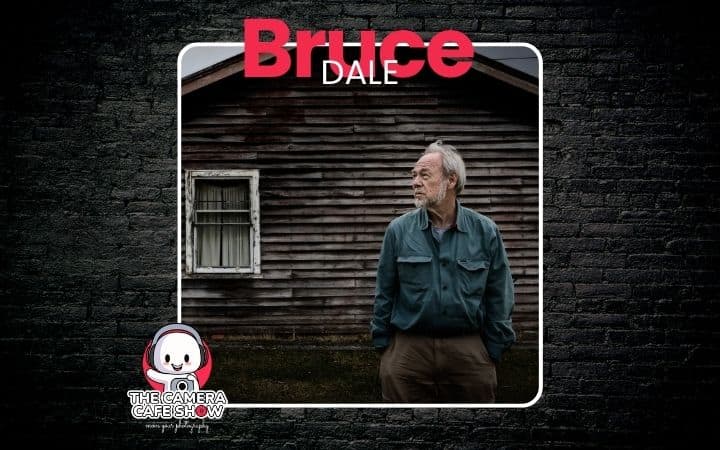
Today I'm once again joined by former National Geographic staff photographer Bruce Dale, whose thirty years with the magazine produced not only remarkable photographs, but also some of the most incredible stories behind them.
If you listened to Part One, you'll already know that Bruce never seemed to take the easy route to making a photograph. And in this second part, things only become more adventurous. We talk about the challenge of mounting cameras on the tail of a jumbo jet, photographing a crystal globe exploding in slow motion, and why one of his photographs ended up travelling farther from Earth than any photographer could ever dream of following, onboard the Voyager space crafts.
Along the way, Bruce also shares the story behind a rather unusual bear massage he once got,he reflects on the creativity and freedom that made National Geographic such a special place to work, and reveals the inventor behind the camera. Because for Bruce, having a great idea was only the beginning. The real work was designing, building, testing, and refining one solution after another until he found the photograph that told the story best.
So grab yourself a coffee, fasten your seatbelt, and enjoy Part Two of my conversation with the wonderful Bruce Dale.
Tom: Bruce, next image might be one of your most unusual experiences of your career, the famous bear massage picture. How does this photo came about?
Bruce: Oh, that was while traveling with gypsies. you call them Roma, not gypsies, but back then they were gypsies. , I actually traveled from England by car to India. 13,000 miles over about, during about five months. In fact, by the way we left Liverpool, and the wife of the gypsy I was traveling with, her name was Sheila Lee, she had her 104th birthday party this summer, and I went to her birthday party. But so where w- what was the question?
Tom: The bear massage picture, haha.
Bruce: oh, the bear massage. So traveling with these, I was with these, some gypsies, Roma, in, in the alleys of Istanbul, they had dancing bears, which by the way, it- it's totally illegal nowadays. This this is one of those things you photograph that you're documenting an era that no longer exists. So they in the alleys, they had two dancing bears, and they were dancing. And I was, I photographed them and crowds that would gather, and then one of them disappeared into a residence with this bear. And I asked my interpreter, I said, "What's going on there?" And he asked the gypsy, and the g- he says there's a lady in there with a bad back, and the bear is going to walk on her back to cure her back." I thought, "What? You gotta be kidding." "No," he goes, "that's what's happening." I said, "Wow can I photograph that?" They said I don't know. I'll ask." And s- and they said, "No. No way. You can't." I said, "Look, I'll pay for her next treatments. I'll pay for the next month, two, two months of treatment." way. You can't." I said, "I'll pay for the next year of treatments." "No, you can't photograph. She won't let you take her picture." So I thought, "Oh, damn." So I said I said, "My back's been bothering me." He says you could. What can they do for it?" And at that exact moment, the lady that was listening on the street in the little house, her hand came out of this barred window with a rug, and they laid it on the street, and I laid down on my s- my stomach, and my interpreter grabbed my camera and took a couple pictures of me. So I'm on my stomach, and the bear gets up on my back. It's a, this is a European brown bear, weighed about 200 pounds, and he walked around on my back, and he was kneading like a cat does. This kneading, this here. truly did feel good. It was just great. And then the bear sat down, and I said to my interpreter, "What's going on?" And then the lady in the house starts yelling at the gypsies, and then the people in the audience the crowd that had gathered around there started laughing and I said to my interpreter what's going on?" And he said, the gypsy says, it was 10 cents to walk on your back, but it'll cost you $1 to have him get off your back." And this lady was yelling, "Let him go. Let him go. He's a foreigner. Stop it." Yeah, so that's the story behind that picture, and I happen to have a picture that my interpreter shot
Tom: This was which year, Bruce?
Bruce: Oh, wow. '69 also, 1969. A few years ago.
Tom: Yeah, a few years ago! This Roma story you did Bruce, is also about preserving traditions that are now lost. What... Did you learn anything from them while you were there?
Bruce: I learned to trust them. I, I, there are, they are... I never had any problem with them. And I learned, one thing I learned is that y- they, people treat you a little bit the way you treat them. There was an occasion I think in Bulgaria maybe. By the way, I got arrested several times on that trip, by the way, for photographing gypsies. But in, in Bulgaria we, what was the point of this? Oh, what were we talking about? I lost my train of thought
Tom: If you yourself, you learned something from them.
Bruce: Oh, yeah. So w- I saw these a bunch of wagons off the highway, and they were... Had a fire going, and we drove off the highway. We had two vehicles. I w- we had a Land Rover camper and a Volkswagen camper. I was traveling with a writer, Bart McDowell, and I bought this Land Rover camper, and in that camper was Clifford Lee and his wife Sheila. And so they were Gypsies, and they were our entrée to other Gypsies along the way. And we drove down there and just struck up a conversation and I made several interesting pictures, But while we were down there, somebody stopped on the road and was photographing them like he was at a, like photographing animals in a zoo, and he's up on their highway. And all the little Gypsy kids ran up to the the car and surrounded it. And I have pictures with it, m- that I shot with a telephoto lens of him trying to take a picture, and kids are reaching up and pulling his arm, and other kids are reaching in the window to see what they can steal off the seats. So it was a lesson as people treat you the way you treat them. If you treat them like animals, they're gonna respond likewise. Yeah.
That, at that same place, I remember one of the hardest things w- working with interpreters is them to say what you ask. Sometimes they know the answer and they butt in. And sometimes, but sometimes they'll ask maybe what you would say stupid questions, like if they were shoeing a horse, I'll say, "Wow, isn't that gonna hurt the horse? Ask him if..." And my interpreter might say, "No, he might answer me." I said no, don't answer for me. I want you to ask him because I want him to think that I'm stupid." And I really was, I didn't know it were. Sometimes, it's hard to get a really good interpreter. And while we were at that particular place I was talking about, I remember photographing a gypsy with a kitten, holding a kitten in his hand, and I wanted to... actually, he had a, he was holding the kitten in his hand, and I wanted to photograph him, and he didn't, he, I could see he didn't, I can see he didn't like it. then I, he put the kitten down and I said, "Can I photograph the kitten?" He said, "Yeah." And I photograph the kitten. I started photographing the kitten, then he picks up the kitten, and before long he's holding the kitten like this. And I was able to photograph him. It's, s- sometimes you, the, in working with people the Roma people were really flamboyant people. It was, there was, there were so many... They were so flamboyant. They were li- there were scenes that, that seemed like they were set up by Cecil B. DeMille.
And one of the things I learned about that in doing this story was that, I was incredibly frustrated at the time because were traveling all the time. And we would pull into a camp or people that we met, and we would take, I would take pictures. But we never stayed for several days, so I didn't, I always was frustrated that, wow, I didn't really stay long enough. But then I realized near the end that all the pictures that I made were pictures exactly in the middle of whatever they were doing. Whether they were shoeing a horse or feeding a horse or they were exactly the way I found them, and there was a purity in those pictures that if I had stayed for several days, I am sure they would've, I would've lost that. That was a lesson in, in that I learned later. So I'm proud of those pictures because they are, there's a, there was a purity in them that I think that it would've been lost if I'd spent time with them. They would, next day they would've dressed up for me a little bit or said, "Oh, we're gonna do this for him,"
I keep in touch with a lot of them. One of them's been here to visit and stayed at my house a couple years ago. He's from Hungary. And another kind of another time I went back to a g- group in a just another remote part of Hungary, and they they treated me like a... They had a party, and they treated me like a groom at a wedding party. They were just, it was just really nice. It was marvelous. And then there's another boy that I was trying to photograph for years, a little boy holding a kitten, not the one I'm talking about before, and I tried forever. The, my friend in Budapest put his, the picture on Facebook. He has a big, he has a big presence on Facebook, and he was able to find... I knew where the pictures were taken in Esztergom, and it's a little village on the on the river across from Slovakia. And they said they found him. So I went to the little village a couple years ago, Esztergom, and there were three people, three men that all said it was him. So we had a little, we had a little get-together, so I have pictures of all three of them toge- So I, what I haven't done, which I should do, is I did learn that ears don't change. The faces, noses change, everything changes, but your ears don't. So I would like to to get some forensic maybe a FBI or somebody who knows forensics and
Tom: Figure it out
Bruce: Yes, which one was him from these pictures then and now.
Tom: How many years you worked on this project, Bruce?
Bruce: How many years have I worked on the project? what was the... Do you mean going back to photograph them or... if you start…We'd have to start in '69 until today. and I've been going back the past 10 years, I guess
Tom: You have a legacy of pictures of the same families then.
Bruce: I have a nice collection of pictures, though I'm afraid to say that a lot of the best pictures are the Geographics archive somewhere with, that I cannot access. Pictures have a different meaning over time. For example, one picture that I know is buried in the archives is a picture in, in, in Hong Kong where some friends took me out one day and they said, "We're gonna show you something." And I said, "Where is it?" So we walked a maybe a mile or two through the side streets, they took me to a little building, and it was the first neon sign in Hong Kong. The only neon sign. It was about, 10... This big and maybe it's... I don't know if it said Coca-Cola or whatever it said. was the only neon sign in the country. And I took a picture and then, so it wound up... It's in the yellow boxes in storage somewhere. I can't get it. Now the, that's a significant picture today. New Hong Kong today is brighter than than Times Square
Tom: Then it's perfect. Let's go from people to technology. The next picture, the idea you had with the Lockheed TriStar to tail-mount a camera, where came this idea from, Bruce?
Bruce: there was a story that Geographic was working on. It was called Aviation Safety. And in this case, I think there had been about At least seven or eight photographers that had worked on it off and on. And Bob Gilcrease asked me if I would like to take it on and see if they could get some pictures that they could, to get this thing published. And I looked at everything that was taken, and I thought what we really need is a..." S- sometimes I'll try to take a picture that, I wanted a dramatic picture. At first I thought maybe I could mount a camera in the wheel well. And I looked at pictures like that, and they were not very dramatic. And then I thought, would it look like from the tail?" so I went to one of the maybe TWA Airways or one of the, offices up in Washington, and I borrowed a pretty large scale model. I took it back to my office in the Geographic, I put a on there with a fisheye lens right up against the tail. And I made a little... I tried different angles, and it looked pretty nice. this is something I've used several times since then. Now, you can, use a scale model to to improvise and kind of look look ahead and get an idea of what the picture will look like.
So having that, I first went to Boeing and said, "I would like to make a picture from the tail of a jumbo jet." And Boeing said I'm sorry, we can't do that. But w- better yet, we'll give you a helicopter and you can fly alongside the tail." And I said, "No, thank you. That's not what I want." I went to Lockheed and they said that's an interesting idea, but what would it look like?" And I showed them, and they said would it really look like that?" they said come on out and we'll, let's we'll test it." So I flew out to Palmdale, California, and which is their home base for Lockheed, and they put me up in a cherry picker up near the tail. And I made some pictures with... They looked just like the ones I did of the model plane. And they said that's a good idea. We- we'll go ahead. We'll work with you on that." While I was up there, I measured the exact where I would like a camera. I'd like... I decided I wanted two cameras. I wanted one that would be horizontal for straight, for normal flight or landing, and I wanted the other one at a 30-degree angle so that when the plane was in a turn and bank it would be, the horizon would be basically level. I, it also gave me a redundancy in case one camera malfunctioned a m- a bug or something flew up against the lens. And for that picture I used Olympus 250 exposure cameras with 250 exposure backs 16 millimeter lenses. And the Geographic made weatherproof, windproof housings for these, o- one for each camera, holding large ones that hold... I still have them. They're big housings that hold these cameras. And, Lockheed made a that went through the tail of the plane that would mount one on each side exactly where I wanted them, and I told them how many inches off this rivet and I wanted it. And so Lockheed built that, and over a period of time, they were-- we went we tested them. I-- plan was to mount the cameras, run a hardwire up to the cockpit, and I had a control box, like a left camera, right camera, and then there was a little clicker there that kept track of how many pictures I shot. I went to a lab in California, and I said, "I want you to be able to process a 250 exposure roll for me." they said we'll have to cut it in six-foot lengths." I said, "No way. I can't, you cannot do that." So finally they figured out a way to process the whole thing without cutting it.
The day of the flight we mounted the cameras on the tail, and I'm up... I was actually up with the cameras on the, this cherry picker, there was a somebody in the cockpit, and I said, "Oh, I connected everything together." By the way, before I did this, I tested everything. I put the cameras on, all the all the wiring was rigged up, and there were cameras on a bed at the motel the night before, and I would click left and everything worked perfect. So we mounted everything up there, and I radioed the cockpit and I said, "Okay, trip left camera." left camera went click, and right camera went click click. I unplugged it, and I, "Damn." And I thought for another minute, I said, "Okay." I plugged everything in and it was okay. And I said, right camera." And he clicks right camera, and right camera goes click. Left camera goes click. Stop." And I thought, no, not knowing what... We're all ready for the flight, this is a big deal, having a, j- jumbo jet online and waiting to fly. And so I said, "Okay, I in my planning, as an emergency, I had provisions to actually disconnect all the wiring, they used to make these little hand grip that would trip the camera. And at the base of the plane, we disconnected the wires. We just plugged in these separate cameras. I had some engineers sit in the tail of the plane on a milk carton during the flight. And I was in the cockpit, was in the cockpit radioing him, yelling, "Left camera, right camera." Pr- he was pressing, and I had a little piece of paper with a mark, marking one, two, three, four, five. One, two, three, four, five, keeping track of the film.
The original, the plan was originally to do a touch and go at Hollywood at LA International Airport. I wanted a, the plane coming in at just that time of the day where it's just exactly dark and the lights of the runway on the sides. And getting landing at LA is not just a simple task. You've gotta be line to land, and you... we did our best to get in the proper line. In fact, at one point I was working with some incredible pilots at Lockheed. One of them was really famous for his work with one of their Blackbird aircraft. Anyways, we are in line to land, and the tower keeps yelling, don't see you on our, Our scope, you're not showing up on our line. Click, b- beep again. And he kept saying I'm beeping." And the light tower says, "We don't see you." And he said I see the airport." He knew damn well that it couldn't beep because they had taken out all the avionics to install my cameras from the tail. So he was so we did a touch and go at LA, but we got vectored in too early, it, the, that looks like the middle of the day. And but I had a backup plan, again, do a backup touch and go at Hollywood Burbank. And first of all, I cautioned that they don't allow touch and goes at these big airports. They had to get a special FAA dispensation to do touch and goes. They had to get a special dispensation for this aircraft because it wasn't a licensed, it was their experimental plane, and so it was a big deal to do touch and goes at these airports. So we went over to Hollywood Burbank. It was perfect. We landed and got this really nice picture, both cameras, great pictures taken. And we took off and then we went back to to Palmdale, to their home base. And as we approached Palmdale as we were coming in for a landing, I touched the cameras. One of the cameras had 64 speed, which is a slower film speed. It did a 23-second time exposure. And so the camera shows the plane in beautiful outline silhouette, and i- in the background is the, are the runway lights. And the runway lights are coming back, and then they sweep up into the air and come along. So the plane is coming in, it makes a 23-second exposure of the lights, and then as the plane touches down and de-rotates, all the lights flip up in the air, and it made this incredible picture that, that, that ran for three pages in the magazine. And this is one of these serendipitous things you never knew, could have planned or even thought of before. It just happened. And so this, it was picked as one of the 50 pictures ever published by the Geographic.
Tom: Yes, I remember that.
Bruce: It was a kind of a special thing and that worked out well. And we originally, I wanted it, I wanted a, one of those situations where they had clouds, that sometimes you get into a cloudy situation where you can dip a wing in it, a wing, and it looks like it's dipping into the cloud like, like cutting through butter, but that, we didn't have that. that's pretty much the story behind that. We were, it was we had other little complications, too, with the plane and a whole bunch of other things that I won't bore you with, but those are the important things. We did get a picture!
Tom: Because for an ambitious project as this, Bruce, I think there wouldn't be any other magazine than National Geographic that had made this possible, no?
Bruce: and I don't think they would do it today either because it was a, it just an idea I had. Let's mount a camera on the tail of the jumbo jet. Sure, go ahead, try it. So it, several trips to California and and building the boxes by everybody. The brackets that Lockheed built to hold the camera, they had to mount it right to, to attach it to the structure of the plane. That, they kept those brackets, and they some video company shoot videos with it. I think there was an IMAX film that has that same angle. Later on, ph-photographers would come up to me and said, "Oh, I know where you got the idea for that picture. I saw it on the IMAX." Haha, I said "You've got that story in reverse!"
Tom: Haha. Nice. Bruce, let's move on. The crystal earth-globe. This might be the most technical ambitious picture that you ever attempted to do, no?
Bruce: that's another one of those pictures that'll never be a- never happen again, I guarantee you. picture, The idea was from Bill Garrett. Great idea. It was our 100th anniversary, he wanted to make an illustration our fragile planet, can we save it? He wanted a photograph a crystal ball being broken apart. Crystal ball will have the Earth engraved on it, and he wanted it as a hologram, he wanted it as a two-part hologram. So when you looked at it and moved the cover back and forth, you'd see a whole globe and it breaking apart. That was his idea. And it wound up becoming a very expensive idea. I was assigned... I worked with the holographers from American Banknote Company. They did the I did a lot of the all the technical stuff. How do you break it? How do you... The timing. How do you... Originally, some people suggested hang it by a thread." No, you can't do that. We, the thread would show in a hologram. So the Geographic built for me a, a device that held with three solenoids that held the globe. The globe had to be oriented properly so that we didn't look like we were blowing away a p- any continent, a particular continent. And so that was critical And the plan was to drop the globe through the air. At a particular point, a gun is fired. strikes the globe. You don't take the picture then. It's gotta continue falling to b- so it's breaking apart, and then the picture is taken down here 27 and a half milliseconds later, or something like that. Holograms are not... don't work with regular images. They work with wave patterns. Normally a hologram is taken holograms are made in steel tables that are standing in beds of sand, and if a truck goes by a block away it will ruin it.
Tom: Yeah.
Bruce: It will destroy the hologram. So we're trying to photograph a globe being broken apart by a bullet. How to break it was in, was my task. I looked at everything, freezing, coining, noise various things, and came after apart many glass globes, came to realize that the best way to crack a globe is with the least powerful pellet or something. I wound up using a, an English competition pistol with an electronic trigger, and I'm using a pellet that's clad in nylon with a steel pellet point inside of it. So to photograph this, we had to use a , pulse laser It pulsed at the exposure I think of each one was something like, I think seven billionths of a second. And the only one available was in California. So everything had to be moved out to California to do this.
The laser couldn't-- You couldn't just push a button and push it like one pop, take a picture. It had to be up and running, taking 10 pictures a second. So we only wanted one of those pulses. So at first I d- used a kind of a shutter that would open up let one pulse through the room and then shut And the problem was that the laser was so powerful that it melted the shutter. then the engineers that with a laser decided that you can actually put that shutter further back down in the systems before it gets amplified to that point. So that's what we wound up using, the same shutter, but in a different part of the laser.
Where would we go next? We had four globes. of them cost at that time $3,500. Today-- in today's dollars, that's 10,000 bucks a piece for them. And I-- So there's, I could, there's a zillion stories about things that worked and didn't work and how we lost one globe and... But in the end I wound up trying to dropping these globes and after they were cracked, they would fall into a very cushioned little container, and I would sometimes glue them back together again. And as a matter of fact, the picture that got published on the cover, you were to look really carefully, one, one someplace, you can see the pellet inside the globe because when I put it back together again, it went back together perfectly except for where it impacted. There was a little hole about a quarter of an inch, and the pellet went through that hole and hit the outside wall and broke it apart.
It almost didn't run, because they had an incredible problem with manufacturing the cover. The cover... and by the way the total cost at the end of this project in today's dollars is about eight million dollars. You may, you can say, "How can it be eight million?" To make the hologram, the first part was it was printed on a plastic material, a little bit like a Saran Wrap, and that was done in New York, and then it was moved over to Massachusetts by truck. Talking about 11 million copies to Massachusetts. They had to laminate that plastic onto a aluminum backing. And from there, it went, From there, it had to go down to, I think it was Georgia. I know Georgia was one of the states where I may get the states mixed up. In Georgia they laminated it onto paper. And from Georgia, it went to Chicago maybe, where they laminated, let's see. They had to have print on the backside of the paper, the inside cover. And from there, it went some place, another state it was chopped up. Then it went up to Back up to Massachusetts, and finally in the end to Corinth, Mississippi where it was bound. to six different places by truck, 11 million copies. So that's, picture cost so much and was, caused so much distress at the Geographic, it cost Bill Garrity his job and changed the whole direction of the Geographic. but I was say I was heavily involved in...
There was a backup picture that I made, which actually I like better than the ones, the hologram one. Of a, that I shot in my garage. Same globe being broken apart, but it's a straight photograph. For lighting, I used a for, I didn't have any really high powered strobes, but I had, I think there were half a dozen Vivitar strobes that you could buy for 50 bucks a piece, and I used a little diode in there to change the shutter speed down to 20 thousandth of a second. And so there was a half a dozen, had them taped together. Maybe there was eight of them, chk-chk, a little bank of strobes. I think I used bubble wrap in front to not lose much light amount, but to soften the light a little bit. Yeah, and so that was an expensive, one of a kind
Tom: Why didn't you talk first to Bill Garrett and say you want to keep your job? I have a better idea. Let's do this more simple.
Bruce: Ahhh Bill, poor Bill. Bill had some great ideas. I wish I had listened to him more because he really was a, he was, he was... He… I miss him. He's gone
Tom: Yeah, I imagine.
Now, Bruce, your picture that is the farthest away, I mean, you have traveled everywhere around the world, and one literally has left the Earth. I checked it today, and it says that your copy, if it's on Voyager 1, it's 16 billion miles from us.
Bruce: I know which one you're talking about, haha
Tom: So how your image got selected to print on this golden Voyager phonograph record?
Bruce: Carl Sagan picked it. That's one of 115 pictures that Carl Sagan picked to put on the Voyager spacecraft to set into orbit. Not orbit, eternal into infinity, basically into outer space, hoping that someday, trillions of years from now, somebody might find it and look back and say, "Oh, that's what it looks like back on Earth." Yeah, as simple as that. I didn't... When I shot that picture, I had no idea. It was a picture the Virginia, in a place called the Dismal Swamp, and it's just a picture of swamp and mushrooms in the foreground. And no idea that picture would wind up in a, the eternal gallery.
Tom: Yeah.
Bruce: Long after the Louvre is gone and the Metropolitan in New York, this thing is gonna be sailing away. It's, right now it's, I think the last I heard it was 15 billion miles away, traveling out of our orbit 38,000 miles per hour continuing. Amazing. Yeah.
Tom: Because if it doesn't hit any space rock or it gets absorbed by any planet it might outlive our humanity even your picture.
Bruce: yeah, it will. It will. It's actually, it's on the verge, depending on how you look at it, it's on the verge of leaving our solar system. It's... And actually there's a twin, there's a V- Voyager 2, and it's got the same on board same record.
Tom: Yeah
Bruce: But I think it's, I don't think there's a risk of it hitting anything right where it is right now. Maybe eventually, who knows? yeah
Tom: Nice. Bruce, after your life of exploration, what still fascinates Bruce Dale today?
Bruce: Today? Today I guess going through my, my old pictures. Actually, I have a , a flat file cabinet what's there. It's about four foot wide by two or three foot deep, I've been cl- it's been collecting pictures for many years, and I'm trying to organize it, and I'm going through there and finding all these old pictures of, I'd totally forgotten about. And I'm finding a lot of pictures that have , been given to me by friends that are signed on the back. Elliott Erwitt and Sally Mann, and all these... A- and all the photography being done today is just fascinating. And, and for me, oh, I don't know what's coming up next on my mind. No.
Tom: I know , what is coming next, Bruce. Next project you're going to do, you showed me, is the old projector you bought and you're going to convert it to do talks, haha.
Bruce: yeah. Yeah, I've, I had an, had a that would... I need to put that , back on the board. Actually, I'm building a... I'm working with my son, he's building a gate for my yard. Really pretty gate. I'll send you a picture of it. He's like a 3D sculptor, and he's building a gate for my yard, and it's a, it's got the, it's gorgeous. I've got to work on that. But the the in North Carolina a month ago, came across an old projector , an old slide projector designed for three and a quarter by four and a quarter plates. And it's k- it's kinda cool. It really looks like a little, look like, it looks like a miniature railroad engine or something. ... I'm tempted to try to put a, to buy one of these miniature digital camera projectors and put it inside of there, and to show up at a lecture someday with my projector, which would ac- I think I can make it work. The only problem is that it doesn't put out a lot of light, so y- th- it would have to be like 10 feet away, less than 10 feet.
Tom: I'm sure you will make it work. So if Bruce, all these filing cabinets or drawers that you have here in the front where we are sitting, if I open it, what would be the strangest thing that I find inside?
Bruce: The strangest thing. I told you I was making a little book called Grandpa's Attic, because my kids, my grandkids and the kids, when I came back from places, I always brought back, I wouldn't call them... They're they're memories. They're not souvenirs, they're memories. And so all the nice memories were kept downstairs, and all the other stuff wound up in the attic. so in my attic my grandkids like to come over because it's like they just it's a treasure hunt for them. And so I got, there's a headlight , from a railroad engine. , There's devices for capturing snakes. There's gold panning devices, miniature railroads, spears from Africa, zebra skins. A little bit of everything. The, I guess the strangest thing? I suppose right now the new projector I got is odd
Tom: Okay. But if you got visitors over, what surprises them the most?
Bruce: Oh, surprise them. Which one are they-- That's different than enjoying the most. The surprises probably would be some of the masks I brought back up that I, that from Bali and various parts of the world. Panama brought back a lot of native masks. They're scary, so that, that stuff gets tucked away. They did not know what some of these objects were. I had a tube tester for testing old radio tubes. Back when we used, before microchips and everything, we had ordinary tubes for radios, and I had a big tube tester up there, and I had a chemistry set and there's a windshield from an Austin-Healey and on. They liked the train. They l- I photographed the factory where they made Bachmann trains, and they wanted to give me some trains. I said, "No, but I'll buy them." So they sold me at cost, and I bought eight railroad sets. These are the little tiny N gauge. They're really small trains. So I had eight of those, and I set those up in the attic. The whole, the entire th-- So it went round and around, and it had overpasses and underpasses and tunnels and an airport. It was pretty cool. They liked that
Tom: And your cameras, Bruce, you kept all your cameras?
Bruce: Oh, I've got some really odd cameras up there too. Yeah. I've got a camera that the Geographic had made for the astronauts. It was actually called a not a holographic, but a, What did they call those cameras when you- It took six pictures and they printed them on a plastic so that when you move the plastic back and forth, it gave you a stereo effect.
Tom: I know what you mean. Yeah
Bruce: But the Geographic had... First they built a prototype, and then they had in Switzerland one built. It had six cameras mounted inside of it, big bro- all anodized gold in a custom-made case. That's an unusual camera. The one of a kind, the only one like that. I might-- I'd like to give that to a museum someday. There's a marvelous , camera museum in Virginia here that I could give it to them. The Geographic doesn't seem to have any interest in it
Tom: No, they are only keeping your pictures locked away in a vault!
Bruce: yeah. Yeah.
Tom: You traveled all over the world, what's the best meal you, you had that absolutely had nothing to do with a fancy restaurant? Where you had the best meal in your life?
Bruce: The best meal in my life? It depends on what you call best. I didn't appreciate it at the time, but when I photographed that Bachman train company, Mr. Bachman invited me to their house, and they had this dinner where I thought I've... Four times I thought we were finished, but they were all courses. And between all the courses, we retired, they retired to a room where they had cigars. I didn't smoke cigars, but that was a pretty special dinner. I've had some really good dinners in China. Had some interesting dinners just recently in Brazil.
Tom: You like home cooking, Bruce?
Bruce: Oh yeah, of course. Yeah. I'm not a cook, but I dabble with it every once in a while
Tom: Okay.
Bruce: A- and you?
Tom: I love to cook. Yes. . When we meet up here in Spain , I will make you some Spanish dish. No problem
Bruce: No I would like that. Yeah
Tom: Bruce, look what a long, exciting talk we had, and it's been an absolute pleasure. I think we traveled from Ohio to National Geographic, to the Ozarks, to China, bears, jumbo jets, and traveling out of our solar system. And with all of this, Bruce, I have to say that still what I have in mind is like the conversation you and I had about your Kodak process. And I think we should record another time a separate YouTube video so that knowledge is out there for the next curious person looking.
Bruce: Okay. I do have some of the original negatives I noticed upstairs, so I could, we could I could demonstrate how they... Part of it anyways
Tom: This will be the next video I will do with Bruce Dale. Bruce, thank you so much for joining me today. Have a nice evening still, and it's been a real pleasure talking to you
Bruce: great talking with you, Tom. Look forward to meeting again for in person sometime
Tom: We will make it happen.
Bruce: , When you come here, if you come here, we'll go to Annapolis, and there's some incredible seafood restaurants where we can have Bob Madden come meet us.
Tom: That will be a fantastic reunion. I have to phone Bob now that I spoke to you. Now you remind me. I will do it later.
Bruce: Yeah, thank you guys for getting me in touch.
Tom: I will see you around. Bye.
Bruce: I see you. Bye.
And that brings us to the end of my conversation with Bruce Dale.
Looking back over these two episodes, it's hard not to admire a career built on curiosity. Bruce never seemed interested in taking the obvious photograph. He was constantly asking, "What if?" But great ideas were never enough for him. He wanted to know how to make them happen. Whether that meant designing camera mounts for a jumbo jet, finding new ways to freeze a moment in time, or inventing entirely new approaches to tell a story, Bruce kept working the problem until he found the best way to tell that story. That's the inventor in him—and it's what makes his work so extraordinary.
If you'd like to discover more of Bruce's remarkable photography, or read even more of the stories behind the images, be sure to visit his website and have a look at his wonderful book, Beyond the Lens: Reflections of a National Geographic Photographer. As always, you'll find all the links in the show notes.
And of course, folks, if you enjoyed this episode—and the series as a whole—have a look at our website and don't forget to subscribe, leave us a review, and follow us on your favourite podcast platform or on YouTube. Every subscription, every review, and every share helps more people discover these wonderful conversations and allows me to keep bringing remarkable photographers like Bruce onto the show.
Until next time, keep shooting and keep on moving your photography. I'll see you next week for another wonderful conversation about photography and life... Adios.