

"It's one I speak about quite a lot, from the 1986 Tour de France. It's a picture of a French cyclist called Bernard Bernardino, and next to him is Greg LeMond, the American cyclist. And it's taken, technically it's taken on a Bronica camera. So manual focus, manual wind on, and this was the days when I was not on a motorbike. I had a car, and say every day you stop once, sometimes twice. But once on this day.
The story of the Tour de France at that time was Greg LeMond, the day before had taken he famous yellow jersey. He became the race leader from Bernard Bernardino, who'd won the Tour de France five times. And this is quite significant because he was a guy who didn't want to not win a sixth tour de France. He won five, he wanted to win the sixth one, and he got beaten by his American teammate and he didn't like it. He's a very proud man, very, very French, very proud.
And I had this one chance of getting one picture of Greg LeMond in yellow on his first day as the race leader. The two cyclist came up the mountain Alp d’Huez, and hundreds of thousands of people, like there are today, but there's many thousands of spectators wanting to see all the same thing as me. And I have one picture, I had one chance to take one picture. And this one picture, I caught it.
It's taken, not with a motor drive, not with auto focus, just one manual picture. And both guys side by side. Something I'm very proud of. And some people say, no, that's not your best picture, but it's the picture that means the most to me because you got one day in the history of the Tour de France, which is very, very important."
Intro:
Greetings and welcome to The Camera Café Show — the podcast where we brew up stories that race beyond the frame and into the heart of what photography can really do.
I’m your host, Tom Jacob, and as always, I’m joined behind the scenes by Richard Clark and Tetiana Malovana.
Today, I sit down with someone roughly 19,000 kilometers away — rocking gently on his porch in New Zealand. If cameras had handlebars, today’s guest would’ve pedaled one through every stage of the Tour de France, the Giro, La Vuelta, Milan–San Remo, the Tour of Flanders, Paris–Roubaix — and just about every race in between.
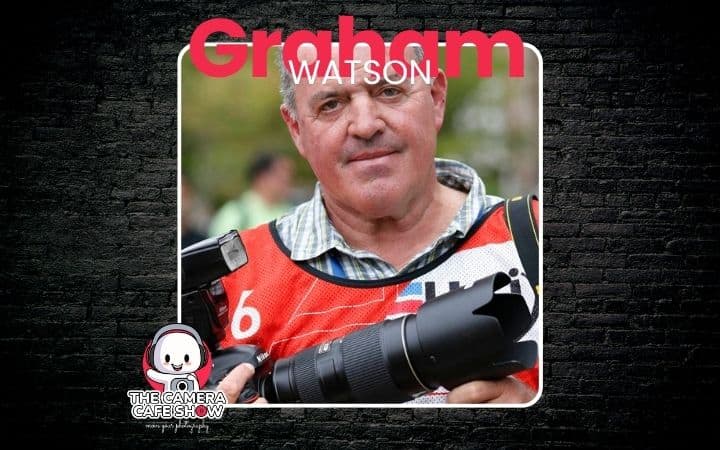
He’s one of cycling’s most iconic visual storytellers — the legendary Graham Watson.
Graham, originally from the UK, spent 40 years — most of them hanging off the back of a motorbike at full speed — capturing the agony and the glory of cycling’s biggest stars: from Eddy Merckx to Indurain, Armstrong, Boonen, LeMond, Delgado, Pantani, Museeuw, Hinault, and so many more.
In this conversation, we go back to where it all started — a portrait studio in London, where he first learned the craft. We follow the road from those early days to his rise as the go-to photographer for cycling’s golden era, with his images appearing in magazines and newspapers around the world.
Graham opens up about what it really meant to chase not just cyclists — but also using the light, the landscapes, and knowing where to be.
We talk gear, from full manual to fully digital, we revisit some of his most memorable race days, we dig into great personal stories and we talk about his excellent latest book that sums up four decades on the road.
And of course, we hear what it feels like to now wake up in New Zealand, a love for Belgian beer, enjoying good food, and watch the sun set — with no press vest required anymore.
So whether you love bikes, photography, or just a great story — pour yourself a coffee and settle in. This one’s full of action, passion, humor, and a view from behind the lens that only a few have ever truly known.
Enjoy this talk with the amazing Graham Watson.
Tom: Good evening, Graham, all the way down there in New Zealand. It's wonderful to see you again and it's wonderful to have time for a little chat on the podcast about photography, life and cycling of course.
Graham: Yeah, it's a pleasure to be here. New Zealand's not so far away from the rest of the world. Maybe 18,000 or 16,000 kilometers!
Tom: And now thanks to the internet it is no problem to connect! So, you are originally from the UK, Graham, but now living in New Zealand. That makes a very early start for me and I'm having, this is double espresso here, what you're having there?
Graham: Sparkling water.
Tom: So sparkling water to end the evening?
Graham: No, no. I'll have a glass of wine later!
Tom: Okay, sounds better. We will talk about food and wine in the end, but now to start this off, Graham, if you had to pick one city or a region that combines good food, beautiful landscapes, and great cycling, where would it be?
Graham: Cool. I think Switzerland.
Tom: Yeah?
Graham: Yeah. Yeah. The best food, because they have three cultures. They have French, German, Italian, and all those three countries have fantastic, fantastic food. And Switzerland has the beauty, the mountains and the lakes and everything. And my second favorite, if you're asking, would be Belgium because they, yeah, they have if I can say Dutch influence for food and French, so it's pretty good combination. But they don't have the scenery of Switzerland.
Tom: Yeah, that's true. But they have the good beer, Graham.
Graham: They have very good beer. Yeah, they have better beer than Switzerland.
Tom: Of course! Graham, you traded the Tour the France for New Zealand. How did you end up there?
Graham: Met a lady in London in 2001. We were having a barbecue at a friend's house I met this lady, and she was from New Zealand, and we fell in love immediately. And then almost immediately we traveled to New Zealand for three weeks in that first winter, the European winter. And of course, you know this, it is exactly as you see in the pictures. It's beautiful.
Tom: Yeah.
Graham: And very friendly. I started immediately thinking, this is a great place to come and live one day. And, you know, it's 15 years later that we moved away from Europe. I retired and New Zealand is where I am.
Tom: Lovely. I have to visit and trust we can go maybe on a bike race sometime together, Graham, that would be amazing.
Graham, I think you retired from being a pro cyclist photographer 2016 or was it 2019?
Graham: 2016. I actually worked the whole of 2016. And then we moved to New Zealand full time. I did one race in the beginning of the year of 2017 in Australia the first big race of the year. And that was my last race, I just walked away. Literally, I just walked away from Adelaide in Australia and was the end of it.
I told nobody what I was doing so nobody knew.
Tom: Right.
Graham: And so, I just opened the door and went through it and goodbye.
Tom: So you have been photographing the great in cycling history for almost 40 years, Graham.
Graham: Yeah.
Tom: After you, let's say, stepped down, you see cycling now different?
Graham: No. I think it's very much the same. The races are the same. Cyclists have evolved. Some, most of the cyclists I photographed have all retired. There's still some left, new faces have come along. And I watch it on TV almost every week, every day if The Tour of France is on, and enjoy it. It hasn't changed much. It's still the same sport in the same places. When I watch the sport, I'm also watching the beautiful landscapes that the helicopters film. That always reminds me of what I used to do.
And, and of course if I see a race in Belgium or Gerona in Spain or Marseille in France, I'm always thinking of the hotels I stayed in and the restaurants I went to. So, it's a, these days, is like a form of entertainment for me. I watch the cycling on tv and so I understand the sport as is today.
Tom: Right.
Graham: But especially I enjoy the landscapes, the countries they go to. And it's very absorbing.
Tom: We will come back to landscapes later, because it's a very big part also in your photography. But now Graham, let's walk a bit back. I think to remember, you told me you were 16 and, in your own words, flunked your exams. And you got offered a photography job and you said, yes, well, why not? And that I think it changed your whole life. Talk me a bit about how it all started.
Graham: Well, I was at school, but I was never interested in learning anything. I didn't like the school at all, and by the time I reached 16 years of age, I had learned nothing. I can speak, I can count money, I can write about things. But I had no qualification. Suddenly you see, you are 16 years of age and in two weeks you're leaving school for good. You're never coming back. And then I thought, wow, what am I going to do for a job?
And this is what the teacher said to me. He said, Graham, what are you going to do? You haven't passed any exams. You are not especially good at English or at mathematics or physics or geography. I said, I don’t know. I said, I'll stop school and I'll find a project to do. And the teacher said, have you thought about being a photographer? And I said no, I didn’t knew that you could be a professional photographer.
I said, no. I said, I expect to be maybe a carpenter working with wood, working in a bank maybe. And he said, well, there's a job available in two weeks’ time in the center of London, and they've contacted the school to ask for people interested to become a photographer. And I said, okay, I'm interested. Yeah.
And I sensed already the adventure maybe by not being in an office, not being in a bank, not being working inside, but actually going out. And I went for an interview three days later in the center of London, a photography studio. And I was given the job. I started working, the school ended on a Friday. I said goodbye to school for the rest of my life and on Monday I started a new job and just learning photography, working with a portrait photographer.
All the clients were, what we call aristocracy. They weren't royal, but they were very, very wealthy people.
Tom: Right.
Graham: Dukes and Duchess and Lord and Lady, all these kinds of things. You know, very successful people. Some of them were royal family. People like the King of Jordan would come and have his pictures taken in the studio in London his wife. And it was really exciting, really interesting. And for six years, I learned photography in this studio, being a photographer. And that's the basic of what I did. I learned about lighting and when exactly to take a picture. The actual moment to take the picture and how to talk.
Tom: Mm-hmm.
Graham: You know, to make them feel relaxed or to make a certain pose for you. And I did this for six years. But during that time, they were paying me about I think it was eight pounds a week, which is maybe 15 euros or something, but it wasn't very much. That was before tax. I had to take a train every day into London, 20 kilometers to get to work. So, every week I had no money at all. So my mother bought me a bicycle and, I sort of realized, if I cycled into London every day, then there's no train to take, there's no money to spend on trains. Doing this every day, 20 kilometers into town, 20 kilometers out, you also start getting very fit. You meet other cyclists doing the same thing as you. You stop at a traffic light, and you talk to a cyclist. And pretty soon after a few years, I took up racing, like to be the next Eddie Merckx. And I joined a cycling club, and I did some races. I went to see the tour of France in 1977. And because by that time I was really excited about cycling. Then the company I worked for were closing, the people that ran it were retiring and I didn't want to go straight to another job.
So, I thought I'll go and see the Tour de France in 1977 and then I'll make a plan after that. And of course, I took my camera. I also wanted to see Eddie Merck's race, I heard so much about him on tv. So, I went to the tour of France to see Eddie Merck's race. I fell in love with the tour of France straight away. But also as a photographer, I had an instinct that there was an opportunity. There was a possible opportunity coming my way if I got serious about it.
Tom: Interesting decision there.
Graham: Yes, and then one picture was published of Eddy Merckx in a cycling magazine in the UK, and it led me into, you know, what I did for the next 40 years, which was take pictures of cycling.
Tom: Great start though!
So Graham, you started when Eddy Merckx, I think stopped racing?
Graham: Yeah, he stopped in, I think April or May in 1978. And I was very lucky to see him that one time in 1977 in Paris.
Tom: Very nice intro into cycling too.
Graham let's talk a bit first about, normally we don't talk a lot about gear, but now we are going to talk a bit about gear, because I find it fascinating in the way you had to work. You shot everything four by four, by five, SLR, DSLR, onto digital, you worked with everything. Which transition you think was the most game changing for you?
Graham: I think it has to be when went from film to digital.
Tom: Hmm. Yeah.
Graham: Because it changed, it changed people's philosophy on photography. When you have a romantic piece of film, I think they call it, and when you go to digital, it changes your philosophy about photography, but also in a working sense.
It changes your working day. Completely changes your whole system, your whole routine. I think that was the biggest transformation.
Tom: Because I find it always amazing, you sat on the back of a motorcycle following the race, and you had first a Bronica or Mamiya in your hand. They're manual, but you also have to manual focus these things, and then I'm not even talking about developing your own film after the race.
How was your workflow in those days, Graham?
Graham: With film?
Tom: Yes.
Graham: Oh, with film whether we talking about black and white or color, it involves many processes. You take your pictures then you develop your film. And in the case of black and white, you make prints and then you send the prints to a magazine, for example, in London, or you send it by express Air Mail to America or to Australia. And with color slides, you process the film when you can. So not every day, maybe once every three days. If you can find a laboratory, then you choose your images you want to keep, and send those to clients. You don't actually have an image, you send a piece of film to somebody and maybe it's goodbye. You never see the film again.
But it's, I think when I was working with film, especially with color slide, for example, take a typical day at the Tour de France, you would have five or six rolls of color slide film, and would sometimes get to a laboratory every three days and sit outside the laboratory for five hours waiting for the film to come back to you.
And then sometimes you'd either cut up the film and send the images to your clients or you would when you buy a film scanner, you then take the film back and you scan everything in and you email it.
There was a transition when you stopped sending film to anybody and actually use a film scanner and scanning the images and then use email to send your pictures. It didn't happen in one day. It took over a period of two or three years was the transition between taking slides and cutting each slide and sending it by post, to then eventually emailing pictures.
Tom: The digital age.
Graham: Yes. I eventually in, I think 2003, I went hundred percent digital. Also during the time when I was working with film several things happened. Sometimes a client would arrange for the film to be taken from me, physically taken from me the end of a race. In the example of the tour of France, one year, films went on Concord from Paris to New York to a company called Sports Illustrated.
Tom: Yes.
Graham: They would come to you at the end of the stage of a Tour de France and they would take your five rolls of film, six rolls of film, and they'd fly them to Paris. And then next morning they put it on the Concord. So, the plane arrives in New York before nine o'clock in the morning. Film was processed in New York and the magazine came out every Friday. This was literally supersonic speed getting everything there.
Then I started to process my own film when I bought a mobile laboratory. It was called a Jobo, J-O-B-O. And for maybe for two years, this laboratory traveled with me, wherever I went. The Tour de France, or Spain, or the classics in Belgium, or the world championships in Japan. And I processed my own film. That way I never had to give the film to somebody. Because I was always scared of losing my images.
Tom: Lots of work, but surely worth it.
Graham: Yes, it was part of the life with film before, before digital came along. In a typical working day is you would work at least until midnight, just processing your film, scanning your film, emailing your images to clients. With digital, you went to bed at 10 o'clock in the evening and everything was done. Everything was finished. With film, you worked to midnight, and you then had to get up in the morning and start work again, because you hadn't finished night before.
With digital, everything was done in the same day, to bed in the evening knowing that work had been finished. Everything had been finished. So, two very different systems.
Tom: Two different worlds too. Also, Graham, when you retired in 2016, you passed the more difficult time in all this, because nowadays it's much easier sending over files. You just picked the most difficult time to be a sport photographer, haha.
Graham: Maybe haha, but, I'm very, very happy that I saw both. I saw black and white film, black and white prints, I saw color slide film, then I saw the digital age coming in. Later in the digital age, as you know, you transmit pictures out of a camera.
Tom: Yeah.
Graham: So I experienced this too for a while. And so, I feel I've seen a very, wide, what's the word, evolution of photography. I've seen so many different, different phases of it, and that not everybody sees these days.
Tom: That’s very true.
Graham: If you come into photography now, your camera is digital, right? You don't, you don't have to learn the hard way, you know?
Tom: Right.
Graham: But I did. I'm glad I experienced it, but also I'm very glad I experienced the very best of the digital world.
Tom: And maybe the very best of the cycling world too, Graham.
Graham: Possibly. Yeah, possibly.
Tom: Apart from your gear, Graham, I guess what you will also need, or be very good in, in your genre, is a bit of preparation? Because you will have to know where the most difficult part for the cyclists is maybe, where you can capture the best emotion. Also, not every race will be in the same place each year.
Graham: Well…I didn't really prepare myself because I became an active cyclist, I think like in 1974. And as a cyclist, you know, you know where the hills are, you know where it's going to hurt you as a cyclist, climbing a hill or a mountain, or if you're going downhill and it's a little bit dangerous. You have a feeling for where to stand to take a good picture. It, it was, it
Tom: Right.
Graham: It was very natural. I knew where to stop on a hill and take a picture, because that was the most important section of the hill. Or if I stop on a descent around a corner, I know that corner is dangerous, or I can feel it's dangerous. So, a lot of my experience as a cyclist, just an amateur cyclist, allowed me to understand where the best place is to take pictures and also the best moments when to take the picture.
The way the cycling season works, you're traveling every day with the races, so there's little time, or go ahead and look at tomorrow's stage. But, in some certain situations, in Belgium for example, what they call the one day classics, you stay a whole week because there's three races, and in the days between the races, you go and look at the hills. You look at the cobblestones or you look at where the best landscapes are. Generally, you don't have the time to go and do a reconnaissance. But over a period of years, all these races go back to the same places they went before.
Tom: Ok.
Graham: In a race like the Tour de France, or the Tour of Spain, or the tour of Italy, they use the same road or they use the same climbs. So, you know, by experience where to be.
Tom: True. And then of course, you can also trust on the one who is driving the motorcycle.
Graham: Yeah. Your motorbike driver is very, very important. Because he is not just your driver. He's your, like, it's if you're playing golf, you have a caddy who carries your golf clubs and gives you advice on when to play the next shot. In this case, your driver drives the motorbike. And he always takes instructions from you. But he also gives me instructions. He will say, and know, the road up in front is slippery, it's dangerous, or he will always be giving me suggestions to get in a better picture, because he also has experience of driving a motorbike.
And so, he becomes good company, some of 'em become your friend, over a period of years. And most of my drivers, like with one, I stayed with for almost 25 years.
Tom: Nice.
Graham: Because he was so good. The important thing is, you travel together all day long then you socialize in evening together. Normally you share rooms as well, so. You have to find the right driver and look after him for, you know, as long as you can. It’s a very, very important part of the work.
Tom: I just have to ask you, Graham, how many cameras or lenses you lose on the back of the motorcycle?
Graham: Quite a few lenses and cameras were dropped. I think when I was younger, I used to drop a lot of my cameras. They'd fall off your shoulder, or when you are, when you're on a motorbike, you could be going over some cobbles and you are just changing a lens. One little mistake and you drop the lens and, it's smashed, it's obliterated. And this happened a lot when I was younger. As you get a little bit older, you're more experienced and you don't like losing, you know, 2000 euros, because the lens is broken.
Tom: I feel you, haha.
Graham: I would think, I would get through at least one or two cameras every year and probably three or four lenses damaged.
But the biggest damage to the cameras, is actually the rain. When it's wet out there, you can't really protect the camera very well, and you can't take pictures if you put the camera away in a bag or on the motorbike, you can't take pictures. So, you have to always have the camera in your hand and be ready for anything.
But if it's raining, then the camera would last, I don’t know, two or three hours, and then it's dead.
Tom: Yep.
Graham: So, there's another, that was another challenge to deal with.
Tom: Yeah. Challenges, yes, Graham, but it's you who told me that the best pictures in cycling comes when it rains.
Graham: Yeah, that's the thing. Yeah. When on a rainy day you know, you're going to get the best pictures. So yes, you look at your camera getting damaged, but you have to say, forget it. It's more important the pictures. It really is, you know, the wet days are the best.
Tom: So, you typically went with one, or I suppose with two cameras, Graham?
Graham: Yeah. I think most days I'd have two cameras, one on each shoulder, but also a third camera. Put somewhere on the motorbike, just if it was raining.
Tom: Yes.
Graham: I would hide it on the motorbike just to have a reserve camera. I suppose about a typical day, I probably have about five or six lenses with me. Something very, very long to take the finish shots and then at the opposite end a fisheye lens, or a very wide angle lens, to get some of those landscape pictures.
Tom: Graham, now, let's jump over to great cycling events. You covered everything in your 40 years from Tour de France to maybe smaller one-day events. If I asked you to pick a race that, you would go to, and say, I am a hundred percent sure I'm going to get all the shots I want today. That blend of terrain, drama, light and emotion.
Which race would it be?
Graham: I would have to say the Giro Italia, the tour of Italy.
Tom: Ok.
Graham: For many reasons. The tour of Italy takes place in May. So, it's not summertime yet. It's not winter. You have the beautiful landscapes, the very green grass, very blue sea, snow on the mountains. Just a lot of color in the picture. And in some days of a tour of Italy, I think you'd say we got all four seasons. You'd have spring, winter, summer, and autumn in one day. And that makes fantastic photography.
Also, because of the time of the year, the cyclists are, what we call fresh. They're not, they haven't got tired yet. The season starts in February, so when July comes along for the tour to France, that's already a time when cyclists who have been racing for five months, start to get very tired. But in May, in the tour of Italy, they're still fresh. The racing is really red hot, much more entertaining, and that also gives you the best pictures. Also, Italian roads are the worst roads in Europe, so there's a lot of crashes and lot of, you know, bad luck comes along because of the roads you're on, in Italy in May. So that's the one race that really gives you everything.
Tom: I was thinking about the landscape now for a moment, because when I look at your pictures, I see that not only you shoot the mandatory close-up ones from the cyclists, but also you use a lot of landscapes, or general landscape-feeling, while they are passing through. You enjoy that part of looking for good landscapes, Graham?
Graham: Yeah. Very, very much because for me, almost 50% of the sport is the beauty of the sport and the beauty of the landscape. Some people see the beauty in a cyclist, an athlete with all their beautiful colored clothing and their, like shorts and everything, and their faces sweating and showing a lot of emotion.
But for me, the beauty of cycling is the landscapes. When you're going along, even through a desert in the Middle East, there’s something very beautiful about it. And, because I spent many years before, not sitting on a motorbike when I started, I was driving a car. So, in the race, I only had like one or two opportunities every day to take a picture, you could make potential out of each time you stop. And one of those, every day, would be a landscape picture. Just to show where it was. Like whereas a football game takes place in the stadium, it could be anywhere, you could be in any stadium in the world, but a bicycle race goes through some pretty spectacular scenery, or even geography.
And every day of a race, I like to show the landscape where the race went through, because then people who see the pictures, appreciate more what that race was about that day, whether it is a mountain alongside the lake, alongside the sea through a desert, along a road between trees. Every day there's a different landscape. And I think it's important to show at least one picture of that, every day. Just to show where the race was.
Tom: I fully understand and it does give so much more context.
Graham, we once talked about cycling and if it's with somebody that doesn't know cycling very well, always the Tour de France comes up, because everybody heard from it. But then you described it to me as being claustrophobic in the last years you saw it. Can you sketch me quick, like a before and now? How how it changed.
Graham: Yeah, it has changed because it has become so popular. It is a good change though. When I first photographed the Tour de France, say in the early 1980s, people watched it, and there were spectators, of course, people are naturally looking at the Tour de France when it comes by. You'll probably saw a few thousand spectators the whole way up a famous climb, but these days, there'll be half a million spectators. It's just that the sport has got so popular. The tour of France has got so popular, and more and more people come to watch it.
And it's, it's almost a, an annual ritual to come to the Tour and spend a week in the Pyrenees or a week in the Alps. The big difference, it got so popular that it became, as you say, claustrophobic because you are traveling along on a motorbike with the cyclists, all day long, from the beginning to the end of the race, tens of thousands of spectators, continually all the way through. And it's quite the potential for a catastrophe, because I'm on one motorbike, but there's 40 other motorbikes, including the police and television and radio. Each team has two team cars behind the race and all the other cars following.
There's this huge potential for an absolute catastrophe, because there's so much humanity it. And humans don't watch a bike race without cheering or do silly things or are dressed up a chicken or as, you know, uncle Sam, and it's actually quite dangerous. It's great to photograph the tour of France, but this 21st century now, it's not the fun, it was 30 years ago.
Tom: But still good fun anyway to go shoot in it?
Graham: It's still fun! It's better than having a normal job, it's quite challenging. You get very nervous on an average day in the Tour de France.
Tom: You are watching like a bit of history too, Graham. I mean, can I imagine you sitting on the back of the motorcycle and getting very near to a cyclist making the picture, but also inside of you rooting for him a bit, to win or not to give up, right?
Graham: Yeah. Always. Though you are thinking of the photography, your next picture. You're thinking of getting your next exclusive masterpiece.
But yes, as a cyclist, you're also traveling sometimes just centimeters away from the greatest cyclists in the world, you know?
And some of them know you, and you can hello quickly, yeah, in the beginning, I was a fan. You know, you see Eddie Merckx, you see a great cyclist like Sean Kelly from Ireland, or Greg Lemond from the States. You want 'em to do well, but still, it's the photography that's the most important thing.
And you can be very disappointed if you have a soft spot for one cyclist. You know, I really always liked Tom Boone, the Flemish guy.
Tom: Yes, I know him.
Graham: He was, to me, he was fantastic. He was like 2 meters tall, and was, he was this wonderful to photograph. So, you want him to win every time, but of course he couldn't. Sometimes he was unlucky, sometimes he crashed. Sometimes he came second or third. So, after a while you don't really get too biased or prejudiced about wanting someone to win. You just take your pictures. And make sure that's the important part of the day.
Tom: You ever helped out in a not photographic way when somebody crashed, Graham?
Graham: You can help in a certain way. You see a lot of crashes as a photographer, and there's a system in place where, yes, you want to help somebody, someone's fallen, they're lying on the ground, and your immediate thought is, oh my goodness, I must help them. But in the 10 seconds it's taken me to think about helping somebody, then one of the doctors from the race, has jumped out of the car or a motorbike, or a team member from two or three traveling cars. And in the 10 seconds it takes for you to think, oh, I must help him, the doctor is already there.
Tom: Right.
Graham: Most cyclists, the crashes aren't too serious. But the serious ones are very serious.
You do not help a cyclist, if you don't have a hundred percent knowledge of medical aid, you don't. It's not your job. You leave the professionals to do that. There is, yeah, there's a side of you that wants to help, but there's a bigger side that says, no, don't get involved.
Tom: What's the worst crash you ever witnessed, Graham?
Graham: I think…I think probably…occasionally people would do die from their injuries, and there was a crash in the tour of Italy. I think in 2011 it was. A Belgian rider crashed onto descent. And I photographed him because you think it's only a crash. But then I realized he's not moving…you carry on, you don't stop, you just carry on. And then they announced, an hour later he died.
It's quite, it's quite…it really does affect you. The fact that someone's died is, is horrible.
Tom: Of course.
Graham: For something you love so much, and someone's died, and he loved it so much. That particular day, I knew I was one of the, maybe two photographers, who'd actually taken a picture after he'd crashed.
And of course, I get to the finish of the race and into the media center, the press center, and everybody wants a picture. This was 2011, so I had digital cameras and I knew, I did not want to let anybody have a picture of him after that.
So, I deleted my pictures in the camera, I think there were three pictures. I deleted each of the three pictures. And then there was nothing to give to anybody. And if I could feel good about it, that was that, that didn’t give the pictures to anybody.
Another photographer did. And the pictures were big picture across a Belgian newspaper next day, from an Italian photographer. But, the family, the family of the cyclists who died, you know, when, they don't want to see this…
Tom: No.
Graham: But you know, newspapers are newspapers and so…
Tom: Yeah.
Graham: I deleted my three pictures, and I was very happy to never see them again.
Tom: That’s really heartwarming, Graham.
Graham, you worked alongside the most, let's say, over your career, the most iconic cyclists. Tell me, is there a rider, or a story, or something that sticks with you after all these years?
Graham: One rider that stands out is probably Lance Armstrong. He raced for 14 years from when he was very young, and then when he won the Tour de France many times before, you know, before he was suspended. I spend a lot of time photographing him, so you get to know the guy.
I know him much better than I know, for example, Tom Boonen or Sean Kelly. I mean, Lance, you got to know the guy. There's many, many stories about him, you know, which I don't tell people about because it's private. But he was suspended, you know, you don't really talk too much about your relationship with him because it's…people don't want to know. But he's probably the one cyclist who I got the most out of, photographically and pleasure, you know, I did enjoy working with him.
But they're, they're all…all the cyclists are pretty friendly and, they do take an interest in what you do. So, more than a few good characters out there.
Tom: Now you talk about Lance Armstrong…how you felt personally, when it all came out?
Graham: Oh, well, it was coming out for a long time. It didn't just come out one evening. It was coming over a period of years. When it did finally come out, when he confessed on tv, to be honest, it was a relief that the suspicion was gone. It was actually true, and the sport could then get on with its life.
And, you know, Lance was finished but the sport would live on. And I suppose I was really sad when he did confess. I was really, really sad for him. Because all he ever wanted to do was win. You know? He wanted to win too much.
But I felt very, very sorry for his fans, the real a hundred percent fans that believed in him. And they would've had a very hard time dealing with this when he confessed, you know, so I, I feel sorry for him, but especially for the fans.
Your first thought as a photographer, your first thought is like, oh no, all those pictures of Lance Armstrong, shall I throw them away? Shall I throw them in the rubbish bin? Well, of course you don't. You keep them all. When other cyclists have become positive with drugs, you keep those locked away, but you don't throw anything away. You just keep them.
Tom: Of course, they are part of your legacy.
Graham: But. You can never use them again. They're kind of commercial value, if you want is, is almost nil. Because people tend not, you don't see pictures of controversial sportsmen.
Tom: No.
Graham: You just don't use them. Magazines don't use them. So, you're very well aware when, with Lance, when he confessed, that your pictures were going to be sitting in a filing cabinet for a hundred years. You get very selfish. You think the first thought was, oh, now what with all my pictures.
People often ask me a little bit more, you know, how does I feel and how do I deal with cyclists, when they show up positive, because quite a few of them have.
Tom: Yes.
Graham: I just think as a photographer, when I took the picture of them, at the tour of France, or the tour of Italy, tour of Spain, or wherever…at the moment I took the picture, I was totally happy. And whatever happens afterwards is beyond my control. You know, I saw them at their very best and I was very pleased to see it. And I got some nice pictures. I keep those as a memory.
Tom: Yeah.
Graham: You have to accept it, you know? A photo as a photographer, you can wear a certain hat and you know, not get too involved, but you, you do care that your, that your photography is not going to be seen so much.
Tom: Because how is your, as a photographer, how is your personal relation with the cyclists Graham?
Graham: Pretty good, pretty good. Cyclists, almost all cyclists are very, should I say good natured. They're not like footballers. They don't have a bad temper. Sometimes they're a little bit quiet if they're thinking about something, but the fact that you're riding a bicycle, every day for five hours or six hours, it means you're very calm. Your legs do the thinking for you.
Tom: Right, haha.
Graham: So, when you speak to a cyclist, normally he's very gentle, you know, not aggressive, doesn't have a big head. You get on with everybody because they're all very good natured.
Tom: They recognized you when were there year after year, Graham?
Graham: Yeah, yeah, sure. I can't say, you don't become friends with them. But if you imagine, all day long you are on a motorbike and you are around these cyclists. You're taking their pictures, and they see you taking their picture. I see them, they see me, so you are, you become a…it's not, you're not a friend but you become a contact. You are someone in their daily life. Every day they see you the same way as they see their mechanic, or the same way every day they see their team masseur. They see a photographer every day. They see me every day.
Tom: True.
Graham: So you actually get to know each other without even talking.
You know, they know me, they see what I'm doing. They see my character. And in the digital age, they see your work. Every day, the cyclists in the tour de France will go on the internet and will look at my website or someone else's website, and look at pictures of them.
They know your work and they trust you. They'll confide in you in a different way to how they confide with a journalist, you know, so generally the relationship is very, very good. Also, you are their life more glamorous.
Tom: Of course.
Graham: Most pictures you take end up on the internet somewhere. And they're very grateful for that. They're doing a job. They're doing a job for their team sponsor, but they themselves, also like seeing their images, you know, on the internet or in magazines, and they know the images have come from you or from me.
Tom: Would they pass you water bottles also, Graham? Haha.
Graham: Not really, haha. But their team managers will pass you a water bottle. You get to know them, because you're so deep into the sport. You know everybody, you know every guy driving a team car. He once maybe was a cyclist, now he's a team car driver. And yes, they give you water or a fizzy drink on a hot day.
But I'd never have a drink off a cyclist. That's too far. That's too much. He needs it more than I do!
Tom: You ever had a beer with a cyclist?
Graham: After a race. Yeah. Yeah. Sometimes also, you get the chance to go to what they call a training camp in December, at the end of a season. All teams get together in November or December, and they have a preseason camp where there's not so much activity on a bicycle. It's more getting new clothing, meeting new teammates for next season, being given instructions by a team physiotherapist or the chiropractor.
Tom: Ok.
Graham: And you go along also and you take pictures of each cyclist in their new for the following season. And then yeah, you can have a beer with 'em because they're not racing, they're not training. And it's good fun. It's good fun.
Tom: Yeah, I can imagine.
Graham: And some of them, when they retire, you become closer friends with them because they're no longer racing on a bicycle. You actually get to know them a little bit better, which is great.
Tom: Maybe on that, we can go back to what happened with Eddie Merckx. You met him, then he stopped racing, but then his son started racing. So, you saw a bit that full circle.
Graham: Yeah.
Tom: You talked to Axel Merckx about this?
Graham: No, not really. But, I met Axel when he was six years old, I think. Because Eddie retired in 1978, he kind of disappeared for about six years, and then I met him again I think in 1980. No, sorry, he was driving the car of the race director of the tour of Flanders in 1991, it was 1991. Suddenly he came back to life. He came out and, I spoke to him, and because he is Eddie Merckx , the magazines still wanted to interview him, so I would many times go to his house in Brussels
Tom: Nice!
Graham: Yes, I would photograph him with a journalist. And like this, I met Axel. Axel was about five when I met him.
Tom: A young boy still.
Graham: And you imagine your father's Eddie Merckx. And your father doesn't want you to be a cyclist, so you play football. But the problem is the DNA of Axel Merckx is a cyclist. So, he became a cyclist, and a good one, he became professional. I think in the early 1990s, he became a professional, but then he had to be as good as his father, and that was impossible. I had so much admiration for him, for being…the bravery to try and race like his father, because you can't be as good as Eddie Merckx. Noone can be. But Axel's a lovely guy. You know, he's like I said earlier, he is very calm. Not aggressive, doesn't have a big head.
Lives life, loves life. He really is a nice guy. I think now he's living in Canada, but yeah. Also, when you see Axel Merckx and you're photographing him, for sure he looks like Eddie Merckx and he rides a bicycle exactly the same style. So, you're photographing Axel and you in your mind, you are seeing Eddie Merckx.
Tom: Must be fun really!
Graham: Yes, very much. I also had this with other cyclists. I found myself during my career, there was an Irish cyclist called Steven Roach who won Tour de France in 1987, and his son, Nicholas Roach, started racing, I think in around 2000 maybe. So I started photographing Nicholas Roach, and we made a joke one day and I said to him, about his father who got to a certain age and he was still racing, I think he was probably 37 years old. And I said, look, if he doesn’t stop racing, your son will be racing the Tour de France with you, and I'll be taking your son's pictures like I took pictures of you both! It's very funny. You know, so you have the father, you have a son, and then next son almost coming along.
Three generations!
Tom: Haha, that would be something though!
Graham, if I should ask you for a picture you took, with some deeper personal meaning, it doesn't have to be from your book, we will talk about that in a moment, but if you would have to pick one picture that has this personal meaning you took, which one would it be?
Graham: It's one I speak about quite a lot, from the 1986 Tour de France. It's a picture of a French cyclist called Bernard Bernardino, and next to him is Greg LeMond, the American cyclist. And it's taken, technically it's taken on a Bronica camera. So manual focus, manual wind on, and this was the days when I was not on a motorbike. I had a car, and say every day you stop once, sometimes twice. But once on this day.
The story of the Tour de France at that time was Greg LeMond, the day before had taken he famous yellow jersey. He became the race leader from Bernard Bernardino, who'd won the Tour de France five times. And this is quite significant because he was a guy who didn't want to not win a sixth tour de France. He won five, he wanted to win the sixth one, and he got beaten by his American teammate and he didn't like it. He's a very proud man, very, very French, very proud.
And I had this one chance of getting one picture of Greg LeMond in yellow on his first day as the race leader. The two cyclist came up the mountain Alp d’Huez, and hundreds of thousands of people, like there are today, but there's many thousands of spectators wanting to see all the same thing as me. And I have one picture, I had one chance to take one picture. And this one picture, I caught it.
Tom: I know the one you talk about.
Graham: Taken not with a motor drive, not with auto focus, just one manual picture. And both guys side by side. Something I'm very proud of. And some people say, no, that's not your best picture, but it's the picture that means the most to me because you got one day in the history of the Tour de France, which is very, very important.
Tom: Then now, let’s bundle all your pictures together. You wrote some books, Graham, let's talk a bit quick about “40 years of cycling photography” with over 300 of your iconic images and some very good stories on the side. You have thousands of images in your database, how you pick 300?
Graham: With great difficulty, with great difficulty, haha. That last book I did was “40 years of cycling”. It was to celebrate my 40 years in cycling as a photographer. I had two responsibilities; this was the last book, and it was 40 years. I had to take some of my best pictures and put it in the book, but the problem was that some of these pictures had appeared in previous books. So, let's say a hundred pictures are been seen before in other books, but then 200 pictures more had never been seen. So, I had to make sure it had a balance between my most famous pictures and ones that no one had ever seen.
You have to have a good balance. And I spent months and months and months looking at pictures trying to choose the best ones for each chapter. And each chapter had a different theme. One was technically working, taking pictures, a story about my favorite cyclist, for example. And I'm aware people, when they buy a book like this, they want to see your best pictures in it.
Tom: Of course.
Graham: I had to try and use some of them, but also, I had to make sure I used new ones that hadn't been seen before. And I really can't tell you how I decided, but the guy that edited the book was actually one of my motorbike drivers was a professional journalist.
Tom: Okay, that’s fun.
Graham: Yes. He edited the book and so he helped choose some of the pictures. He understood exactly what my thought was about using pictures previously published. So, he helped me choose the pictures. I can be a good photographer, but I cannot choose my own pictures.
Tom: I understand that.
Graham: I need someone else to say that picture, that picture, that one.
Tom: Yeah.
Graham: I can choose some things, but it's, it was too much.
Tom: I think most of us photographers, we want to see a book of us on, on the bookshelf. What does it feel like, if you take your book in your hand, Graham? I mean, you're very proud of it, of course, but does it feel as like a happy , sort of, retirement gift to you?
Graham: I don’t know…I'm very proud of the book because it's my last book when I retired. It sums up my whole career, 40 years of cycling. Yes, I'm very proud of it.
But as a photographer I'm also very critical of the way the book is published. I'm very critical of printing. I'm very critical of maybe the way the picture's been cropped, so it's not a hundred percent pleasure. I look at a book, because there's no such thing as a perfect book, you know, you have to work with an editor, you have to work with a designer. And you compromise. You know, you sometimes look at a page, a page in the book thinking that's the wrong picture. They should have used another picture. I can't look at the book with a hundred percent satisfaction, but maybe 95%.
Tom: But Graham, I was really imagining now you were going to tell me, I'm sitting on my porch in New Zealand, watching the sunset, in my rocking chair with a nice Chardonnay, with my book!
Graham: Yeah, haha. It's very strange. That book, I've never read it as a book. Because when you produce a book, you have to make each chapter, and then you have to work with a designer and editor. And then you, let's say like chapter three, you read chapter three so many times, on the computer.
Tom: Of course.
Graham: So, I read it so many times. And then finally one day the book is printed. You have the book in your hand, you're on the deck of your house, you have a glass of Chardonnay in your hand. But. I can't bring myself to read the book, because I've read it so many times. Not as a book. I've read it as a PDF, but now it's a book.
You can't, you can't read your own book.
Tom: Yeah, I understand you.
Graham: It's almost impossible.
Maybe in 20 years’ time I will. But again, it's not that I am not proud of it, but you know. We always want to do a little bit better.
Tom: Graham, what's then something that totally quiet or mundane, that you now enjoy?
Graham: Quiet or mundane. No, I don't do quiet or mundane, haha. I do lot of cycling still. I still go out on my bicycle. I have a gravel bike, and I have a mountain bike, and I have a road bike. And every day I look at the weather and if it's wet, then I'll go, well, if it's wet, I'll stay indoors, but most days, probably like three or four times a week, I'll go out on a bike sometimes for one hour, sometimes for five hours. When the weather's bad, I'll go walking. The most mundane, I think the most mundane thing I do is probably read the news on the internet in the morning. You know, I have breakfast and I spend probably an hour and a half looking at the news on the internet. And then that's the most mundane thing I do. And then the day starts.
Tom: You remember the best Belgium beer you ever drank?
Graham: I'm not an expert. I mean I enjoy…how do you say….a Trappist?
Tom: Trappist, yes.
Graham: Trappist, or also Westmalle.
Tom: Westmalle, very nice!
Graham: Yeah. But they were like, there were nice beers, strong beers, but of course, I know they're really strong, especially now. But I never, I'm more of a wine fan, you know. I would have one beer, every day in Belgium before dinner, but then wine during dinner. But, yeah, haha, some of the beers in Belgium are strong.
Tom: They will make it very difficult to get up at 6:00 AM in the morning.
Graham: Exactly. Yeah. Yeah.
Tom: Graham, to finish this, I think it's something that everybody wants to know. If you have to give me your top three cyclists ever, tell me who and why?
Graham: Sean Kelly, the Irish cyclist, because he was, when I first started, he was also just starting as a professional cyclist. And he wasn't my hero, but he was probably the nearest, he was probably the only cyclist that was a hero or almost a hero in my life. He was hard, hard person. He never spoke to you. He never spoke. He would just nod. He wouldn't speak to you. He wasn't rude, he is just very shy, very introverted. But he was incredible cyclist. He was fantastic. He won some of the best one-day classics, the tour of Lombardi, he also won the tour of Spain, so, an extraordinary cyclist.
Then, I would say, the Spanish cyclist, Indurain, because he was the most perfect cyclist I photographed. He was two meters tall and had a beautiful kind of bronze skin, brown eyes, very, very statuesque and a such a nice person. He was such a nice person. And he was one cyclist who I didn't get to know at all racing. I photographed him for probably 8 or 10 years, but then I saw him in Australia years after he retired. And he gave me a big hug! I was quite surprised because he was so shy.
Tom: That’s wonderful though, haha.
Graham: Yes! And the other guy, I would say, can I have four?
Tom: Yeah, sure.
Graham: So I would say Tom Boonen.
Tom: Ok.
Graham: I liked him too. He was very, statuesque, very tall. He won everything. He won every race he got into. He was incredible. He was just so strong. I would photograph him, he was next to your motorbike and racing hard, and you would hear his legs just pushing down on the pedals, and you'd hear the bike, we say creaking. The bike would make a noise because Tom Boonen is so strong that the bike just kind of was complaining.
And then, then I would say, Alberto Contador, another Spanish rider because he was, he wanted to win every day. He wanted to win everything. And he had an unique style. He wasn't very big person. He was very, very skinny, very thin. He never talked to anybody. He was very, he was a real star. But that was part of the attraction, is that this guy's a star. He doesn't talk to you, but he performs very well in front of your camera.
So they're my four favorites.
Tom: You ever get starstruck, Graham?
Graham: In the very beginning yes. Starstruck in the sense of idolizing somebody you mean?
Tom: Yes. In the sense of maybe missing a shot?
Graham: Ah, yeah, yeah, yeah. When I, take me back to beginnings, when I was learning photography in the studio in London and I was photographing royalty. You learn how to talk to people. Not as a friend, but as a photographer. Because you want to take the best picture of them. So it's no good being a friend, you gotta keep, keep a certain distance. You talk to somebody and talk about, it's not quite mundane, but you're looking at their eyes and you're waiting for a certain moment when press the button.
And that's what I do with cyclists. I'm trying to keep it keep away from, I'm not trying to be their friend. Some cyclists say, you never talk to us. And I said, well, you've got your job to do. I've got my job. And I said, I'll talk to you at the end of the season. I'll have a beer with you, but during the race, I'm trying to take the best picture of you. So, just let me do it. I was not, was never really starstruck, but, if you were starstruck, then yes, you're going to miss the shot.
And I did this sometimes in the beginning you suddenly see Sean Kelly or Greg LeMond or someone else quite famous, and you're thinking, damn, that's him. You know, you're standing in front of him.
Tom: Yeah.
Graham: So now you gotta, you gotta keep your distance and to try get the best pictures.
Tom: Of course. 40 years professionalism on a bicycle there, Graham!
Graham, I'm very happy with this episode, because I'm not very good at cycling, well cycling history, but we made I think, we made an excellent episode.
Graham: Good. I'm glad for that.
Tom: Yes. I'm going to let you go on with your evening and with your chardonnay. I finished my coffee, I need something else now, I'm going for breakfast.
Graham, thanks a lot we could connect, we could make this talk and I had really a nice time.
Graham: Good. Thanks very much Tom.
Tom: We keep in contact, and I really hope to catch up with you and have a beer.
Graham: That would be nice. Come down to come to New Zealand.
Tom: We will have to make it work. Graham, have a nice day still!
Graham: Okay, thank you Tom.
Tom: Okay. Bye.
Graham: Bye. Bye.
Outro:
And that wraps up our conversation with the incredible Graham Watson — a man who didn’t just photograph races but captured the heart and grit of cycling like no one else.
You can find more of his work — and his beautiful book 40 Years of Cycling Photography — over at grahamwatson.com. It’s one of those books that deserves a permanent spot on your coffee table.
If this episode brought back memories or made you see photography in a new light, I’d love to hear from you. Drop us a message, or tag us with your thoughts or questions on social or an email — you might hear your name in a future episode.
And as always, don’t forget to follow or subscribe to The Camera Café Show, so you don’t miss the stories we’ve got coming up and know who we have lined up for the coming weeks.
Thanks so much for listening — and see you next time here for another wonderful talk with another wonderful photographer.