

“ Belugas are known as the canaries of the sea. I'm not sure why singing attracts anybody, but certainly I remember getting in the water in the Arctic and saying, "Try singing 'cause they might come and check you out." And all I could think of was Happy Birthday, so I was snorkeling around singing Happy Birthday. I remember looking down and there was something that looked really small that I thought was maybe a jellyfish way below me, something white in the gloom. This is in the Canadian Arctic, so we were in a few hundred meters of water. And then this glowing white thing that I thought was a jellyfish started getting larger and larger, and then I realized it was a beluga whale, it was a mother with her calf clearly thinking, "What on earth is this terrible noise?" And so this whale swam up, and she and the calf were just swimming around me. Oh, God, it was magical. It was extraordinary. Yeah, special memories.”
INTRO:
Most career plans when you’re a child don't involve wildlife documentaries, Sir David Attenborough, Arctic expeditions or singing Happy Birthday to belugas. Our guest today clearly wasn't following the usual career path. And that's where our story begins. I am Tom Jacob and this is the Camera Cafe Show.
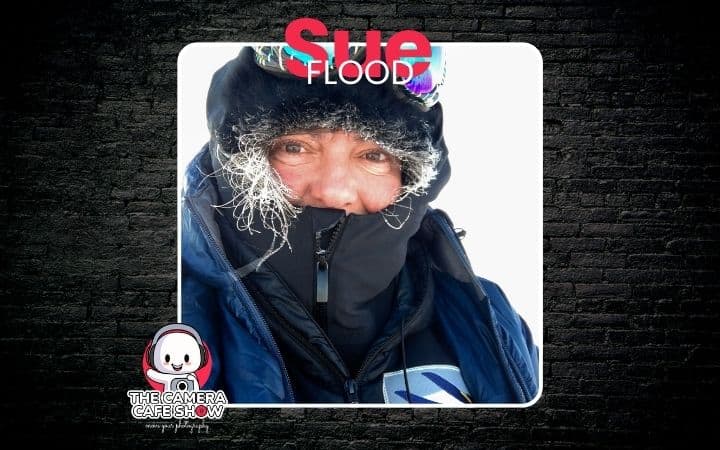
My guest today is Sue Flood. And before we get into all those adventures, there is one small matter we need to settle. Sue was awarded an OBE earlier this year for her services to science, conservation and the natural world, so technically I suppose I should be calling her Lady Sue... but fortunately, we've agreed we're still on Sue terms.
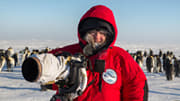
Sue is an award-winning photographer, zoologist and conservationist who spent 11 years with the BBC Natural History Unit, working on productions with Sir David Attenborough all over the world including The Blue Planet and Planet Earth. Her camera has since taken her to some of the wildest places on Earth, including the Arctic, and did I mention she has a special love for penguins?
In this Part One, we go back to the beginning: growing up in North Wales, dreaming of working with Sir David Attenborough, leaving a job she didn't enjoy behind, and eventually, by persistence and a bit of luck, finding her way into the BBC. And that's just the beginning, but I promise it's a fantastic start to the adventures waiting for us in Part Two, where we head even further south with her camera in hand, meet some very special animals, have a coffee with Sir Michael Palin, and discover what's inside her next book.
But for now, grab yourself a coffee, put on your diving mask and join me for Part One of my conversation with the wonderful Sue Flood.
Tom: Greetings and welcome back on the show, everyone. My guest today has a lifetime chasing the most amazing places and wildest places on Earth. Along the way, she's met Sir David Attenborough, traveled the globe with the BBC Natural History Unit, and built a career inspiring now photographers and nature lovers alike. Sue, it's a pleasure to finally meet you here on the show.
Sue: Oh, it's a pleasure to be here and thank you for indeed for having me on!
Tom: We're going to have an amazing talk. But first of all, last May you were awarded an OBE, so should I refer now to you as Lady Sue or are we still on first name terms?
Sue: Definitely not Lady Sue! Haha. Yeah I have to say I was astonished to get that news. I was getting on a plane in Hong Kong, and my husband, Chris, who never ever opens my mail, had messaged me and said "There's some paperwork you need to check." And I said, "Can't it wait till tomorrow? I'm home tomorrow." And he said no, you need to check it." And I thought, "Oh no, I've got a parking ticket or something like that." And then I looked at my phone, and there was this letter saying that I'd been awarded the OBE, Order of the British Empire what was it? For services to science, conservation, and the natural world. And I have to say I burst out crying. I was so surprised and amazed. And, as I say, he never opens my mail, but he'd seen this very important looking letter turn up, and he decided it would be a good idea to open it. Well done him.
Tom: But, Sue, congratulations because, awards like these, they don't happen overnight. They recognize a lifetime of work. I suspect the little girl from Wales, she had no idea that she would be standing at Windsor Castle in front of Prince William one day?
Sue: No absolutely not. I genuinely is such an incredible honor. I love my job. I love my job. It's what I dreamt of doing as a kid, to a wildlife filmmaker, a wildlife photographer, to then be recognized for it's just lovely. And to then have all these literally thousands of people writing and saying lovely things, whether it's people I was at school with, or university, or my old neighbors, or little kids who've come to talks I've given it's so lovely and of course a great honor. And hopefully, what I'm really hoping is that's gonna be able to help amplify my voice to talk about conservation and the power of photography for good purposes. Yeah, it's it's lovely. And it was Prince William was great. When we met in Windsor Castle, as you say it, it was lovely. And I he... A few nights beforehand, it had been David Attenborough's birthday celebration at the Royal Albert Hall in London, and the royal box in, in the Royal Albert Hall had David Attenborough sitting with Prince William and also lovely Sir Michael Palin. Prince William gave a wonderful talk about David Attenborough's life. So it was really nice to be able to talk to Prince William about, what it meant as a kid to end up working with Sir David Attenborough. And I said, "He's inspired me since I was as old as your children." And yeah, it's I have to pinch myself.
Tom: And slightly nervous, no?
Sue: it's I was slightly nervous beforehand. I was so worried because I seem to spend most of my life wearing GORE-TEX clothing and or crawling around in a hide or something. So I don't often get to wear a dress and nice shoes And it's very... It was very well organized, and you had to go in one at a time. And it was lovely because we had a little rehearsal, and they explained that, you would queue, and you'd go in o- one at a time, and you'd have time to talk to Prince William. I said, "Has anybody ever, tripped or done anything wrong?" And they explained that one woman had when she'd gone to curtsy, 'cause you can either curtsy or bow or whatever, had actually fallen over. She wasn't used to curtsying either. And then another woman had fainted. So at least I managed not to do either of those things. Yeah.
Tom: You did very well, Sue. Haha. Let's go a bit back. Paint us a picture where you grew up. What was life for little Sue in North Wales?
Sue: Ah. I remember that very well. So when I was growing up in North Wales I lived... I grew up in a small village. My mum was a teacher, then, me, she l- left that be a stay-at-home mum with me and my brother. And my father, he used to be in the merchant navy, he left that and changed direction when I was born. But when I was a child, used to hear these stories of his travels and it was so incredibly exciting to hear these stories as a kid. And just outside my office here, I've got this big camphor wood chest that belonged to him, that he brought back from the Far East when he was in the merchant navy. I would open it up and it would be full of all these things that I was allowed to get out and with or look at. And there were, kimonos from Japan. There was a headhunter sword from Borneo. There were these hats from Burma, Myanmar. Brought back from China. And it was so exotic, and he clearly had loved his travels. And that definitely made a massive impression on me, that there was... there I was in this little village in North Wales, but there was this world this sort of exotic world of travel. And I must say sorry, Mum, that my mum, I remember when I was about eight and she said, "Your job when you grow up is to look after your husband." And I thought that sounded terrible even when I was about eight years old. So in terms of differing messages from my parents, I definitely preferred the message I heard from my dad. and I'm just looking up over my computer here. They're both looking at me. Sadly, they've both passed away now, but yeah, they, I think about them every day and yeah, they they were both a big influence on me. But yeah I'm glad I listened to the message from my dad rather than the message from my mum, or I'd probably be doing things like ironing and, maybe I should iron 'cause then that would my shirt would look quite so messy.
Tom: You spent most of your time growing up outdoors, or you were more the kind of ‘dreaming of adventures’ you could have, girl?
Sue: My parents, we'd go to places locally and then we'd go on holiday to... We'd go on holiday to Scotland a lot actually, and I spend increasing amounts of time in Scotland, also over to France. But nothing sort of a long way away just because of you know, couldn't really afford to do that. But I was 21 I went somewhere a long way away, which was Australia. but I yeah, and, I'd be outdoors and loved wildlife. And one of the other things that really made a big impression as a child was as a family, many families, we'd sit and watch David Attenborough on TV d- with his wildlife documentaries, and again, that was all part of this this world outside North Wales. And like many children, I loved animals and, but seeing things so the series Life on Earth as a teenager and seeing other series I'm sure you're familiar with the sequence where he was in Rwanda and he's there with the gorillas on the floor of the rainforest. Just things that, you thought, "Oh, imagine, imagine doing that. what an incredible thing to do." And of course, now we've got many channels and YouTube things, but, as a kid, when you got to just see you know, two or three channels or four channels. It was a wonderful opportunity to see these places in these incredible documentaries, and it was an absolute dream to want to do that. And I remember at high school our teacher, Miss Brown, our teacher we were asked what would we like to do when we left school. without hesitating, I said, "I want to make wildlife films with David Attenborough." And she said no one really gets to do that. How about domestic science? How about cooking?" So luckily for the world of cooking, I ignored that advice. I... it did. It seemed like an impossible dream. I may as well have said I'd like to go to the moon or, I'd like to be in a rock band, although that would be more a more obvious thing that lots of kids want to do. But it... no one in my family made wildlife films. No one knew about how to do it. I certainly didn't. And it was a long slog to get to do what I eventually ended up doing. But it was definitely worth the long slog.
Tom: Wonderful. The, Sue, you went on to study zoology?
Sue: I did. I was interested in animals and I knew that, Durham University had a very good zoology course. So I applied to a number of universities and was delighted to get accepted at Durham. I, while I was there, bearing in mind that, I'd, had got this dream job, I wrote to the BBC Natural History Unit. So that's the bit of the, the BBC that makes all of their wildlife programs, and they have this wonderful unit in Bristol. I wrote to them, and a very kindly and incredible producer called Mike Salisbury, who sadly passed away recently. He was an absolutely brilliant producer, series producer, and he worked on so many of the Attenborough series. He wrote me a very nice letter. Of course, this is in the days of snail mail, no emails, and just wrote me a nice letter saying, "We thank you for your interest." Because I'd said, I'm studying zoology, and I'd love to work with David Attenborough." And Mike bothered to write back and say that's great, but we do get a lot of letters from people who study zoology, who, or biology, and of course, who want to work with David. So we need to that you're really serious about that. So think about doing something that would make us take another look at your CV, at your resume." So I d- thought that's good advice." And there was something called Operation Rally. It was this incredible program that was inspired Prince Charles, so King Charles as he is now, but as he was then Prince Charles, started this up with a, a chap called John Blashford Snell, called John Blashford Snell. And the idea was it was to give young people a chance to do, community work and conservation project, projects and a, a sort of real character-building thing. And there was a lot on the television, a lot in the newspapers about this when I was at university. a dear friend at university, she said, "Oh, we should apply for this." And I said, "Oh, God, there's no way you'd get on that. That's impossible." And she said, "Oh, come on, let's apply." And so we both applied for it. And I remember going to this interview with these very ancient old men in their suits in this in this room in the university. And if you got through that interview process, you were then selected for this weekend to, again, do various activities as a team and see how you got on. And if you got through that, then you were selected for this three-month project. So I still can't believe I managed to get on, but I was selected and got to go. They gave you a choice of where you could go. So it was three months of voluntary work. You had to raise a sum to go, and I... after I graduated, I went to Australia, to work for the Queensland National Parks and Wildlife Service. And oh, it was, it was amazing. It was I never dreamt I'd get to go to Australia and was, as I say, doing conservation projects. I was doing dive surveys on the Barrier Reef. I'd learnt to dive when I was at university. I'd spend my weekends going off doing that. I did a caving project in the Outback. I did a project in the rainforest where we were building a walking path through the rainforest in the national park, and it was just really fantastic experience as I say, for three months. And I'm still dear friends with some of the people who I met then. And it was, it-- That experience doing that project definitely helped the BBC take another look at me when I was applying for jobs. That was very useful.
Tom: I think every day for three months you were pinching yourself and you were saying, "I'm actually doing this."
Sue: Oh, yeah. Like I say you've grown up in this little village in North Wales and, gosh, going to Australia, wow. And I'd never been on a long-haul flight before and seeing all these different animals and doing things like diving on the Barrier Reef and... But it was that sense of adventure, but doing something with your zoology. And that's the thing, that's the lovely thing now about my job, that being able to use my zoology experience and my photography it- it's it's been wonderful. But certainly Operation Rally was a big turning point. And following that, there was another place that I applied to, and I should say, it- it's not like I could afford to do these things. I had no money. I had a large credit card bill because I wasn't earning any money doing these voluntary things. it was a great experience, and I volunteered for a place called Bermuda Biological Station for Research, and I was... that was meant to be another three-month project where I was getting my food and my board and volunteering at the station. and it turned into eight months. And that was fabulous because again, that was experience. While I was there, I qualified as a dive instructor as to just doing the diving. Working with the scientists at the biological station. and then there was a team coming out from the UK to excavate a shipwreck that had sunk in 1609, a ship called the Sea Venture. And the team were from the Mary Rose Trust, had the Mary Rose was Henry VIII's flagship, and they'd been excavating that in the UK, and they were coming over to work on this ship. So again I wrote to them and said, "Look, could I come and volunteer for you?" And had a couple of weeks doing that. So just things where I was, if you like, trying to make my own luck. It's something you'll often hear people say, isn't it, that, "Oh, you're so lucky to do that."
Tom: Yes, haha.
Sue: but I think that, I'm a firm believer that you make your own luck and work hard. And of course, sometimes you don't get the breaks, but if you do get opportunity, then trying to make the most of it which I hope I've done.
Tom: Between Operation Rally and the moment you finally got accepted into the BBC, there passed seven years and I was going to ask you what you did in the seven years, but you were just building up all the momentum Sue!
Sue: I was! So I had the Operation Rally experience. and when I was at university, a bit like when I was at high school the university careers advisory department, as it was called, too asked what I was going to do when I left Durham, I said I wanted to make wildlife films with David Attenborough. And they were clearly very surprised, and they said that's nice to have that idea as a goal but if it doesn't work out, it would be good to have something to fall back on." And, people kept putting me off this idea, and they suggested that accountancy would be a good plan. And I have to say, it was... So I had a number of friends who were doing that, and I thought maybe that is a good idea to have something to fall back on." And I somehow miraculously got accepted by a very good accountancy firm in London called Pricewaterhouse. And as a, a trainee chartered accountant I hated every minute. I hated it. I was absolutely useless. the... And the thing was, having been a student it's... And not having much spare cash, I used to work in the local pub, to get some pocket money and that kind of thing. And suddenly getting paid as a trainee accountant, it seemed like, gosh, this is a lot of money. But- It was a lot of money, but I absolutely hated every second, and I realized I'd been much happier when I was doing the voluntary job and earning nothing at all. at that point, I remember making this decision, and is how I've lived my life, and it is can't stress this enough. I always say I've got three rules, and one is do not do things for the money. Do not do things for the money. Some things get paid well for, but I enjoy them. Some things I don't get paid anything for because there are things that I might choose to support because I- projects I believe in. my other rule is do not work with or for people you don't like and respect, and that's very good rule. And then my third rule is enjoy it. but I think doing that accountancy training at which I was so completely and utterly useless it was a really good lesson 'cause I say I've never, ever since never been tempted to do things for the money, only because I've wanted to do them. And there was a very lovely chap called Jez Franks. And Jez I actually found him on LinkedIn and this is from, a long time ago, over 30 years ago. And Jez the person at Pricewaterhouse who was responsible for helping people develop their careers, and I remember sitting with him "I really am not enjoying this." And, he was there to obviously encourage people and make sure they were, no doubt growing into fantastic accountants and partners and paying back the, the investment that Pricewaterhouse had put in them. But he was a very kind guy, and I think he could see how utterly miserable was. And he, his, i- he took the time to Talk to me. And, his advice then did give me the, the encouragement that, to the decision to leave. And it was from l- it was leaving Pricewaterhouse after a year to then go and do this voluntary job. And I remember handing in my notice, and one of the senior partners saying, "Are you sure you're doing the right thing, leaving this well-paying job to go and do voluntary work?" And I said, And yeah, it, that was a good decision. Thank you, Jez, for that encouragement, if you're listening.
Tom: And then through all these years you kept writing the BBC, until one time somebody didn't turn up for a job and you got in.
Sue: That's right. You've done your, you've done your research, I must say. That's right. So I... the experience I got in Australia and in Bermuda and it definitely helped me rather than, I was applying for jobs, and first of all, I didn't get an interview, and then I was getting more experience, and then I was getting through to the last few and so on. And you can imagine, there's a lot of competition for these for these places. And then I got to the last two for a particular job, and they said, "You'd have got the job if you'd got some TV experience." But of course, it's a bit of a catch-22. How do you get the experience? And again, a lovely producer called Michael Bright he had been one of the people who'd interviewed me, so there was a panel of three people. And he said look, you didn't get the job, but keep in touch with us and let us know if you're in Bristol and, come and let us know how you're getting on." And I took a bus from home in North Wales, I was still in North Wales at this point, went to Bristol, as though I happened to be popping into Bristol. It was a, a few hours to get there. had a coffee with Michael and he was, asking what I'd been up to. And then he said "Do you have any free time? Because I was meant to have a new researcher starting today, and she she didn't turn up." And he said, "Would you be able to... have you got any free time?" And I said yes." And he said, "When could you start?" And I said, "Today." And so I got this three-day contract, and I'd also, I'd got other research things that I'd been doing for another TV company. But it was that, that just that little opening in the door where, wow, this could be a fantastic opportunity. So I decided to take that three-day job, and then that became another three days, and then three weeks, and then was it. That led to 11 years at the Natural History Unit. And after a few months, I got the job working as the researcher on the David Attenborough series, Wildlife on One. so that time working with David, and felt like I'd won the lottery. It was fantastic.
Tom: I will ask you something about David later, Sue, but for people that have only watched this series like "The Blue Planet" or "Planet Earth" from their couch like me, what was life really inside of the Natural History Unit like day to day?
Sue: Busy pressurized exciting. It, there's a lot of people who want your job. You work very hard, and you're always, you're putting in long hours. But then, what... It's a wonderful job. It's, if you're interested in natural history making programs and, what a wonderful thing to be able to do. So I started off as the researcher and you're surrounded by other people who are interested in wildlife, who are really ke- keen biologists. And again, I'm still friends with them and many of them. And it was a great environment where, yeah, p- you realize you were part of something special. And the Natural History Unit is a brilliant place to have worked. In my, let's see after a couple of years of working on Wildlife on One on different, So that was at the time, that was the BBC's longest-running nature program. It was a half-hour program presented by David. And then I heard that there was a job as a researcher on a series that had the working title Oceans, and that's the series that became The Blue Planet. So one of my friends had told me about this and I, as I say, I by now was a dive instructor. I'd worked on a program about a marine program and for the job as the researcher and was absolutely thrilled to get the job. So that was definitely... I mentioned about winning the lottery. That definitely felt like winning the lottery. And so I started as the researcher, and I was actually on Blue Planet for almost five years. So a year doing the research, three years In the field filming, and then a year of post-production. So it was a great opportunity. Excuse me.
Tom: Let's have a drink Sue. Now, you worked alongside some of the greatest wildlife cameramen in the world.
Sue: Yeah
Tom: and one of these people, of course was Doug Allan, who sadly passed away not long time ago. For people listening that didn't knew Doug like you do, who was Doug Allan?
Sue: Doug was an absolutely brilliant cameraman. Doug had studied marine biology that was his background, and he worked for the British Antarctic Survey for many years. His dream was to work with David Attenborough. And Doug and I were friends for several years, and then eventually ended up, actually getting married, and we worked together for a long time. And even, we used to joke we get on we got on much better when we were divorced than when we were married. We were both absolutely passionate about our jobs and worked very hard, probably too hard. And it's, it's hard working together when doing that sort of thing. But we had some absolutely wonderful adventures. He was a a- as I always used to tell him, he was a, a bri- a brilliant cameraman, not such a brilliant husband, but a brilliant cameraman. And I laugh about that, but I have enormous amounts of respect for Doug and yeah, some very happy memories of our time together. So we were together for 15 years and as I say, even when we split up, we had a business together have a business together. And he w- he worked on extraordinary documentaries and I think he had eight Emmys I think five BAFTAs. He was a, a very good director cameraman, presenter, an excellent diver. And was, we did a lot in the Arctic and Antarctic together in particular. And yeah it's really... again, I think of him every day and have some you know, some wonderful memories of our together. In fact, I'm just laughing about thinking about... we made a number of films in the Arctic and we spent a lot of time in the Arctic for both Blue Planet and also Planet Earth. And it was when we were filming in the Arctic, and we were camping on the ice for six weeks and ended up floating off on a piece of ice whe- when the ice broke up when we were asleep. And that's actually where he proposed to me on a piece of ice in when we were waiting to be rescued. Which I have to say, I didn't think we would be. And as I always used to joke with Doug, I don't think he thought we were gonna get rescued, which is probably why he proposed. But yeah, we were, we had some incredible adventures and, swimming with narwhals and filming polar bears and yeah. So yeah I miss him a lot and he his legacy is some absolutely brilliant films.
Tom: I was going to ask you Sue what's the first thing that pops into your mind or the craziest thing you both did together? But maybe the proposal is already a good story.
Sue: Yeah, I have to say that was... there's two particular things that suddenly jump out when you ask that question, and one was, floating off on the ice because that was that was an incredibly stressful day, as you can imagine. 14th of June, 2000. Yeah, that was extraordinary 'cause I... We ended up... The piece of ice was only 100 foot across, about 30 meters across, and there was myself, Doug, an Inuit friend Alike Nakatarvik, the three of us were just on this tiny piece of ice, and the ice had broken up while we were asleep, and luckily had broken around our tent and we had to wait to be picked up by helicopter. So that was definitely one of the, the moments. Another... so many fantastic moments. Like I say, swimming with narwhals or working in Tonga for Planet Earth when we were with humpback whales. We had 10 weeks filming a sequence for the Shallow Seas program. With all of these big series, you're... it's time in the field just being patient makes me think of my mum actually, 'cause my mum used to say, "How come you're so patient with animals and not with people?" But yes. But yeah, certainly some of those fantastic series and those experiences, particularly working in the Antarctic and the Arctic. But Tonga with the humpbacks was a very special experience
Tom: Oh, and you, you sang a song to them! Now I remember.
Sue: It's funny, 'cause many marine mammals, of course, they're communicating underwater sound and certainly with, for example, beluga whales. Belugas are known as the canaries of the sea. They're highly vocal, sometimes if you're in that environment and you sing down your snorkel or, you're humming through the mouthpiece or something like that, if you're on... if you're diving, that can often attract oh I'm not sure why singing attracts anybody, but certainly I remember getting in the water in the Arctic and saying, "Try singing 'cause they might come and check you out." And all I could think of was Happy Birthday, so I was snorkeling around singing Happy Birthday. And I remember looking down and there was something, some- something that looked really small that I thought was maybe a jellyfish way below me, something white in the gloom. This is in the Canadian Arctic, so we were in a few hundred meters of water. And then this glowing white thing that I thought was a jellyfish started getting larger and larger, and then I realized it was a beluga whale, it was a mother with her calf clearly thinking, "What on earth is this terrible noise?" And so this whale swam up, and she and the calf were just swimming around me. Oh, God, it was magical. So yeah, certainly that sort of thing where, and also, humpbacks, humpback whales are highly vocal as well. I remember being in the water with Doug, and it was my 40th birthday, and I think probably the one of the best birthday presents ever, and these humpbacks started singing, and literally your whole insides were reverberating with the sound because of this incredible sound that the humpbacks were making, and just your whole insides were reverberating with this. It was extraordinary. Yeah, special memories.
Tom: You got me goosebumps with all this story!
Sue: me too! That was that was definitely... Again, that was, what an incredible privilege. That's the word I always come back to with my job. A privilege to get to spend time with these animals and in these environments that you're so fortunate to work in, and a job trying to capture behavior in the natural world, trying to get people interested in the natural world and its conservation, whether it's with a still image or a moving image it's what drives you to, to do that. And then, that's what inspired me as a kid, was watching these images And it's really lovely actually to have, children coming up and, chatting to you. I had a Experience back in November, and I was traveling in China with my dear friend Lisa, who's from Hong Kong. And were in this museum in Guilin, and I was the only person in there who wasn't Chinese. And I walked into the cafe, and there was a group of schoolchildren, and one of them said, "Hello." A- and so I replied to them, "Ni hao." And they were giggling. And I Sat down, and this group of kids came over, and one of them Daniel, he spoke very good English. And so we started chatting, and he was a little bit shy to start with. And they were asking me, why I was there, and I explained I was on holiday and... And then I got out my phone, and I started showing them photographs of wildlife and some of the adventures I'd had. And, here I am swimming with a whale, and here's a narwhal, and here's a polar bear. And it was just such a special experience because, Whilst I didn't speak the language, you could communicate with kids through these images. And I always think photography is the universal language, isn't it? You don't need to speak our language to be able to connect with someone. And it was lovely. And Lisa, my friend Lisa, she had-- I didn't realize at the time, she was taking all these photographs of me surrounded by these kids who were engrossed in these images on the phone. And so I was showing them videos of in the Great Bear Rainforest, the largest temperate rainforest in the world, and, emperor penguins. And of course, you pull up a picture, and these Chinese school children would then be saying, "Penguin," or, bear." And even though they haven't seen them, it's just, kids love animals and just making that connection. It was lovely. And actually, one of the really special things I've just this week my business partner, Ian and I, we've been just finishing off a book on our polar photography. And one of the things Lisa, who I mentioned, she's invited us to Hong Kong to go and speak to this group of 400 schoolchildren. That's going to be a terrifying experience trying to hold the attention of 400 12-year-olds, but to go and talk about wildlife and our experiences and conservation. Yeah, it'll be really... Yeah, it'll be lovely, hope.
OUTRO:
And that's a wrap for Part One of my conversation with Sue Flood.
Well... from a little village in North Wales to the BBC Natural History Unit, it seems Sue has always had a talent for finding her way into extraordinary places. And if singing Happy Birthday to a beluga is anything to go by, she's certainly found some unusual ways of making friends along the way.
But we're only halfway through Sue's story. In Part Two, we're heading even further south, there are penguins—lots of penguins—more adventures, Sir Michael Palin, and a whole new chapter in Sue's life as a photographer, author and conservationist.
As always, you can find everything we talked about today, along with more information about Sue and her work, in the show notes.
And if you enjoyed our conversation, don't forget to follow The Camera Café Show, leave us a review, or share the episode with someone who loves photography, wildlife, adventure... or simply singing to things that probably don't understand you.
Until next time, keep shooting and keep on moving your photography. I see you next week here for Part Two with Sue Flood... Adios.