

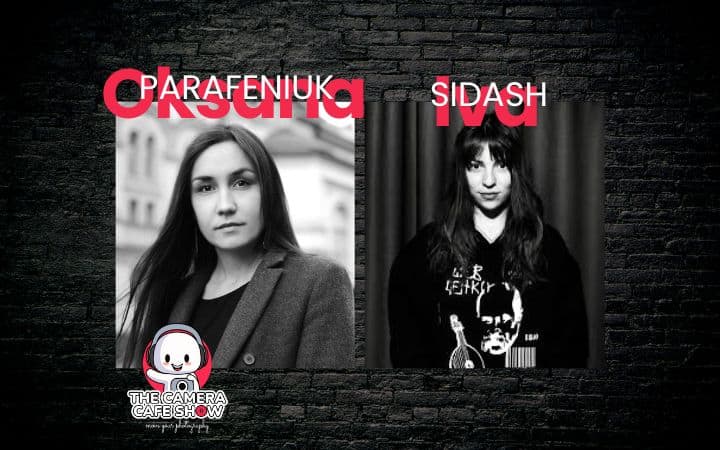
Tom: Welcome everyone to the show and today it will be a bit of a special one. It might be a bit longer, but stick with us because it'll be really worth it. Today we have not only one, but two photographers here on the show, both journalists from the Ukraine, both documenting the war, each their own way telling stories. And one of them, Eva Sash, actually was on the podcast some years ago and now she's back and we will continue our conversation. And joining her is Oksana Parafeniuk, also journalist working in the Ukraine. And I'm looking forward to hear a story. Eva and Oksana, welcome on the show.
Iva: Thank you so much, Tom.
Tom: So before we begin, Sana, you told me in an email we might have a special guest running in the background today. There we will have your little son, Luca, showing up on the camera.
Oksana: hopefully not. I close the door to the office, but it doesn't lock. He's with my husband, but we might hear him screaming if he decides he doesn't want to go to sleep or something like that.
Tom: No problem, haha.
Oksana: He might join. He's three. Turning four soon. Yeah.
Tom: Maybe he'll join in the end. That would be very nice. Eva I think your parents had a dog. How is your life now? You have yourself now a dog or a cat?
Iva: no, everything has changed a lot. So first thing is that I moved, to Kiv. now me and Oxana, we are in the same city.
Tom: Ok.
Iva: I was living in Liviv, as you remember, and since the start of full scale war, I've been traveling a lot through the Ukraine, mostly IV hierarchy iv. And it was very difficult for me to manage the travel every time. It was difficult for me to live for two cities, so I decided not to live for three cities. But, I think it's a good option for me because now I'm in the middle and I can go to my family to see my parents, my sisters, and I can go farther to the east and document war. So this is like a good starting point for me.
Tom: But no dogs, no cats.
Iva: Actually, I thought that we were talking maybe about cats because when we talked with you about cat, I had Tommy, my favorite, the only one pet. My parents have dogs for me it was difficult to navigate with him 'cause he was with me like for 18 years and when I was going to the Eastern Ukraine, I had to find someone to be with my cat and it was very difficult 'cause he was very sick when I was very happy to have him in my life, as and unfortunately he died 'cause he was old. But this is like a big, very sad tragedy for me 'cause he was with me all the time. So basically when that happened I realized that. Now I can travel much more. I can go to Kiev. I can live my life. Because back then it was really important for me to be with him. And yeah, unfortunately everything changed. I don't have any other pets now because I feel that my only cat was Tommy and I cannot allow myself to have another cat. Maybe that will change just like I'm very crazy about him. So far, yes, I'm living without any pets.
Tom: Oxana? Eva, she really likes to talk. Eh? You see?
Oksana: Yeah, but I don't like to talk. This is true fact. And you figured it out in the first five minutes.
Tom: Mm-hmm. Mm-hmm.
Oksana: Oh,
Tom: your girls are both now in Kiev as we are talking.
Oksana: yes. Yes.
Tom: Okay? And you catch up sometimes for the coffee.
Oksana: Not really. We see each other at photographic events. Mostly. Like some, yeah. Gatherings of photographers. Maybe, it's been a while since we saw each other on any like assignments or when we were working. But yeah, I spend most of my evenings with family, so I don't go out too much.
Tom: Yeah,
Oksana: yeah.
Tom: I will need to come to the Ukraine and then we have a meeting in Kiev. No problem. Eva, when I talk to you, let me think. It's back in 2022 or 2023. I remember then you were saying you were living day by day, not thinking too far ahead. What feels a normal day now for you?
Iva: I would say nothing has changed regarding this because especially when you talk about the of freelance photographer, you never know when you have other assignments. And sometimes they come and they go very fast. So it's better to find the time to make them. But of course it's difficult to arrange. I would say this is still difficult to arrange everything because the war is happening in this country and you have to navigate, but you cannot plan so much.
Tom: Hmm.
Iva: may maybe when we talk about some documentary work, like my personal project or something like this here I have a little bit more freedom to choose when I'm free to go and to do my work. But yes, when we talk about like the assignments, you never know when you have them. So I would say it's still very difficult to plan tomorrow of, or like weeks ahead. Yeah. I wish I would have this possibility because sometimes it's difficult and tiring to sit and wait or not to do your other work because you never know. yeah, that's the reality. And I just, I got used to this. I would say.
Tom: And Sana, your son is growing up inside this reality now he's aware of what is happening around him.
Oksana: he's aware of some things. We have, for example, when there is danger from the air like missiles or drones there is air raid alerts in different parts of the country. So we're lucky ones because it's like right outside of our window. By lucky like, when it goes on, it's incredibly loud. So of course he's very much aware when the aired alert goes on knows we always take him to the corridor, which will be the safest place in the apartment away from all the windows. So he knows when there's aired alert. We go to the corridor. Sometimes if there is a big attack, actually, like we are monitoring with my husband what's happening, if there is actually a big attack on Kiev, then we go down to the subway. We live very close to the subway station, so he also knows that, he, he's very interested in the idea of a drone. So out of all the things, he doesn't under, I talked to him about what war is, in simple ways, possible things, he's the most fascinated by the idea of a drone. So there is like a lot of advertisements all over Kiev, inviting people to join different military units or drone units. And every time he sees pictures of drones, he is absolutely so interested. And he builds from he has this like Legos and other, building blocks. He likes to build drones from this, which is, sad. But, my, my goal and just to give a little bit of background for the audience I was six months pregnant when the full scale invasion started and I had I, we with my husband the left to Poland, I gave birth in Poland and then we came back. Kyiv when Luca was, one and a half months old. I, of course was very stressed about the safety situation and I still am like some people say they adjusted to this reality, and I cannot say that I am, I take every, attack as seriously as I did, three and a half years ago. And what I was saying is that my goal him is to not for, he needs to know about the war, but my goal is for him to be not traumatized. So that's why often when there is an attack in the middle of the night, we also take him to the subway. He's sleeping most of the time, but I don't want him to hear explosions and, have this fear. So far we've managed to more or less protect him from this. But of course he's, he knows what the war is and actually what, my husband is American, so also has a family in the United States. And one time after trip for Christmas to the United States, we were walking to kindergarten with my son here in Kyiv. And he asked me, mom, why is there is no air raid alert in Mexico? We went also to Mexico. He said, why? There is no air alerts in Mexico in the United States. So like it is, he understands that there's difference. Or like he would ask why there is no planes flying and he loves plane. So every time we go somewhere abroad, loves airports and planes. And of course here it's not the situation. So yeah, it's I know it's like most children, but of course he never knew a different reality. And we moved back, we, with my husband, we were like, oh, hopefully by the time he's two or whatever the age is when kids start to understand things better. We hoped of course that this will be over, it's not over and far from over, most likely.
Tom: Well, let's keep hope for now. Sana, Eva, when we talked years ago, I think it was just a few months into the war in your country, and you talked to me how suddenly everything changed for you and you felt like you needed to document what was going on in, your country. For everybody listening, I will have this conversation in the show notes, so please check this out later. Just to have a little recap, how did photography start for you? Eva?
Iva: this is a very long story.
Tom: Make it short. Make it short.
Iva: it's difficult
Tom: short version.
Iva: Yeah. I would say that I started with the, like photography was my hobby because before I was working in IT company and I totally was. Working in different field, but then I found myself out that there is something more. And I started to discover this and basically it all I began photography and I moved very fast because I started to be obsessed with this. It was in 2019. After that, in 20 20, 20 21, I started working as a photo journalist. And when the full skill war started was working a little bit before except for the journalist, but I switched to freelance and everything was new to me. I would say that this was a huge learning process for me since then, and still is, I feel that this experience of four years already gave me this kind of knowledge which I got on practice the most. that's just was moving really fast to different kind of photography.
Tom: If you look back to this Eva. How you remember that version of yourself?
Iva: that's a very good question, Tom. I was thinking should I listen to the, to my audio that I was talking to you on the podcast and I decided that it's too much for me and I realized that yes, of course I changed a lot I feel we all have changed because when you have this very different experience, it just, it's difficult to explain, to be honest, but, as a photographer, it's easy for me to say how I changed as a photographer because I can compare of what I was doing back then, what I'm doing now with whom I work, what projects I'm mostly interested in. But when we talk about this kind of change as a person this is very difficult to explain because this war has huge. On each of us. I can't even imagine what Oxana is going through, having this small kid. Because for me, when I think about myself, I always think about like my family, about my sisters, about everyone else. Or when I talk about like my friends, mostly all of them are fighting and I lost a lot of friends. And it's difficult to understand it now because it just, you just have to keep going. And I think we don't have time and I don't have rights to reflect too much now because we have, we are still on this process. We are still doing our work and we are still yeah, documenting what we can. So that's why I would say that probably. I would understand better or this huge process maybe when the war is over and maybe I will have this time to think because now I'm just trying to keep going because it's just too painful to sit. To sit and to think of what has happened so far.
Tom: I think you explained it very well for a surprise question.
Iva: That, that was a good question though.
Tom: Oxana. I like to go back a bit with you because I don't know you still, before photography, before everything else, what kind of girl were you when you grew up, what you remember the most about those years?
Oksana: I actually got interested in photography early, I guess when I was 18 or 19. before then, I was a very good student in school. I responsible, never did anything bad. I was actually boring if I think about it, every time someone, a lot of like journalists and photojournalist, they like had this like rebellious young years of teenage years and I'm like, actually I was I'm really good girl. Yeah, I was a, yeah, I was a very good student. , But the one thing I was like, good at most subjects, but I had no idea what I wanna do with my life. So that was one thing that was missing from, and it took me many years to actually get to, this career photo journalists. It took a like a long professional and education path and I tried different things. So yeah, but also I think. I don't have a proof because I didn't think that I wanna be a photographer back then, but maybe when I was around. So when I was small my uncle, my mom's brother, he had this professional camera and it, photography was his hobby. And he sometimes would take family pictures of us. And I remember maybe when I was around 10 or so, we were at the, like countryside with my grandmother and she was still alive and he asked me to take a picture of them. So like my grandmother, my mom and him. And I remember holding this camera, and taking this photo and it had this tilted horizon. We still have this picture and I, it's still my issue, like the horizontally often. but somehow I think maybe there was just, something. I got in my head, and then later I, I decided I want to buy a camera and try it as a hobby. And, it was my hobby for many years. And actually my uncle continued to play some role in it because he had a lot of photo books. And so when I started getting interested in, not for the journalism in the beginning, but more like art photography, he would bring, and he lived in actually he would bring me these huge photo books on the train so I can look at them and then he would take them back. And so anyway, that's just a little piece of the story. But as far as my young years, yeah, I was pretty boring.
Tom: You were a good eater also.
Oksana: eater, I
Tom: Yes. Food.
Oksana: I like to eat now more than I like to eat when I was small. Yeah.
Tom: So at what point did photography become something that, more than a curiosity, because I think you were also a fixer first for photojournalist oxana.
Oksana: Yeah, So my photography interest started before I was ever a fixer. As I said, when I was around 19, and pretty soon, was something I was really passionate about, just like Eva said that you become a little obsessed, but I didn't have a lot of free time because I was studying it. So I have a master's degree in it. had a part-time job in the office of Fulbright. It's educational exchanges with the United States. But somehow I still managed to like, find time, to learn about photography. And at the beginning I was mostly taking pictures of friends portraits some still life I liked in the beginning, self portraits something a bit more. Yeah, artistic and staged. Then in 2013 and 14, during my Don Revolution in Kyiv, I ended up working as a fake service foreign journalist for the first time because I quit my job and I didn't know what to do. And this is how I discovered journalism. I just, I never really thought that I wanted to be a journalist, a photojournalist, and I didn't really have a good understanding that it's even a career or how it works, being a fixer and all, all the sea lands and the war started in Eastern Ukraine and I followed there. This is how I started discovering what journalism is about, what is storytelling. And for some years, even though for, I had a camera, but I was somehow very insecure. And to me it seemed really difficult bring it up and take pictures of, people. And I was just trying to understand how it works. But of course in the heart, deep inside of me, that's what I wanted to do. But I took time to just learn about this journalism overall. And then slowly in 2016, I finally started, working on my own project and slowly started getting my first assignments. So I knew that's what I want to do. It just took me, a long time and,
Tom: Mm-hmm.
Oksana: and for some years I continued. didn't have a lot of photo assignments, so I couldn't make a living out of photography. I was still continuing to, be a local producer with foreign media or translator. And then only since a full scale invasion, I managed to, give it up and just take just do photojournalism since then.
Tom: And you both did an amazing job because I have here my list somewhere, because you both had. Pictures published, and this is just a small list. Washington Post, New York Times Time, la the Spiegel, NBC News, wall Street Journal, Newsweek, members of the UK United Association of Professional Photographers and Women Photography Collective. Very well done. Both of you. How does it feel, you didn't really study photography , but it became your voice and it's now in so many media outlets.
Oksana: So we didn't study it in, a setting, like a university, when you get interested in something, I was studying it from everywhere I could, like from photo books, galleries, internet, other photographers. I tried to attend, some workshops every time I could find something that would happen, and I could go to, and then I also studied a lot from my husband who is also a photojournalist from like more like an inside job. And you keep studying all the time because in the job like this, you can't just stop being interested. I feel very, surprised still every day that I can call myself a photojournalist because at some point, I didn't believe it's possible for me. And I feel like it's a lot of responsibility, especially considering the belief, in a country at war. And all the stories we photograph right now are all about war, and it's really a huge moral, ethical all kinds of responsibilities. and also just, hopefully has at least some little impact. Yeah, it's it's there is not so many photojournalist Ukrainian photojournalist, and that's why, we feel like it's a tremendous privilege, but also a tremendous
Tom: Yeah. Mm-hmm. Eva, we already touched
Oksana: I.
Tom: before how you went from street photography to documentary work. I'd love to pick up a bit where we left it last time, because since then you had just an incredible, amazing journey in this past three or four years. You went to study at the ICP, you won the Eon Perry grant and so many things more so how have been those last years for.
Iva: yeah, I think that lot of things have happened thanks to my decision to go to International Center of Photography, to ICP and to, 'cause I, it, for me back then, it was in 2023, it was such a difficult decision. 'cause I wanted to stay in Ukraine. I wanted to keep documenting the war in my country, but I just felt I don't have this experience and I need something more to be more effective. maybe that's why I took a risk. And I decided to go to New York for one year. I'm very happy I did this because it really gave me a lot of knowledges. It gave me a lot of opportunities in terms of meeting new people, understanding this world of photojournalism better. I feel it was very life changing event for me because I became a little bit more confident in myself and still not enough I feel, but it gives. Sometimes I just it's really great to find people life who supports your work, who believes in your work. And you have these people, I feel I'm very happy to meet all those people because sometimes it's really difficult to navigate. And I feel that photography is still very lonely journey. when you meet other people, when you see how they look at your work, how they share what they do, it gives you kind of inspiration to keep going. And for me this year at ICP actually was something like this. And of course, after winning Ian Perry, which is really very important phase of my life because. I met wonderful people. These people became my family, and thanks to them, I was able to do photography more. I was able to focus on my own documentary projects. I believe that I'm very happy to get assignments, and I always take them whenever I have it because first of all, it's good to be able to talk about Ukraine for big medias, but also for me, it's very important to keep going with my own work because the way I work, I, it's important for me to take time to to have this kind of connection with people like photograph, to get into their life. And usually assignments are really short and you cannot. Get into this as deep as you want, but when you talk about like your personal project, you still can understand it from different perspective. And thanks to the grants, to these grants I had it gives, it gave me the possibility to work more on my personal project.
Tom: Well, in a minute I'm going to ask you both a bit of backstory to. A project, I picked a project from both of you, but just a quick question. You feel like photography is something that reflects who you are or that shaped what you have become?
Iva: I think for me it's both. Because one thing leads to another, and one thing is connected to another. Because for me I at least I strive to do this, to be in photography, not just like the observer or something. Of course, when we talk about photo journalism and all this stuff, for sure. But when we talk about like photography as the world, for me, this is something deeper. And for me, in this case, I would definitely think that this kind of reflection is important in photography. But when we talk about photojournalism, then I would say that it, yes, of course shaped me in the way I see this world now and in the way I perceive myself and how I see things, how I understand it. Because photography is wonderful tool. That gives you the possibility to understand other experiences, which you never had. And that's why if you talk about the projects we make or like the pictures we make you can hear other stories. You can live their lives through photography. And for me, this is very precious gift because you start to understand it better. You start to understand people better, their choices, their reality.
Oksana: Yeah,
Tom: for you, Oksana.
Oksana: Yeah, Eva said it beautifully. It's a hundred percent both because of course, the desire to be a photojournalist comes from, interest in humanity and other people's lives, and the fact that you can, open this little window and they, if they let you in and just. Appreciate this multitude of people like human experience. And it became even more, living in Ukraine and this, just living in Ukraine is already a really like rich experience in both the Kais and lows, both, profound tragedy, but also in a middle of this you can find profound happiness as well. Like all the emotions become really sharp. And
Iva: and so you.
Oksana: for me, yeah, I just, I wanna learn about what people go through and share it with the world. I think even in a more profound way, each person, each, family, all these places to go to all of that leaves a huge mark, in your mind, in your soul, in your memory. Like all of that inevitably shapes who you are. And, every conversation you have you think about something and learn and then sometimes you make mistakes about both how you photograph or how you do things, approach things. And so every next, next time you go out with a camera, you do things a little bit different and hopefully better. So yeah, def definitely both.
Tom: I think I knew the answer, but very good girls, . I picked a project for each of you eva, I would like to step a bit into the project. You make the house of one slipper. What began this project for you?
Iva: so this project is very important for me personally because this is the story I did when I was in New York, when I was at ICP. And I'm always joking that as I told you, it was very difficult decision for me to to New York to leave my country. But when I went there. I also, it was difficult process for me to understand where I am, what should I do? Because my first questions were like, why I'm here? I need to be in Ukraine. Of course it's wonderful to study and to get other more knowledges, but there is the war happening there and I need to be there. I need to document what I see. Like I'm too far from everything. I'm too far from my dear people from everything. So that's why it took me time to understand that Eva, but that's exactly why you are here, because you want to do it better, in better way, a more professional way. So I started thinking about this and then I found this, a story about like this, a rehabilitation center where Ukrainian soldiers were coming for the rehabilitation and to get the prosthesis. And I am saying, I'm joking that. So I found my Ukraine in New York, in state and Ireland because that's where their hub was. And I am very grateful for this people and for this opportunity to make this project because I think it made my life there much more easier. 'cause I felt like I'm here, I'm in Ukraine, even though I'm not. But I'm talking about the same topic, which is important for me to tell. I'm talking about Ukraine. I'm talking about this wonderful people and. the soldiers like very often saying because we got very connected with them, with the soldiers who came there. And as I told you, for me, it's important when I work on documentary project to get to know these people, to tell about myself, to become like more friends than just I'm photographer and you are the model. we spent a lot of time just talking or walking or drinking in the bar or and then when everything started, when I realized that they can trust me also, this was my first time working with such a difficult topic of rehabilitation, of amputation. And for me, I was very worried like how to do it. In order to be as much, to have to do it right, ethically have not to cross any borders, because I understood that this was my first time working with a subject. But slowly and slowly I just realized that it works because we are connected. And I remember the soldiers were saying like, Eva, we are so happy you are here. We feel that with the you help us heal. I really remember this saying, and for me it was like basically they were helping me heal there, and thanks to them, I managed to to be there and to get all this experience, which I came for. For me, this project began also, I remember I was struggling a lot because I didn't want to do just a story, another story about rehabilitation. There are so many stories about this, which is wonderful, but I didn't want to repeat others, and it took me time to understand like how I want to do it. I switched to film. I never photographed on film before, on medium format. So basically I allow myself to take time to get to know these people, to take time to learn some new photography for myself. That's why I would say that this project is is something very special for me and very important for me because it holds all the memories I had back then and it holds what is important for me.
Tom: How were the conversations with the soldiers? Because you talked about some very specific moments when they step on the mine when they are very close to death. They were very open, or it was hard for them to talk about this.
Iva: I was trying not to push them. I wanted to take this time for them to be comfortable with me. I was asking sometimes very simple questions because I didn't want them to rera, I didn't want to retraumatize them with this memory. I didn't want to make it more painful than it is. So I was starting with very easy questions and usually like they were just keep going and I was not interrupting them. And I think in this situations, it just important to leave this space. Which they can then fill in if they want to. And maybe if I ask these direct questions on my own, I think I will just receive yes or no answers. But when I like gave this space for them, they started to share in very important moments like how he was drinking this coffee and making coffee before the shell happened, or something very personal, and I feel that this was a good lesson for me not to not to chase anything but just to let it go as it is on its own.
Tom: And I read that some of them, they are determined to go back to the front when they get back to Ukraine.
Iva: Yeah. Some of them are fighting now. still keep in touch with them. I still photograph them when it's possible. And yeah, for me, this is such an incredible example of this Ukrainian spirit that whichever happens, you keep going. And for me, like this, people became like really very close because that's when I needed them. And now like we are still in touch, we are still, meeting each other when they come to Kyiv. even going to them, to their units, photographing them because I think it's very difficult to realize when the project is over and maybe that's even better not to do. And just if there is another opportunity to. working on the project, which is important for you. You just go and you do this. And that's exactly what was what I was doing. I realized that I really want to see these people, I really want to be with them. And so of course my camera is always with me. So this is just something that keeps going even now, maybe in different way. I don't go specifically to like their houses or, but it's great to keep in touch and to be friends because we kind overcame a lot together.
Tom: Yeah. You're like supporting each other. It's very nice.
Iva: Yeah.