

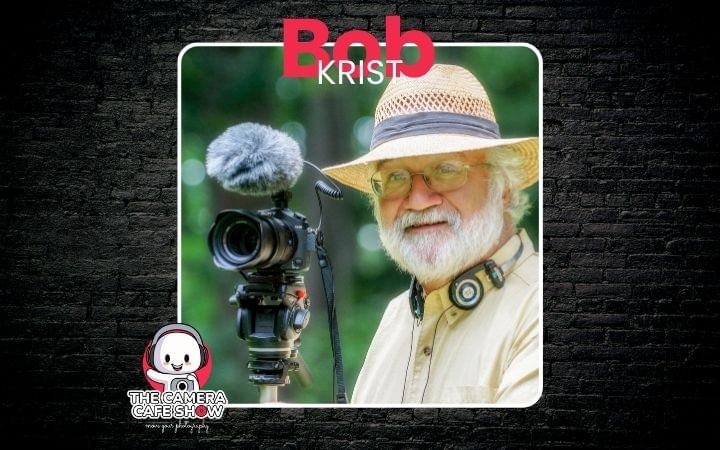
Greetings and welcome back to The Camera Café Show — the podcast where we brew up photography with a purpose, and sometimes… shaken by filters, stirred by real stories. I’m your host, Tom Jacob, with Richard Clark and Tetiana Malovana behind the scenes, keeping the focus sharp.
If you caught Part 1 with legendary National Geographic photographer Bob Krist, you already know this conversation is about something bigger than just travel snaps — it’s about what real travel photography means in an age of social media likes.
In this second half, we go a bit deeper. Bob takes us again behind the curtain of nearly four decades with National Geographic, sharing stories that never made it into print, we talk about life on the road for magazines, and the possible toll that constant travel as a photographer can take on family life. Bob also reflects on experiencing a deep personal loss, and how — if ever — one finds a way back to creative work after such moments. We also talk about his reinvention — moving from still photography to video, the why behind it, and exploring new ways to tell stories. We also talk about his latest book, which is beautiful, while sharing the travel stories behind it and yes — we laugh. A lot.
It’s a conversation that balances humor and heart, reminding us that photography isn’t just about what we see — but what we live through.
Grab a cup, settle in, and join me for Part 2 of my conversation with Bob Krist.
Tom: Bob, when you were out before, shooting travel photography, what's for you a visual cue that tells you there is a story here that is worth staying for?
Bob: That's a good question. Sometimes it's you know, I like to say that you kind of use all your senses when you're, when you're looking for a good travel photograph and besides your eyes. And so, like I remember I was doing a story in New Orleans, for travel holiday and, it was hot and it was the middle of the day. The light wasn't right, but I was still out because you know, you if you're, if you're not in it, you can't win it. You know, you, looking, you won't find. And I heard some strands of saxophone music, and I, and I followed the music and I found this saxophonist warming up. He was waiting for his ride. He was going to a gig and he was in front of this shotgun house, and he was dressed in orange. And the wall was pink, and it was like wild. And I photographed him. And then he said, well, you know I want, I'm doing some, a new cd. I want a new CD cover. I said, well, let's meet tomorrow and I'll shoot some more pictures, closeups. And then, and so then I went and shot some. And then he said, let me take you down to Kid Sheik's house. Well, kid Sheik is like a god in jazz. And then he got me into the, all these jazz musician things. So. So following that sound, that initial sound of the music was what ended up in a great set of pictures that I never would've gotten ordinarily. So it's hard to know, but you take your cue from a number of things. Another time I was working on a book in Tuscany and I was work walking in this small town, and I smelled this amazing bread. And I was like, I followed the scent and there were all these old ladies making this boiled bread for this festival that was gonna happen. So I hung out and I got them making pasta and stuff like that, and I was following, literally following my nose. So but usually it's the light. the light that draws you into these things. And you know, you know, you've, you've probably picked the place because you think it has good potential for a story or for pictures. So once you make that initial choice. When you're there, you know, you're following, you're following the visual cues. It's usually the light, but it can be the music. You know, you're the camera a, is an excuse to be curious. It's like a passport to be curious, you know ordinarily I'm kind of shy. I don't like to bother people. But with the camera in front of me, it's like a license for me to say, Hey, what's around that corner? Where's that aroma coming from? Where's that music coming from? And that leads you into these great picture situations. So, but it's usually the light, you know. Had a, a photography column in Travel and Leisure for many years, and I used to interview other photographers who had stories in the middle of the book that, and they hired this very well known portrait photographer called Michael O'Neill at in the eighties and nineties, or maybe it was the nineties and the early aughts, he owned the New York Times. Magazine cover. He every celebrity, every, he was known as the portraitist for the New York Times Magazine. So they gave him a travel assignment. So I schedule an interview with him and I have all these deep questions like, what do you know, what is your philosophy? Do you research? I do you do any historical research? And I'm thinking all this kind of National Geographic stuff. And he, and he looks at me, I'm, I ask him this whole deep question. He says, nah. He said, look for the good light and I shoot what's in it. And I thought, oh my God, I'm in the presence of a zen master. the good light and I shoot what's in it. And there's a lot of truth to be that, you know, forget all and all that other stuff, and is this culturally significant? It's like, is it beautiful? Does it have good light? I'll shoot it.
Tom: There you go.
Bob: there is a certain degree of that and hoping to be lucky, right.
Tom: But then of course, Bob, if you follow your nose, it's always better because you get food and drinks afterwards.
Bob: yes. It's very important. It's very important. And, you know one, look at me. They know I'm an appreciator of food and drinks, so I've been welcome to many meals that way. I
Tom: Bob, just a moment back to National Geographic. I was wondering: would they publish a not good technical picture, but it does have a great feel of the place.
Bob: Oh yeah. You know they, the moment trumps all for a geographic picture, if it's a little I remember there was a great shot from a, about Central America that was shot by a staffer named Robert Madden, who was just up here through Maine. He's 86 and he's still, he's still with us, still. And he was he was, he took a plane into this outback area in the Honduras or something, he turned around to see another plane come in and hit a supply truck. And he had the presence of mind to lift his camera and he had this impact. The truck drivers jump, it's, it's shaky and everything, but the moment was unbelievable and they published it. So, you know, I like to say, and when I wrote a lot of my how to travel books, I like to say that the three elements of a strong photograph are color, composition and moment. Does it have good or slash light? Does it have a strong composition and does it have a sense of moment? You know, still photographers. We're slicing off 120 fifth of a second in the great flow of time, and we're holding that up and saying, Hey, look at this. Well, if you do that, it has to be a moment that's worthy. and a beautiful light, beautiful composition is great. But the, for a picture to really be what I call a portfolio picture, it has to have all three. It has to have beautiful composition, beautiful light, but the sense of moment is the hardest to get. I think because it's the hardest, it's the most precious. Now there's, there will be cadres of photographers who will disagree with me, who would never let a less than technically perfect picture pass from their, from their cameras to their websites. But I think when you're talking about people in journalism and street photography. Sometimes the moment Trumps technical shortcomings. Now, mind you, the geographic wouldn't publish a whole story of technically poor pictures. But if the moment was so strong that's the last of their worries. The other two things, it's, it's the storytelling, power of whatever the picture is, the storytelling power of the moment. Bob, I want to come a moment to, I think we just touched on it before, the travel photography. You are many days away from home and it kind of can bring a kind of mental or a physical toll. What's, what was for you, the, the hardest part of it, Bob, as being a parent and, and a husband. Well you know, the hardest part is. when your kids start to get old enough to have their own lives, they're, they are on a very regular schedule. Their soccer games, their music and stuff like that, and you're, you're away their birthdays and things like that. So the hardest part was kind of explaining to the kids, you know, daddy loves you, but he may not be there for your game and he may not be there for your birthday. But we had, we kind of had a rule in our house if, if we could get, have a party within like two weeks of either side of a birthday that counted we, so in our household we kind of trained our kids to not fixate so much on the day, as long as we celebrated at some time I was fortunate in that my wife Peggy, is very independent. She was very strong with the boys. She was very supportive. She ran my career. She was my agent. She did all the stock sales, she booked all the assignments. So we had, we had a joint venture, but she was also, I never, and this was very rare, I never got one bit of resentment from her about, oh, you have to go again and you're leaving me with the kids. She knew that this is what we needed to do to succeed. And then as the kids got older, you know, when they were old enough to be semi responsible, I would take each boy on one big trip. as my assistant starting from the age of about 13 once a year. So by the time those kids applied to college, they had passports this thick, and they were in Myanmar and one who was in southern India and stuff before they got to college. So they got to see a lot of the world. And so that was the perk, but the downside was that we missed birthday parties, we missed anniversaries, we missed stuff like that, but we tried to make up for it in other ways. but it does, it does take its toll. But that's why national Geographic Traveler was what's much more to my speed because being away for three weeks. You know, there's a lot of businessmen who are away three weeks a month or whatever, but being away three and a half months that's that start, then you start to really lose touch, you know? So, but it was still hard. It was still hard, but I was blessed that the boys were pretty independent and Peggy was very independent. And then they sure did enjoy going to Peru and Bali and all these other places as they got a little older. So it had, it comes with its pluses and minuses.
Tom: Bob, if it's okay, I want to ask you something about emotional toll, because I know a boy of you passed away years ago.
Bob: yes.
Tom: Which I cannot imagine how it must feel. How you came back to photography after that, Bob.
Bob: Well. Yeah. You know, when you lose we lost a boy in a car accident, our youngest son. And there's no really coming back after that. It your life in two, there's the time before and the time after, and you're never the same. going back to photography for me, after three or six months, I was still on, I was on autopilot for a couple of years. my wife and I, our main concern was trying to help our sons, our other two sons, deal with it. And so. And the, the boy we lost was our, was our bleeding heart, do-gooder. And he was involved in all these charitable causes. So in a way to try to channel some of that grief, my wife and I formed a foundation in his memory that carried on some of the work that he did. Like he was a great musician and he used to play in this traveling jazz band and these competitions, and he would go up against these schools that, in the inner city that didn't have the same resources that he had in the suburb. So he would like collect instruments from his friends who weren't playing them, and he'd drive them over to Camden and give them to these kids in this jazz band because they were so talented, but they didn't have the same opportunities that these suburban kids had. So we continued that. We gave scholarships. We continued to do that kind work. we kept the foundation open for almost 20 years. We million dollars. We sent about 140 kids to college. We gave scholarships and that was one way of dealing with the grief. but honest to God, Tom, you don't come back from something like that. And, you know, I can, all of us my other two and my wife, we can divide our life before that time and after that time. But you have to go on and you have to make the most of it. And after a while, you know, going back on the road was kind of a welcome relief because it took my mind off of those things slightly. I, how my wife dealt with it was working. I. Through on the foundation thing. She was the heart and soul foundation. But it scars you, I, I don't want to say that it doesn't you know, you, outlive your kids. Basically, it's, it's, it interrupts the order of things, you know? And when that happens, it's, you know, we all lose our parents and our grandparents, and that's tragic enough. But that's the
Tom: It's like the natural step. Mm-hmm. He was in photography too?
Bob: He was, but he was a musician at heart. Oh, he was an awesome musician. He could play the guitar, the upright bass. He was he was he was on another level with his musicianship, but we took him up to Iceland once my wife and I, 'cause the other two boys had been in Iceland when they were little. we tried to get him up to Iceland and I gave him a camera and. Damn. He had a pretty good eye too. But, his first love. Yeah.
Tom: Well, Bob, but then I can ask you about resilience, because you reinvented then afterwards yourself, because later in life you dived headfirst after in video production.
What gave video that still photography didn't give you anymore?
Bob: Very good question. It gave me was the ability to tell my story of the travels I was getting pretty, the more, the more software that was involved with producing a photograph, the more you could mess with it, the less interested I had become in it, because it would, it just seemed. I don't know. So technical and so divorced from, you know, with the slide shooting slide film was a very existential experience. shot the picture and if you did it right, you got a picture and if you didn't get it right, it went into the trash can. But now, you know, you can come and you can do frequency something and mask this and mask that. And was, then there started to be these things, I guess it was early AI where you could replace the sky and you could do all this stuff. And I was like, this is, to me, I understand that it's art, but I was a journalist. I couldn't use art. I had to show the way it was. So I became less and less interested in tared up software pictures. At the same time, they put video capabilities and still cameras. And you know, being an English major, being an ex actor, reading plays, doing all this stuff, you know, I read Joseph Campbell's the Hero with a thousand Faces in college, three or four times. And, you know, the Hero's Journey. This the story. I became very interested in the filmmaking thing, but I had used up just about all of my chops about learning new technology with going from film to digital. Now I'm gonna try to learn to edit video, but I kept throwing myself at it because, because wanted to tell my stories. And at the magazines were dying. Geographic in the beginning would run some of my short travel documentaries on their website, but then I started getting commercial work from tourist boards. that really solidified it was I was living in bucks County, Pennsylvania, very beautiful bucolic area. It's between New York and Philly. and the tourist board used to hire me to shoot. Pretty scenics and stuff. And then they said I had done a couple of in order to teach myself video, I had done a couple of personality profiles about interesting people, a lady who did this elaborate Halloween decorations for her house. And I did an interview and shot that and they said, would you do some stories about Bucks County people for us? And we want this guy, we want, you know we'd like to talk about antiquing in Bucks County. So I found a guy who had this specialty of antique toys, and I about it, and we started making these storytelling films. And I love the storytelling, the story of the thing and, and how deep you could go in video and how, you know, you did have to control a lot more things, but you could control it and you could tell a story and without the magazines. And the written word, you know, I was always illustrating stories. I never went for like the single beautiful picture. I was shooting stories. Well, if the magazines are folding and there's no more stories, you find that you are a visual storyteller. So the video became my new passion and I really enjoyed it. And boy did we make some good money there. In the beginning when I was still doing some of that commercial work, we did a whole series for Pennsylvania tourism, including a couple of national TV commercials and stuff. And that got me hooked. And so that's what I'm doing. Now I just, I just signed a nice contract with Maine Public Television. They saw a couple of my I love to do character sketches of interesting people, ship builders, old and stuff. And I do these little 5, 7, 9 minute films about these guys, and they're usually pretty interesting old characters and stuff. And this producer from Maine Public Television saw one in a, in a film festival, and she said, what else do you have of Maine? Because we were looking for a local program, so I just signed a contract with them and they're gonna do a block of my about five of my stories about interesting Mainers. And then I there's a new streaming station that opened up in the state, and I pitched them on a road trip, a hundredth anniversary road trip for Route One and, and stuff. And I'm, I'm really enjoying this and I love. I love the storytelling aspect and the control. Now I'm the guy who determines what the story is, how is gonna go, not the writer. I do admit a certain bit of egotism in the writers I worked with. I would say, you? That is the worst interview question I've ever heard. Why are you asking that question? Well, now I'm the interviewer, you know? So I'm doing, I'm doing that road trip and then I try to help out, you know, I'm retired, fortunately. I'm I don't need to make money. I. although talk to me in another six months after what's going on with our economy, and I'll let you know about that. but so I do a lot of work with local like the land trust here in Booth Bay. They're trying to preserve land and raise money to do that. So I do I do some video work for them. We've got a beautiful art deco theater in the next town that's trying to raise some money. So I'm doing a little video pitch with them to, so I do stuff pro bono, but I do these travel stories and that's what video gives to me is that ability to, to craft the whole story because I'm not interested in gee whiz photos anymore because. You know, you can't tr unfortunately, you can't trust what you see of a lot, you know, and I've still got a pretty good eye for seeing ai. But from what I can tell from Facebook comments on pictures that are so, obviously ai, to me, 95% of at these pictures have no idea whether it's real or, or ai. And that, that lack of credibility is a shame. We've lost, we've, we've, the genie of credibility in photography is out of the bottle, and we're never putting them in again, I'm afraid. So, and I mean, it's gonna happen with video too, with deep fake video, least when you're crafting a video story, you, it's a story. And, and it's not just one image. So I still love to shoot stills. I mean, I love to take my modified, my infrared modified a 6,000 out and shoot some black and white infrared of, especially like in Europe of castles and old things like that and rock formations and stuff. But video storytelling, it's still travel, storytelling. And the storytelling is what I really, really enjoy.
Tom: So that picture of that Big Red Lobster in main is not AI. It's really there.
Bob: It's the largets blow up lobster in the world, and it overlooks route one. So it's one of those ticky tacky things. You know, it's the hundredth anniversary of Route One. So when road, when road travel started in the United States in the early 19 hundreds, the roadside attractions were the weirdest things that people could imagine. And so we're looking for, and there's a, there's a great aspect of that here in Maine. There's giant statues of fishermen catching sardines. And there's, there's, there's all kinds of weird roadside attractions that are still here a hundred years later. And that's we're concentrating on. The, the kind of stories that are of people and places that are still a little, they're not. cut from their own mold. They're not polished and homogenized, by modern culture. They're still they're still a little rough around the edges and authentic, I think as we go on. think authenticity is the only thing we have to sell to give We have to be authentic because, you know, it's too easy to be slick now. And I think even the younger people who have grown up on this stuff, I think that's one of the reasons why there's such a great interest in film photography from a younger generation that never knew it earlier, but they know it now because it feels real. It's, it's not as as digital. And so there's something that feels authentic about it. I, I just laugh at these little. Fuji cameras that looked like they were, you know, made back in the seventies turning out to be like fashion statements. You can't, they can't keep 'em in stock, you know? And I'm like, because the retro feel. So I think, I think in their own way, even younger people are yearning for something authentic. And that's what I try to do in my travel stories. I'm interested in authentic people who have not been kind of polished by modern marketing society who are still around the edges, who are who are genuine. And those are the people that I, that I want to kind of profile and tell their stories.
Tom: Right. The only thing left for the video segment still is, Bob, what is your secret when you tell your wife, I'm going to ditch all this still photography now, and I'm going to buy all new video equipment.
Bob: Well, you know, my wife has a very enlightened approach to it. She says, you know, you don't play golf. don't sail. You don't mess around with other women, so I guess you have to have one expensive hobby. And we used to be able to write it off, you know, I was in business I could write it off, but now I'm retired, I can't write it off. So she gives me a very strict budget of what I'm, my
Tom: Okay.
Bob: boating budget goes right into my gear. But I'm actually trying to get rid of a lot of gear. I find myself, and I don't know if you've experienced this, Tom sometimes you have too much stuff. You have too much to choose from. when, I mean, when I was on the newspaper, I literally would shoot probably. For months with a 24 on one camera and a one a 100. It was a 100. 'cause I shot Minolta when I was first and they didn't make a 1 0 5. They made a 102.5 and I had a 24 F two and I used one for the scene setters and one for the other things. And it was very simple choice. It was the 24 or the 1 0 5, occasionally, maybe a 50. Now I've got this array of like, hmm, do I want the 24 1 4 or do I want the 24 1 8? And I was like, no, this is too many choices. Too many choices. So I've been giving away a lot of stuff to, there's media workshop, and every summer when we come back to Maine, I go through my office, I say, okay, I put together a carload of stuff, grip equipment that I'll never use. And I, and I drive up to Maine and I donate it to their department or something like that, because I really, you know you reach a point in your life where it's, it's kind of ironic. at a point where I could afford to buy just about any piece of gear I wanted, but I it anymore. My knees are shot, my back hurts, you know, so I'm looking for the smallest, lightest stuff possible, you know, and to that end, you know another thing I get a kick out of is you go on YouTube and there's all these, all these photography teachers and influencers saying. You know if you're a beginner, you begin with the A PSC, the crop sensor, but then you know, as you get more pro, you're gonna, you're gonna need the full frame. And I'm thinking back to when digital was first introduced down at the geographic and how many magnificent stories were shot on the crop sensor. D 70 Nikon D 70, and saying, really you're, you're you know, so they, there's, there's this full frame worship has gotten crazy. And this whole thing about equipment. Most any equipment you buy these days is good enough. It's not anymore. And, know, yeah.
I keep thinking, I mean, I'm looking right now, I'm looking at a 16 to 300 uni zoom lens that Sigma just came out with. 'cause I said, oh, if I had that, then I could get rid of my Rx ten four and everything. So one of the hardest arguments to make is your significant other or your bookkeeper is I wanna pare down my equipment by buying something new. It's an oxymoron. Let me downsize by buying something new and I'll sell the other stuff. Don't worry. You know,
Tom: Haha. And probably it's also always better and bigger.
Bob: yes. Yeah. And more expensive. Yeah. yeah, I waited on that 16 to 300. It's already gone up like a hundred bucks, so I should have, I should have acted when struck while the iron was hot. But anyway, I.
Tom: Now you see you're bringing all my problems back, because your book is never going to arrive to my home like this with all the tariffs going on.
Bob: I'm gonna gonna deliver it. I'm gonna deliver it in person next year when we're in Spain.
Tom: Very well. Time goes very fast because I wanted to talk about books and I even had it, your book: the spirit of place,
Bob: oh yeah,
Tom: but that's your old, from 2000 or something like this. I had it and I cannot find it back. But let's talk about your book Old Souls and Timeless Places. It's like a very personal book. You feel like it's a creative closure book or a kind of compilation of love letters to the kind of travel storytelling you like to do.
Bob: Yes. Yeah. This is the book you're referring to all and it's
Tom: Yes. Yes.
Bob: and white. And,
Tom: Yes.
Bob: one of the one of the things that I always had was like, I always shot a loud black and white on the side when I was shooting other assignments. And this is all part of that whether an editor wants something or not. I tried to pitch this book to a lot of people and nobody was really interested. And it's just a collection of portraits of people who really touched me and who I think I touched during the course of my assignments and places that seem to, it's like the anti Instagram book is what I call it. It's a, it's the people in places that are, that are have enough gravitas and substance to withstand change. And so after I retired I was involved in, a copyright infringement lawsuit that I had a very good lawyer and we were wronged on many occasions by some publishers. And I got a pretty good settlement out of it. And I said, I'm gonna take part of this settlement and I'm gonna print my own book. And I contracted with a, with a printer publisher down in Pennsylvania who does a lot of the great art books for George Teis and all. And
Tom: Okay.
Bob: in and white. And I hired a designer and I hired an editor and I wrote my, my intro and everything and I acted as my own publisher. It's not, it's self-publishing in a way, but we published, we printed about a thousand. Of them. And I only have a few left. I'm, I'm contemplating going back to press, but that's a very expensive proposition, especially now again with tariffs and whatnot. So I did it and I submitted it to a, a really tough travel journalism award called the Lowell Thomas awards. And last year, I think George Steinitz from National Geographic won Book of the year. But the year I submitted this, it won book of the year over many color books. And I, and it was very close to my heart because it, it was literally a labor of love and the irony is that it was basically paid for, by the fines that unscrupulous publishers me. So it's especially delicious that way, you know?
Tom: Bob, sometimes when you find an interesting person, and you kind of lose the track that you are a photographer, and you are talking with them and you forget maybe to even take a picture. You had a moment like this somewhere?
Bob: There have been a couple of times where I, yeah, you walk away from a picture not too many times, but where I. You know, there was a basic as much of a charm, barrage as you unleashed on somebody or whatever. They still really did not wanna be photographed. And you have to respect that, but they're still worth talking to. And, you know, and every time they'd say something interesting or they'd see an interesting expression, a little piece of you dies inside that you can't document it, but you have to respect their wishes, you know, so it's happened a couple of times. But my charm barrage is pretty good when I'm, on it. So it hasn't happened that often.
Tom: Are you ever considering slowing down or what would retirement mean for you, Bob?
Bob: Well, you know retirement has meant for me so far just working on my own projects without having to sell 'em first. You know, what's gonna happen? I, you know, the body wears out and I'm, I'm 73 and I'm running into bad knees, bad back, and I feel it at the end of the day working. So there will come a time where even with the smallest, lightest gear, it's gonna be too much of a problem. But that, when that day comes, I'll deal with it. But in the meantime, I'm trying to get as much of my stories told while I'm still able to do it. But there will come a time where I. It'd be time to break out the, all the stack of books I've been meaning to read in the last five or six years. You know, I do listen to a lot of books when I'm driving back and forth between Maine and our place in Maryland, where we go when it gets real cold up here. But yeah, some reading and just catching up with that and just seeing old friends. We're doing a lot of that already. My wife is very, very good carving out time to see old friends. whenever we're traveling, we're always making wide detours to see people we haven't seen in years because, you know, that's the kind of thing before you know it, people are gone, you know, Including us. So taking the time to try to make, to, you know, reach out and see old friends again is very important. And so there'll be time for that and everything, but so far I, you know, I'm still, I still got some gas in the tank, so I'm gonna, I'm gonna keep going.
Tom: So you split your time between Maine and Mexico, I suppose by now, Bob, you are the best ceviche chef there?
Bob: No, but I did learn how to make a pretty good margarita. We actually, we actually sold our place in Mexico, and we bought a little place down in Annapolis to be closer to our oldest boy as we got older.
Tom: Okay.
Bob: but I, we try to spend a lot of time on the road in the winter, so we don't spend that much time in Annapolis. We, Maine is, Maine is our legal state of residence, and it's the place that. In this country that resounds with me the most. I first came up here in the early eighties to teach at the main photo workshop and had such great experiences there that when I had the freedom to not be in the New York metropolitan area this is the first place I wanted to come and live. Of of winters up here. You know, the older you get, the more cold averse you get generally. So the winter, a couple of winters up here convinced me that I was not the rugged mannar that I thought I was. And that's when we had a place, Mexico too. So we have two very small places, you know, and we kind of commute back and forth, but we sold San Miguel and now we have this place in Maryland, which is a little warmer than Maine, but it's not as nice as Andalucia.
Tom: How's your Spanish by the way, Bob?
Bob: You know if I have one regret, I don't have many regrets, but if I have one regret, it's that I am just monolingual and I never, I studied French through high school and grammar school, and I can barely speak three sentences. It just didn't sink in. And, being monolingual is a big regret on my point, on my part. And I've tried, I've tried, but man, I'm thick as a brick. And to me, like you who can speak two and three languages, you're like, shamans. It's like magic to me. I, you know, it just never s sunk in. My brother speaks three languages. My, my father, his people were from Austria. didn't speak English until he was seven. He just was, came off the in the house when we were younger. But in those days, in the states. It was like that was the old world and nobody ever thought raising kids in the fifties, well, we should teach these kids our native language.
It was, no, we're in the new world now, and that's the old world and we're done with it. So they didn't think to teach us the language. when you're in a big place like the United States, you drive thousands of miles in every direction and English is being spoken. So it's, it's there's a, there's a little bit of an excuse why so many Americans are monolingual, but had they thought differently, like the thing that we wanted our kids, that was, that was tantamount. I wanted them to be bilingual. So we used to send them to Spanish language immersion camps every summer when they were old enough and they're all, they were all my oldest boys, very fluent. The middle boy is pretty good, and the youngest guy, he was like me. He was struggling, but he, he got by.
Tom: And it can do wonders for travel photography, Bob. It'll make things amazing.
Bob: why, and that's why, you know I have always tried to find a good fixer, a guide fixer who's a, can translate and who has a sense of what a journalist wants. And because you're very dependent on, when you're monolingual on the fixer kind of telling you what's going on and helping you arrange things, otherwise you're, you're boxed off like this. And, a, disadvantage in my line of work. And had I had a second or third language. it would've been so much better. But, know, that ship has sailed for me, unfortunately. But my kids, my kids are bilingual, so that's, something.
Tom: Yeah. It moves on.
Bob: Yeah.
Tom: Bob, to end this, I have a question. I mean, it's not about photography, but I see you sitting there, and when this comes out on YouTube, the people can see you with all your lush white hair, your big white beard, and I want to ask you, Bob, how much extra revenue you make in December dressing up as Santa Claus?
Bob: You know, you laugh. But I was, I was down getting my hair cut. There's this young lady who runs a hair salon just down the street, and she's a inveterate traveler. So whenever we go whenever I go, we're always swapping tails. She's been all over the world teaching English in Japan and South America. And the last winter, just before I left, I was getting pretty shaggy and I went down there and she said, you know, down at the Portland Mall, they're paying 18, $19 an hour for the Santa Clauses. She said, you sure you want me to cut your hair because you could go down there right now? And I'm like, know, and once when I was an actor in my twenties and I was with the Berkeley stage company and we were so broke, so broke it was Christmas time and in the states there used to be, it was called Western Temporary. All the, all the department stores, Santa Clauses are hired by a, an employment agency. The stores don't hire 'em. This hires them and sends them out to stores. And I remember walking past the window of the office of Western Temporary with this big thing of Santa Claus saying, can you fill his shoes? And I was, you know, I was 22 broke. And I said, yeah, I'm, I'm kind of, you know, I'm just rehearsing in the days. My evenings are free now. And oh, I go in. So I actually did go in and I spent one Christmas season playing Santa Claus in a, in a JCPenney in a ghetto in, in Oakland, California which was life changing.
Tom: Yes.
Bob: So, but that's the first and last time I've ever played it, except for my nieces and nephews at Christmas time or something like that. But I had to laugh when Nikki, the, the lady that does right here says, yeah, that they're paying like 18, $19 an hour for this down at the Portland Mall and I was like, no, you'd have to pay me a lot more than that. I've been there, done that, you know,
Tom: Yep.
Bob: when I was young and broke.
Tom: Bob ha has been an amazing talk. I think we have to cut it here and we will catch up soon. I have to thank you to give me your time
Bob: Oh, my pleasure.
Tom: Maybe people listening get a bit a better idea of what they should point their camera to next time when traveling.
Bob: I hope so. Yeah.
Tom: There is still more to explore down the road, but I hope to catch up with you in real life. Bob, we have to talk about your project that maybe you want to do in Belgium.
Bob: Yes.
Tom: We will have a beer or a coffee and you will give me your book. I will be very happy.
Bob: Okay. That's sounds like a good plan.
Tom: That sounds a great plan, Bob, thanks a lot. We will be in touch and have a nice day still. Greetings to your wife, before I forget!
Bob: Thank you. I will, I'll pass on
Tom: Okay, I will see you soon, Bob. Bye.
Bob: Bye Tom.
Tom: Bye.
And that’s a wrap on Part 2 of our conversation with Bob Krist — a legendary National Geographic voice reminding us that travel photography is about real stories, not just likes.
From the challenges of life on the road, to moments of personal reflection, to reinventing himself as a fantastic film maker now — Bob shows us that storytelling evolves, but its soul never fades.
If you enjoyed this two-part journey, take a moment to visit his website, check out his books, and dig deeper into his work. I know you will love it.
And of course, don’t forget to follow The Camera Café Show on your favorite podcast player, do leave us a review (it’s quick!), and share this episode with a friend who loves photography with heart and humor.
Thank you for listening — and remember, the best stories aren’t found in your Instagram feed… they’re waiting out there on the road. I see you next week here for another wonderful talk with another wonderful photographer…adios!