

"So I went to one area I went for years, I mean literally 10 years I visited one lake and I never got to see the Matterhorn over this particular lake on a clear day. And then one day it happened. And you're thinking, oh gosh, I kind of almost forgot about it. There was this time in the summer, and gosh, they were actually mosquitoes at 3,000 meters. I mean, how is that even possible? How can you get mosquitoes up there? It was in the middle of summer, I'm getting bitten like anything, and there was me and this other photographer. And we were just like, kind of looking at each other thinking, what on earth are we doing here? But we both, were staying there and I was thinking, am I just doing this because I've got a gut instinct, or I'm doing it because another photographer's doing it, and we're both thinking I'm not going because she's not going, or I'm not going because he's not going.
Anyway, so we stopped there and three hours later, gosh, the skies lifted and had the most astonishing sunset on the Monte rosa."
Intro:
Greetings everyone and welcome to another Camera Cafe Show podcast episode where we brew up inspiration for your photography journey. I'm your host, Tom Jacob, and join me here as we fuel your creativity behind your lens.
And quick, if you liked today's show, please leave us a review and share it with your fellow photography enthusiasts. Thanks!
Today we go to new heights as we walk up some mountains and enjoy the views while we have a wonderful chat with alpine photographer, Fi Bunn from the UK/Switzerland. Fi is an amazing artist and photographer, whose work has captivated audiences not only in galleries or on her social media accounts, but as we speak is featured in an exhibition organized by the John Muir Trust, in Scotland. Let's delve into Fi’s journey as a photographer, her passion for capturing this beauty of our natural world, how we can see glaciers are disappearing but through art we can inspire others to cherish and protect our environment. Grab your favorite drink, sit back, and let Fi take you on your next mountain walk with this fantastic episode with her...let's get rolling:
Tom: Good evening, Fi, the mountain lady. How are things there tonight?
Fiona: Oh, really, really great, thanks, Tom. It's really lovely to have a chance to connect with you and with your viewers.
Tom: It will be a great episode, I'm sure, Fi.
Fiona: Thank you.
Tom: Fi, in a chat we had we talked about how photography can touch your heart. And in your case, it was mountain photography and being in Switzerland. You remember what sparked that genre of photography in you?
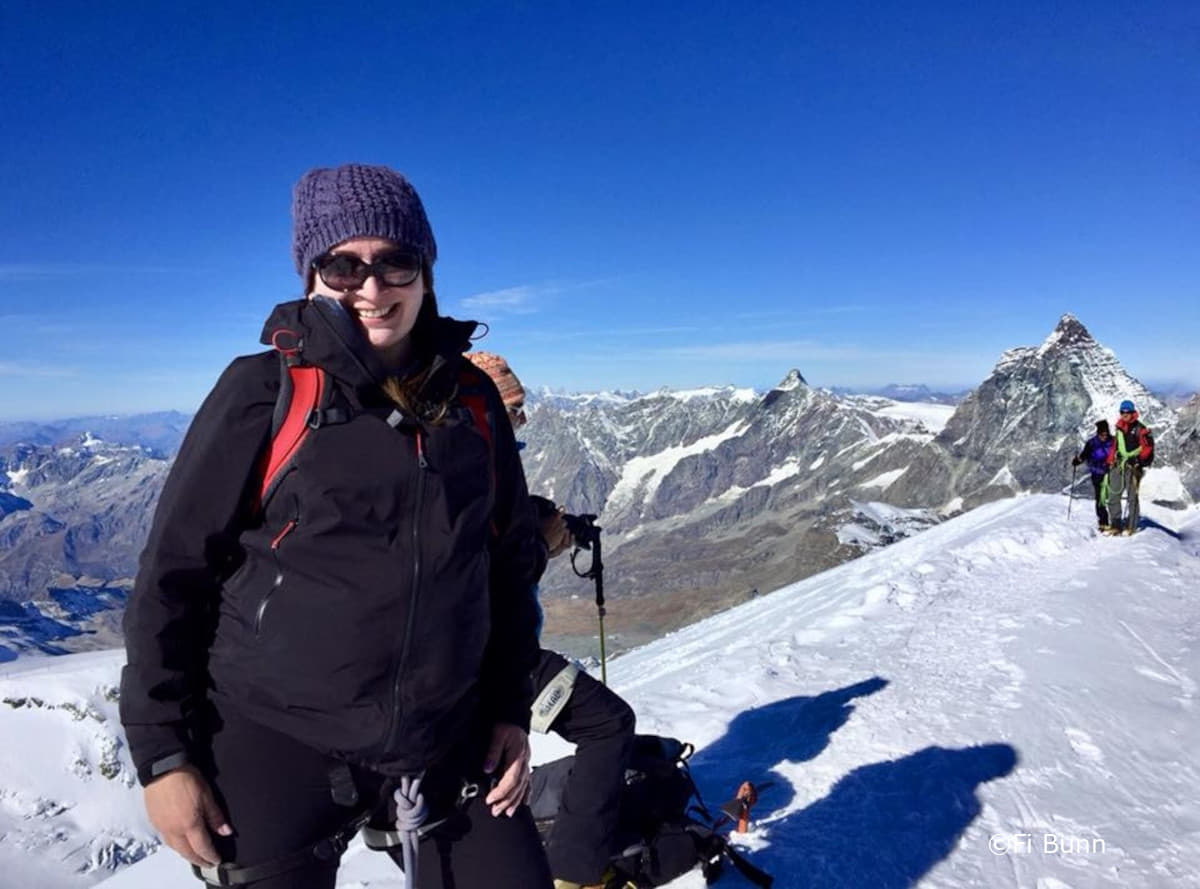
Fiona: Yeah, I was thinking about our conversation and I just realized what is it about me that I absolutely love about photography. And it really is the joy of being an alpine photographer, you know, and that really goes back to my childhood. I think it's often the case for many people that there's something that happens, that draws you to a particular art form, or activity, or sport, and maybe, you know, two or three things that people like doing, but for me, it was going to the mountains when I was a child with my parents.
My father was Scottish, and my mother was Swiss. So every part of the time we went on holiday as a child, we visited the Alps or the Highlands and went for long hikes. And just had this experience of being part of the wild spaces, being part of nature. And, yeah, even as a child, I did take a few photographs, but I kind of just really admired my father, who was a very good amateur photographer, as well as being an engineer and many other jobs that most artists do. And, it just, it really opened up the experience for me to enjoy that. I think that kind of moved into my adulthood when I had an opportunity to spend a bit more time taking photos as an adult. So, yes, that was the start really.
Tom: Then came the day Fi you decided to show your work to people in the Photographers Gallery in London. I think that was like your photography moment for you, right?
Fiona: Yes. It's kind of always like a challenge to find your own voice as a photographer and that can take, you know, a significant amount of time or not at all. I was working in humanitarian aid out in the Middle East and looking after advocating for minorities. And I really needed to have something for my own time, I mean it was lovely seeing what was happening for the people I knew who were living out there, working out there, experiencing the challenges they had. But I just kind of thought, I really need something for me, you know, that I love doing.
So about 12 years ago, I'd been on holiday a couple of times and taking some photographs with one of my cameras, which was actually a really old one, but I was still using it up to about eight years ago, a Panasonic with a Leica lens, and I took some photographs and sort of took them onto social media. And my friends they were like, Fiona, those photographs are incredible. You know, we didn't know that, how much you were into photography. And I was like, well, I didn't know I was into photography that much. I'd done it at college, you know, gone in the dark room, learned how to make my own prints and stuff like that. But this was with digital cameras on holiday. So, I thought, well, I was a graphic designer when I was younger, loved art, arts in the family in different forms and I heard that the Photographer's Gallery up in London, which is like sort of the premier art photography place in the city in terms of just being for photographers and having amazing exhibitions. It's just off Oxford Street. If people haven't been there before, I really recommend popping along and having a look. Very friendly and not that expensive. So they had, a day for photographers to come and to share their work. It was very, very friendly, inexpensive, you know, sometimes you see these things and you think I'm not going to pay 25 pounds for that. But I just kind of thought, it's 25 pounds, I mean, just don't have coffee for a week, go along, show your work, just have a chat.
So I got my portfolio together, got some A3 prints done. Actually I just used a local printer, I usually use a London printer now that does very lovely C-type prints, but on this occasion, I just used a local shop and took my stuff along. I met with some other photographers as we sat there with our portfolios, all sort of looking to reveal our work to someone. And they were from a really diverse group of people, there were people there who were portrait photographers, street photographers, about 10 of us sitting there waiting. I went into the room and there was, you know, about six desks there with different staff members from the photographer's gallery who are curators. I showed my work and they were just completely encouraging, lovely people. They saw my work and they just said, you know, Fiona, this is really good. I said, Oh, thank you. So it's really nice, I mean, we have our own self confidence but when somebody, you know, who kind of knows their stuff and is selling this stuff on a regular basis to what I consider to be one of the top, you know, photographer galleries in the country. It says they like what you've got.
So I said, well, how, how can I move forward with this work, how does this progress? And they were very kind. They said, there are a few options for you. So one of the option is to send your work to a a stock photo company that would take your work and sell it off to whoever needs it. Now that's a great idea, but part of me was just like inside, I'm thinking, Oh, okay, I've seen that a lot. I experienced a lot of stock photography when I was a graphic designer, I kind of know the system. And then they said to me, but you know, have you thought of sharing your work with newspapers, because your work would reach that audience. Almost like photojournalism, but sort of kind of more artistic photojournalism, if can describe it that way. And I just kind of thought, yeah, I thank you, I would love to do that. And they said, you know, we think your work could sit within that genre and we'd encourage you to, you know, continue doing what you're doing and get out there and do what you love doing. So I took their advice, continued going on my explorations in the mountains during my holidays.
I sat down with a friend the other day and I said, I can't actually remember when I just had a holiday. I've literally worked every holiday I've had for the last ten years at least. I have used my holiday to do my photography. Anyway, so I did send my work. I send an email to various businesses and newspapers, including the Guardian and the Telegraph. And straight away, someone at the Guardian, a very nice lady, got in touch with me and said, Fiona, we love your work, we can see it's really good but just to bear in mind that you know, newspapers these days haven't got the big budgets that they may have had in the past, because of the digital age we're in now, where everything is so accessible for nothing. But they said, just send your stuff, where, as and when, if you get any great idea projects. And, you know, we can't offer to sort of pay you, but if, you know, if there was a particular project you really wanted to do, we could pay for you for your expenses.
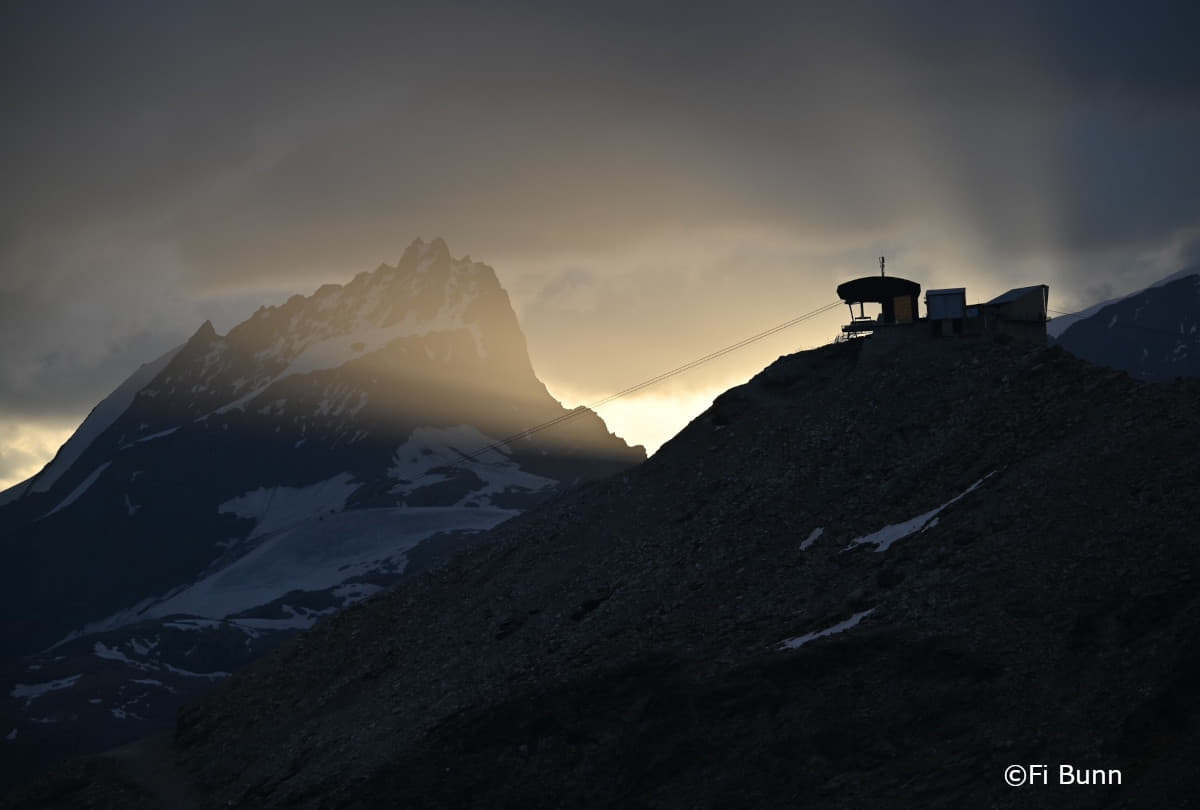
I saw that they had a regular readers portal that they regularly showed readers work. So I got straight in there and got some of my work uploaded. I think I've had four or five pieces in the Guardian during a period of about five years, on a very regular basis, which was great and really was so helpful for me as a photographer. So that's a little bit of my background of how I got into that sort of work.
Tom: Fi, if we talk about galleries, I think your work has been showcased in the UK, has been showcased in Switzerland and Italy. And now of course, you have the great honor of being showcased in the Creative Freedom exposition organized by the John Muir Trust. Tell us a bit more about your Beyond the Eyes project there.
Fiona: Yeah, thank you so much. I really appreciate that. Yes, I've had a few exhibitions just because I think it's really good to get your work out there, meet people, meet other photographers, artists, I've done work with friends who are painters. And we've shown our work together and it's what you what you bring together as a team. Now, the Creative Freedom one, I just was so delighted. I'm sure most of your followers will have heard of John Muir, a famous botanist, writer, philosopher, glaciologist. A Scottish guy who was taken to America as a child with his parents, and lived in America for many years but he passed away many years ago now.
I was just on the internet, browsing as you do, and I saw that the John Muir Trust, they've been around for 40 years now and based in Scotland, that's the birthplace of John Muir, and I saw the Creative Freedom advertisement. They said it's been 40 years since the organization was established in the UK, and we just like to draw out, various artists, multimedia, paintings, poetry, and photography to contribute their work to celebrate this sort of creative freedom thing of helping artists. And it just sort of rang true to me straight away, helping artists to become part of the wild space concept, being able to support wild areas in different parts of the country. I was just so delighted when I heard about it. I know we've all gone for lots of competitions and sure a lot of people have, and they're usually like 25 pounds to enter or something, but this was really good. They invited you to give a bit of background of your work, and the fact that we were all working together on this concept of wild spaces and protecting the wild spaces was great. So I applied, I think around 600 people applied and I'm sure a lot of people even who follow you may have applied and I was just absolutely so delighted that one of my pieces was included in this exhibition, to be shown at the John Muir Trust Visitor Centre in Pitclochry, which is just south of the Cairngorns in the Highlands of Scotland. So there were probably, I think, about 15 or 16 of us whose work is being shown in those different genres, and two photographers. So mine and another photographer's work has gone into the final showing. I'm just so delighted because actually my piece of work is actually at the Matterhorn in Switzerland, so I was like, I'm delighted that they've included me within this, because it's not even a Scottish mountain!
Tom: That's pretty cool, yes.
Fiona: There were two other pieces of work that went with it, the whole thing was about the way glaciers are reducing throughout the world at the moment. Water is becoming a real issue in many countries to such an extent that, I think in the first world, in the developed world, we don't kind of know the impact of what is happening, all we see is the visual impact of the glaciers becoming smaller and reducing significantly. I believe one of the Swiss research organizations said that actually 10 percent of the glaciers disappeared in a time of two years, which is 10 percent in two years. That is astonishing. Absolutely astonishing. I just felt it was an opportunity really to sort of talk about what I've seen, what I enjoy, and present that visually as a photographer.
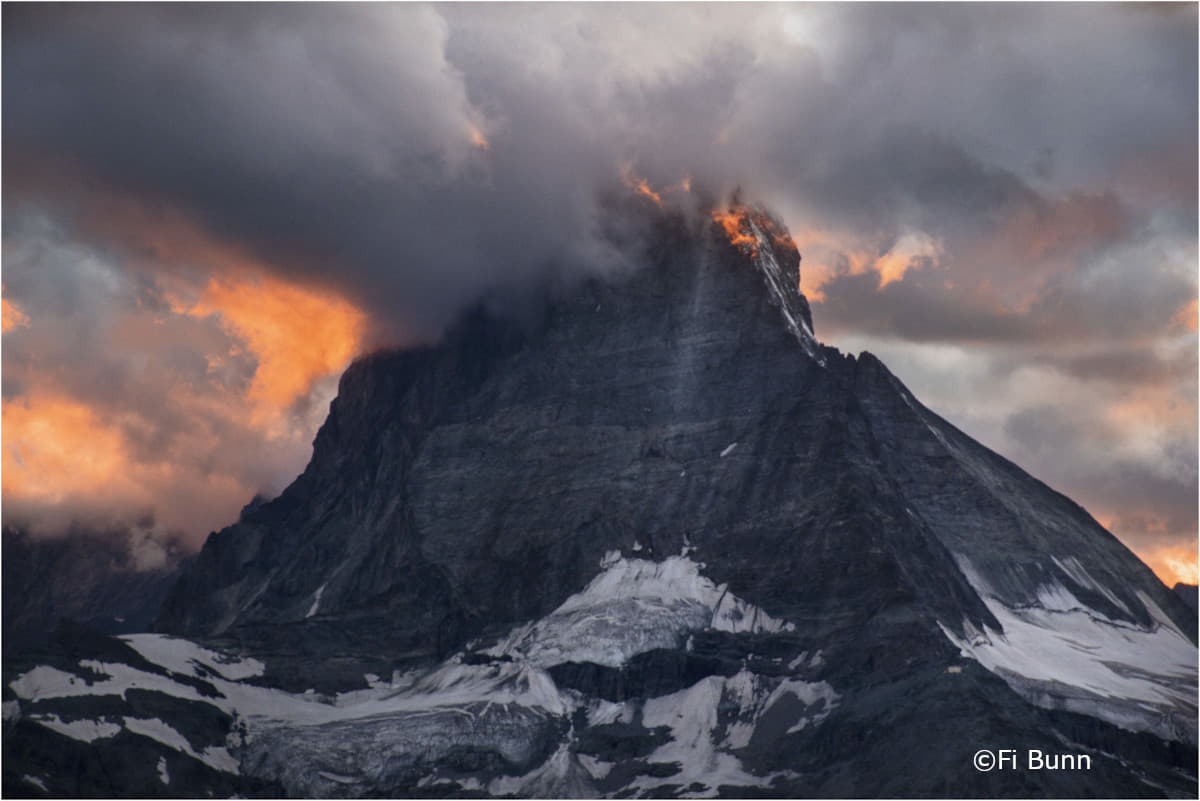
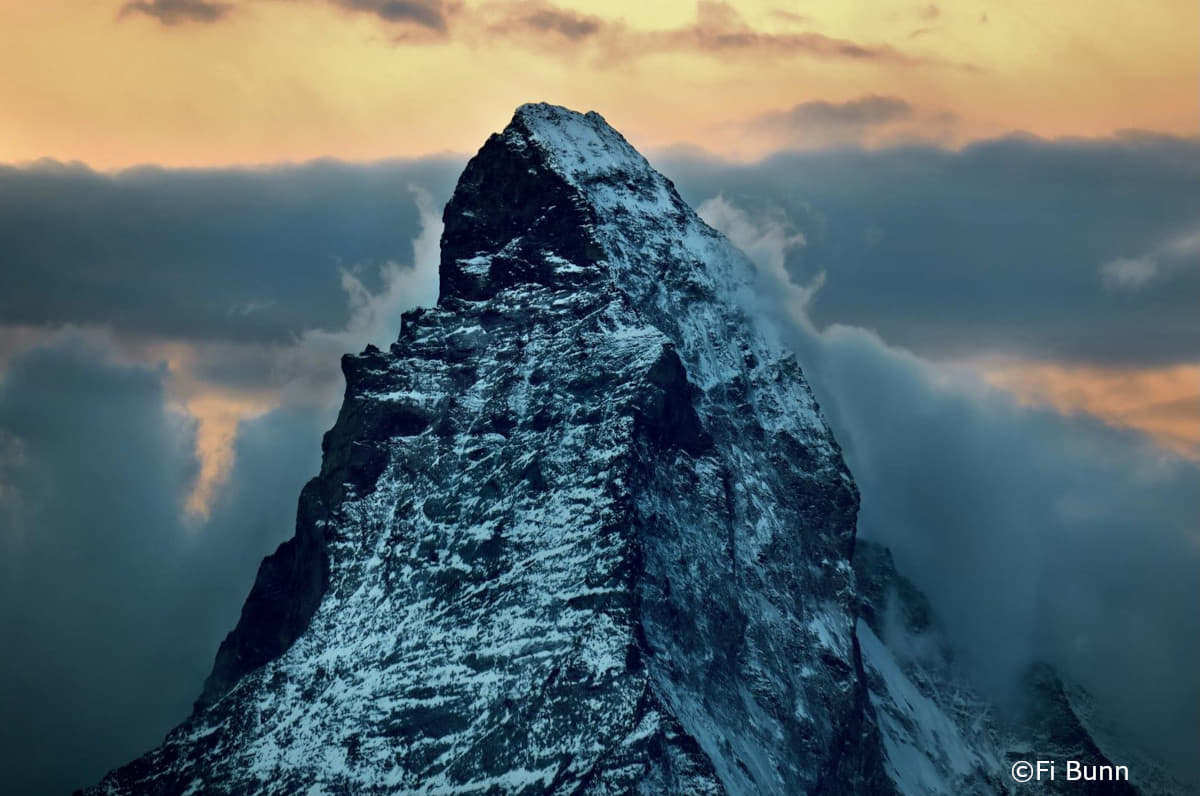
And this particular picture, Matterhorn Fire, they said such nice things to me about it. I think as an artist, we kind of get used to believing in ourselves. We have to believe in ourselves. It's the only way you can do what you do is because you actually believe you've got a voice that you can share. But for them to actually say, Fiona, we've not ever seen the Matterhorn like that before. We've not seen it way it's shown. And I was like, well, yeah, part of me was like, join the club. That was the first time I'd seen it like that. And it just, for me, it really represented what we now see in the Alps, which is a beautiful mountain, but which is just scarred and hardly any snow on it anymore, no glaciers on it anymore. And just the way that the sunrise hit the mountain in such a way that it looked like it was on fire. We've all seen pictures like that in Yosemite. We've seen the waterfall of fire that comes off Yosemite, which has become like amazing photograph that is presented in lots of places, but to see it on the Matterhorn was quite astonishing and kind of brought it home to me.
I had a lovely time. I took my work up there, I've got obviously contacts up there since I had a Scottish dad, so it was a really great opportunity for me to go up there, deliver my work and see it presented in such a place at the Visitor Centre at Pitlochry, in a way that it just really stood out. I've always liked big photos and I love the opportunity to really present my work in a way that is striking. It reminds me of the galleries I went to as a child, which were portraits and landscapes that just drew you in and took you to a place where you were there with them. And I would say about this particular picture, Matterhorn Fire, is that for me, the fact it actually makes people think that it was almost painting. I believe you'd embellished it, but no, it's as it is, and that to me, as a photographer, is just, yes, to create something as a photographer that is unique, that is something that you have spent time in the mountains, just being there enjoying that wild space and able to present something quite unique and, you know, a great, a great pleasure, a great joy.
So they had the launch, I stayed up there a couple of more nights, went up to Glencoe, an opportunity around Ben Nevis area, beautiful area, I recommend Scotland for artists, absolutely stunning. The exhibition goes on until the 25th of May, and it's a free exhibition. I have actually done a blog,about my visit there that is on my website. So people are very welcome to see that on there if they want to have a look. It talks a bit about, you know, what we're talking about tonight.
Tom: We will mention all this in our show notes Fi, no problem.
Fiona: Oh, so kind, thank you.
Tom: Fi, as being an artist, what do you hope visitors take away when they see the exhibition there?
Fiona: I kind of really want to, shock is probably the wrong word, I want them to have an awesome encounter if I'm honest. I think they're going to do a comments section on people's responses. It's a bit difficult when you're in an exhibition with lots of other people, but I'd say it's really good to do your own exhibition occasionally and have a visitor book where people can just like, kind of write straight away. I find it really helpful as an artist, you know. Some people just say something really nice, like I really liked it, but some people are challenged. One person said it reminded me of something from Lord of the Rings, the fire on it. And I actually thought, well, that's really good if they think that, because actually that's kind of showing them, you know, the impact of what's happening at the moment. And I think that's probably why they've chosen my pieces, because it's kind of so different.
And literally that sunrise fire on the summit was there for five minutes, if that, and gone. That's where, you know, our work as an artist is never wasted, it's always useful. It's always important because you're enjoying the experience, but you're making people think as well. I love the idea of making people think on an aesthetic level. I really love that. But I also love the fact that if we can make people think, Oh, why does that look like that? Why is that? And to be able to do that with landscapes, I think is where that thing I said earlier about, it's not landscape journalism as such, but it's trying to evoke something more from people, and I'm kind of hoping, in a small way, that it's actually impacting other people as well.
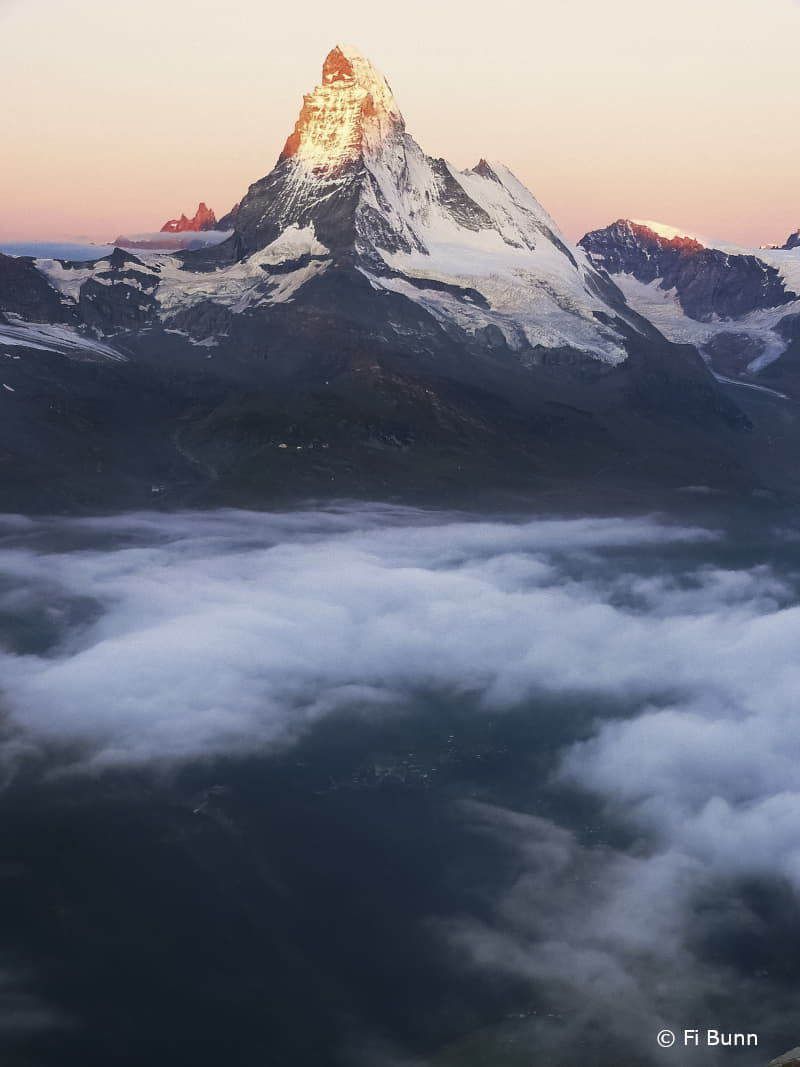
Tom: Fi, you're also a contributor, I think, to GlacierHub.org, which works in relationship with with Columbia University. You already saw yourself 20 years ago that glaciers are reducing. How is this situation today?
Fiona: Yes. It's really struck me, when I've been thinking about it recently, because I'm thinking to myself, I'm not an environmentalist as such, I'm an artist who thinks the environment's important. And it's really difficult because there's loads of people out there who really know their stuff. And you know, we're artists and we communicate through visual imagery. I'm sure a lot of us have gone to college or gone to written stuff, but it's a different experience. But going there, it was astonishing.
Two areas have really struck me through that process when I was out there. I'd gone a lot when I was a child, we'd gone in the summer, I hadn't particularly gone in the winter as a child. You know, it was summer holidays in the UK, six weeks of summer holiday and if you've got relatives, you tend to go out and spend a lot of time there. But about 20 years ago, I went with one of my best friends and we wanted to explore the Southern Alps again, Valais and the Zermatt area. We went down there and I was just so shocked. I'm sorry, I have to say I was really shocked. We actually drove, on the way to the south of Switzerland, we drove over the Furka pass, which is the very famous pass people have probably seen in sort of James Bond movies where there's this twisty road and there's this amazing hotel on the corner.
The glaciers when I was driving down there as a child, the glaciers then were enormous, imposing. And we were on our way 20 years ago driving down and I was thinking, this is really weird, those glaciers just disappeared. It's gone. It's just all grey. It's halfway up the mountain. It's gone. And then we got down to Zermatt and I was just so shocked. I mean, we were hiking quite high and we were looking down and I just said to my friend, this is really weird, that the glacier's gone. It's actually one of the glaciers to the right of the Matterhorn. Gone completely. It's gone completely. And then looking back up towards the Monterosa, I thought, this is really strange. Where's it gone? It's disappearing. Then I went back quite regularly over the last 12 years, I was like spending most of my summers going over there and then I shared online one of my pictures of one of the glaciers by the Matterhorn that had completely gone. And also the Furka pass glacier had gone.
And it was then that people started saying to me, I can see that's gone too. And quite well known mountaineers actually started to make comments at the same time. You know how life works like this sometimes, you all notice stuff at the same time! I thought to myself, well I'm not an environmentalist but something funny is going on here and it was very strange. So I made an effort and start following organizations which I thought were, what I would consider to be very measured in their responses, to what's happening. People like Glacier Hub, I was reading their stuff because they were trying to communicate that artists have something to communicate into this process because of what they're seeing. I was looking at their work and I was thinking, actually, it's kind of, whatever your politics are, something is happening
And there are two sort of outcomes that have really stood with me over time. The first outcome is that, if it carries on as it is, in the Alps particularly, there will be no glaciers in a hundred years time, and there'll be no glaciers sooner than that it is looking like at the moment. And how does that impact us? Well, the first area it impacts, from what I've seen, what will happen as the earth warms up, is that spring and summer months, there will be much more water flowing through the valleys in the Alps, much more water, there's quite a large lake now under Mont Blanc.
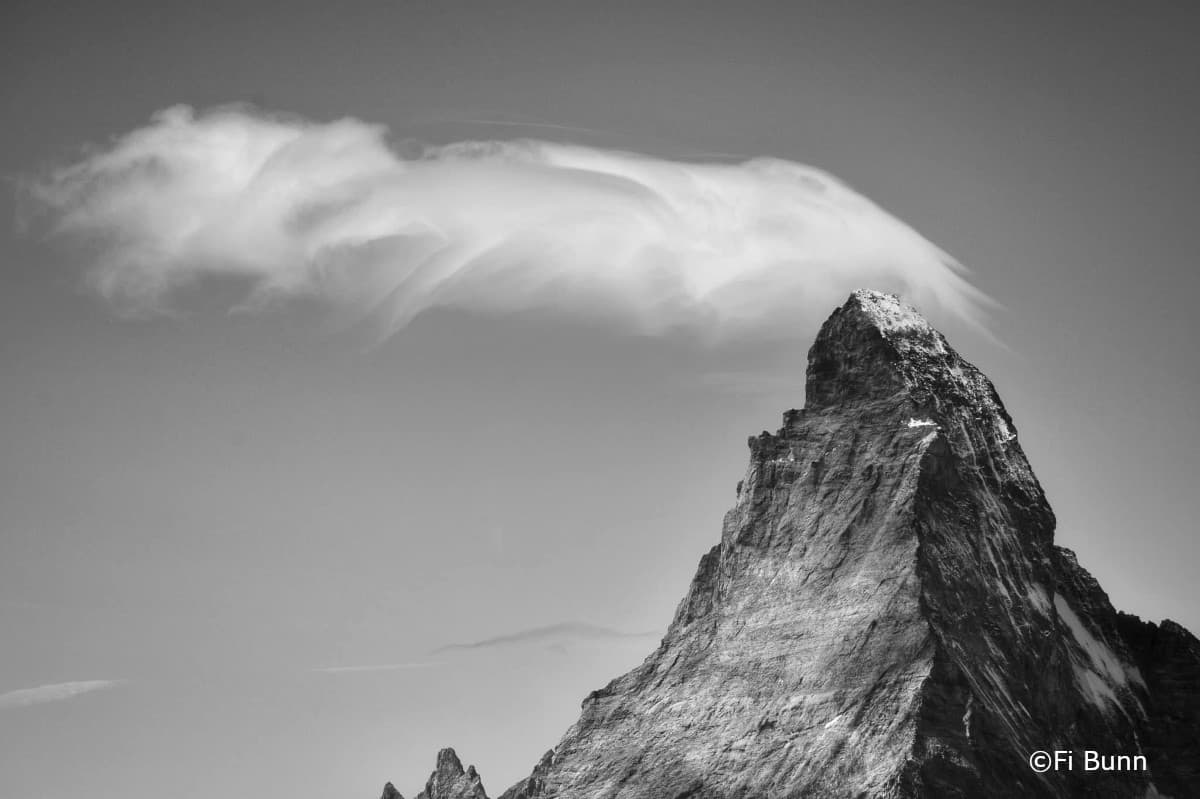
But the thing is, that as those glaciers go, the impact is going to be that the riverbeds will start to dry up, and the pastures that rely on th sort of water from the mountains will reduce. It is going to happen. The general consensus is it's going to change over the next 100 years time. There will not be glaciers as we know them. But it can slow down, and that's why you hear governments now saying all over the world, most governments now acknowledge that there's been a massive impact on glacial reduction. So for us in developing countries, we will find a way around it. There will be a way of supplying enough water, probably through more hydroelectric dams or something, to keep the water flowing. It won't look so great, it'll look nice in the winter, when everyone goes skiing, it will still look pretty, but the economic change that will happen will be quite, significant.
The second area, just very briefly, that will impact what I've seen, is a bit more serious, and it's water shortages will start to impact more in places like India. It's been documented quite widely in Harvard and the New York Times did an amazing article on it, the impact it's having on farmers in the south of India. They are now seeing, and this is proper documented facts, that the Indian government is now going to have to give around 1.3 billion dollars to help farmers sustain themselves with all the crop reduction from the lack of water. And the more serious thing is that, with all the proper research done on it, is what is believed is that 59,000 farmers in southern India have died in the last 30 years through suicide because of not having any crops and it's absolutely tragic. If we're human beings, we don't want to see people suffer and hear that.
It's going to be challenging for people in the Alps and places to cope with more avalanches and how to cope with the impacts in general. There's people in South America now who are struggling who live in mountains. We just have to be aware, I mean not to be too down, we just really need to be aware that we have a responsibility as artists to a certain degree to show what we see. This is what being an artist is about, you show what you see. You know, words are not our big thing always. I don't know many artists who are great with writing and words, but what we are good at doing is showing images that we see. You know, show what we love, but also show what we see that are impacting in different ways. If my photographs can help in any way, that's what I think is important.
Tom: Fi, your other side, with the humanitarian aid projects you do, are they also in relation with climate change sometimes?
Fiona: Yes. Quite a lot of our work was in Iraq and there is an impact there on reduction of water as well. I think a lot more research needs to happen there. In my heart, I've always wanted to get more Iraqi and Mena, Middle Eastern, North Africa artists to start to show their photos, what they see. You know, that for me was the greatest pleasure in working as a advocate for minorities in different countries. And when they talk about minorities, they're talking about anyone who's not the status quo largest group. So it could be gender, it could be women, it could be different cultural groups. I was going to do some work in Southern Africa at one point, it was just trying to get them to show pictures of what they do. And I think anything we can do to encourage our artists friends in different countries, to show their work, would be absolutely amazing. It's still in the back of my mind that project.
In the back of my mind I'm thinking I would love to get our Mena friends to show more of their work because they live there, they see it, they see the changes and it's their country and we really ought to support people like that more, to be honest. Which is why I think being part of an artistic community, particularly through social media, I think is kind of really important. Anything we can do to support each other is always a good thing. You know, our pictures are powerful. In all very different ways.
Tom: You think Fi, we as photographers on social media, can have a global impact for change there?
Fiona: Yeah, I think we can. I think even if it's just encouraging other photographers. You know, you really are making an impact. I would say on some social media platforms, we all have a bigger following than others. We can connect with different communities in different ways. But it's about being part of a wider community. And the minute that clicked in my brain, I realized it's not that no one's seeing my work, that's nonsense, your work's always seen. It's just that maybe they don't respond, they're busy, it's not their thing. But it is seen. And as you build community, it's very encouraging being noticed, because we all work quite solo as artists. That's why what you're doing, Tom, is so nice because it's actually really important that artists do get together, you know, in different forms to encourage each other really.
Tom: Yes. Trying to give a voice to everyone.
I think the biggest challenge that photographers face on social media, is exactly starting this community feel and starting to get noticed. And if you want to make an impact somehow, you will need it.
Fiona: Yeah. Yeah. I mean, I kind of really challenged myself and I thought, well, what do I really love? It took me a while to really connect with what I really love, and what I really love is being in the mountains, is being with people, it's getting inspired by other mountaineers, what they're doing. I mean, I'm not a great, I'm a rubbish mountaineer. But I do my job, I hike, I get to where I need to go. You just kind of get inspired and you learn so much. And there is a moment you think to yourself, gosh, you know, I've actually grown as an artist. You know, because we are as artists, quite solo most of the time. It's really good to be part of a community because they will back you up. I hope we all continue to back each other up, it's really important.
Tom: Fi, let's walk a bit over to the gear question that everybody always likes.
Fiona: I know, I'm so, oh, I'm going to be a shocker for your gear experts, I tell you, I'm not being modest, I'm not being humble, oh, dear, okay, ask away.
Tom: I just was wondering what you use nowadays as camera.
Fiona: Oh, gosh. Well, at the moment, I've got my worthy old Nikon D5600. It's got the Nikkor 18 to 140mm lens. RAW and JPEG tend to be the ones I use together. The reason I use them together is that you want your RAW files for your absolutely beautiful prints, and your JPEGs for socials, they're not going to be the best version, but they're good enough. I like this particular Nikon because it's very light. There are quite a few others which are very similar to this, but they're extremely heavy. For me, first of all, it's a nice light camera, but secondly, I was a charity worker for 12 years and I have my financial limit on things, you know, until I get really famous to have lots of money!
But no, this has been a trusty camera. I've just gone and bought myself, but it's probably already out of date, I've just gone and bought myself my Nikon mirrorless Z5, which is very nice. And with that, I've got the Nikkor Z24 to 200mm. I should have bought the next one up, but I was just a little bit hesitant because of the cost. So on the whole my camera level at the moment is about 1,500 pounds for purchasing, but my main reasons is literally the lightness of the camera. I just, in my heart, I really want to go for some better kit. I had my little Panasonic, 10 years ago with a lovely Leica lens on it, and getting very good shots, but I would never not go now without RAW. I gave in and thought, I'm just going to have to find the money from somewhere to make this possible. There are lots of ways of doing things, but I mean, I would always say, if you can go for the very best kit, do go for it. Bear in mind weight, bear in mind weather sealing. Because like in the Alps, you are literally soaked through sometimes. I mean, I'm not kidding you, even in the summer. And you've just got to be aware of your kit if it really is appropriate for what you need it.
So yes, so that's my modest little collection of cameras at the moment. Oh, dear.
Tom: But I think Fi, you have to ask yourself also if spending money on a more higher-end camera will make you a better photographer. Asking yourself it it will make a difference in your work.
Fiona: I know, I know. It's the challenge I've always had because the humanitarian work is kind of dying down at the moment, which is good because I accomplished what I wanted to do. I still got my amazing friends out there who are just remarkable and the work they do caring for people. I sort of kind of think, you know, some photographs I would like to take on a high end commercial level, some of them would just be amazing done in a certain way. I love large scale and I go up to A0. You know, my heart is to really see large landscape pictures impacting communities more so that they see beautiful pictures that will inspire them or encourage them. We'll see. But thank you for saying that, that's so kind.
Tom: Fi, when you walk up a mountain with your camera, you already have a particular shot in mind before or you know where you want to go and then you just wait for the moment?
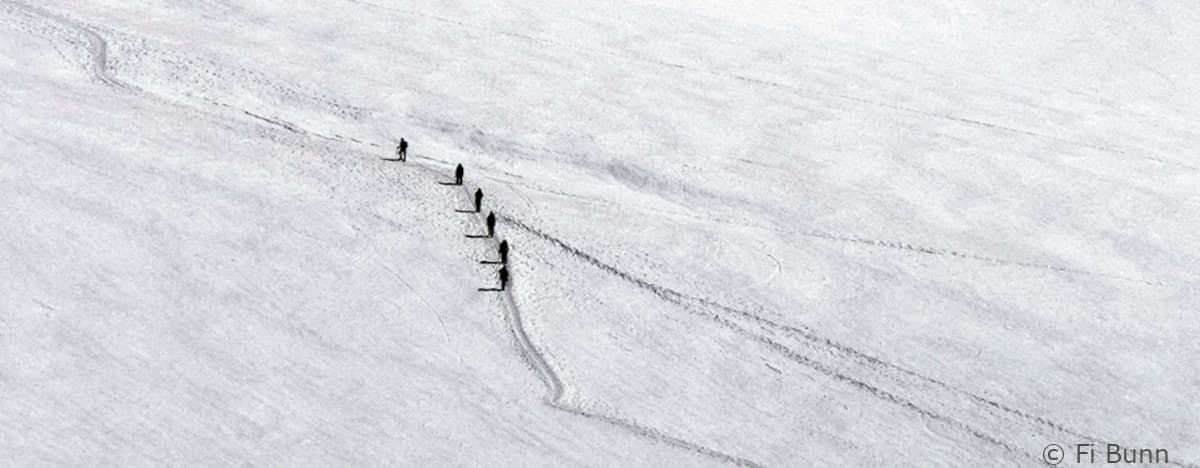
Fiona: There are certain places I love to go. I kind of, you know, the only way I can compare it is, when you're a mountaineer, you need to acclimatize. So you go out and do certain walks and hikes that you know are gonna sort of get your body ready. That's a bit like when I go to the Alps, there's places I know that I go to, that I kind of think straight away, yeah if you go up that mountain, if you go on that trek, you know you're going to sort of set your mind straight. You've got your alpine head on, and you know what you want to do. But then, gosh, the sky's the limit honestly, you just do not know what you're going to expect. I mean you can go up in the mountains and you know certain places you're going to go, you're going to get a great shot.
So you go there, and it's all whited out, you can't see a thing. This is where you need patience as a photographer, as everyone knows. And you think, I'll just give up on this project for the day, and try and find another place. But you know, distances when you're hiking, are quite wide. You kind of think, over that valley, it might be a bit better. We'll go over there. But then sometimes you just, I don't know, is it a gut instinct I don't know, but you think, just wait, just stay where you are. And five hours later, you might get that most amazing shot!
And that's what's happened to me quite a few times. You just stick with it, don't necessarily go straight away. Hang about and just see what happens. One of the memories I have most striking was when I was at the base of the Matterhorn, looking over Zermatt Valley and the sky was just so grey and cloudy, and this was in the middle of summer. I mean, you just cannot guarantee the weather. So I went to one area I went for years, I mean literally 10 years I visited one lake and I never got to see the Matterhorn over this particular lake on a clear day. And then one day it happened. And you're thinking, oh gosh, I kind of almost forgot about it. There was this time in the summer, and gosh, they were actually mosquitoes at 3,000 meters. I mean, how is that even possible? How can you get mosquitoes up there? It was in the middle of summer, I'm getting bitten like anything, and there was me and this other photographer. And we were just like, kind of looking at each other thinking, what on earth are we doing here? But we both, were staying there and I was thinking, am I just doing this because I've got a gut instinct, or I'm doing it because another photographer's doing it, and we're both thinking I'm not going because she's not going, or I'm not going because he's not going.
Anyway, so we stopped there and three hours later, gosh, the skies lifted and had the most astonishing sunset on the Monte rosa. I'm talking, I have never seen it like that, so absolutely beautiful. And we had the Matterhorn behind us, clouds still on it. Oh my God, that was incredible, although it was too close for good pictures, don't get too close to a mountain, you need to give it a bit of distance, so it wasn't going to have an impact. But looking out eight miles down that way, oh my God, and it's still one of my favorite pictures, I call it 'Monte rosa Twilight', which is a bit corny, but I love it because of the colors. As a photographer, I mean, we see so many commercial photos where it's lovely, but it's so hyper, hyper realistic, hyper real, but actually be there when it really is that real and really is that beautiful. It's astonishing.
Tom: So you would say Fi that mountains are your happy place?
Fiona: Yeah. Yeah. I have to admit, a lot of people, particularly with all the stuff on the news at the moment, there's an avalanche here and an avalanche there, I have never not felt safe in the Alps. I was a little bit more nervous in America because they have bears and mountain lions, but I can honestly say, I have always felt safe there. You know, as a photographer I quite often I work solo. I do go to the mountains with friends, but quite often they're like, I'm not going to do that route for you or I don't want to do that walk, and I just head off on my own. But yeah, it is kind of really my happy place. Yes.
Tom: Fi, is there a photographer that you look up to, like an inspiration? Maybe not only on a technical standpoint, but in a way that he or she has changed the world somehow?
Fiona: Yeah, there are a couple. I do love Sebastian Salgado's work. I remember going to his exhibition in London, at the National History museum. He had his work there and I just loved it. It was, gosh, when you looked at the pictures up close, it was a rough picture, I mean the grain was outta this world but they were just beautiful massive pictures. Black and white primarily. I'm not a black and white photographer, but I just loved the authenticity of his work, of what he was trying to do tell you. I like his work and I like the fact that he's taken the money he's made and he rewilded land where he lived and created a new forest on Earth. It's just incredible.
I also really do quite like Ansel Adams actually, you know, he focused on a particular area in his pictures, that's what I like. His confidence as an artist was obviously very clear.
I'm always open to hearing from other people if they've seen another artist they would really recommend to me. I love that. I feel like I still have so much to learn. I think we all feel like that sometimes, don't we?
Tom: And now you have this amazing podcast where you can learn things too, Fi. So many things to think about and so many places to go.
Fi, I think we can round it up here...it's been an amazing talk. I think I'm ready to take my backpack and walk up a mountain tomorrow!
Fiona: I've actually got a list of all the places I would love going. But yes, thank you. And yes, there's just so many beautiful places. So many beautiful alpine type landscapes too. There's amazing landscapes in Spain. There's so many places to visit.
Tom: Yes, they sure are. Fi, thank you very much. We keep in contact and have a great evening still.
Fiona: Tom, thank you so much for taking the time to talk with me.
Tom: It's been my pleasure.
Fiona: Thank you.
Tom: I see you around Fee. Bye.
Fiona: Bye.
And that wraps up another exciting episode of "The Camera Cafe Show." I hope you enjoyed our conversation about alpine photography and an artists view through the eyes of Fi. If you want to find out more about her, you can find that all back, together with the transcript on our website.
Remember, sometimes all we need is a little bit of passion and I'll sure hope this episode sparked some curiosity in you. If so, we'd love to hear from you!
Don't forget to tune in next time for more captivating discussions and insights to fuel your creativity behind the lens. We've got a packed calendar for this year, so be sure to stay connected in any way, with us.
This is Tom Jacob, singing of for today...Until next time, keep shooting, keep sharing, and of course, keep moving your photography. Adios!