

"I'm not interested in money particularly; I need enough to eat and live in a nice place. But believe me, I've made so much less money. You don't do photography for money, do it because you love it. It's one of the first things I'll tell any student, you're doing it and if you want to change professions like I did, I have had so many students who want to change being in business to being creative. It's not about money, to me it’s about being happy. And I am very happy. I had my miserable years and tough years and all that. And I swore to myself when I was young that I would not, as an adult, work in a profession or at a job that I didn't like. So, make money but do it in something you love. Make less and be happier than miserable and make more money. Because you're going to bring your miserable self around everywhere you go and it ain't going to be fun or good for you or your neighbors or your family or your people. Right?"
Intro:
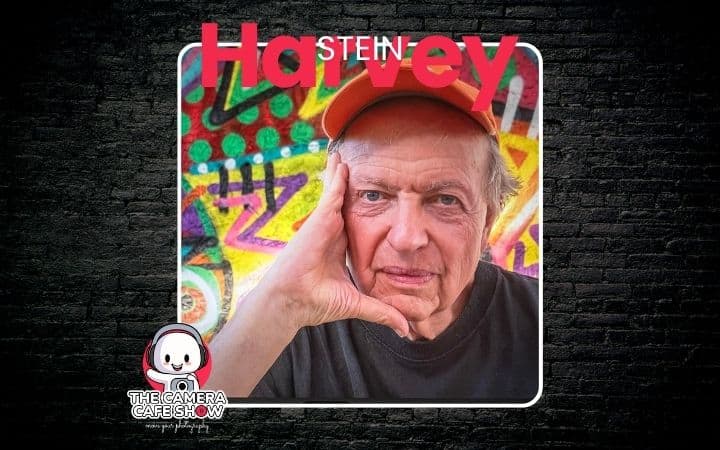
Greeting, and welcome back to The Camera Cafe Show, the podcast where we brew up inspiration for your photography journey! I am you host Tom Jacob, with Tetiana Malovana and Richard Clark sitting in the background today. Let's get rolling, but if you haven’t listened to Part 1 with Harvey Stein yet—hit pause, go check it out, and then come back. Trust me, you don’t want to miss the first half of this conversation with one of street photography’s true legends.
Now, in this second part, we’re shifting gears a bit, we dive into how he engages with strangers on the street, even during challenging times like COVID or on his travels when he doesn’t speak the language. We explore his philosophy on street photography, why he works in series, and how he finds meaning in long-term projects. Harvey also shares his thoughts on his own rise of digital photography, the challenges nowadays of creating photo books, and why teaching has been such a big part of his journey.
And to wrap things up, we go through some of his Mexico photographs, discussing how each place he visits brings out something new in his work.
It’s another masterclass in street photography, some laughs, and—of course—some great storytelling from one of the best in the business. Enjoy this second part with Harvey Stein
Harvey: But that's how I started. I always like new environments, but I don't believe you have to go far. You know, when Covid came, I just did my neighborhood for three years. I never shot in my neighborhood. The Upper West Side, boring, not interesting. I have 175 photographs of that three-year period. I've printed them all. It won’t be a book 'cause no one's interested in the Upper West Side particularly. It doesn't have enough universality. Only people with masks. I would go up to them and they would freak out 'cause there was a stranger going up to them. I was wearing a mask, and I would ask them about their life and how they're doing how covid affected your life?
I got into talks and conversations, and that was good. It worked out. I didn't think I'd do really good work. I don't know if it's my better work, but it's pretty good. I guess I have to look at it.
But I do a lot of portraits. My first two books weren't street. They Portraits of the Artists in their studios and the Twins were street and in their homes. But, I've done a lot of studio portraiture and taught studio portrait classes, but that work has never shown. I did a whole project on people living with AIDS. It was my most social documentary kind of documentary hardcore. From 1992 to 1996, I shot 120 people living with AIDS, with a 4x5 camera in the studio. I set up a studio at the facility where I found them, not in a hospital situation, in a studio situation, and gave them beautiful 11x14 prints. I shot it for the Gay Men's Health crisis, which is the world's first AIDS organization, and the largest AIDS organization. Founded by Larry Kramer and some gay men, I photographed that for four years, on my own dime, I would have to take taxis down to GMHCI with a 4x5 camera. I had five or six things to lug, screen backdrop, equipment, lights, studio light, Dyna lights, strobes. And I loved doing that, but it was really hard.
I couldn't do it now. I wouldn't have the energy probably, but who knows?
Tom: Harvey, I want to come back a moment to the hand, the rejection you sometimes get.
Harvey: Yeah.
Tom: Do you sometimes push it to get an image if you feel it's worth it, or you just let it be?
Harvey: I do. If I really want it, I'll try to talk them into it. They'll say, oh, come back tomorrow. I'm not ready. I say, I won't be here tomorrow. Let's do it now. I'm here. You're here. I go in with a compliment when I approach a person. Usually, you look great in that shirt. Oh, I love your tattoos. I'd like to photograph it. I mean, I don't come on to anyone, but things like I love your tie. I love your shirt. That your hat is great. Or like, kids or young people with t-shirts with a face of someone. I would go like, oh, wow, that's Malcolm X. I love to hear him talk. Or who is that? It's some rocker that I've never heard of or someone, I don’t know. So, I try to find something to go into the session, quote unquote session and compliment them and disarm them or find something to talk about. And then, oh, by the way, and I make the picture.
I don't want to guide them. If they smile, I don’t photograph it. If it's an event and they're smiling I'll take a photo and then I say, could you be serious? 'cause I don't want people to smile. That to me is phony. It's not as tough a picture as if they're serious and looking. I want them to look not mad, but real or authentic.
And I try to do that. But yeah, I'll try to push it a little bit. But it is never worth it, I've never been in a fight. I've had people say no, but it depends how much I want it. I say, okay, I'll shoot fast even, oh, I'm sorry I took a shot. But it's best when you have cooperation.
Tom: I agree.
Harvey: Again, I don't do candid. I mean, I don't want to shoot war. I've done a lot of demonstrations and that I'll shoot candidly, or they're demonstrating, they expect to be photographed, they want to be photographed. That was fun for a while in the seventies.
Anti-war. I have a lot of anti-war stuff. I still go to like rallies, anti-abortion or pro-abortion rallies or political rallies. But not lately. If I lived in Washington DC, I would be doing more of that. It gets boring a little bit after, and it's a little too easy to do. It's hard to do a really good one of a political rally, but it's very available when there's a rally.
Tom: Harvey, when you travel abroad, do you feel you have to change your photography style?
Harvey: No, I'm even more aggressive because again, I don't speak the language, so I don't, I'm like a dummy on the street. I don't know, I shouldn't be here or I don't know. India, everyone should go to India. You've been to India?
Tom: Yeah, yeah. Many times
Harvey: How many times have you been there about
Tom: 12.
Harvey: Wow. Fabulous.
Tom: Yeah.
Harvey: I love it. I mean 99.9% of the people say
Tom: Say yes to pictures.
Harvey: They come up to you and even ask you, could you photograph me? Could I photograph you? I mean, they just like being photographed and they feel, I think it's an honor, especially someone from another culture,
Tom: Yes.
Harvey: I've been told it's easier for me to photograph there as I am not a native person to India. That it's easier because we're foreign and you know, they want us to like the country and they're welcoming. I don't know that, but it's always been really delightful. I've traveled a lot and I never found a culture as welcoming.
Tom: I agree.
Harvey: I've been in Japan and you think, oh, Japanese, they, they're great photographers. They produce cameras. They didn't like it. They didn't like it. There’s always exceptions to the rule. Maybe one on a trip out of hundreds and thousands of photographs you've taken. And it's very, to me, exotic India, colorful. It's dense. I mean, Mumbai is ¡ four times bigger New York City. How can that be? I hardly know New York, I'm from here. So yeah, travel is great,
Tom: And spicy Indian food. How good are you with that?
Harvey: I’m good.
Tom: Yes?
Harvey: I get tired of it after three weeks there, I get tired of the food and I like some spaghetti, which you can find or pizza, you know.
Tom: Right.
Harvey: But it's exciting, and the food's exciting. Just to be on your own there. I mean, I walk around with my workshop. I have a great assistant, Margarita Mavromichalis
Tom: Yes, you told me.
Harvey: She's amazing. She's like the best. Can't say enough good things about her. And I can photograph alone there. I can photograph with her and I can photograph with my class and all of that. And you're the only photographer around usually, unless there's some kind of an event. It's so big. There's so much humanity. So, travel is great.
I say you don't travel far; you can photograph in your neighborhood. I did a whole body of work on my street when I first started out in the seventies and did a project of my street. My block, two blocks. Every facade. Every facade with a person in front of the buildings. A church, a grocery store, a hardware store on the block and then apartment houses. So, you can photograph right at home. You don't have to photograph halfway across the world. I do both. I love photographing in New York and I do it all the time. I'm pretty well much known as a New York photographer. I've done 10 books. Six of them are in New York
I want to show you my list before we're finished. And Mexico. I love shooting in Mexico. It’s a harder country to photograph in. Maybe because you are an American, because I feel, America has mistreated Mexico along with other countries.
Tom: I think also you say that you find your book about Mexico, your
Harvey: My strongest,
Tom: your strongest.
Harvey: I think so, because I really got into it. I think images really work and they're more maybe documentary, not like hardcore documentary, but more, they feel more documentary to me. By the way, all my books except two are black and white. If I get the India work published, that'll be the first book that's digital that I've shot, it'll be in color. My first book that I published in color, I did it at Coney Island. And I did a book on the Mardi Gras in New Orleans in the seventies. That’s color, obviously. That book has an interesting story where I just have a Polaroid sitting in my desk here.
I met a publisher, a small press publisher. His name is Andrew. He's in Richmond, Virginia. And he has a company called Zatara, Z-A-T-A-R-A Press. And he publishes books to his liking, two or three or four a year. He’s done this for about 10 years. I met him at a book fair, and he asked me, do you have any work? He knows my work. Do you have anything that would be a surprise coming from you known as a street photographer?
I said, yeah, I have this body of work that I shot on the street with a Polaroid closeup of people, in masks for Mardi Grass. And he said, oh, I'd like to see them. I like Polaroid. I like masks. So later we did a book.
Here's an image.
Tom: Excellent.
Harvey: This is not a Polaroid, by the way. It's from a Fuji camera. Here's another image. I just happened to have them here. It's called ‘Then and There’ Mardi Gras, 1979. So there. The book looks like a Polaroid and it very in small it's very interesting.
Tom: But it's sold out. Right?
Harvey: Yes, it’s sold out. We did 400 copies, that’s what small presses do. Small runs. He won't redo it because he wants to move on. Which is a shame. We could sell more. I could sell more books and he could sell more books. I sold some, he sold most of them and that was delightful.
Tom: I think to remember you told Harvey that you were going to sell them for $1 million?
Harvey: Oh yeah! As a group, I want to sell it. Did I tell you that? My fantasy is to sell them. I have 45, beautiful, well 47 beautiful Polaroid images taken in 1979. They're still in my drawer here on my left, and they're in great shape. And as a group, I want to sell them to a museum that's like Lucas Samara sold all his pictures he did of himself, his self-portrait photographs with Polaroid film, he sold, I think, I'm not sure if it was MoMA for millions of dollars.
And I'm thinking of Cindy Sherman sold her film stills, as body of work as a star being exploited. I think that's, she played the role of maybe not all movie stars, but women being exploited. And she sold that to MoMA Museum of Modern Art here in New York and made millions of dollars. So, if I could sell that, well, I'm not interested in money particularly. I want to, I need enough to eat and live and we have a nice place. But believe me, I've made so much less money. You don't do photography for money. Do it because you love it. And it's one of the first things I'll tell any student. And if you want to change professions like I did, and I have had so many students who want to change from being in business, especially lawyers. I've had a lot of lawyers who want, disenfranchised or disappointed and they want to change careers.
It's not about money. It's about being happy. And I am very happy. I had my miserable years and years and all that, and I swore to myself when I was young I would not as an adult, work a profession or at a job that I didn't like. Because my dad was in that situation. He'd come home from work and grumbled and be pissed off and mad and all that. I mean, he was a nice guy, really nice guy, and I loved my father, but he was never happy at work. And I saw that and I said, I'm not going to be like that. I mean, we're here once, we go around this place once, try to be happy. That's a third of your life, work life, right. For me, it's half of my life. I work 10, 12 hours a day. Why be miserable? Why just for money? What’s money buying you? So, make money, but do it something you love to do or make less and be happier than miserable and make more money. You’re going to bring your miserable self around everywhere you go and it won’t be fun or good for you or neighbors or your people. Right?
Tom: What's your best piece of advice you ever got about photography, Harvey?
Harvey: You know, I never look for much advice. I give a lot of advice, I might not have taken much advice. I think, I don't know, just work hard. What I would say is I'm going to turn that around. Be true to yourself. Do what you want to do and what you think you can do and, and even things you think you can't do. Try to be honest with yourself. Be authentic, be real, and do things you really like to do. Short of mayhem and murder, and help people. I got a lot of help. Be helpful. I could be jealous too and say, why is that person getting that? And I'm not. But that just goes so far, and I find you give help, you're going to get help.
You get what you give. And if you give shit, you're going to get it back. If you give love, you'll get that back.
Tom: Very true.
Harvey: And you know, I think that's what I've gotten from people along the way and I see how other people work. You'll be good at it. I worked at three, I worked at probably three jobs in eight years when I got out of college, I didn’t like them. I wasn't great. I could fit in, maybe I could do it, but I wasn't that happy. And it shows, it eventually shows, but you'll be good maybe but you'll be great at what you love to do. And that's the best advice I could give.
I have friends that are doctors, lawyers, and I'm a schleppy poor photographer. And they say we admire you. And they're rich. My schoolmates in high school who are still, I have best friends from high school, and they say, we admire you so much. We wish we could have done what you did, but we couldn't. And you've done it and you know, so I don't know. I feel lucky. I feel lucky. And health, keep your health. That's really important. That's the luck of the draw. But you, we can affect our health. Eat well, exercise, don't do stupid ass things that can hurt yourself and, and be active and be around people, young and old, right? Young and old.
I used to be the youngest. Now I'm one of the oldest. Oh my God. And I think artists live longer because they're happier. I photographed 165 artists. So many of them were older in their eighties and nineties and were spry and fine. I thought, wow, they're getting along so well. Because they love what they're doing. If you love to go to work in an office, do that. If you like paving the sidewalks, do that. And work towards that.
Tom: Talking about the artists, was it Andy Warhol that didn't want to talk to you?
Harvey: Yes, he was the only person I photographed that said no to an interview. He owned Interview Magazine! How could he not? I don't know if you're familiar with it, it was a major magazine in the seventies, eighties, nineties. He owned it. He would stand in the street in Soho with the arts of Manhattan and he would give out free copies of Interview Magazine to get it going. I have a couple, signed copies, what chutzpah this guy had, but he was shy and he said no to me for three years and I had to go through his agent and finally we got it. I got an appointment, he kept me waiting for two hours and he gave me 10 minutes. He didn't even give me 15 minutes, the famous 15 minutes. And I nailed him. I got a great photograph. I don't have it up. I can't show it. It's in my book, Artists Observed.
You can get Artists Observed for $10 and it's a really well printed. Abrams printed it. But I liked him, you know, I like his work. And my father knew his family. My father worked in the town next to Pittsburgh he was raised, it's called McKeesport, in Pennsylvania. And my father knew his, I don't know, his uncle or somebody. I even mentioned that to him. Not to him directly, but to his agent, but he, I don't know. Oh, and he wanted payment for his time. I said, I'm just, I was probably seven years into photography, I'm still struggling as a photographer, and you want payment from me? No, I can't do that. And he still agreed, but with a lot of persistence. He wouldn't be interviewed. And I used quotes from my interviews. He's the only one I didn't interview. I wrote quotes, something like, what you see is what you get. And he's a blank, you know? So it's a good quote. Oh, wait…Art isn't art isn't art. It's a boy's name. Or something like that. I mean, it was a silly, but yeah. But I got a really good photograph that I've managed to sell somewhat, not much.
Tom: What is your hobby Harvey? What is your music track when you're in your dark room or you don't listen to music?
Harvey: I don't listen to music. If I would listen, I would listen to really good talk radio. We have a really good public station here that I would listen to. If I listen to music, I would listen to reggae. There's an Afro Pop show some Saturday mornings I listen to. I want to know what's going on in the world. I listen to news. I read The Times still, the New York Times. I don't get my news from Instagram or Facebook or outlets like that. I like reggae, I like pop as a kid. I like classical. Jazz. I was a big jazz fan. I would go to lots of jazz concerts and I'll listen to some jazz music. Music, it's great to hear it in a movie, it revs you up, but I don't need it. It's like a drug. I don't need it but I enjoy it in a weird way.
Tom: So you never take your wife out dancing Harvey?
Harvey: Not now. No. Well, you know, last summer we went to concerts where we could dance, but I don't think we danced. I am a good dancer. I should get her to pop in here. I don't know because today's an important day. It's the Holocaust remembrance day.
Tom: Ah. Yes, I saw it.
Harvey: She was watching a lot of that online. Yeah. Her parents were in the we're in a camp and survived. They both survived and met. Either met there or in a resettlement camp. Then they moved here to America, and then she was born two, two months later. So, she's a child of Holocaust survivors.
Tom: You ever visited the camps Harvey?
Harvey: Yes, yes. I've been to Poland. Went to, have you visited?
Tom: Yes.
Harvey: Auschwitz?
Tom: Yes. Very sobering.
Harvey: I wanted to do a project on Auschwitz. I have some good contacts, but I've never been able to go up and do it. I think I could get behind the scenes and stuff there.
Tom: Ok.
Harvey: Yeah, I've been to, and you know, I was stationed in Germany 20 years after the war, less than 20 years after the war, I went to Dachau, that was awful. And we went in Czechoslovakia we went to Triblinska. I think that's the concentration camp where they, it was like a show camp, where the inmates drew and they could form an orchestra and they'd have the UN come in to inspect it, and the Nazis would say, well, look, it's just a nice camp here.
Tom: But if you would do a book about this, Harvey, I mean, then without people in it?
Harvey: Without people, you're asking me if I would do a book without people?
Tom: Yes.
Harvey: I would do a project. I wouldn't, I mean, maybe the ultimate goal would be to try to do a book, but I never start a project thinking I'll do a book. It's too soon to think that way. Once I'm in the project and it's rolling along and I see what I'm getting and I'm liking it, I would then start maybe thinking about a book.
Tom: Right.
Harvey: You know, I don't sit down and try to get ideas at my desk. I learn from my photographs. I really believe that my photographs speak to me, guide me, give me ideas in some way. I learn from other photographers, I learn from the people, I learn from my students. But it's the photographs that tell me I'm on the right track.
I shot three sets of twins one weekend in May 1970, let's say 72. And I said, I like these pictures. They were just random. On a weekend I bumped into on the street three sets of twins. I moved fast and photographed them. Can I photograph you side by side? They're looking in the camera. I don't know if any of them are in the book. I'd have to look, probably not.
So that's how I got the idea. And I said, let me go look for more twins. And so, after six years, I had 155 sets of twins and a trip down to a twin convention in Washington, DC to get older people and more people to finalize it. So that's how I start going to Mexico one year next year going to India.
I didn't think I'd do a book. I keep going back, one of my secrets is I keep going back to the same places which I find interesting and exciting. I mean the same cities, the same towns. I'll don’t always go to new places when I go to Mexico or to India. This trip, I'm going to new cities and new areas but I got to go back many times. Or I go to Coney Island. I’ve been to Coney Island a thousand times. I was there January 1st. I'm not doing another book, but I have enough stuff probably to do another book because I've been so many times since my last book. It’s a fun place to go. I go much less, but I keep going back, and that's how you get an appreciation of a place.
I did a book on Harlem. It's two miles away from me. I could walk there. I took a train. From 1990, let's see, oh, for 23 years, I shot Harlem and the book came out in 2013. And I go back there once in a while. To do books, you have to make sure you get everything you need. Don't rush it. I have a lot of patience. Maybe too much. Yeah.
Tom: And we have a lot of time already here Harvey, because we are talking one hour and a half!
Harvey: It's too long, right?
Tom: We’ll just put it out in two parts Harvey, no problem. I just enjoy hearing you talk.
Harvey: I enjoyed talking to you. I want to ask you, have you been to New York?
Tom: No, I trust if, if I go maybe next year, you will receive me there and you will take me around.
Harvey: Definitely. We'll go to Coney Island.
Tom: Okay. That sounds good.
Harvey: We'll go shoot a parade maybe. If you come in the fall or the spring. There are all kinds of things to do. There's a Mexican parade, a Puerto Rican parade, an Israeli parade, a German parade, a Japanese parade. I mean it's incredible. Ecuador, Columbia, Argentinian, Greek, every country. And then there's these other kinds of parades too, and demonstration and just walking the streets.
Tom: I'm sure we will find something, Harvey. It doesn't matter where. We'll find something.
Harvey: I'm sure.
Tom: Harvey, what about, because we discussed talking about two other books, but I think time will be too short today.
Harvey: I had a sheet up with my contact information. Maybe I can give that to you, and you could put it in somewhere.
Tom: Yeah. We'll put it all in the show notes. No problem.
Harvey: You know, I put things up on my screen and then they seem to disappear. I could show you the covers. I can't even find my Mexico stuff now here. Let me show you quick a few Mexico pictures.
Tom: Yeah, of course.
Harvey: Okay. I'm going to show you just the starting 10 pictures maybe of the book.
So the name of the book is Mexico Between Life and Death. I've always wanted to go to Mexico since I was a teenager. How could there be a country like America but so different, much poorer, much warmer, much more emotional, the people, Hispanic, a whole different language. I wanted to go there. And the way they treat people's lives and death is much different than here in America. They revere their older people there. We put them in homes for the aging and store them away more or less. You know, they don't live with their families so much. Here they live in homes for the elderly. So I was looking for images of death, not dead people. And so, this is what I came up with between life and death. I'm looking for images of life also.
So this is in Chipotle Park in New in Mexico. And look what he has. He's wearing a skeleton t-shirt with ghosts. Perfect. So, I just went up to him. And he is blowing bubbles. He has, I guess, liquid in the basket. He has a little wand over here in his hand and he dips it in, and blows bubbles. And I got a bubble in front of his face that kind of distorts him and makes him look a little strange and scary.
This is a man that walked towards me. I walked toward him at a town called San Miguel. Very nice town. It doesn't look it here because they're tearing up the streets and they're putting all the wires underneath. This is 1994, 95 maybe. I shot the book from 1993 to 2010, 14 trips in 18 years. Very hot and very bright, sunny, you can see. And I knew if I exposed for his face and got detail in his face, I would overexpose. It would be probably all white, so that wouldn't be good. So, I exposed for the daylight, not for his face in the heavy shadow. And as a result, his face goes underexposed. Two or three stops it goes black. He became anonymous, or every man for me, and he has something here, I can't really make out if that's a brand name. So, I like that. He and I are meeting, we're not saying anything, we're passing yet we're sharing an instant together.
She's passing me, she's over by the wall and she crossed my path, came across and looked at me as much as I looked at her. Very curious. I photographed her in one shot, wide angle, 21-millimeter lens. That's what I use and love to use on the street. It's the only lens I use, by the way, on the street. It forces me to get close, so I get her. I can get some of her being, and I get all the umbrella and the street and where she is. I like doing umbrellas. I like the form of them, the shape of them. They add a visual dimension and I like her look into the camera at me.
I approached him. I stopped him. Here's my here's my bag. It hang off my shoulder, my hands up with the Leica in my face. I'm not right in front of him, but I'm real close to him. I just stopped him, and he saw the camera.
I don't know if I said, por favor. I probably said, please una foto por favor. He stopped and I see him as like carrying the burden of his life on his shoulders. He's got a heavy bundle on his shoulders, and I wondered, how the hell is it on there? Well, it so happens. He has straps. Here's a strap, here's a strap.
I didn't realize that. I even didn’t see it when I made the print, I didn't see the strap. He's carrying this, the burden that he's carrying to get through life. I mean, maybe I'm being a little traumatic and we're in the flower market of this small town, and it's during the Day of the Dead celebrations. That's one reason I was interested. They, they celebrate the day of the dead where they go to cemeteries, clean the grave sites put on the grave pictures of their ancestors, food that they like, flowers that they like, they feel that they come down to visit. And you have to have a good life for them not to be angry with you.
This is in a small, beautiful town called Guanajuato, and it's considered the Paris of Mexico. You wouldn't know it by this picture. And I love the peeling wall. I love the way they were standing. One in focus, one out. They are sisters, the way they're dressed, they're dressed for some kind of event. The dolly, her strong look. So, this is how I want people to look into the camera. Not smiling.
This is in Mexico City. They're doing an old dance called a Danzon. D-A-N-Z-O-N. And it's where the music plays and then it stops, and they freeze. I don't know if they're frozen here or dancing. And I wanted the center to be open and I wanted the women to be frontal and the men to be peripheral. Not in much in just side sideline. Not in the photograph. And it worked out. I guess she's moving 'cause she's a little blurred still. And I found it a fascinating kind of old fashioned dance.
I love the bars. So, I went to breakfast in the town of San Migue. This is a shelf, this is a small icon statue sitting on the shelf. It's not like it looks here. The window, I think there was glass in the window because here's a reflection. I see a reflection. But I heard someone singing and walking toward glass. I always carry my camera wherever I go, it's on the shelf, the little shelf here. I'm sitting by the window. I grabbed my camera and she passed by. I took one frame. Wow. And I got her in mid scream mid song. And I love her hands. She must have been high on life. I don't know.
Strong shadows. The light in Mexico is fabulous. And mostly sun. This is in Guanajuato also, a city that I went to many times, and they have lots of steps. I saw this from above, the viewing areas. I saw just a normal walkway with lots of steps. I saw the great shadows and I waited for people to come by. Some people came by, but he was the best. And I saw actually not aware of these eyes looking at us. And I love these eyes. And they're not eyes, right? They're these decorations on the fence here. And the way the light and the shadows hit it made them. Like eyes. And I love the strong shadow.
This is a child, infant, not a child. At a market where no one was around. No one was here selling. I couldn't believe it. I was shocked. So I went in, I might have moved the chair a little, and I photographed the infant, but I felt I was too close with my wide angle, 21mm. I got back because I wanted to show the scene, the environment, the foreground in the background to show how alone this child was. There was no one sitting here, no one lurking around. It was like another piece of fruit on the shelf for sale. I mean, in a way it was shocking. Here's the word. F-R-U-T-T-I. Fruit.
This is a theme where I want to look for skeletons. I want to look for life and dance. I could find it at a lot of places. She's cleaning and there's the skeleton, and I love the one eye, and I got her to look at me. And here I am, with some hair still. My shadow is allowing me to see her and not being reflective of the background. And so that combination of real life and life of the dead.
Another theme is bars. I have a lot of bars, metal bars. I have three more pictures. So, mentioning bars. Here's another bar. And sombreros. I have lots of sombreros, so I have many themes running through the book, right?
Next picture, a bar. And they were just looking at me and this guy was anyway, and I love that strong look. Another family looking at me, they're curious, and they're behind bars at a church service. This was around Easter.
And then finally this photo, I didn't talk to him. He was waiting to cross the street. I think he saw me, and he was waiting for me to photograph him. And I tried to align, or I noticed the tip of the sombrero was just barely touching the light pole, and the light was just beautiful. Just beautiful. So that's just a smattering, there's 150 or 160 images in the book. And I love the book. I really love the book. And I do think it's my strongest.
We should say goodbye. I want to thank you for hosting me and hearing some of my stories. And I very much enjoyed being with you, and I hope this was helpful to people or interesting, whatever.
Tom: I'm sure it is Harvey, and I am really happy that after so many months of planning it finally came true.
Harvey: Yeah. I am too. I am too
Tom: I wish you all the best on your trip to India and send me an email when you are there. When you have time.
Harvey: I'll try to do that. Yeah, I will do that.
Tom: Okay.
Harvey: And you'll be well.
Tom: Harvey, thanks a lot. Have a nice day. Give greetings to your wife. Bye!
Harvey: Yes. Okay. Bye!
Outro:
And that’s a wrap on Part 2 with Harvey Stein! Man, what a conversation. If this chat didn’t make you want to pick up your camera and start a new project, I don’t know what will! Huge thanks to Harvey for sharing his time and wisdom with us. From the streets of New York to the classroom, Harvey’s insight on photography, teaching, and the ever-changing industry is something every street photographer should hear.
You know you can find everything on Harvey back in our shownotes, and be sure to snatch up one of his books, it will be a great piece in your collection.
As always folks, if you enjoyed this episode, don’t forget to leave a review, share it with a fellow photographer, and, of course, subscribe so you never miss an episode. Until next time—keep shooting, keep moving and keep having fun with your photography!