

"I think that my greatest personal asset is my eyes. I see things. What often I do is when I was first starting out, especially, I went to a location, I'd take the drone up and I would spin it and take a 360 video. And when I got home, I would really inspect that video closely, to find any little nuggets in the landscape. I particularly look, and I can very easily get distracted. By like a flock of birds. Ooh, let's go, let's go follow them.
But I'm always trying to find something different and being that. You know, when you've got a camera on a ground level, you could be a mile away and take a photo. But when you're shooting these top down abstracts, you're only 400 feet away. Often what I have to do is my camera's pointing down, would go take one photo here, here, here, like six photos, and then merge all of those. It really looks like I'm way up in the sky. But I'm not, I’m still compliant with all the rules and regulations."
Intro:
Greetings and welcome back to The Camera Café Show — the podcast where we brew up inspiration for your photography journey. I am your host…
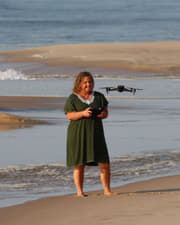
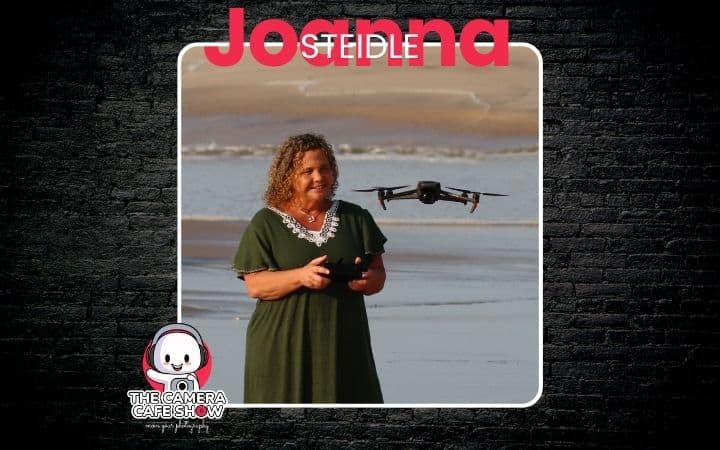
Today’s episode is one I’ve really been looking forward to sharing with you! My guest is not only a multiple award-winning drone photographer, a long-time friend and someone who’s work I admire immensely, but her work has appeared in places like CNN, The New York Times, Newsweek, the Smithsonian Magazine, Forbes, and Wired magazine — or featured on TV by National Geographic, Discovery channel, ABC News, The Weather Channel, and PBS —: the amazing Joanna Steidle.
Joanna’s work has received numerous international awards, and I am sure, since we recorded this talk some weeks ago, she has won some more. Joanna is also the only female DJI-drones creator (like their ambassador) in the USA as to date. Her ability to turn aerial views into art that feels both epic and intimate is just incredible, as you will hear in our story. From documenting shark migrations off the Hamptons to capturing swirling snow on empty beaches, she’s found beauty in places most of us wouldn’t think to look — and usually from a few hundred feet in the air!
We talk about her journey into drone photography, how she developed her unique eye, what it takes to master this kind of gear, how her relationship with the natural world has deepened along the way….and gear, yes, this episode we will talk a bit about gear, what Joanna recommends starting out with in drone photography and with which regulations you need to comply. It’s a chat filled with insights, some great behind-the-scenes stories, and plenty of laughter from the woman with the curly hair who loves seagulls.
And hey — if you enjoy this episode folks, don’t forget to like and subscribe on whatever app or platform you’re tuning in from. It really helps others find the show too! Now, hit play, buckle up, and let Joanna’s passion for drone photography lift you a little higher.
Tom: Welcome, Joanna, today on our podcast. It is a pleasure to see you again and to have a little talk about photography.
Joanna: You too. Tom, thank you so much for having me. It's an honor.
Tom: It's my pleasure. I really enjoy talking to you for everybody at home. I think we know each other for quite some years. I think it goes back six, seven, maybe eight years. I don't know, long time.
Joanna: Time. It could be long time. I'm a big fan of your work.
Tom: I remember your first steps in drone photography. Let's say it like this.
Joanna: A long, bright, I look at the stuff I did when I first began and it's like scary. But it's part of my story. I grew thanks to people like you that inspired me, in many ways to improve and do better and it's been
Tom: Let's talk about your amazing work, about you now. Joanna, your work featured in National Geographic, BBC, Discovery Channel, used in multiple news outlets. You had expositions, you won major drone photography awards, and you were A DJI drone ambassador. And I am sure I'm forgetting some things in the middle. Did you ever imagine your career would take off like this?
Joanna: Not in my wildest dreams, I still don't. Actually, most days I don't think my work is that fantastic. I just think it's part of the journey and there's lots of ways to improve and I dreamt, I dreamt a lot. I hoped and I dreamt really hard and that's just what happened.
Tom: And it paid off? It paid off all these nights getting up at 2:00 AM?
Joanna: I do a lot of promoting of my own work, I'm on multiple platforms. And I'm a big part of the drone community, which is a worldwide community of drone pilots that are really interested in the photography and videography. I've had some incredible mentors. It's one of the first things when started, when I decided that was purpose.
And I distinctly remember the moment, like I first got a camera drone and I had taken that first photo of a lantern room at the top of a lighthouse. It was, I could feel it in every cell of my body that this was my purpose, and then I needed to learn everything I possibly could. And I still, every day it's pretty much I wake up feeling like I don't know very much, but I'm open to listening and experiencing whatever possible.
Tom: Just to be clear, Joe, before you picked up a drone with a camera, you had not experienced photography whatsoever.
Joanna: At all. None at all. I know. I still don't really know much. I feel, I know it looks good to me. I know I like things that are different, unique perspectives. And I didn't want to go down a road. I initially started doing kinda landmarks and landscapes and things like that.
But when I first started to pick up drones, I spent a whole first year just learning how to fly. I got a tiny little drone like this and I learned how to fly it manually. I crashed it. I learned how to rebuild it and replace all the parts and then crash it again. And over and over. And that's, then I got the camera drone, and it took me a while.
I've really only been into the photography about five years. I think it was 2019 that I made a conscious decision to focus on that; I was pulled in a lot of different directions. I was very interested in the legalities, of the laws. 2016 is when we first started the drone laws here in the United States. And then we saw laws popping up in different areas of our country. That interests me the security aspects using drones for security and how they might affect our, my homeland and whatnot. Also, search and rescue were a big interest to me using drones to locate in emergency circumstances.
There was a lot of different things, but then it was the photography. I said that this is it. Most of my life, I do have a background in computer science visual design, websites. I did graphic art, I did marketing promotion. I had a experience in Adobe Photoshop. And in 2019, one of my mentors said, Joanna, you have to learn Lightroom. You have to, it was a different step. And along the way I haven't learned things proper way from the beginning. But I'm going back and learning them now, little by little.
Tom: You were the person that if you buy a new drone, you read the manual jaw or not,
Joanna: I do. I read quite a bit of it, a lot of the sections that I know are new and different as an upgrade.
Tom: Then Joe, this drone photography is of course completely different or gives you a different perspective than ground photography. What are some of the biggest challenges that come with shooting from the sky?
Joanna: What? There's a lot that goes into it before you even take the drone up. I have to get it registered. Does it have to be registered? I go through safety checks. I have to be aware, I have apps on my phone that tell me where all the planes and helicopters are. You have to those, of course. Pretty much the main rule, I have to stay within 400 feet high here. And then my challenges on my side is I live on Eastern Long Island in New York, and it's pretty flat. We don't have any mountains and we don't have any real tall buildings. When you're up here, you're looking at a flat landscape, there's not much there. What I have to do is try to find that spot, because on the ground you're limited in the air. I could fly any direction, any height, a camera, angles and whatnot. One of the things that I started to really focus on was top down where the camera is pointing straight down the land, which works great in a flat landscape. If you have something interesting, or shadows, you do shadows top down, it's a whole different vibe.
Tom: And of course it gives you also a very different perspective. What are some of the most surprising things you discovered from above Joe?
Joanna: Oh, one of the most surprising things is marine life. We had a major resurgence here in New York of the bait fish called menh. Have sharks and whales and dolphins and rays that were coming in close to shore, means I can launch freight from the beach. I don't need to be on a boat. That was really unbelievable. You can see the whales and the dolphins from shore a little bit, but it's such an incredibly different perspective. That goes for all the waterways. We have a lot of marshes and waterways that just create these abstract visions.
I really look for the composition first and try to get that frame. When I first started I didn't even know, get that frame for high resolution. I was just snapping away. Now it', a much tighter control of exactly what I'm looking for. Anything different and unique. My newest drone has got really a great Zoom lens on it. A 1 66 millimeter, that what that'll do is give me a really nice compression on the land, which just opens you up to many more possibilities.
Tom: I was wondering, Joe, if you have this view from above from nature. It kind of gives you almost like a spiritual connection. A bit.
Joanna: I have a spiritual connection before I even take that drone up. There's a whole kind of baseball player does before they're going to bat. This ritual of this, whatever they do, it's. And the spiritual connection is really, really important to me. And I always ask Mother Nature help me find what she wants me to bring to the world.
Some moments are surreal. And I really like kind of action type things. Like the fish and the whales and birds and surfers or cars or anything that's moving that I can possibly chase it, is fun. Those moments that are fleeting and will never have again. It's very spiritual. When I first saw my very first humpback whale, I just couldn't believe it. I just couldn't believe. I had been searching it wasn't like a surprise, but I had the camera face down and the whale came under into my frame. It was like my hands started shaking a little bit. And I just knew that, take a deep breath 'cause I am flying an aircraft. Number one. Number two, I had to respect the distance. We have approached distances for whales and that's about a hundred feet here, close to a football field. And I got one of the best clips of my life that first dime.
Tom: It's not the picture we see in the back, Joe?
Joanna: Yeah, this is. Same whale might not have been the same moment. I have a lunge feed, they jump out of the water and feeding on fish. It's a surface and they move their bodies, and they go through the school of fish like this. It's something relatively unique to my area in the world.
Tom: But then, but then of course if you do landscape, landscapes are sitting still, but then you do sharks and whales and dolphins and stingrays, and this is all moving very fast. How you prepare yourself with this flying.
Joanna: I just make sure all my settings are before I go, when I'm up there and I make sure I need filters for specific video type footage. Polarizers in the water when the sun is upright. And then I just make sure my settings are exactly where I want them to be I can switch between the photo and the video relatively quickly.
And when I do the marine life, which I've been spending most of my time in the summers doing, you get used to looking straight down, searching for things. When I went to New Hampshire for the foliage this year, there is nothing moving. You just accept the sun. Or the clouds in the sky. And you have the cameras almost always pointed this way. There is some top downs I do, but very different, but I like that I wouldn't wanna do the same thing. Just, just can't. And it's one of the reasons I think I really have stuck with the drones work.
Throughout my life, I had a whole bunch of different types of careers. A music store, I had as a jewelry maker. I did video installations and user interface designs and database administration technology director. Then just a basic consultant in any kinds technologies. Website designer, I said that I think. But I always got bored. I always got to a point where I would do something great and big and then I'd be like, let's learn something else. And in this world I can do variations. I'm shooting and each time it's different. I get that all in one which is what I've been looking for my whole life,
Tom: Each time I open your Instagram, it's something different. I love it. You always surprise me.
Joanna: I'm glad you think that. Because when I first started everybody said, You have to, if your work should all look the same, you should have a style and focus on one thing. And, and I said, I tried that. I was trying to force things too much and I said, What? Just screw it. Just screw it. And either it works out or it doesn't, and it's been working out pretty good. Turns out that I do have somewhat of a style and people recognize my work and,
Tom: Joe, let's dive into gear. Normally we don't do a lot, but today with you, we're going to do gear.
Joanna: Let's do it.
Tom: Let's talk about your tools of the trade. What are you currently flying with?
Joanna: My main go-to drone is the DGI Mavic 3 Pro. It's got the three lenses, it's got the wide angle with 24 and up to the 1 66 millimeter. That I also have a DJ IAV 2 FPV drone, which is first person view. I fly that with goggles. That I need a visual observer, just to be compliant. That I love. We love that kind of footage. It's not photography. You have to do only video with this. You could do photos, but you don't wanna, that gives me the fighter jet feeling that you're zooming, and that's a drone they used to fly up the side of a building and down the building. That's very exciting and fun. And I also have the DGI mini 4 Pro. I think I won it as a prize. And that's my teaching drone. That's what I give lessons with. It's an easy beginner drone and it's also has a vertical camera. When I have to do short vertical shorts for a client I'll use that.
Tom: And the Mavic three Pro, what makes it stand out?
Joanna: The zoom lens. The zoom, I can finally, I can see a mile down the beach. I could see a whale spout a mile down the beach. Plus I can get better footage because, I have to stay a hundred feet away from the whale, 150 feet away from seals. With that Zoom, the shots gotten much better. And like I said, I can spot things from far away. Like I can spot a flock of seagulls also way down the beach and say, Oh, let's go to, let's go see them, let's go. And the seagulls are my friends, I've been flying around them for a long time. They know my car when I pull up 'cause I bring bread, they get a treat. They know the lady with the curly hair. They're kind of great birds and they've come to not really even care about the drone.
Tom: You fly between them, Joe?
Joanna: I have, I have, I try when there's a large amount of drone significant amount of birds just hover the drone. You hover and just stay there still, avoid you a whole flock. You can have a huge flock, fly through you. Long as you're not moving, they won't hit you. Thing is, is once you start moving around the birds, they don't know which direction you're gonna go and you could hit them. We definitely don't wanna hit them, but I've, I've flown around the seas enough that I do know them pretty and how they move. And they literally glide sideways back and forth along the shore. And I studied them. I brought bread and I watched the way they come up and go down to the bread, but then fly away. Real low to the ground, You know, we can study the way they're moving. When they're, when it's a golden hour and you've got the shadows, I've done that too. I go like to same locations different times a year, different times a day.
Tom: Exciting all and, and memory card wise, what you're using.
Joanna: I use the extreme micro disc sand disc, extreme pro, the black ones. A faster speed for the video. Yep.
Tom: And you talked about this FPV drones, the fast ones, because I remember we talked about this, you started out with flying fast drones. Joe, without doing photography.
Joanna: Oh we wanted to be a racer. That was the thing. That's why I started, I wanted to race these drones. Drone racing had already started, I knew I was like late for the party, but when growing up, I kind of wanted to race cars, I like to go fast, I do have one. Do you wanna see the FPV?
Tom: Show me, show me.
Joanna: Alright, this is the Avada FPV. She's like this, she's got the camera. And this is a DJI action five pro. I put that camera on top. Little one for this light thing. But camera is much better than this camera and I love it. I'm flying through the trees, over snow covered bushes and stuff like that.
Tom: The most extreme flight you made with the drone?
Joanna: I've gone through art exhibits of millions, millions of dollars. Millions and millions of dollars worth of art. When you fly inside, close to some high-end art. I fly in stores and, we like it. It's fun.
Tom: This is also the one you use, Joe, when you fly through houses?
Joanna: I do through houses, art exhibits. I did Christmas video of a department store. You can go through restaurants, I can fly through trees because the props have that guards around them, it can bump into something and bounce off. Like branches or reeds or grasses can get caught up in the props and that's a problem. It does if you've kind of a situation where you have to go for it. You can't be sitting back. And I think I equate flying to like tennis, the more you practice, the better you get. And I found that in my whole photography journey. It's very similar too, you have to play with people that are better than you in order to improve your own skills. You don't improve by playing with people with less experience. I always tried to myself to been a lot of people that have helped me along the way.
Tom: If for a total beginner, what would be a good drone not breaking the bank, and what would I need permit wise to start?
Joanna: I can only tell you about United States. EU has some others. The many 4 pro that I have it’s the DGI mini 4 Pro. I've had a lot of people just buy that one. Not sure what the pricing on that is now. I think it's gone quite down quite a bit, but I always suggest that a beginner get a hubs in like H 107. They're very much smaller drones. And first learn to fly that first and then get yourself a camera drone.
Tom: Because if you fly through a house, Joe, you have now the experience to make in one go or you also need to practice still.
Joanna: I practice every day pretty much. But when you're flying the FPV one, the best shots are called one shots. You take off, you fly up here, you fly down through the front door, go all around the house, up in, out the balcony, around the chandelier, and do it all in one flight. And that calls one shot. I would suggest, as for learning, that's what I suggest beginners do. I have that drone I can teach people. A lot of people don't even know if they wanna fly drones, it's an expense just to get one and find out you don't like it. But I've never experienced that. Everyone who tries to fly loves it. I can help people consult on which kind of drones would best, best suit their needs.
If you're gonna be doing photography, you really need the DJI Mavic 3 Pro. You can get away with the Mavic 2, but I would suggest to Mavic 3. Again, like I said, I suggest the small ones for beginners. And I would suggest reading our Part 107 regulations here in the United States. There's some basic things, avoid demand aircraft, don't fly over 400 feet high. Keep the drone within your visual line of sight. Don't go flying, try flying it a mile down the road. Unfortunately, we don't have much enforcement here in terms of those regulations unless it's a safety issue. Like, we recently had a drone hit a plane in the California wildfires. And then what happens is all the planes have to come down until drones are identified. 'cause you can, they're the prop spin and you can get cut.
Tom: But for this also, you need a permit. What I need when I start out?
Joanna: The very first thing you need to do is get a trust certification from the United States FAA. That is a T-R-U-S-T. It's a free course offered the FAA, it takes about 30 minutes and it makes you certified to fly recreationally. In order to actually sell your photography and your videography, you have to take a major pilot test. It's called a remote one Part 107 license, and it's issued at certain flight schools. And what you have to show up in person and that test is very similar to a private pilot exam. You have to know airspace. You have to know airport information in terms of approach distances, how to read all the maps and identify risks. And then you also need all the Part 107 regulations, which are the drone regulations such as restrictions, flying over people, moving vehicles things like that.
Tom: You see, it's all not so very easy because I think many people will just buy a drone and throw it up in the air and start flying.
Joanna: I know. I would only say 20% of the people I know comply with the regulations. I don't really have a choice. I can't expect, number one, I don't wanna get fined. Two, it's the law. And number three, I can't really put myself out there as a role model, if I'm not compliant.
Tom: Exactly. Joe, let me talk, or let's talk about your artistic view a bit, what you think. A lot of your workplace with this pattern, symmetry or abstraction, you look for these things when you fly or it's more an instinctive thing.
Joanna: I think that my greatest personal asset is my eyes. I see things. What often I do is when I was first starting out, especially, I went to a location, I'd take the drone up and I would spin it and take a 360 video. And when I got home, I would really inspect that video closely, to find any little nuggets in the landscape. I particularly look, and I can very easily get distracted. By like a flock of birds. Ooh, let's go, let's go follow them.
But I'm always trying to find something different and being that. You know, when you've got a camera on a ground level, you could be a mile away and take a photo. But when you're shooting these top down abstracts, you're only 400 feet away. Often what I have to do is my camera's pointing down, would go take one photo here, here, here, like six photos, and then merge all of those. It really looks like I'm way up in the sky. But I'm not, I’m still compliant with all the rules and regulations.
Tom: And I think about the aspect of light. Because, we photographers, we always talk about light is the most important thing. This is the same in drone photography.
Joanna: I think composition is for me. Light is definitely important, but if I get a good composition, I can do anything in post. Do anything I want with it in post. But the light is important. It's the best especially in terms of video footage is always golden hours. It just, the way it lights up the landscape is far more powerful than something midday.
Here what I'll do is I'll during the midday, I'll shoot anything I need to shoot without shadows. You know, if I have to do a property, often properties are surrounded by trees, tremendous amount of shadow, something like that. And on cloudy days, we can do something more oriented towards drone caption, inception videos of photos are really neat. They're another merge. I could send you example too if you want. It's another merged image, but it'll look like the photo itself will look like you're looking up a road and then flat. It’s kind of a warped view of the world, interesting things you can find. But I do love to shadow play. Got some tennis or court shots where, my daughter-in-law, she's fantastic, she's posing and she casts her shadow. And then I put the tennis ball in the shadow. She's not actually hitting the ball, but it looks like that in the shadow. Little play on.
Tom: Very creative!
Joanna: There's much you can do. It's unbelievable, you know?
Tom: But then, this is creative and then we have the other pictures like how is called your picture in the Sienna Drone Award that won the gateway,
Joanna: Oh, the shark.
Tom: The shark one. Tell me a bit of story behind this image. It's an incredible image.
Joanna: Thank you. That was a good one. I have that moment and I have a bunch of seconds before and a bunch of seconds after. Basically when I'm shooting the marine life, I have to capture them at the very top of the water. 'cause if they're submerged under the water, they're not clear. That shark was very see on the top of the surface. I was able to get a relatively clear image. I can tell you that here our water was brown. It was brown. And it's not the photos I see from the Pacific Ocean where everything is bright blue, got this royal blue to it. We have more of a green, a green look to the water, but a lot of times it's brown. That photo also had a few hundred water bubbles spots on it. When you have the fish and you have the whales and they're kicking up water, they're kicking up bubbles. I had to go into, I went into each and every spot and I stamped them out according to the lighting around it. You can imagine how fun that is, but very much worth it.
Tom: Let's talk a bit about editing then. Because I think editing is a very big part of your process. Joe, walk me a bit, just a bit quick through your workflow.
Joanna: Tom. I don't know what I do. I don't, I pull everything into Lightroom and I just kind of fiddle around and fiddle around until I know I've gotten to a point where I need to like, either start stamping or I can't quite control the color as I want to. I pull it into Photoshop. Do a lot in Photoshops.
What I don't do is I don't interfere with the integrity of the photo. I don't take a shark and move it. I do have a few composite photos that I put out there and make sure people know their definitely composites. But what I do is I go through the edits, I get all excited. I'm like, Oh, this is great. I love it. And then one of the keys for me is to put it aside and wake up two mornings later and I'll look at it and I'll be like, Oh this is off. Way off. Like I think it's really important to take my eyes away from the subject that could go on for weeks or months. It really could until I am absolutely until the day I wake up and I look at it and I'm like, that's it. At a couple years later and I'll change it again. Now that we have a little bit of more experience, I can look back at some of the photos I did in Lightroom, I mostly handle a lot of the lighting, and a bit of the color. Then I take it to Photoshop to stamp out all the spots. And I really look at every single pixel. Sometimes I'll use the paint brush to smooth water out or to grass out or I'll leave it noise when I want, kind of like a sandy rough look. And lots of layers, masks.
Tom: You ever have people telling you that maybe in the pictures that you create, they look like AI pictures?
Joanna: I have had that, not as much. I have had that, I've definitely been accused of that. Not much recently. Because I always have the raw, I can just prove.
Tom: Now we talk about raw files, I think when you started out, you threw them away, and then what happened?
Joanna: Man. I didn't know. No idea. 'cause I always worked in Photoshop, I didn't realize that Lightroom was feeding off a folder.
Tom: And then I think you won a contest.
Joanna: Oh I was chosen for a Sienna award, I had tried for the Sienna Awards probably I think two years before I got my first one with them. I was like, Oh, great. They needed a raw image. I don't have the raw image. And that's when I realized crap. Now I really, I couldn't enter anything that I didn't have. And which was hard lesson to learn, but I learned it throw anything away. I just got bigger hard drives.
Tom: It's the way to go.
Joanna: I just got bigger and more hard drives and view. That was disappointing. But I know, a lesson learned. I learned a very big lesson. And when Lightroom can't find the file, it was like, Oh no!
Tom: We all have to learn.
Joanna: Lots of mistakes.
Tom: It makes it fun also now to talk afterwards.
Joanna: Sure. Of course, of course. But that's why I give lessons too because I can tell people mistakes that I've already made. They don't have to make them, brings a certain value to the lesson and the course. So basically some of the private lessons, I just do an hour lesson with people, and I can really cut the learning curve like six months to a year because it's just much to learn even before you get.
Tom: Joe, let's talk just a little bit about conservation. You don't just capture beautiful images. You also work closely with the NOAA to track marine life?
Joanna: I do send them all my whale sightings. I send I notify them. I give them coordinates and photos of whale sightings. I work with them. I've also worked with Theodore Roosevelt Conservation Center and the nature Conservancy here. And I most recently was in the Vital Impact. I was like, Oh wow. I was honored to be chosen for that. And that really helps more on a global sense. I've also worked with a French physicist that comes out and books me for a week and we do documentation and he studies schools of fish. Anything involved in the science. I learned how to measure and document the length of sharks and whales. It just requires specific height and a reference card and that was very interesting. I think in terms of the environmental and the conservation, the most benefit that I can do is just put my work out there. A lot of my videos end up on national tv, BBC, National Geographic.
And I think that the more people see perspective or something beautiful in nature, they're more inclined to put the devices down and just go out and experience it, And the more you experience the natural world, I think the less stress you have in your life the more peace and contentment you can find. And that gives you a greater appreciation of our planet.
Tom: How do you think drone photography, in particular, can contribute to conservation, Joe?
Joanna: Oh gosh. There's many things that can be done with the drone photography. We also have drones with thermal imaging for agricultural purposes that can return the health of plant life. You can also see document erosion on our coastlines. And the effects of replenishing that. We have wind turbines going in. You can document that. You can really study the marshes, the flow of the tides by going at different times a year. The ice formations, that's helpful. But I think that working with scientists directly has helped me understand the best settings that they can really use that for scientific purposes. Some settings that were, I found very interesting.
Tom: And I think you yourself, you saw the change, Joe. When they put the limit to bait fish, catch.
Joanna: The NOAA, like you said, is they put a catch limit on the bait fish on the east coast, the whole east coast of the United States was the first one they put. They enacted that in 2012. By 2019 New York state put a catch limit. They limited a specific type of netting, large amounts of netting, of the bait fish. And that's really when things started to explode. We had like 3 amazing years. Major, major, major resurgents here. But what was happening is it was bringing in a lot of sharks to the coast. In 2022, in 2023, we had seven shark bites. Of seven shark bites here which we hadn't had in a long time. And it's really only because the bait fish were close to shore and the sharks were feeding on them. I could tell you sharks really do not want to eat humans. They don't. And that's why I think a lot of times they'll bite and release. Like, what is this?
But then what happened is I found that some of the laws had changed. And last year we had about an 80% decrease in the bait fish along the shore based on my records and some other marine biologists I had seen. But I can't conclude that any one reason for that. A calcium tide that could have sent them up north. We had, New York State reopen the purse signing, I thought that influenced things. We had the wind turbines going in. I thought that might've influenced things, but I'm still doing quite a bit of research. We're hoping that I think last year they really just migrated further north to main area. There's quite a few counted up there. I have to kinda wait the counts and the numbers come in, to study things a little further. I just document visually, what's happening. I keep detailed what I see, when I see, any kind of species. Sometimes sharks are hard to identify. In terms of the breed, either they're too far under the water, or looks close to each other. Like a spinner shark and a black tip look very close to each other. And if you can't see the fin on the underside, then you just don't know what it is.
Tom: I'm a diver. If you want, I can join you and I can go in the water and I can find out.
Joanna: That would be great. As long as you have like a little buzzer I can buzz you. When a shark comes a little too close, we'll buzz you.
Tom: And you can always clone me out in light room later.
Joanna: We can. I do have the action five that I fly with this camera also an underwater camera. I have swam out. You really don't wanna swim in those bait balls. I'm more scared of blue fish than anything else. The blue fish will just, a school of blue fish will just tear you to the bone. If they're more skid of us. But people, surfers like, have severely damaged foot from blue fish.
Tom: Not a nice experience.
Joanna: Out, Tom.
Tom: Of course. Of course. My private lesson. And then I can maybe win some awards like you did, Joe, because let me think. What you have highly commanded in Wildlife Photographer of the Year. You did the same in the Sierra Drone Awards, you award in Shark Fest for with your videos and National Geographic, this book World from above. What does it mean for you, Joe, all this?
Joanna: It's honestly, the contests are a business decision. It's not really about winning or competing. What happens is after the first contest major contest and it was a DJI Sky Pixel contest and I won, I think I might have won the MIni 4 but I had idea my work was even close to DJI as one of the top platforms for drone photography. Air VS is probably the top platform for drone videos. And the Sienna Awards is really the biggest. It's like the awards for drone photography. And what I had noticed is number one, when I won the sky pixels, I said, Wow, I get this free prize. I became a creator for DJI, which means they promote my work. They give me drones, promote my work, and I get prize money. All in all, you know, and honestly, it's mostly about the publications. Because Sienna Awards, what happened I was in Forbes Magazine and Wired Magazine and like-minded magazines all over the world, some contests don't really get publicized. I really wanted to focus on the contest that get me publicized. And what happens is, is it just it kind of snowballs. There's like bit of a snowball effect. Forbes will share it, then somebody else will. On and on. And that's why I do it. Because that's how Vital Impacts found me. It's how National Geographic found me. We just keep going. And what happens is now I've got some photographers that are like way much more successful, in their missions and branding and stuff, or, Look at you, you found me and you are interested. Just the fact that somebody notices my work. It gives me a little inkling that I'm going in a direction. I didn't win at first, I had to kept trying. I learned the judges. I see what the judges like, I look at previous winners. There's a lot of research I do. And over the years now it's getting a little bit easier. But we like prize money. Come on.
Tom: Of course.
Joanna: A lot of money one year on the prize money, I was like, Oh, I will not stop doing this. It's a big help when you're first starting out
Tom: Of course. The DJI ambassador you are, I think you're the only female one in the United States.
Joanna: I'm, I'm a creator, technically it's called a creator. I'm an ambassador with women who drone and I'm a member of Women and Drone. But there’s no only, I'm a Sky Pixel creator and I think there's only 10 women in the world, 10 of us women in the world. And I'm the only one in the United States. I think there's only eight creators in the United States total.
Tom: They pick you up.
Joanna: They picked me up from their Facebook group. DDI noticed my work. They thought it was great. They asked me to moderate of their groups and I met a wonderful group of guys who have really helped me along the way. It's like a little family. We moderate the group. And one of the admins that worked for DJI basically said we're giving you a platform. Show us what you have. I really listened to what he said and I said, Let's go for this. Let's do everything we can. And it just happened. It was a great opportunity. I'm part of the creator chat, I can hear what all the guys are chat yapping about. About all the new gear and what they're doing, and where to go, you can meet up with people. If I ever get over to the volcanoes in Iceland, I know exactly where to go and who to call and stuff like that. The community around the world is a real blessing, and I really hope to give back. I have about four or five female mentors. I should say four now. The other one is pretty much beyond me. I take women under my wing and people that I feel have a real passion to improve and I can help them. It's a wonderful cycle.
Tom: If you ever make it to Spain, I will invite you a coffee because I dunno where you have to fly, but you, somebody will know
Joanna: I know a few people in Spain.
Tom: You see.
Joanna: What a beautiful country.
Tom: How is it going to print sales, Joe? Because you're printing at home?
Joanna: Nope, I don’t print from home. I go through a printer. And I ship, they just ship direct to the client. But I also have a local woman that I use for galleries and exhibits. She does amazing work. We like having our photos in the window of a Hamptons store. That's always nice. It's one of the ways of getting stuff out. I did just sign with my first international photo gallery. I'm excited. You have to watch and stay tuned for that announcement this spring.
Tom: You always surprise me with new things you see?
Joanna: I'm excited. I do put in the three to four hours a day promoting,
Tom: Of course.
Joanna: Just taking a long time, but it's working.
Tom: It is paying off.
Joe, I wanted to touch just a little moment. I think there is a bit of political turmoil around drones lately.
Joanna: We had these drone sightings. People said they were seeing drones, large amounts of drones hovering over and flying low in the sky. That really from everything that I saw online, it all looked like manned aircraft. It's like people never looked up in the sky on a ever before. I see them all the time, red and gray, green flashing lights, and whether it's satellites and stuff. There's a new prototype. Looks like a helicopter manned aircraft that they're running tests on. That I believe was probably what was happening here. We had the crash a drone crest in during a rescue mission, which is very disturbing to those of us who comply. I don't care if people fly beyond visual line of sight and sell their stuff without being certified. But when somebody interferes with the rescue mission it really makes the community unhappy.
Tom: Of course.
Joanna: One then we had the drone show where the drones malfunctioned and one hit a boy. Was just devastating to hear. They wanna ban the drones, they wanna ban DJI. Some people are really intent on banning them here, we don't have any other drones. There is other, there's a few other manufacturers, I've tried them all, and they're not even close to DJI. It would affect a couple million people at least. But I read a lot. I read up on it. I have good sources. I think one of the tough things beginning to is finding accurate sources of information or where, people you can trust, you can read and you can trust what they're saying is true. I've got a whole list of those too.
Tom: A bit on a brighter side. If you could take your drone and you'll get a ticket to anywhere in the world without restrictions. Where would you like to go?
Joanna: Oh, come on. That's a tough one. I only get one choice. One choice really?
Tom: You have to have a number one.
Joanna: One? Oh, Iceland would probably be number one. Probably be the number one with the volcanoes. And the waterways. And the icebergs. Plus there's even whales there,
Tom: You see him?
Joanna: We'd like, that's another bonus. Whales. I'd like to see Australia, South Africa. There's Portugal and Spain. We'd like to do Italy. I'd like to go all over. Really, really. And then of course there's a lot of marine life, I'd like to study in The Bahamas area. My understanding it's a real hotspot. Couple of hotspots for that. One day I'll just pack up a van and I'll travel across the US first. And then, we'll know, hopefully we'll get to reach these other areas. I'd like to get a killer rail, know an orca that is the top, actually the top of my list. And orca or whole pot of orcas.
Tom: You see.
Joanna: Dream big. Let's do a whole pot of orcas.
Tom: You just listed five and already I asked you one. Then we make it easier. Joe, what's the most memorable flight you ever did?
Joanna: But the whales.
Tom: The whale one.
Joanna: The first whales lung feeding. Yep. Yep. It's really sticks with me.
Tom: I think you only sleep maybe five hours every day. I think that day you didn't even sleep.
Joanna: Sleep. Probably not. I have to sleep. It's really important because you don't wanna fly a drone when you're too tired. What I do in the summer when I'm like at the beach trying to catch stuff, I go early. Sunrise and any kind of golden hour. Usually I'll come home for like the midday, when the sun's are highest, take a quick nap and then go back out until the sun goes down.
Tom: It is a perfect plan. Joe, we will end now. But wait, don't go away still, after you see my screen even goes out. Joe, I think we have to round it up here because I think you have something more exciting later to do.
Joanna: Not more exciting. Just different.
Tom: It's a different, another interview. Thank you very much for our talk and I hope there are months between before we see each other again.
Joanna: Thank you for having me. It was such a delight getting to talk to you. Hopefully we can talk again and I can ask you the questions.
Tom: Who knows, Joe, thanks. We'll be in contact and have a nice day still.
Joanna: Thank you. Bye
Tom: I see you. Bye.
Outro:
And that’s a wrap on today’s episode with the brilliant Joanna Steidle. I hope you’re walking away with some fresh inspiration — whether it’s to try out drone photography yourself, or just to start looking at your surroundings a little differently.
You can find links to Joanna’s work, her website, and some of the stunning images we talked about right in the show notes. Seriously, go check them out — they’re totally worth a look.
If you haven’t already, be sure to subscribe to the show, and sign up for our newsletter so you never miss an episode. We’ve got more amazing guests coming up, and I can’t wait to share them with you.
Thanks again for hanging out with us today, and as always… don’t forget to move your own photography. I see you next time here on the Camera Café show…adios!