

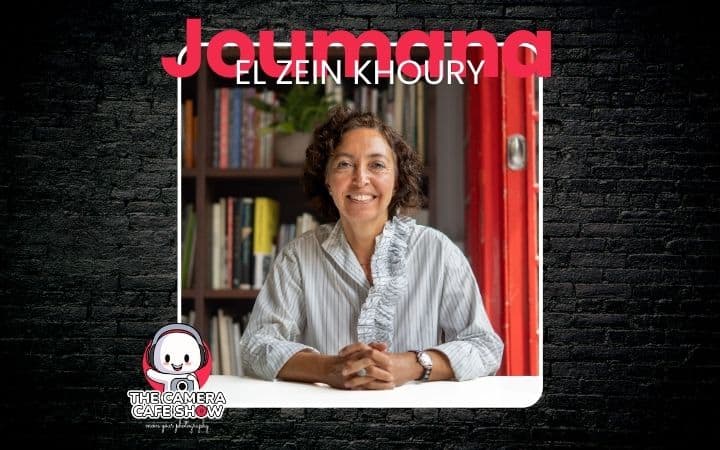
Tom: Good afternoon, Joumana and welcome on the podcast. It's a pleasure to have you here for a little talk about maybe your live photography and of course world press photo.
Joumana: Yes. So nice to have you to be here with you. Thank you so much for the invitation.
Tom: No, it's a pleasure. And of course the total coincidence that today we do the interview and tomorrow, what day is it tomorrow?
Joumana: So tomorrow we're actually going to be having the presentations for the Joop Swart Masterclass participants for the 29th edition. And yeah, and then we're gonna be doing also a whole public program around our seventh year anniversary. So it's a very exciting week this week.
Tom: I'm sure you're not going to sleep tonight. Ah, well with three kids also. Maybe it's difficult!
Joumana: Well, they're big now, so it's okay.
Tom: Joumana, you were born in Beirut, I think you were educated in Paris in New York, now you live in the Netherlands. Pick me one favorite cuisine if you have to eat it for the rest of the week.
Joumana: Lebanese! People will pick that cuisine sure. It's yeah. The thing is that we had to leave Lebanon because of, I was born in 75 when the war had just started, and so we needed to migrate from Lebanon and then we were thinking, okay, one year, two years, and then, yeah, 50 years later, we're still out of the country. But it is still my home country, despite all of that.
Tom: I was going to ask you if you moved a lot, Joumana. How you feed that connection with your home country when you were so far away from it.
Joumana: Well, I think it's quite interesting. I think, you know growing up you know, whenever people ask me what nationality I am, my, you know, I always say I'm Lebanese actually. So Lebanon has always been and continues to be very close to my heart, and my home country. But I have to. Say growing up, of course, you know you're always searching for your identity, especially when you don't grow at home and you grow in different cultures change different countries, different languages, different foods, different norms, et cetera. But around 10 years ago I met this. This writer, her name is ak. She's a Turkish writer, and she said that she feels like a nomad home is actually, she takes a bit of everything from every culture that she goes into and she lives in. And then her home is what she keeps in herself from all of these different cultures. how I like to identify myself today is, feel a bit at home in different places and it's because I take so many things in me and it's a richness to have that. And, in our world that is so polarized, so closed up upon each other, so much lacking of dialogue and people not wanting to know, you know, what the others are thinking or the perspective of the other. I think this is really actually.
Tom: Hmm. I mean, culture in itself, it's richness. It's, it's basically , like food , or,
Joumana: Yes.
Tom: having, having a roof above your head, I mean.
Joumana: yeah, it's a, it's a basic need. I mean, it's as much a basic need as food and housing and health.
Tom: Mm-hmm. Mm-hmm. Hmm. Mm-hmm. Yeah. So your. In WordPress photo, we will come back to it in a moment. You are a non photographer.
Joumana: Yes.
Tom: If a picture, you know, they always say a picture is worth a thousand words. What is a question you ask yourself? Humana, when you see a winning picture or maybe a selected picture for that matter before anyone tells you what the story behind this.
Joumana: I mean, I have to confess, I really don't like the quote of a picture is worth a thousand words because even though a picture, you immediately have. reaction towards a picture and an emotion that a picture can give you. When you really read the picture and understand the caption and understand who took the picture, then you're able to, read it in a very different manner actually. of course images are a universal language and that is a richness in itself. But it can also become a danger when in our world today when there's so many images that people are consuming on a daily basis in such a quick manner. not even taught to be able to read these images in a proper way, then it becomes quite dangerous actually, because then they're only thing, okay, I only I'm looking at what I am, I'm, I'm, I'm experimenting and experiencing what I'm seeing without wanting to know what is behind it. And that is, I find very problematic in a world where there's polarization, where there's. Fake news where there's people who react without pausing and thinking that becomes very dangerous.
Tom: Mm-hmm. But on the other side, of course, we have. With all the social media there is coming out, much more work than ever and it's amazing. It's only that we need to stop and think what we are seeing,
Joumana: Yeah.
Tom: I'm seeing so, many people with so many great projects now and it's
Joumana: Absolutely, there's a richness to it. And, you know at World Press photo for example we only allow professional photographers to enter their work to our But the definition of professional photographer has really evolved since years. So at some point it was. A professional photographer could only be someone with a press today. A professional photographer is someone who has so many followers and has so much impact on social media also. That is also, and in that sense, it's, it's an incredible tool and, and power that you can take in your hand. a photographer anywhere around the world, if you know how to use it in a proper way. especially when the industry of photography and the media industry is becoming so complicated, And, much, so much linked also to freelancers, et cetera. So it gives it much more freedom for photographers from around the world to be able to share their work.
Tom: Mm-hmm. Let's get a bit to you for a moment, Joanna. So your professional career is amazing in itself. I mean,
Joumana: Thank you.
Tom: from you worked in Prince Klaus Fund, the Luana Foundation. The Arab Image Foundation, and then you entered into World Press photo.
Joumana: Yes.
Tom: Tell me a little bit how you got there. You got asked for it or it was like your destiny for your next big project in life.
Joumana: World Press photo. I mean, I think so one thing is Sure is that, i've always wanted to work in the nonprofit and I've always wanted to work in a place where I could have an impact basically. And one thing is that I also knew the importance of, what you were saying of giving power and allowing people to have the power in themselves to tell their own stories and to bring their own stories to as many people as possible. And so in that sense, that's where, you know, my work at the Arab Image Foundation, at the Prince Klaus Fund really, I was bottle fed by it. The Arab Image Foundation is. One of the first places where I really realized it's, it's a foundation that is based in Lebanon it has an amazing archive which is created by five artists who decided to create an archive that counters, the colonial. Photographic history that is made of the Arab world. So what they did is they went and they started this archive and created this archive about the history of the Arab world through the lens of Arab photographers. And it's there. I had like, whoa, just. By photographing the same thing, but through a different lens is a big difference and has such a big impact on how you see yourself as a person coming from that place. How you identify, how you're understood by the other people, et cetera. so in that sense, that has been really my red lines throughout my career. At the Prince Klaus Fund you know, it's a foundation that supports culture around the world. Specifically for development of people. It's, that's where they say culture is a need. And Yeah. And then I was there for six, seven years and I'm like, okay, I'm ready for something new. And then that's where a World Press photo was, and it's in the Netherlands. And what really attracted me to World Press photo one, the fact that. It's an organization that has such a humongous reach and has such a big voice, whereby you can really be able to shift narratives to really touch lots of people. But also I thought that it really was an organization that needed to be refreshed in that sense. And that needed to have to bring in a different eye and a different lens. And that's where. thought I could be of help there. And I think the fact a photographer actually made my work easier Because I didn't have all of this baggage on my, on my shoulders about what you do. Can I do this? So I didn't have all of those, the boundaries that maybe someone who is so into the photography world would have.
Tom: So on your very first day, what outsider question you asked all the board there that maybe a photographer didn't think about?
Joumana: Well, I don't know. I mean, what I did actually in my first two, three months was I spoke to over 300 people and what I did is I everyone to give me, so I asked people, the board, my staff, but also other people who were working very closely with the foundation, give me five names. Of individuals that you think I should speak to and you decide who is important for me to speak to. And then from those conversations I asked every single one, tell me the good, the bad, and the ugly about world press photo. And in that sense, I really wanted to understand. How different people saw the organization, what value it still had, what the problems were in it, et cetera. And it was really great to be able to do that from, to get, to take the time to do that also. And what I learned from those conversations was first and foremost that because that was one of my questions. Is there still room for this organization? And everybody said yes, definitely there is a lot of people said also that, you know, there's a trust that has been lost in the organization, that it was really catering to a certain type of audience and that it needed to be opened up more, et cetera. So, yeah, so that was a bit how it started.
Tom: Mm-hmm. I hear your Democratic dictator there.
Joumana: Yes, I am. I really? Yeah. I think, I think all directors are democratic dictators in any case, because you
Tom: Yes,
Joumana: be,
Tom: but,
Joumana: need to be able to hear, to listen, to ask to listen, and then you need to be able to make decisions at the end and to impose those decisions. If you do right, then you don't need to impose those decisions because people follow you and sometimes you need to push them a bit further in order for people to accept them.
Tom: Yes. But of course, it's because you care for the foundation and you care for the people.
Joumana: Absolutely.
Tom: Also, another thing you did, Humana, it's fantastic of course, is the, is the implementing this regional strategy.
Joumana: Yes.
Tom: Talk me a bit, more about this. This is really, really fascinating.
Joumana: I mean, when I came in we looked at the numbers of where the winners were coming from, and we saw that almost. 80% of the winners were a bit more, actually were coming from Europe and North America, and most of them were men. And I'm like, okay, we cannot call ourselves world press photo when we have that. That's just not possible. And so I said. You know what, actually it was in the middle of the World Cup and I was like, okay, what is the most like global thing that happens around the world or competition?
Tom: Football.
Joumana: okay, with all the problems that it has, of course, football and the fifa, And so how do they do it? And they do it, you know, through among each other. And then they go up and. And that's really where I got the idea of really dividing the world in regions. And then I'm not gonna even bore you with all the long discussions of how you divide in which regions and how many regions and all. That quite an interesting discussion. And then from there you asked photographers to submit their work. In the regions where they have done that work. So if you're a Dutch photographer who has worked in uga, then you submit it to Africa. But then there's a first selection that is done by a regional jury, and that jury , is five individuals who are from different areas of that region, but also come from different professional backgrounds, different cultures, different genders, et cetera. And they do a first selection. They do that in a way that is very different because they do that with a context sensitivity that comes only if you understand that
Tom: There. Yeah. Hmm.
Joumana: that first selection is then sent to the global jury, and the global jury is composed of all of the juror of the different regional juries. it was fascinating to see We were a bit, you know, nervous and excited about what will happen and it was quite fascinating to see that in the first year, 80% of the winners Regional, were regional photographers or local photographers. And that just came so naturally. really incredible it was really very heartwarming to also see the first group of winners because there could see winners who had a very big career who were a FP Reuters, et cetera, but you could also see winners. needed to go and rent their equipment every single time they had a commission and a totally different reality. But then when they came together, they shared the same core and the same work, and the same feelings and the same problems and all of that. And that's very inspiring humbling. And yeah, and privileging.
Tom: mm-hmm. You just make me think with all this, that last week Joana, I spoke with Leon from South Africa, and I think she won last year.
Joumana: yes,
Tom: She won the story of the year, I think, and she's just this amazing, very down to earth person.
Joumana: Yeah.
Tom: She loves a lot and she has so many good stories to tell and I really, really had a great time with her on the podcast.
Joumana: Yeah, no, it's incredible. Each one of these photographers is. Is really call them heroes because world, being a photographer and a photojournalist really a dedication. I mean, off, you don't have the economic security that you used to have. There's stuff photographers in big medias, . They put their life at risk every single day and the mental toll that they have on them is incredible. And yeah, they're really heroes and they're doing that in order for us as a public to be able to see what they are witnessing firsthand. And I come back to, you know, saying that it's. Because knowing that it's all the more important for us as a public and an audience to be able to be responsible in terms of how we read their images and how we receive them and what we do with them.
Tom: Hmm. Do you wanna talk me a bit because you just mentioned it a bit quick then let's say. I'm a photographer in Nigeria or in Argentina, and from the moment I upload my picture and I want to send it to World Press photo, what's the process behind it? Where, it goes and how it gets to the final step. If it would be the winning picture.
Joumana: So there's, off, there's quite a lot of work that's done beforehand. So every year we update our ethic code, our manipulation, check codes, et cetera. And for us it's very important that every single photographer needs to sign an ethic code whereby how did they, know, work on the image. How did they work with the protagonist? What was, so all that is very important for us, and that is updated every year. checks also are updated every single year, basically. So that is also something that is quite important. So then the photographer goes to our website and they upload their work. They have to be a professional photographer, as I said. And there's different ways, and the definition is quite broad in that sense. and then they have to upload the photo. They upload the caption. And they upload also a motivation letter in terms of what was their motivation in making that photo and why did they decide to work on that specific project. And then, that is then divided per region, and then each regional jury member has four phases where they look at these images. So there's four selection phases. first selection phase, we even give the jury members actually a number of seconds where they need to see the images. For example, in Europe, there's over, I don't know, 30,000 images or 20,000 images that they need to look at. the first selection is really done only visually. So they just look at the visuals. They don't know the title, they don't know anything. They just see the visuals. then the second phase, you get the title and then you get where the photographer is from and what the gender of the photographer is. And then. We have a selection of, I think 20 singles, 20 to 30 singles, and then stories and long-term projects that then go to the global jury. And then in the global jury, that's where there's more research that is done around the captions. And the global jury then gets to see what the motivation of the photographer was in terms of taking the image. All that is done online until not all that is done online. So the first phase, the global jury comes to Amsterdam, where they come and sit together and have a week long of discussions around the images. And the final selection is we print all of the images and then you, we put them on a big table and then the jury just. You know, has these incredible discussions. It's actually the best part of the year for me, is when I'm sitting in these discussions and listening to the jury members talk. It's very, very enriching.
Tom: Yeah, and how hard it is to pick only one.
Joumana: Well, I mean, they pick more than one, they pick 42. But the photo of the year, sometimes it's quite easy they know it from the beginning actually. sometimes you're like, okay, I'm sure it's gonna be this one. And then at the last minute everything changes because it's also, Is also a narrative of what they're trying to say about the world today. It's also, it's also a. A message that they put out there. And it's quite interesting because every year the jury changes, which means that every year there is a different dynamic, there's a different focus. There's some juries are, you know, more crazy than others. Some are much more toned down, some are much more looking at the technicalities of the images.
Tom: Yes.
Joumana: it's, it's always fascinating in terms of seeing the dynamic that develops throughout the jury.
Tom: Mm-hmm. No, it must be an amazing, an amazing time, an amazing process sitting there. Yeah.
Joumana: It really is.
Tom: And what you think Joa with these regional changes you made? What, new criteria you think that, these regional judges prioritize , when they see work, because of course they will see it different than, we do. Maybe
Joumana: I think there has definitely. It depends on which region you speak about. It's quite interesting because every region reacts to this regional focus in a very different way. For example, you see in the African region the African regional jury members are very keen and very active in terms of. We don't wanna showcase Africa in the way that done. We really don't wanna go stereotypical, so they're very, like, have quite an activist stand in that sense. Other regions react totally differently, I think what I've really seen throughout is, the importance of showcasing what events were very important in the region also in what way they are showcased and by whom they are showcased. And what is the message that will come across at the end? So definitely I think who is taking the image sometimes is quite important. Other times it is not because the image is just so strong in it by itself that you don't really care. But this year, for example, there was. One photo that has one world press photo that is in the Donbas region. showcasing a soldier from the Russian military who was in a make makeshift hospital actually. And the photographer was Russian, and there was quite a lot of discussion in terms of, okay, what is this photo trying to show and what is the caption behind it? So we had to really ask the photographer without the jury knowing who the photographer us, but us as an is, but us as an organization. What was the whole story around the soldier, et cetera? So because the photographer was also Russian, there was quite a lot of, Sensitivity in terms of what is being said and what is trying to be portrayed here. And in this, in this occurrence, the photographer was showcasing how this soldier was actually a Ukrainian. Who was conscripted into order to become part of the Russian army and who was fighting Ukraine now against Ukrainian army. So it's this that the jury wanted to show. so it is, it is complex actually.
Tom: Hmm. Hmm. I mean, you have so many, images, so many stories to go through. Yeah.
Joumana: yeah. But things are becoming more and more comp so we are really on the frontline of seeing things. So, last year we had quite a number of. Images that were changed without the photographer knowing because the photographer had used a ID Noising, for example. So that is one thing we had last year a whole, question around that. Is it important for which agency a photographer is working for? Does that change the image that is in front of you? So there's really some very tough questions that we need to navigate when we are putting these images out there and that the jury needs to navigate when they're also judging the images. I think that comes very much from the regional setup.
Tom: Hmm. I think that, , you did a fantastic word there because it makes it so it's already interesting, but it makes it much more like personal. Interesting now.
Joumana: Yeah,
Tom: Yeah. Very, very, very well done.
Joumana: Thank you.
Tom: Germana, you are really a bit like, let's say a custodian of history and WordPress photo has, happy pictures and it, but it also has a lot of human suffering or painful moments in the archives. What do you feel when you're dealing with such a powerful collection of human suffering?
Joumana: Depression. I mean, I have to say it does. The contest, it does take me around two to three months to really get over it, get over all of the images that we look at, Through the entries, but also when we have, for example, this year, as you know, we've done this exhibition together with Christina has curated, is called What Have We Done? It was the first time that we asked an external curator to have a cart blanc and look at our archive and to come up with something. And I was very interesting that she found those visual tropes and those very present visual tropes within our archive. And of course, this exhibition does not give any answers as to what we should do or not, but what it does do and what it has had on me in any case, is, okay, what is the responsibility of World Press Photo in terms of how the society sees women today? With so many images from World Press photo that have been awarded of where you see women weeping, which are also of course, images that have been on the front pages of big media, et cetera. How does that image of a woman being really on the receiving, on the grieving, on the not active side, how does that, how has that influence how women are perceived today? Or men rescuing, for example, has the same thing or the black lives or, so it's, and in that sense I always say that. More than anything, world Press photo. What I find is the most difficult is the responsibility that comes with it. I think we are responsible for the captions that we write. We are responsible for the photos that are being awarded. We're responsible for how we showcase them, and we're responsible also for the archive and what we do with it. And so, what I hope, you know, we will be able to get from now for the seven, if we still exist 70 years from now is an archive that also shows differences in that sense basically. And not only and hopefully an evolution in those kind of stereotyping and visual patterns.
Tom: I am sure, but let's go slowly. Let's go 10 years By 10 years. By 10 years. So Joa tomorrow. Yes. 70 years. I was going to ask you what. What things you all have in mind or what things you all did or want to do , for the 70th anniversary?
Joumana: Yes. So we have this exhibition that has just showcased in the Netherlands, that was in South Africa, in Johannesburg, and that will be going to Bangladesh, daca. so that is one thing. We have also a publication that we have done that you can download from our website, with some really interesting texts by great academics around archives and around stereotyping and visual patterns, et cetera. We have also some videos that we were able to make. All that thanks to great support from the Open Society Institute videos that we were able to make with Dan MacLean and , so there's three videos. so please, I invite also all of your listeners to go and look at them because they're very interesting. And we've done two more things, which is, festival. So there was a popup one that took place in Kronan in Johannesburg and will take place in daca, but that's also taking place tomorrow in Amsterdam. there we will be having a couple of really great talks where we're gonna be having, for example Fred Richen around rethinking photography for the 21st century. We're going to be having an amazing talk with Hannah Ye Morales but also talks around, you know, photographers as custodians of our collective visual history with Palm Janssen and Miriam Oz. So I'm really excited about that and that you can also be streaming tomorrow live. last but not least, next week we'll be launching our, on the 17th of November, we'll be launching our 70 year print sale, actually, which is going to be the 10 great images from. decade that will be for the first time people will be able to purchase. And of course all the money will go partly to the photographers, but also partly to support the world press.
Tom: You see? Amazing. So what's this in the back there?
Joumana: Which one?
Tom: Not the plane, the other one.
Joumana: So this one is a photo by Ito Barada. Ito is a Moroccan photographer and here her work was around how nature takes over urban cities, and I really love her work. She's also worked quite a lot. She has a beautiful project around Big shots of buses in Morocco and the logos of buses because those logos are how people who cross from Morocco to Europe recognize. Through the logos, which country the bus is going through. It's, her work is beautiful. And actually up there is a work by Ari, and he's a Lebanese photographer and his work is very much around archives, especially linked to the Lebanese Civil War. So yeah.
Tom: Nice. You see with your, with the image sale in process next week. I will have a look. One question about 70 years of World Press photo founded 1955 in the Netherlands. And I think then it was more dominated by the West and by Prince of course. But today, Jua everybody is or can be a documentarian with his phone. What you think that the foundation can give me as a unique value that a viral picture today on social media cannot give me?
Joumana: Yeah, I mean definitely authenticity.
Tom: Mm-hmm. Yeah.
Joumana: That the photos are authentic, definitely that the photos have been taken with care and sensitively. Definitely a lot of information around what is happening throughout the world. I mean, what, we really, why do we do what we do? You know, on the forefront we're just an organization that has a contest, awards and then does exhibitions. Right. But actually that's, why do we do that? We do that because we believe that by bringing these images as many people as possible, and we, you know, through our platforms and our exhibitions, reach literally billions of people basically. And. We do that because we believe that by being able to put yourself in someone else's shoes by being able to understand someone else's perspective. Then you can, you know, potentially change your mind on certain issues or develop your understanding of certain places and make the world, you know, a smaller place in that sense. And in a more place, it's really about creating dialogue. There's a philosopher, he's from Martini. His name is Ed Gli, and he speaks about a relationship is about changing by exchanging without losing oneself. And I find that it's exactly what photography does that's what you will get through World Press photo is that,
Tom: You see what the perfect answer.
Joumana: thank you.
Tom: Hmm. You just curious, JOA, you as a non photographer, what you enjoy more? The one single decisive moment picture or a small story?
Joumana: Yeah, it depends. Depends what the picture is and it depends what the story is. I think. I think. really do. I, you're putting me on the spot here. But I think I really do enjoy the long-term projects actually, I think projects are really. Projects where the photographer is totally immersed, where the photographer really has a deep connection with what they're working on, and where the photographer really takes the time to understand who's in front of him to try and bring that understanding into the work, et cetera. So in that sense, yeah, maybe long-term stories are what I prefer the most.
Tom: You know what I was thinking that when I see a decisive moment picture, it can be amazing, but I like the one Humana where maybe it's not decisive, but it's instantly I say, I want to see more. I want to see more. Because this is a great project.
Joumana: Yeah, absolutely, absolutely. But you know, I always wanna see more and I always appreciate the images much more. When I also hear the photographer story behind it. I hear how this year we had the whole documentation around the Dion gap, how, you know, the photographer went 10 times, cross the Dion gap. And all the stories and then, you know, I appreciate the work even more actually. So that's why I tell you a picture is worth a thousand words, yes and no, because actually the words that come with the picture reinforce that image a big way. You know, I, I've been asking myself the question, especially this year with the 70 year I've been asking my question, what is the agency of a photo today compared to 70 years ago? And I actually think 70 years ago, a photo had much more agency by itself than what it does today. years ago you know, a photo could literally stop the Vietnam War today. A photo is part of that, but cannot do it alone anymore. you need to have, because of so many images, because of the ai, because of all of that. And so in that sense today, a photo is still very powerful, but it needs to be accompanied by words. It needs to be accompanied by the story. It needs to be accompanied by the photographer. And yeah, it's also part of the history of photography today and every time it's like, oh, AI is here, so photography is gonna collapse. But yeah, I mean, color came and photography did not collapse. Mobile phone came and photography So I really don't think it will collapse. I think actually it'll become even stronger because of the witness part of it.
Tom: You see? And why you think I'm doing this podcast, Humana? Just to get the people behind the picture. Yeah, of course. Let's talk quick about something amazing, also the Swar or maybe you say Swar. I think it's Swar Masterclass. I think 30 years you are running it in World Press photo. I have had many photographers on the podcast who were inside.
Joumana: Yeah.
Tom: It's, focused, I think, on this very personal mentorship. Talk me a bit about it. What's the photographer in for when he goes in the program?
Joumana: So yeah, it's the 29th edition this year, which is really incredible and it's very, very rewarding when you see that previous yos, right Masterclass, nom no mentees become awardees actually. of the contest. It's really rewarding. And every year we have a couple, which is amazing actually, because it just shows how much the workshop has, and masterclass has really influenced and impacted their work and their career. Three years ago we decided to re-look totally at the masterclass and to look at okay, what is happening around, there's lots of, so Magnum does workshops, there's lots of different organizations who are doing it. What is today missing for photographers? what we realized is that not many photographers are able to have, toolkit of what they need in order to have a sustainable career this year now. so we have adapted the masterclass by, on the one hand of course, having the core focus, which is around the making of your project and the finalization of the project that they're working on. But also there's a whole other part to the masterclass, which is about do you negotiate contracts? Safety training, resilience training portfolio reviews, how do you write grants, et cetera. Because of the fact, as I told you earlier, that more and more photographers are actually freelancers, so they don't have access to all of that. And in that sense this is very important also. but yes, tomorrow we will have the presentation of the 13 mentees and their work is incredible. Yesterday I was doing the rehearsal and I was listening to their pitches Their work is so different, each one of them, but also so similar. So similar in the care that they put in it and the, in the hope that they have in it because of the work that they put in it. And the fact that they have felt so enriched because they have come together and they've built very close ties together. but also in the reality. That just, you know, comes in our face because this week two of the photographers could not be with us because one of them is in Lebanon and has a refugee status, a Palestinian refugee status. So he could not leave. And the other one is in Za and he could not leave either. So yeah, so tomorrow there will be a work around how, domestic workers are treated in the Gulf. Domestic workers from Bangladesh specifically are treated in the Gulf in a very beautiful way. also work around how urbanization has been eating up the water lands in Mexico, but also what does it mean to be in a space where you don't have. State, and yeah, so much more. So it's it's, it's, it's very inspiring.
Tom: You see, I see your eyes twinkling. It's only on the podcast. We won't see it. But now I think today in an Instagram post, I think you presented six of them. And I think three of them they are from Lebanon or, stationed in Beirut. Maybe there are more. And I was. I had a question in mind that you come from Lebanon and Lebanon, you know, economical crisis problems with basic necessities. You work in a foundation that promotes global talent and maybe in your own country. Much of this talent is going away due of what is happening in the country, and you will need these people to build up the country later again. But then I saw your post today and I say there is still people there doing amazing work.
Joumana: Yeah, I mean, yes. First off, this. Yor Masterclass is specifically centered around the Susa region. And in that sense because the funding comes from an organization that has really has a specific focus on it. So that's why the participants come from the Arab world and North Africa, and the other part comes from the rest of the world. But yes there are a lot of, there is a lot of brain drain that is happening in my country, but also in many other countries. But you see that the photographers, to stay there. They want to stay in the country. had a photographer who won, who is from Sudan, whose whole family is outside of Sudan, but he has decided that he wants to stay in Sudan. We have a photographer who won last year, who is from Haiti, whose whole family left Haiti, but he is still there because he wants to be able to document. Last year, the photographer of the of the year, Sam, she's from. Did this very, had to take, make that very difficult decision of leaving Raza for the security of her children. she was in a full depression because of that until she found a way of how to come out of it and to still work around it. definitely photographers. Really want to stay in the countries in order to be able to showcase what is happening. And you see also a shift in the media organizations where a lot of media organizations are working with photographers from those countries and working with regional talents. And that is quite a hopeful development in that sense.
Tom: I think we can see the same in, Ukraine.
Joumana: Yes,
Tom: some photographers there and it's this, it's this the same.
Joumana: Absolutely.
Tom: Mm-hmm. Just quick, because I don't want to. Go all out on, ai because you touched it because I was not going to ask it, but what's, you feel like it's, maybe a threat AI getting to a foundation, like, WordPress photo , or you're planning to do something ?
Joumana: Yeah, so I mean, of course it's a threat. AI is a threat in many different ways. AI is a threat in terms of fake news. AI is a threat in terms of specifically of fake news actually. But, you know, for now, we, so we have these forensic experts that we work with every year, who check every single image that wins world press photo in order to make sure that it is not manipulated, et cetera. for now, they can still, discern when there is an AI manipulation or not, they're able to do it because they still have the raw files. So there's still, AI is not yet generating raw files, but they do expect that maybe in a year or two or three, I don't know, AI might be able to create files. So that is really something that we are now dev develop looking into and what can we do about that? also working very closely with, for example, our sponsor whose Fuji film who is also working in the photo industry and the camera industry in order to see how to what kind of policy to do around that. So there's a lot of things happening around, I think there's also a very important element and that is, the visual literacy of the audience and of people, these images. know, I always say that when you compare how much we as people are being taught, how to read a book, so you're being taught from when you're very little, what, how to read the alphabet, how to decifer books, sentences, et cetera. When you see how much you're being taught as to how to read an image and when you see the number of images that you're faced with on a daily basis and the number of words that you're faced with in a daily basis, it just does not compare basically. there's issue in terms of visual literacy that is really something that we are very keen on that we have been working on quite a lot, but that we are very keen on continuing to work a lot, a lot on a lot, because I think that it also is. What I said, the responsibility also of the in terms of how to understand these images. But I think AI will pass.
Tom: Yeah. Mm-hmm.
Joumana: I think it will pass. And I think actually what I said, I'm hopeful that photographers will come out from it. stronger. Maybe not all photographers. Maybe some photography will be done by ai. I don't know, maybe, you know, sports photography will be done or portraits, I don't know. But I think that there's some essential part of photography, which is the witnessing that will still be there, and that people will really want to have a human being's eye behind it.
Tom: Mm-hmm. I would not worry too much about it because there is. Always people joana who wants to tell real stories.
Joumana: Yeah, exactly. And people who want to see real stories.
Tom: yeah, of course. Now let's not get this us down Joana, you told me you need detox time after judging and working there. What's your activity you like to do when you come home?
Joumana: I love, I actually like to do ceramics
Tom: Okay. Yeah.
Joumana: and cooking and listening to lots of music all the time, and very loud. So that's really what I do. But I have to
Tom: Music.
Joumana: Yes. But I do get a lot of motivation when I go to some of the exhibition venues and I see the audience interacting with the exhibitions and the emotions that the audience has when they are looking at the exhibition and the time that they spend in terms of. Reading the captions, looking at the images, going through it, and the care that they put, you know, it makes it all worthwhile. And then I'm fully motivated again and ready for a new session and a new year.
Tom: Mm-hmm. So you're going to be a fly on the wall in your own exhibition, so to speak.
Joumana: Always,
Tom: Amazing.
Joumana: actually mostly of the time almost, even though I'm a democratic dictator, I think be, I need to be a fly in the wall on the wall in order to be able to do that.
Tom: Yeah. Mm-hmm. And Democratic dictator. If that needs a theme song, which one is it?
Joumana: Oh my God.
Tom: Which is the one that makes you happy? Jumping on the street in Amsterdam.
Joumana: What's it called? The moon. Oh shoot. It's is it the moon dance? It's the moon dance, I think. Right? Let me tell you what it is. You have a second for me.
Tom: I have a second. Yes.
Joumana: I will tell you what it's, which one it is called. It's you see when you want it. It's not there. In the Moonlight, that's the
Tom: now I know. Now I know the one you mean. It is a pity. I cannot put it now to end the interview for you to copyright issues, but I know everybody will know. The one you mean Humana, to end this, your whole career has been about promoting culture now for photography and critical looking. What's one critical thing that you successfully forced your kids to love?
Joumana: I think the fact that they question what is in front and their, the curiosity. I think, I think being curious is what I, and being curious and open to others. I think that is really what yeah. what I brought to them. I hope in any case
Tom: Mm-hmm And when you go out and you say, let's visit this museum, they are happy,
Joumana: they are.
Tom: excellent.
Joumana: They are, and they take the time to read the captions.
Tom: you see, you will make another museum curator. Very, very happy. Joa, thank you so much for giving me your time
Joumana: Thank you so
Tom: Because I know from tomorrow it'll be an exciting week. You will have a lot of things to do,
Joumana: Yes.
Tom: I hope you also take some time off for yourself, make your favorite Lebanese cuisine. I dunno what it is, but you will, you will send me a picture. I will look forward staying in touch and yeah, maybe the print sale next week and let's see what, I can find
Joumana: Great. Thank you. It's on the 17th. It's in two weeks,
Tom: Okay. But by the time this comes out, it's in full run.
Joumana: definitely. Great. Thank you so
Tom: Okay. Thank you Joumana, and have it still a nice evening.
Joumana: Yes, you too. Bye.