

"I come around a corner and I hear something down below me and I look, and I see ears coming just above the brush. First there's two ears, then there's four ears, then there's six ears, and then suddenly a bear pops its head up. And it's a mother black bear with two cubs. And I was like, wow. Well, this seems like a good photo opportunity to see what happens! You know, they were a little close, but there was a lot of brush between us and I was kind of on a little slope looking down on them.
Well, they popped up 'cause they heard my shutter click a couple times. I had it on mechanical shutter, I should have had it on silent. And that got the mother's attention. And the cubs were all looking at me and I thought, okay, well they're gonna run away now. Well, they didn't run away. The mom was like, what's this guy up to? And they actually came closer and I'm thinking, I probably need to back up now. And the mother, it's amazing how bears train their cubs. They're so smart and the cubs are smart. She does this little grunt just to, you could hardly hear it, but those two cubs went straight up a tree."
Intro:
Greetings and welcome back to The Camera Café Show — the podcast where we brew up each week inspiring photography stories with amazing guests.
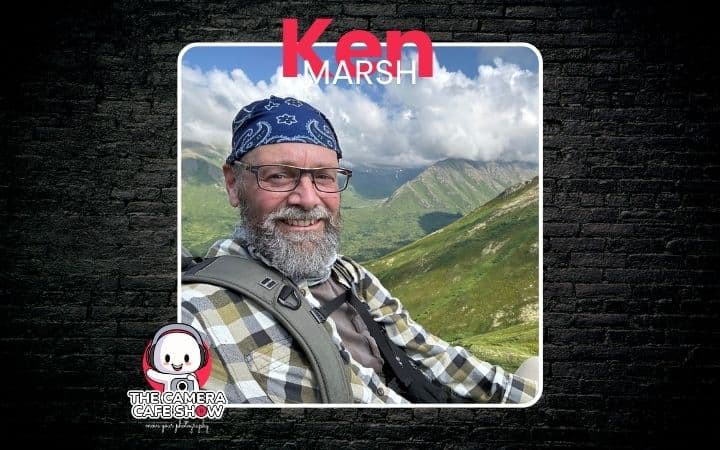
If you listened last week, then you know this is Part 2 of our special Mini Guide to Wildlife Photography in Alaska with the one and only Ken Marsh!
If you missed Part 1, just hit play and that part after you listened today and go check it out — we covered Ken’s background, some great stories, and the fundamentals of photographing wildlife in the Alaskan wilderness.
Today, we go even deeper. In this second part, we walk through the seasons of Alaska — what wildlife you’ll find and where, from salmon-chasing bears in summer to moose in the fall rut. Ken shares tips on photographing in near 24-hour daylight, what to do when you (accidentally) meet a bear or a moose, if to go with rental cars or renting a trailer van, how useful a good guide can be and how to make the most of your trip whether you’re heading into Denali national park or down any remote bush trail.
We even wrap things up with a few local food tips and campfire stories — including a few close calls with animals that’ll make you think twice about getting that shot.
It’s practical, entertaining, and packed with insight from someone who’s lived and photographed this land for decades. Let’s jump back in with Ken Marsh.
Tom: Ken, let's jump over to summertime. It's a good time to go to Alaska?
Ken: Summertime is a great time to, to visit Alaska for wildlife. The core time to come up and visit and get pictures of like brown bears, grizzly bears feeding on salmon. The salmon runs up here, depending on where you're at, generally starts sometimes around mid-June or so, roughly, sometimes a little bit earlier than that, but mid-June and they run all the way into September, actually in some places into October. But yeah, summertime can be a great time to come up and photograph bears, feeding on salmon black bears at any time. It's a good time to visit Denali. You can see lots of various types of wildlife in Denali in June, July, and August. A good time to visit, you know, if you're doing a road trip visiting some of our bigger communities like Anchorage or Fairbanks up north. Yeah, that's really the core of the tourist season.
Tom: Yes. Okay, because you have longer daylight hours too there then I think.
Ken: That's a good point. Yeah. Nearly 24 hours of daylight. June 21st. of course, longest day of the year. It really doesn't get dark here in South Central.
And if you go further up north towards Fairbanks or all the way to for that matter yeah, it just doesn't get dark. It's daylight 24/7. In fact, last year, in early June, mid-June when I was there, photographing migratory waterfowl, we actually got up at 3:00 AM. Three o'clock in the morning to go photograph, because by 7:00 or 8:00 AM the sun's already high. It's like noon, you know, in a normal setting. So you start getting that harsh, harsh light, but for the best light, yeah, you're actually photographing in what would be normally the middle of the night.
Tom: And the wildlife is used to this change in time.
Ken: Absolutely. Yeah, that's I mean, it's their world and they just adapt to it. They're most active then too, you know, in the golden hours as we call them, you know, early in the morning.
And of course, late in the evening would be something like, gosh, you know, starting at 10:00 PM at night. Going until maybe midnight or 1:00 AM. And then, you know, it might get a little bit dusky for an hour or two depending on where you're at in the time of year. But yeah, by three or four in the morning, things are starting, the sun is starting to gain more intensity and you're getting that golden light again, and it's time to shoot.
So, yeah, one thing that I to try to do is, well, I've tried to do this for years, is basically become nocturnal in the summer.
And I might do that with this trailer. Basically, sleep during the day and then get up and start getting outside about seven o'clock in the evening and then be out shooting until, oh, you know, 5, 6, 7 o'clock the next morning. So basically, shooting in what would normally be nighttime, that's when wildlife is going to be most active and that's when you're going to have the best light to do it. So, if you can do that, you've got a leg up on everybody else for sure. And that's an advantage of summer here.
Tom: It sounds an amazing experience, but I'm not sure I can have a coffee at two o'clock at night, Ken.
Ken: I tell you what! I know I was pretty, pretty groggy there a couple times out at 3:30 AM in the morning out in the tundra, you know, having to shake my head and start shooting. Yeah, it can take some adapting and lots of caffeine, lots of coffee!
Tom: Let’s move over to Autumn Ken. I suppose this is like the best time to go to Alaska for photography?
Ken: In my opinion it is. And, I think a lot of people would agree again, depending on what it is you're looking for, but what it is autumn is here in South Central and interior Alaska especially. Yeah, basically the seasonal pendulum is starting to swing, and it's starting to gain speed because we've gone from, you know, things kind of slowdown in the slowest day of the year, now the days are getting shorter, shorter, shorter, and, time just seems to ramp up and go faster.
Birds are getting ready to band together or, you know, flock up and start flying south. You start getting the beautiful colors in the forests and on the hillsides and on the tundra’s. You start getting those first snows, what they call termination dust up here in South central Alaska. First snow up on the mountain peaks. Critters like bears are feeding, it's what's called, I think the biologists call it hyperphagia. Hypo hyperphagia, where they're eating as much as they can to put on that last bit of fat so that they can hibernate and make it through the winter the same time.
Moose and caribou, it's their breeding season. In the fall, the velvet comes off their antlers. Their antlers are in their full grown splendor. They're out there fighting. They're very active, so you see them more often. They're actually on the move more. Not just hiding in the brush. So, you actually tend to see them more against those gorgeous backgrounds. So yeah, fall is a wonderful time in that sense. It just seems like everything has really picked up its pace and is much more active than it's been since springtime, I would say. The one thing that you just got to watch is, the weather can be a little bit fickle in September, you know.
Tom: Yes.
Ken: August through September the fall time. Be prepared for any kind of weather. It could be mild and sunny and that'd be wonderful, but there's a real good chance that it'll be cold and windy and blowing. But as miserable as that can seem, that can also make for some very wonderful moody photography. So, yes, fall's a great time to come.
Tom: When starts the first snow usually there, Ken?
Ken: Well, it depends again, where you're at, because the Alaska's so big, you know, you really can't paint with a real broad brush, but in the high elevations in the mountains or going up further north in the state, starting with, say Denali Park in the North, you'll start getting some snow by…oh, it could happen anytime in September, but it's usually later in September. Normally, as far as snow, that's going to be serious and sticking for the winter, that starts happening usually sometime in October.
In those places that are up high or farther north, here in South Central, if you were just in the Anchorage area and the Kenai Peninsula, places like that. First snow often is in early October. Some as far as sticking, it might be later in the month, but yeah, by November it's usually full-on winter here. We're just coming off three record years of record snow, where we had, I think last year we had something like 10 or 11 feet of snow here in Anchorage. It's like over three meters.
Tom: Wow.
Ken: Yeah. Last year at this time, there was snow all over the place. This year, like I said, I got my snow tires off today, so it can change. But generally speaking, there you go.
Tom: Well, I think it keeps you fit also, all that snow shoveling through winter, Ken!
Ken: Whether you like it or not! Yes, you can save on the on the gym membership and just shovel, haha.
Tom: And all for free!
So, Ken, we have our small mini guide of the seasons in Alaska. Now, let's talk about bears.
Ken: Okay.
Tom: Which are the most common species of bears you have and what to do if you encounter some unexpectedly.
Ken: Well, what people like to say, what the experts like to say, biologists and such, is that Alaska is bear country. And you may encounter a bear almost anywhere in Alaska, including right here in the middle of the biggest city population 300,000 people, bears turn up all the time.
For the most part, you're talking about brown or grizzly bears.They're the same bear, by the way. A brown bear and a grizzly bear are the same bear, but they're separated by geography. So, biologists call the bears that live along the coast, that tend to grow bigger, those are called brown bears by our biologists.
Genetically they're the very same animal as the interior grizzly, which is a smaller animal and lives a much more hard scrabble life. The main difference is the brown bear lives on the coast where you have these great salmon streams that are basically protein pipelines, all this food coming in. The coastal regions also tend to be more temperate, so they have longer growing seasons before they have to hibernate.
The grizzly up in the high arctic or up in the mountains doesn't necessarily get all those salmon, has a shorter growing season because the snow leaves later and falls sooner. So they almost look like two different animals, but they're not, they're the same, only separated by geography.
Most of the bears that you encounter in Alaska are either going to be the brown grizzly bear or black bear. We've got black bears all over the state, even up north of the Brooks Range, where you're starting to fall into the Arctic slope or the North Slope. You'll find the brown bears or grizzly bears all the way up north into polar bear country. The polar bears you'll find from, oh, pretty much the Arctic Ocean, Beaufort Sea up, you know, up in that range. In fact, there was a sow and cub spotted up there when we were taking pictures of the birds last time, last spring. For the most part, what most people are going to encounter in Alaska is either going to be brown bears or black bears.
Basically, you want to treat bears with respect. Whether, you know, whether it's a black bear, a brown bear, whatever. You don't want to get too close to them. You want to be careful with food sources. Say you're camping; You don't want to leave food out or garbage out, bears will be drawn in when you're sleeping or away from camp or something like that. Especially brown grizzly bears particularly if they're on a food source, whether it be your garbage or whether maybe they killed a moose calf or something like that, and you happen on them. They get very defensive of those food sources and that's where attacks happen can get hurt.
People also get into trouble with bears when, basically, when they surprise bears in close quarters. That scenario where you're walking on a trail and you come around a tight corner and boom, there's a bear right there. A black bear in a situation like that is more likely to turn and run away. You can't say that a hundred percent of the time, but more likely you're probably, you know, make some bit of noise, maybe, you know, put your hands up, make sure the animal sees you. You don't want to surprise it. Hey, hey, bear, talk a little bit softly. Yo, there's a person here. Just to let it know and hopefully it'll turn around and go away.
You do the same thing with brown bears. The problem with brown bears is that, you know, they're a little bit more likely to come right through you if you surprise them. Not always. A lot of times they'll do like the black bear, but the brown grizzly bear tends to be a little bit more dangerous, and when they're encountered or surprised at close range, they're a little bit more likely to attack.
And attacks are, what I used to call when I was with the Department of Fish and Game, and this is kind of flipped to say because they're actually very serious, but I used to call 'em Slap and Dash. That's kind of what they do. Basically, you've come around the corner, you've surprised them. And they see you as a threat, and it's not that they want to come kill you or anything, they just see a threat and they want to stop that threat, especially if they have a cub with 'em.
What they'll do is they'll run straight at you. They'll knock you down, they might rough you up a little bit and really tear you up. And then they'll grab their cub and say, let's go. And off they go. That's generally what happens in those situations. Like I say, guarding a food source. Boy, if there's a bear feeding on a kill and, you know, maybe you're out in Denali Park or something and you see a bear feeding on something, keep your distance, you know, shoot from a good, safe distance. And if you can't do that, go away. Don't push it because bears or grizzly bears on kills are murder. I mean, they're not messing around.
The other very, very extremely lightning strike rare situation is the predatory bear. And in my experience with the Department of Fish and Game, I saw instances of predatory attacks from both brown grizzly bears and black bears. In fact, one day, it was early summer, just south of Anchorage, we had a young teenager who was participating in an organized run on one of the trails he was actually attacked and killed by a predatory black bear. So, I got up in front of news cameras that day to announce this and to tell people to stay away from the area and, you know, be very cautious around bears and all of that.
And I underscore the fact that this happens very, very rarely. It probably isn't going to happen again for a long time because bears just usually aren't predators against humans. But, son of a gun, he next day, we had another one happen hundreds of miles north up near Fairbanks. There was a woman who was working with a mine up there. She was doing some sort of environmental work, I believe for them, and she was killed, by a predatory black bear again. I guess that's the message I'm trying to get across is, first of all, it's very rare, but you know, those numbers don't always happen in sync, so it's going to be another a hundred years until it happens again. It could happen again the next day. And it did. So those are very rare situations. Of course, Timothy Treadwell, everybody knows that tragic story about how Timothy Treadwell, who was a naturalist and pushed the boundaries a little bit with the brown Bears of Cat Mine, national Park and Preserve.
And he and his girlfriend were actually tragically mauled by a predatory brown bear. That was a situation whereas I believe salmon runs that year were poor, the bears were getting ready to go into hibernation, and this hungry bear acted out of character and attacked them.
Tom: Yes.
Ken: I had a similar situation happen. Not that many years ago, 2018, something like that, where a mine worker in southeast Alaska down in the temperate rainforest we mentioned before, on Admiralty Island, which has a very high concentration of brown bears. He was out doing his mine work alone encountered a sow brown bear with a couple of cubs and was also killed in a predatory attack. Again, that was a situation where locals said the salmon runs were poor that year, and the berry crop was very poor. Kind of a double whammy. These bears are getting ready to go into hibernation and they were hungry.
So anyway, I've probably taken up too much time talking about the predatory attack because it is the rare outlier, but it is basically to avoid some of these things, especially the surprise attacks where, you know, you come around a corner and the bear's there. Travel in a group if you can, you know, with a friend or friends. Make plenty of sound as you're going along. Talk, you know, talk to each other. Some people sing, some people you know, whatever you can do, just so that you don't surprise an animal so that when you're still in the blind part of that curve, they can hear you, and they can turn around and vanish into the trees.
That all can be a little bit counterintuitive when you're wanting to take pictures of wildlife. But I guess the long and short of it is, you know, you don't want to be taking pictures of wildlife that are, you know, this close and coming at you, better to see 'em off in the distance. Stay away.
Bring some sort of defense mechanism if you can. This can be problematic in some situations, like the pepper spray. Airlines won't let you carry pepper spray, or bear spray, but on some of the smaller bush planes, like the float planes, they have places in the floats where you can actually put pepper spray and safely transport them. So when you get to Anchorage or Fairbanks or Juneau, or wherever you're stopping at, before you get to your little air taxi, bush air taxi, buy yourself a can there in town. Ask the pilot if he can stow that in your pontoon of the plane. And then you would have that along.
So that would be a nutshell, a description of bears, some of the dangers, and how best to navigate and avoid them.
Tom: I think if I'm going there with you to make pictures of bears, Ken, I will really stay behind you. I can run fast though, I have to warn you.
Ken: Yeah, haha, I've heard people say, you know, the best thing to do is bring, just bring a stick along, you know, a friend and a stick, and if you run into the bears, you hit your friend with the stick in the leg, and then you run away!
Tom: Excellent advice, haha.
Ken, let's talk a bit about food.
Ken: Okay.
Tom: What's a common or uncommon or a traditional Alaskan dish there that you think people should try?
Ken: Well, probably fresh salmon for sure. You know, in the summertime we've got, our streams are full, just loaded with salmon in most cases, in many areas. So our fresh seafood can be number one. We also get all kinds of shellfish like scallops and shrimp. Crabs, some of our crabs have been having some trouble, I think, but you can still get some good crab. King Crab is the best if you can get it. It can be a little expensive. Also halibut, you know, the flat fish.
Tom: Yes, delicious.
Ken: In places like Homer you can go down in their boardwalk there, and you can get some wonderful deep fried halibut or halibut on a stick. They've got all kinds of different things in some of our coastal towns as far as that goes. If you go to some of the Bush communities or places as Nome, you can run into a local that has muskox meat. Now, that's kind of a rarity, but when I was at McNeil River a couple years ago, there was a fellow there who had brought a big chunk of Muskox roast. Wonderful meat. And if you can have a chance from a local, to get a taste of that, it's not only exotic, but it's actually very good, very tasty. So, those would be a couple of suggestions.
Tom: What's your favorite dish to cook at home, Ken?
Ken: Favorite to cook at home? That’s gonna be a tossup between salmon, red salmon or sockeye salmon we call 'em, or a good moose. A good moose steak or a moose roast. But you don't want to overcook wild game. That's the biggest sin of wild game or fish.
So yeah, good moose or good sockeye salmon would be my favorites!
Tom: I am getting very hungry now, Ken! I didn't eat still, and it's 10.30 PM in Spain.
Ken: Oh goodness. Haha.
Tom: Haha. Ken, to round this up a bit, let me ask you a few more fun questions.
Ken: Okay.
Tom: If a magazine would ask you to represent Alaska in just one picture, where would you go and what would you shoot?
Ken: Well, Alaska in one picture, it's been done to death. It's but it's still an unusual photo and it's still representative of Alaska. That would be in Denali Park where you got the moose in the lake with you know, the tallest mountain in North America reflecting in the lake. I think it's Wonder Lake that most people take this picture of. I mean, that has everything, you've got the wildlife, you've got the gorgeous scenery, you've got the iconic tallest mountain in North America, tallest in Alaska obviously, you've got snow up there.
I'd have it in the fall so that, you know, it had the beautiful fall colors. If I could only do one picture, it would probably be, it'd probably be that one. But there's, there's a lot of others too. I mean, the brown bears with the bright red salmon in its mouth. If you can get some nice mountains in the background, that's an awful close second, I would say. Yeah, I guess that's what I'd go for.
Tom: Wonderful. To end, Ken, tell me your best campfire story from Alaska.
Ken: Oh boy. Let me think. Gosh, I'd have to really think about that. The wolf story is one of my favorites after all was said and done. But I had a situation just last spring where I was out.
I wanted to photograph Boreal chickadees, you know, little, little birds about this big, not much bigger than a hummingbird. It was springtime and it was time for them to nest, and I'd found them in this little section of woods. It was only a couple miles from my house here in Anchorage and I thought, well, I'll go back out there and see if I can find them nesting and get some nice pictures of them going into the old woodpecker holes and stuff.
So, I go out to do that and I had my long lens on of course for that. I come around a corner and I hear something down below me and I look, and I see ears coming just above the brush. First there's two ears, then there's four ears, then there's six ears, and then suddenly a bear pops its head up. And it's a mother black bear with two cubs. And I was like, wow. Well, this seems like a good photo opportunity to see what happens! You know, they were a little close, but there was a lot of brush between us and I was kind of on a little slope looking down on them.
Well, they popped up 'cause they heard my shutter click a couple times. I had it on mechanical shutter, I should have had it on silent. And that got the mother's attention. And the cubs were all looking at me and I thought, okay, well they're gonna run away now. Well, they didn't run away. The mom was like, what's this guy up to? And they actually came closer and I'm thinking, I probably need to back up now. And the mother, it's amazing how bears train their cubs. They're so smart and the cubs are smart. She does this little grunt just to, you could hardly hear it, but those two cubs went straight up a tree. Then she stands up on her hind legs and she's just looking at me. You know I'm like, oh, this is a great photo opportunity. And I'm taking the pictures and I'm thinking while the little voice in my head saying, remember your own advice? You're supposed to back up in situations like this, but it's such a great opportunity! And I took a couple more pictures and then she comes down and I thought, okay, now they'll leave.
She leaves those cubs up in the tree and then she comes right out under the trail that I'm on. She comes out of the brush and she's facing me and I'm like; All right, I need to start backing up a little bit, but I gotta take this picture! All of a sudden she starts popping her teeth and she starts coming towards me. I took one more picture and I pulled out my bear spray and I started walking away and I thought, okay, I would never do that with a brown or grizzly bear. I was really pushing it with this black bear.
I start walking away so that this mother bear, I mean, they are really intelligent animals, she sees that I'm not going to be a threat, that I'm walking away and she stops. She sees that I'm still walking. So, she turns around, goes back to the edge of the trail, she makes that little grunt again, and those cubs boom come right down the tree. She looks over her shoulder one more more time as they gather behind her. And they walk away, and I thought, you know I don't think I'm gonna do that again. I think in the future I'm going to, when I hear that little voice saying, back off, back up, back off, I'm gonna listen to that rather than to get the shot. No. In situations like that, it's better for the animal and better for your own safety to listen to that little voice that says: The heck with the shot. Let's show these animals some respect and back off. I guess that would be a recent story that that comes to mind.
Tom: That sounds a great campfire story though Ken!
Ken: Yes, haha. I've had a situation where I've had to use bear spray on moose too. And that can be harrowing. I had one situation where I'd been taking photos of a large bull moose in the rut there in the fall who was chasing cows around. And he finally goes into the brush after some cows and things got kind of slow. And there, on the other side of this little pond, there was a young bull laying there. And I thought, well, we'll take a couple pictures! And again, I had it on mechanical shutter, so they could hear it. Young bull moose can be a little goofy. You know, they don't make a lot of sense sometimes. There was plenty of space. I was probably 75 yards away at least, and he was on the far side of the pond, but it's in the rut and their hormones are going and they're a little confused and they're just agitated. So, he got up and I said, oh, okay. He is up. I'll take a couple more pictures. Then he gets into the water and he starts coming my way and I went, oh no, come on. You're not, not really? I did the right thing. I turned around and started walking away. The problem was, it was all open tundra, with no trees.There was no place for me to get behind anything or get into and disappear. I just had to keep backing up.
He gets up onto my side of the lake, and he starts coming to me. He's not running, he's not chasing me, but he's coming. And he is coming closer and closer until he's too close to take pictures of anymore. So I got out the bear spray, and finally when he was so close that I could almost reach out and touch him, mind you, it wasn't like he was gonna come hook me yet with his antlers, but he was being, a jerk, that’s what he was being. I sprayed him in the face and boy, he retreated. The bear spray, when you spray, it makes a noise, like a kind of a jet, real loud. And he turned around and he ran about oh, 30 yards or so, and then he turned around looking at me like, why did you do that?
Well, the problem is when you let moose get that close, they might seem almost tame. They get that close and then they suddenly realize you're a person and they spook, and then they kick the living daylights outta you. So yeah, I ended up having to spray that guy, and it was the right thing to do. But there was nothing I could have done about the situation. In that case, I did everything right, I'm afraid. But that's what happens.
Tom: You see Ken, I'm listening to you and I'm thinking at when people see pictures, I take macro pictures of wasps or bumblebees, and they're already afraid of those. I'm just imagining you were running away from a moose, I mean, it's a whole different ballpark there!
Ken: It is, yeah, haha. In a situation like that, if it would've been, you know, forest or trees around, I would've ran right behind a tree. Well, there's another campfire story, taking pictures of a large bull moose one time in Kincaid Park right here in Anchorage, which is, if people visit, in the fall or even in the summer and want to take pictures of moose. It's five minutes from the airport if they rent a car or something and they got a good chance of seeing moose and black bear.
I was taking a picture of a large bull with a harem of cows at a fairly close range. I didn't feel like I was getting too close or crowding them. They were completely ignoring me. The bull moose starts to get kind of frisky with one of the females, and she rejects him. She wasn't ready for that. She kind of bolts away from him. And the other two cows were kind of edging away from him and he stops.
Again, my little shutter sound caught his attention, and he looks at me it's almost like he was blaming me for him getting rejected by the cow, because he looks at me, and here he comes. I had my camera up on a tripod actually at that time because it was in the forest and pretty dark and was having to do some slower exposures. And here he comes, and he wasn't stopping, and I didn't have bear spray that time. So, I had to leave my thousands of dollars’ worth of camera equipment, you know, on the tripod and turn around.
I ran for a big spruce tree that was right there. And he chases me right to that big spruce tree he starts hammering, like trying to get me with his antlers. And I'm having to go back like this so the trunk of the trees is between me and the moose. And these big, big antlers are going boom, boom, boom, all around me like this. Finally, he stops, and he looks at me like, there, I taught you a lesson. He turns around and he goes back to the to the cows. And he never did touch my camera gear or my tripod luckily. But I called it a day after that. That was enough, haha. So, remember, wildlife up here can be a little bit unpredictable sometimes, especially in the rut, the breeding season.
Tom: I’ll remind that, haha.
Ken: Be on your toes. In that case, the tree saved me.
Tom: You see sometimes it's better, Ken, to listen to that little voice in your head and say, it's time for a wild salmon steak in a pub.
Ken: Absolutely!
Tom: Ken, it's been a pleasure talking to you and getting to know more of Alaska. I really hope one time I can catch up with you there, and you take me to all the places that we just discussed. I think we made a nice little podcast episode about Alaska, where to go and where to get the best photo opportunities!
Ken: Fantastic. Well, great to hear Tom and good talking with you!
Tom: Ken, have a nice day still, but please don't bother any bears today. It's, been enough for now.
Ken: I think so. I'm getting older and therefore slower! So yes, I'm not gonna push my luck.
Tom: Okay, Ken, I see you around. Take good care.
Ken: Bye-bye.
Tom: Bye.
Outro:
And that’s a wrap on our two-part mini guide to wildlife photography in Alaska with the brilliant Ken Marsh!
From seasonal wildlife tips and location suggestions to real talk on bears, moose, gear — and yes, deep-fried halibut — Ken shared a masterclass in understanding and respecting the wild.
If you enjoyed this two-parter, be sure to check out Ken’s work at Wild Country with Ken Marsh, we’ve got the link in the shownotes, and give us a follow or subscribe wherever you’re listening. It helps more people find the show and keeps the inspiration flowing.
Until next time — stay safe, shoot smart, and as always… move your own photography. We hope to see you next week here at the camera cafe show for another wonderful talk, with another wonderful photographer and get you inspired…adios!