

"And literally six months after the surgery, I was in Antarctica. And then a few months after that, I was in Africa. And then I was in Iceland. And my job as a photographer really started at that point. So, I made a slideshow on a DVD that I gave, it was only a copy that I gave, to Dr Jokey. And I said, this is, you know, just take a look at it. And there was a message at the end, after he'd looked through the videos, I said, I was only able to do all of this because of you. And I thanked him for basically saving my life. But he was one of the people in my life that I know I owe everything to. And having that kind of a person in your life, I think changes how you think a little bit, you know, and I just feel grateful for literally every day that I'm still here."
Intro:
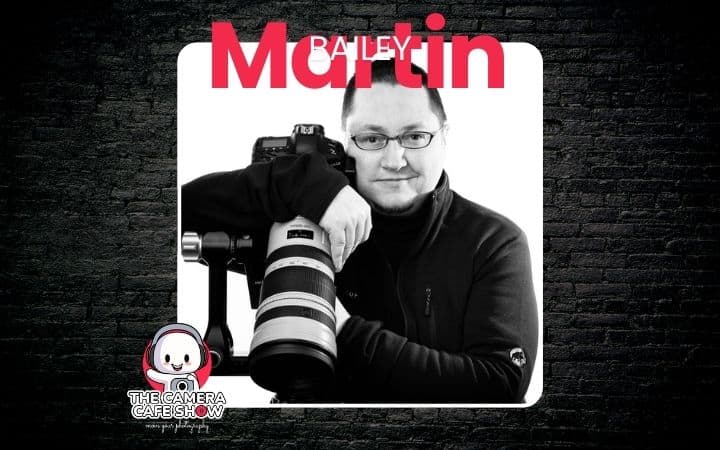
Greetings and Welcome back to The Camera Café Show! I am your host Tom Jacob, and sorry it took a bit longer this past week to bring out a new episode, but I am still battling with a nasty flu I picked up…man, it seems like the older one gets, the longer you got stuck with it, right?…anyway…Today, we’re heading to Japan—at least in air waves—to chat with a photographer who’s been inspiring creatives for two decades: Martin Bailey!
Martin is a Tokyo-based nature and wildlife photographer, photography educator, and the host of one of the longest-running photography podcasts out there. Whether he’s leading photography tours in Japan and Namibia, capturing the breathtaking wildlife over there, or inspiring people on his podcast, Martin brings a level of curiosity and dedication and is the person who is truly contagious, in a very optimistic way, and a pleasure to talk to.
In this episode with him, we dive into his journey—from moving to Japan as a lace engineer (yes, really!) to becoming, due to changes that present itself in life, a full-time photographer. We talk about his philosophy on photography and Japanese life, the importance of respecting nature, the ups and downs of running a podcast, and how he made for himself the best job in the world running his photography tours. We will also get into the more serious topic of resilience—how Martin was diagnosed with a brain tumor, underwent surgery and how that experience shaped his outlook on life and creativity, but in a surprisingly optimistic way, very characteristic for him.
So, grab a coffee, get comfy, and let’s listen to how Martin Bailey created for himself the best job in the world!
Tom: Welcome, Martin, on our podcast today. It's wonderful to have you here for a short talk about photography.
Martin: Well, thank you for inviting me. I'm very happy to be here.
Tom: What have you been up to in the past days there in Japan, Martin?
Martin: Well, I moved house in April this year. And a lot of my time since then has been about getting our new house ready to, you know, for all of the stuff that we need to do.
Tom: Big job, I know how it goes.
Martin: I've built a new studio, it's both for my photography and music. I make my own music for my productions and things, So I've built a new studio and I've finally, now it, I mean, we have, they seem to be getting worse, but we have quite a oppressively hot summers here in Japan, and I don't get out with my camera very much in the middle of summer because it's just too hot. But it's cooled down now, so I've been getting out a little bit more.
I did some recent shoots in the new area, because I moved from Tokyo to a prefecture, a little bit, sort of northwest of Tokyo called Gumma. And in the Gumma prefecture, I'd not really done much traveling, so I've been getting out and, you know, shooting the local area. And starting to sort of feel my new, you know, my new turf as it was.
Tom: How many boxes did you have to pack Martin?
Martin: Oh, it was crazy. You know, we lived in our old apartment for 14 years, and the actual floor space, we bought a house now, so the actual floor space is only about three-square meters more in our new house. But you know, because I run a business as well as my home from the same building, it must have been about 130 boxes. And that was just things that go in boxes. So, a lot of other stuff like desks and things and, you know, the beds, sofa, all of that. We ended up, I think, we had 2 eight-ton trucks and 1 four-ton truck. It was crazy. So yeah, it was quite a feat to move. And the people that did it, you know, the movers themselves, they were amazing. They really did an amazing job. So, we were, you know, we were just so thankful that they were so accommodating, but also so very helpful on the day.
Tom: But this is all passed now luckily, and you're in your new home and we can record in your new studio.
Martin: Yes. Yeah. So, it's eight months ago, but it still feels new, you know, we've moved to a completely different neighbourhood.
I actually did my first local photography job just a couple of weeks ago. I don't do a lot of commercial work or, um, portraits and, and you know, sort of that kind of photography. The majority of my income comes from running tours and selling software. I make photography and music related software that keeps at least a part of the roof over our head. But when we moved out here, obviously certain people heard that I was a photographer and one gentleman asked me if I would take his funeral photo, which might sound strange.
A lot of the time here people have a photograph taken specially for use at their funeral. So they'll, you know, you'll have like an altar with maybe the cask, the coffin, and lots of flowers. And then above that will be a photograph of the person. And quite a lot of time in Japan, people want to have that photograph taken in a certain way. People that die suddenly often have a photograph that, you know, they weren't really prepared for that purpose. But when people get elderly here, they start to think about, you know, planning for a funeral. And this gentleman asked me to photograph it, do his photograph, his portrait for his funeral.
And it feels a little bit strange and maybe from a western perspective, a little bit strange. But yeah, it was a nice thing to do. And, you know, that sort of thing, it makes a little bit of extra money here and there. So, I absolutely enjoyed that and try to get more of that kind of work on a daily or weekly basis.
Tom: Martin, how would you describe your philosophy as a photographer?
Martin: That is a good question. I'm not sure if it's just as a photographer, but as a human being in general, I don't like to disrupt people with my presence, you know, whether I have a camera in my hand or not.
For example, I mean, a big part of my work is wildlife, and I travel with lots of amazing photographers in Japan here and in many countries around the world, Africa being one of my favorites. And I always try to ensure that I, and we as a group, don't encroach too much on the wildlife, on the subjects, you know, get too close to them. In Antarctica, if you've been down there, you'll know that there are laws or rules where you are not allowed to go within three meters of an animal.
And if you're sitting on a beach, they can come to you but you are not allowed to go within three meters of them. So they can come and sit on you if they want, but that has to be from them. In Hokkaido where I do a lot of wildlife work with the Red Crowned cranes and the Eagles, you know, I always just try to make sure that we don't upset them in any way.
I just think as a person, but also just as, you know, in general, I don't like to leave people with a bad, say, taste in their mouth, if you know what I mean. Not that they'd be like sucking on my fingers or whatever, but I just like people to think when we've parted, the subjects to really just be unchanged by the interaction. I've seen photographers very, and I don't wanna sound overly critical, but I've seen some photographers that get right into their wildlife's face.
I had one guy on a trip who kept getting closer, I wasn't there, someone in my team told me later, but he kept getting closer and closer to a deer that was standing on the edge of an icy cliff. And the deer almost backed off the cliff and it would've died. It was literally a probably 60 or 70 meter drop behind it. And so, luckily someone called out and told him to stop. But I mean, you shouldn't need to be told to stop doing something like that.
Another example, and this is again, I don't want to be overly critical, especially when you think that the people I'm talking about are people that have paid me to be on my tour, but I had another guy one year who, when we go to the Snow Monkeys in Nano, you know, a little bit further from where I am now in Japan, on the middle day, we take in a packed lunch and the hotel gives us that lunch in plastic bags. And I always tell my guests that you have to make sure that it's either in a pocket or inside your bag.
You can't take it that way into the snow monkeys because as soon as the monkeys see you, even on the trail on the way in, if they see you with a bag, they'll know it's food and they will take it from you. And that is not good. And one guy, I don't know if it was because he wasn't a native English speaker, but he just walked down and someone in the group told him, they said, you have to put that lunch pack into your bag. And he didn't, he said, no, it'll be fine. And within 30 seconds a monkey flew down the mountain, took the bag from him, and ran into the woods with it. And I said to him, and this is a professional wildlife photographer, I said to him: Why didn't you listen? Why did you take your bag? Like, you know, hold the bag in your hand like that. I told you, I told everybody not to do that. And he said, Martin, it doesn't matter. I can go without lunch. And I said, you think that my concern is about you getting hungry? I said, that animal has taken plastic, it's taken chocolate, bananas, sandwiches, and lots of high calorie food that it would never get access to.
So that in itself is not good for the animal, but it's taken plastic too into the wilderness. It could eat it and could choke on it. It doesn't know the difference between plastic and food maybe. If it chokes on it, you've killed a monkey, a wild animal. And his face changed, and he was like, oh yeah, I'd not really thought about that.
And I said, well, you are a professional wildlife photographer. It's your job to think about that. But in reality, I just think that as a human being, any, but all of us have the responsibility to think like that, to think more responsible about the environment and about. How we affect the wildlife that we're hoping to make photographs of.
Tom: You also think this kind of philosophy you have in your life, Martin, came together with your move to Japan, or you had this already before when you were still living in England?
Martin: I'd like to think that I was, I've always been a relatively mindful person, but I think I know that Japan has changed me as well. I mean, I came to Japan when I was 24. I thought I was an adult and everything, but when you think back, I was still very, very young and probably green behind the ears.
My wife has had a lot of positive effects on me as well. For example, I used to make, like a lot of people in the West, make excuses for things. If something doesn't go well or something doesn't go how you wanted it to, they sort of try to blame someone else. Yeah. Well, I had a horrible boss, or I, you know, it was him, he backed into me or something, and my wife, as a Japanese person taught me that, you know, we are responsible for our own actions and if something doesn't go well, don't make excuses. And literally, one of the ways to say sorry in Japan is, it means: I've got nothing to say. I cannot say anything. It means, you know, I'm not going to make excuses. And that, I think, is an important thing that I've learned from being in Japan. So I try not to make excuses. If something goes wrong, I'll either apologize if I know it was my fault or I'll try in some way to make amends, but it's, it's very rarely by blaming it on someone else now, which I kind of like as a trait.
Tom: It sounds a great advice too Martin.
Martin, photography wise, you moved to Japan, but you didn't study photography, when you came over from the Midlands?
Martin: Right. Yeah. So I moved to Japan in 1991 and I was a lace engineer. I was literally out of high school. None of my friends went to university, it was just, it was, you know, it just wasn't done at the time. Not in our school at least. It was right in the middle of, you know, I mean I think now she did a lot of good things that the country needed, but it was in the middle of, at the time, what we called Thatchers Britain, Margaret Thatcher.
And, you know, the coal miners were all being laid off and there was lots of unrest and it just wasn't the time when people, at least in my area, were thinking, oh yes, let's go to university and get a better education. And so I didn't have an education as such, but I did have a trade and it was making lace.
So I had the opportunity to come to Japan to do that job, and I came over. I did that for four years, and then I went to university here. I was 28, I think. When the contract finished for making the lace, I'd saved up some money, and I used the money that I'd saved instead of going back to England and going back to the pub every night, I put myself through college here, and that gave me, not photography still, but I passed exams on Photoshop 3 and things like that. I was learning software, multimedia software. So I was learning how to make multimedia presentations and 3CGI, you know, computer graphics.
I learned computer science, and so I learned a lot of skills that became a really good foundation for what I'm doing now. I don't think I've wasted the time that I spent at college here, because it got me an education, it gave me a degree, but it also literally gave me a foundation. A lot of the money that I make now is from products that I probably wouldn't have had the skills to make. I've learned a lot myself about programming, but I wouldn't have the skills to make it unless I had that foundation from the college.
So, yeah, and that sort of led me in a way, into photography, because I'd always been a hobbyist. I had an SLR camera all the time when I was in Japan. I would go off into the mountains and I would photograph the shrines and things. But, when digital came along in the late ‘90, early 2000, I thought, great, you know, now I can use photography as an excuse to play with my computer as well. So digital really changed things for me.
I do still shoot film still occasionally. I love shooting medium format film and developing it myself. But I think the merger between photography and computers, what was really threw me into the photographer's world, and that led me of course, a few years later in 2005, to start my own podcast. It was the third photography podcast on iTunes. And that really changed things. Now all of a sudden, I had an audience, I had a possible way of making more money from my photography. It led me to more commercial work. But, you know, in general, it just gave me the audience that gave me the confidence to try to make more from my photography than I probably would've ever dared to do if I was just still doing it as a hobby.
Tom: You remember that day you told, I suppose you were already with your wife together, you said: Maybe photography is something for me and I'm going to go for it full time?
Martin: Absolutely! And I remember saying that about five or six times before she shook her head this way, it was always this way. You know? So she would always shake, say no, as opposed to, yes. I know the difference between the last time she actually never said yes, but she didn't say no.
The reason that she didn't say no was because I was working for an US based company here in Japan, and I'd become a senior manager and the VP came one day with unannounced and told us that, you know, I was going to lose four people in my group, in my team. I had to tell someone in India that we'd just hired, that they'd lost their job.
I had my own not direct skip level employees coming into my office crying because they'd been told they had lost their job. And I just, I couldn't handle it. I, you know, if they'd have talked to me as the manager of these people, I could have given them four people that we could have let go. But they made their decisions based on, you know, like coaching conversations and things that. I used coaching conversations differently for different people. I would give someone that was very promising, perhaps a harsh convers or harsh evaluation because I knew that that person would respond to that. But people that I knew would respond negatively, I gave them a better evaluation, even though they were not as good an engineer. And the upper management took those figures and just used them to slice people out of my team. And I said, no, this is wrong. I couldn't really handle the feelings that I was getting, the negative feelings that I was getting from that job.
And I just said, okay, I'm done. I already started doing my tours. I was making some money, and also, I booked myself on some Antarctica trips that I couldn't do without leaving anyway because I wouldn't have had enough annual leave.
I just said, okay, this is it. I have to cut the cord. And at that point, seeing how cut up I'd been from this whole thing with the VP turning up and, you know, firing some of my team, she looked at me and she said, yeah, I can see that this is not working. Ironically about six to eight months after I left, the team I worked for was closed down anyway, you know, so I would've lost my job.
If I'd not left I would've lost the job with more money because they paid a certain amount of severance. But, you know, money has never been my main interest. It's always been about doing what I consider to be the right thing at the right time.
It was the right time. My wife knew that it was, it was not working anymore. But on the other hand, she knew that I was bringing her home a truckload of cash every month. It was hard because, you know, I mean, I probably make now in real terms, I probably make about the same amount as I was making in one year, in maybe five or six years now.
But I'm, I'm so much happier,
Tom: Yeah. I know the feeling, Martin.
Martin: And everything's worked out to be good. So, I'm happy. The world is a much better place with me doing what I'm doing now. Then it would've been stuck in that job or another similar job.
Tom: I think it's a great deal. While we are on money topic, Martin, I was going to ask you, because you mainly do, photography tours and then, you know, COVID hit us all photographers and the economy fell. And how did you solve this period of these two, three years?
Martin: There was, obviously, I mean, I looked at the figures. My revenue for the two years that Covid was really, 'cause Japan closed everything down, they closed the borders. A lot of countries did, but I couldn't even get out of Japan until two years and three months after Covid started.
That was in May, I think it was in 2022 I had to go to Namibia. I looked at the figures and my revenue were down by 97% for those two years. So, I was literally earning 3% of what I was before and I managed to get through that. In two ways really. Well, there's three ways. There's the mental side as well.
I'll try and remember to relay all three. But the first one was that the Japanese government did do a relatively good job of subsidizing people that had lost income. It wasn't enough, but they did help with some grants, you know, you didn't have to pay them back, if you could prove that your revenue was down by more than so much percent, They gave grants to people that you know you didn't have to pay them back, unless you were cheating the government,
then they came down really hard and got everything back. But I've never done anything like that. I was able to get enough to see us through to a degree, but then when things started getting better, the money stopped from the government. And understandably it was things were getting a little bit better, but because I made most of my money from my winter tours and my summer visits to Africa, I lost literally like just over two years of that revenue.
The second thing was that I actually am still paying for Covid. I had always money from people for future tours and I had always made sure that I didn't touch that money, or the profit held for tours was used until I actually started the tour.
But with Covid I had to take some of the money out of our business account, and this is perfectly legal, but I had to use some of the money that I was holding for future tours to live. And that means that when I did those tours, the profit in real terms was almost zero because I'd already spent the money to live.
The other thing was the mental thing. I mean, I had a really hard time. I was having nightmares the whole time that I was in a beautiful hotel with a group of guests, and we couldn't get out to photograph. We were looking out at some beautiful scenery and all of the doors were locked or we'd get out and my camera bag had been stolen, or I'd open it up and it was full of mud and broke.
Every night this happened, and I started to get really depressed and it was like I, I was watching my business be flushed down the toilet by the virus and the way things were being handled. And, you know, although the Japanese government did do a good job helping people out financially, I think that they were too strict for too long. I was seeing other people's tour starting up and I couldn't get out of the country. People couldn't get in. And it was just, it was incredible to me that even on the second year, I still couldn't run my tours. Mentally, I was getting in a bad shape.
In Tokyo I don't do a lot of street photography and all the things that Tokyo was really good for. I always used to head out of the prefecture out of Tokyo, go north to Hokkaido, or go to close to where we live now. And I couldn't even do that because they said, you've got to stay in your own state. This was like up to almost two years later, so I couldn't even go out and do my photography, so I'd got no creative release.
And what I did was I actually ended up going in instead of trying to go out into the world. I bought two microscopes and I started to explore the microscopic world.
I made a video of all of the life that you can find in just a few drops of river water. You place it onto a slide, and you know, there are like little, tiny plankton that look like mice and rabbits and they run around eating stuff and algae, and there's all sorts of things that are in literally just a drop or two of water. And I had finally, for the first time in a couple of years, I felt as though I was being creative. I was working seven or eight hours some days just preparing slides and making crystals and things and photographing them. I even got to the point where I got a really bad neck because I was looking down into the microscope so much.
But that creativity released me, the nightmares stopped. I got a camera in my hand again or at least on the top of the microscope and I was making photographs. I was, I was being creative. I was doing what I love, and that helped me mentally, so that, that was the third way in which I was able to get through Covid.
Tom: Martin, now we are talking getting better in a mental way. But I want to touch a moment on resilience, for people that don't know you, for people that don't know your journey.
You were diagnosed with a brain tumor some years ago.
Martin: Yes.
Tom: How did this, let's say, how did this influence your perspective on things, on live itself?
Martin: You know that, I mean, it was less than a year after I quit my job, which again, was both good and bad. I didn't have to put a burden on the people I was working with. But obviously, financially it was more difficult because I had to cancel some jobs. The way it influenced me, I mean, I could have come out of that either paralyzed, blinded, both, or worse still, I could have died.
Literally the day after I'd been for the main tests, you know, I'd been diagnosed a few days earlier with a CAT scan. I went to a bigger hospital for an MRI, and we were starting to talk about the plan for getting surgery to try to remove this. And I went home that night, and I had what was, by all accounts, a stroke. I was sitting on the sofa typing an email on my laptop and the vision in my left eye closed down. It went from the left side, it went black until a tiny spot in the right and then it went black. I couldn't see with my left eye. And that happened over the course of just three or four seconds.
I turned to my wife to say something's wrong, and I couldn't speak. My mouth wasn't working properly. She knew obviously that something bad was happening, so she called an ambulance. And I still think to this day that this is my own stupidity saved me because I thought, okay, I'm going to be in hospital for a while, I'd better go up to the studio and get some cables and things. So literally with half of my body closed down, I hopped up my stairs to get some cables and the exertion unblocked, whatever had blocked in my brain, and it cleared my eyesight. It came back, took about 30 seconds or so, my eyesight came back.
And whatever blockage had that had been there, the movement caused it to go away. They still took me into hospital, I think it was a few days or maybe a week later, I stayed in hospital because it could have happened again at any time, and they did the operation.
I think that the, you know, the people that we meet in our lives, there are a number of people that I've met in my life that I would say completely changed the outcome of a possible situation. And the one, the gentleman that saved my life really, was my main doctor. It sounds like a silly name in English, but his name was Dr. Jokey. Not jokey like haha laughing, but in Japanese it's a name that you hear Dr. Jokey. And this gentleman, he'd been doing the surgery on me for around eight hours. There was a lot of blood coming out and he, he said, if you were a Japanese person, we would've had to do a blood transfusion because Japanese people don't have that much blood in their bodies. You as a westerner you've got, you're bigger, you know, you generally bigger build. So we thought you'd be okay without a transfusion, he said. But we got to a point where we could not remove a big amount, over half of what was left, of the tumor.
But it wasn't, it wasn't cancerous. It was a benign cancer, not malignant. All of the other surgeons in the room said, let's take the top of his head off and we'll go in through the top and remove it. And he said this, Dr. Jokey said, if we do that, we will probably either blind him or paralyze him, and he's just given up a good job to become a photographer.
How good do you think he'll be if he can't walk or can't see? And he said, I am not going to go in. He said we'll close him everything up. They'd done it through my nose, and he said, we're gonna leave it there. And he literally saved my life by doing that. If they'd have gone in, I know lots of people in other countries that had the invasive, open head surgery for this illness, and none of them that I knew either lived or were not maimed in some way.
And I literally, within six months of finishing the surgery, I'm still on medication, I have to have medication now to stop it from growing too big again, there's a bit left, but I control it with medication. But I literally, six months after the surgery, I was in Antarctica. And then a few months after that I was in Africa, and then I was in Iceland. And my job as a photographer really started at that point. So, I made a DVD slideshow that I gave, it was only a copy that I gave to Dr. Jokey. I said, you know, just take a look at it. And there was a message at the end, after he'd looked through the videos, I said, I was only able to do all of this because of you. And I thanked him for basically saving my life. He was one of the people in my life that I know, I owe everything too. And having that kind of a person in your life, I think changes how you think a little bit.
I just feel grateful for literally every day that I'm still here, I feel grateful for it. It's an eye-opener in many ways. I've always been a person that I think has always been somewhat mindful and try to be thankful for things that I have, but this experience completely, it changed that completely tenfold, a hundred fold.
Tom: But I think Martin, you are like these persons that are the eternal optimists, right?
Martin: Yes! I often call myself a terminal optimist. I'm an optimist and I'll probably, even when I die, I'll probably still be looking on the bright side or looking for the silver lining on the cloud or whatever. So, yeah, a terminal optimist.
Tom: I love it. Martin, let's talk a bit about your workshops. I saw on your website, you cancelled your second trip,
Martin: Yes.
Tom: You told it's a jungle out there. What you mean by this?
Martin: Well, the Japanese government did a campaign, I think it was 30 million visitors per year into Japan, and they spent a lot of money on PR in various comfort countries, and they made people want to come to Japan, to the point where Japan is now really suffering with over tourism.
There are places in Kyoto and where the local people can't even get on the bus because they're full of inbound visitors. I've heard, I think that is it in Barcelona now or somewhere in Spain where they've banned or they've restricted visitors for similar reasons.
Tom: Yes.
Martin: So that really is what's happening here. I couldn't get all of the hotels that we need for the third trip, that was the final decision maker. But I literally saw that, on my trips, that my guests on the third trip from the middle to the end of February, were starting to not enjoy the trip as much because there was so many people there and some of the locations were so crowded.
I would like to tell everybody, if you are coming to do the wildlife, Hokkaido wildlife trips and you wanted to come between the middle and the end of February and you find that my tour is no longer there, don't go with someone else because it is terrible now. The first one that I do is still fine. The problem is of course, is that now people are going to start to come a little bit earlier, and I think that probably within the next four or five years it's going to be similar. I almost think that, you know, if people want to come a little bit later, let them come with someone else and I'll just do my tour earlier with my guests.
I always did two. Now, the wildlife trip, the timing with the people is really just not working. I think it will get better if the government steps up and starts to help with the infrastructure. But we need more bus companies, you know, and this is not a government thing.
We need more people in the tourism trade. We need more hotels. We need so much more than the government realizes. It's like, yeah, let's bring all of these people to Japan and make lots of money on them. Yeah. Great. But they're not enjoying it as much as they used to because there's just too many of them now.
Tom: Martin, you teach photographers that come with you on your tours. You have learned from them during all these years something too?
Martin: I learn a lot from my guests, of course. I teach and I help them, I mean, one of the main things is just getting them to the right place at the right time. But I am very proactive in ensuring that my guests have the skills to make the photographs that they're presented with. Some of the subjects that we photograph require you to photograph them in a certain way, they require certain skills, and some people come with those skills and some people need to learn them while we're traveling.
So, I'm very proactive in getting people up to speed on that, on that stuff, but yeah, I've learnt even just being around creative people helps you to become more creative yourself. I've become a better photographer from the exposure that I've had to, you know, probably now, well over a thousand guests over the years I've been doing. I did my first tour in 2008, so it's been what, 17 years or so now? I've learned so much from the people that I've been fortunate to travel with. The vast majority are not people that don't understand what a plastic bag means to a monkey. You know, the vast majority are incredibly talented and creative people and I'm sure you get the same thing.
Tom: Of course.
Martin: You know we get to learn a lot by being surrounded by talented and creative people. So, yeah, I've learned from them as well.
Tom: Martin, you touched before a moment the snow monkeys, and I want to get back to them later, but I don't know if it was you that I heard saying, that the Crowned Cranes, there were only 30 of them left after World War II?
Martin: Yeah, yeah, yeah. So, I think there were 23 pairs, so it would've been like 46 cranes after the war. And there were a number of people in Hokkaido, around the Kuro area, that gave up their land to create feeding grounds for the cranes. And the government stepped into a degree and stopped people from going encroaching further and developing the marshes, which is their main breeding ground to get through the winter, you know, and most of the natural food for the cranes is under the snow in the winter, so it was difficult for them to go and find a lot of that because people had basically built on most of the places that the cranes would have originally gone to get their food.
So there were people that started to essentially just give up their land, at least during the winter when the cranes were out of the marshes. In the summertime, they get their food in the marsh. There's fish, there's crayfish, there's all sorts of things that they will feed on, but in the winter, they started to throw out corn, like corn on the cob. They would take corn and throw it out onto the snow and the cranes would come to these fields to feed on the corn. And that helped them to come back from the 23 pairs.
I think it's currently over 3000 or so. There are more in Korea and the eastern China but in total globally, I think there's only just over 3000 or so. If you think about that, that's a whole species and to have only 3000 or so of them, it's quite a shame. But it's a lot better than 46. So yeah. I think it's a success story.
Tom: Martin, conservation I think is very important your work , or trying to bring over a small message,
Martin: Yeah.
Tom: In this age of Instagram with many people doing just the opposite, just to get the shot they want. You have seen this first hand somewhere there too?
Martin: I have to a degree. I'm not a racist person, but there are certain countries that have people that have less, sense of responsibility or even, you know, morals when it comes to nature photography. I'm not going to mention the country, but there is one country that is relatively close to Japan here, and their visitors do things that I honestly, I cannot comprehend. I've seen them do, throwing things at nests, owls’ nests, throwing sticks and stones at nests to get the owls to open their eyes. The result of that is, of course, that the owls they've used a specific hole in a tree for their entire life. Their parents used it and they essentially make it so that that animal has has to leave that tree. You know, they cause the animal to do something that it wouldn't have done otherwise.
But even before that, it's just mean to throw things at a nest or at an animal to get it to open its eyes. It's a nocturnal animal. They sleep during the day, get a photograph of it sleeping for Christ's sake. And actually if they were more patient, they would know that owls do wake up and, I mean, I've got photographs of owls on a nest, waking up with one eye, and I've got them waking up and yawning and I've got one waking up to spit out a pellet. I've seen them do that, and it's purely from having the patience to just sit and watch. But these people turn up and the owls there, eyes closed. What do we do? Do we wait like a good wildlife photographer and see what happens? No, let's find a stick and throw it at the nest. I can't believe that is the sort of thought process that some people have, but unfortunately it is.
Tom: I hear you. And landscape-wise Martin you see a change too?
Martin: Landscape-wise, I think the main thing is, and this is something that I always make sure happens on my trips, is a lot of the time we are near to photographing on private property, and some people think it's okay to jump over the fence and walk into private property. That has caused a lot of problems in Hokkaido. There are people up there that have chopped down trees that became famous because they don't want people to go in into their land to photograph the trees. We get hassled every year by the local government in one particular place. As soon as they hear that there's a tourist bus in the area, they send out a little, you know, the little baby cars that we have in Japan, the light small cars.
Someone comes steaming up the hill and parks up and comes to find the leader of the group. And they'll say, you've got to tell your group that they cannot go in this field, in that field. And I'll say, they've already been told, I've been doing this for like 15, 16 years and. If you find someone in a field in my group, tell me, because I don't want them to be in there but I can assure you they won't go in there, so please don't worry about it. You don't have to come and tell me this every year. They don't recognize that it's me or anything, but there are a lot of groups that don't even know that that's a problem.
So yeah, I think again, it's just a, it's just a common-sense thing. If you are photographing someone's property, don't go into the property. Just have your fund from the public street, you know, or places like that. If there are places that we absolutely have to get into, there are a few places that we go to where we do go into private property, but I have permission from the owners of that land on every shoot where that happens
They ultimately say, oh, well you know what, you can park your bus in our land here if you want to. And they give us a place to park the bus. But other groups, no, they just turn up in the minibus that the driver of the bus is the photographer. And that's illegal in Japan as well, you're not actually allowed to bring people to Japan and drive them yourself. But they'll drive up in their minibus, everyone will get out, walk into their private land, and they'll get in the way by parking in the street. And, you know, again, to me, a little more thought and responsibility would go a long way and ultimately it makes things worse for everybody because sometimes they just stop everybody coming to the place. And that's a shame.
Tom: Martin, how important would you rate, if you would teach somebody new to photography on a scale to 1 to 10, the gear?
Martin: Um, it's this difficult one 'cause photography has always been a technical thing to do. You know, yes, you get creative with your gear, but you have to have a piece of equipment that is capable of doing the things that you want to do. And a sometimes a lesser camera doesn't have the features that you want to make the most of.
Like megapixels. I am a complete, you know, I'm sold. If I can get more megapixels with a reasonably fast frame rate, then I will have more megapixels. And the frame rates. Now I can get 20 frames per second on my R five. I don't need more than that. I shot for many years with just two or three frames a second with the one Ds, well, the one Ds, the mark, uh, what is it? The five , I forget which one it is now. It's the DSLR that was out before, I can't remember what the name of it was for strangely, but that camera was really slow and I was still nailing my photographs. So, 20 frames per second I don't need anymore.
But if you can give me more megapixels and still have over 10 to 15 frames per second, I'll take that. We need a certain amount of features on the camera, so on a scale of 1 to 10, I would say that, you know, what camera you decide to buy is probably one of the most important things, so I'd give it probably a 10. But once you've learned how to use that camera, how to master exposure and how to frame and focus on things in an instant, once you've learn that stuff, you have to let the camera and the technical fall into the background and literally just be in the zone. You have to try to get into the zone and be creative without the technical being like a shackle around your feet.
But you have to learn the technical to get to that point. So, you know, get a good camera, get some good lenses, learn how to use them, learn how to really make the most and get the most out of your gear, and then let that fall into the background and just be as creative as you can be.
Tom: Very good Martin. We never do much technical side on the podcast, but in short, Martin, tell me why you always expose to the right side of the histogram.
Martin: That's a great question. The shortest answer is because it will give you the best quality image that you can possibly make. The longer explanation, and stop me if you want, if I go too long here, but essentially cameras record information with more data assigned to the brighter side of the histogram.
So the lighter end has less noise in the signal. You know, you have to add a certain amount of noise to images to make gradations look smooth. You can use the best computer in the world but if you don't add a little bit of noise to a gradation, it looks steppy. Images will always have a certain amount of noise, and that is more apparent in the dark, the mid-range to the dark areas. So if you take your information and store it in the bright end of the histogram, the right side, so exposing to the right, then you will have less noise in your image. And I've taken photographs of dark skinned people in dark rooms where they only have literally their eyes and maybe their teeth that are white, and I have to let the ISO go to 6400 or higher because I don't use lights in there, and I can get a noise free image because I'm still exposing to the right. That doesn't mean I'm making a dark person's skin look really bright. They still look dark, but their eyes and their teeth don't overexpose.
So check the histogram and check with really small things. The histogram doesn't often work. Check your warnings and make sure that things aren't overexposed and stop there. And then you'll have an image that is just more manageable. It's got better data for you to bring out in, in your postproduction.
I did a private exhibition at Cannon's headquarters in Tokyo and one of the photographs was one of the images that I just spoke about, a Namibian Himba girl inside a hut. The photograph was, I think it was,40 by 66 inches on the wall. I did the print myself. The engineers that made the camera, they looked at the plaque and saw that it had been shot at 6400 ISO and they said that there's not enough noise. It should be noisier. It's a dark image. And I said, guys, you need to learn how to use the cameras that you do such a good job of making, because that's not how it works.
You know if you do this, you won't get noise. I'm now shooting with the R5 ridiculous, way more, very, very high ISOs. And because I expose to the right, I'm still not battling with noise. So that's the main reason. It's just to get a clean image with as best, you know, as good data as I can from the camera.
Not a short answer, sorry about that.
Tom: Is was the answer I was hoping for, Martin. That's all we need.
Martin: Good, good.
Tom: What's been your, you think, your proudest moment as of now as a photographer, Martin?
Martin: You know, I have a number of them and I'll try to relay the quickest one that I can think of. I had a lady with me on one of my tours a few years ago and she had been under the weather. She didn't enjoy the walking at the snow monkeys for example, she looked a little bit down as we were working together in the field. We'd been to the cranes for two days and there was no snow, there was snow on the ground, but no falling snow. And on the third morning when we were set, we were supposed to go to a different place, it was snowing. So I changed the plan because I'm the tour leader, I can change the plan if we've got time to do things. We went back to the cranes and we walked into the enclosure, and as soon as we did, there were 30 or so pairs of cranes that just, they started to dance and they were doing the courtship dances and honking and, you know , the calling that they do. It was just a magical moment for about maybe 10 minutes and I looked across and this lady that had been down and she'd been moping around, she was photograph away, and she was giggling like a teenager. She was just so happy to be where she was and to be photographing these cranes doing this stuff. And I thought to myself, you know, you've created for yourself the best job in the world.
You can bring that much joy to people just by bringing them to these places. And I've got four or five more stories like that. I won't relay them because of the time, but that to me, it's one of those moments when I just know that I've done the right thing to be doing what I'm doing now.
Tom: And you think this is the same podcast wise, because you are quite an institution in photography podcasts since 2005, Martin. Has it changed or teached you something about photography?
Martin: I became a better photographer just by doing the podcast. Not only because, you know, we talked earlier about being around creative people. That's one thing. that's a big thing, but it taught me to think about my processes. And I remember around a month or two after I'd started the podcast, it gave me more incentive to go out and shoot. I would get somewhere and I was going through the steps as I was shooting. I was going through the steps that I was thinking about what I would talk about in a podcast, about the shoot. And so I caught myself making mistakes as I before I made them. I started to improve my process just by going through the steps more systematically, and I came up with like literally what I called the mental checklist.
It started to be things like, just look behind you, what's happening behind you? What would happen if you slow the shutter speed down? What happens, you know, if everything's blurry, you've got to change something to make it better. And I started to change things that made my photography much better relatively quickly.
That led me to say to people, you know, you don't have to necessarily make a podcast to do this, but questioning your processes and questioning things you're doing is just a conscious decision. It's more about being deliberate, about what we do. And if you're deliberate, if you make decisions as you shoot, you can make yourself a better photographer without doing the podcast. If you want to do a podcast, of course, that's great, but it's something that I know I learned a lot from just through thinking things through more methodically.
Tom: I know. Each time we interview a guest, we learn something new and each time I want to try it but I don't have the hours in a day, Martin, I don’t know if it’s the same for you!
Martin: Oh, I know what you mean. I know what you mean. Yeah. Yeah, yeah. Absolutely. Yeah.
Tom: Martin, we've been talking a long time. I very much enjoy it, but I think we have to move a bit towards the end here now, but let's do a quick, fun round of, questions. Don't think too much, ok?
Martin: Okay.
Tom: What's your favourite piece of gear anytime?
Martin: My camera!
Tom: Tea or coffee, Martin.
Martin: Mostly coffee, rarely tea.
Tom: What's the most unexpected thing you ever photographed?
Martin: The plankton in the water that I mentioned earlier, I just think thought that was so fascinating that so much life exists in just a few drops of water.
Tom: What's your go-to comfort food?
Martin: That's a good question. Probably chocolate.
Tom: If you could Martin instantly master any other skill than photography, what would it be?
Martin: The piano.
Tom: What's your favourite wildlife encounter, Martin?
Martin: I'd say photographing the cheetah in Namibia. The wild cheetah and not the ones in, you know, the places, I mean, that's an important job, but there are reserves that take in cheetahs, partly to help them, partly because they want something to get people into photograph. I'm not so interested in that. Wild cheetah. They are an incredibly special animal, and I love photographing them.
Tom: They're, they're, they're amazing. Martin, I always ask this to people, how are your cooking skills?
Martin: Cooking skills? Pretty good! I like cooking but with a Japanese wife I don't get allowed in the kitchen as much as I would like, but I do enjoy cooking.
Tom: Martin, thanks a lot for this interview. I really enjoyed it. You are a very positive person, you're a great photographer and I would love to catch up one day on a photo tour with you.
Martin: Well, thank you very much. You know, I'm really happy that you invited me on and I've enjoyed the conversation a lot as well. You've asked some great questions. Really thank you very much and anytime, just let me know, I'll be ready to come back on anytime.
Tom: I will let you know Martin. I let you go on with the rest of your day. It's 10 o'clock the morning here in Spain for that matter, so it just begins for me. We'll be in touch Martin and thanks again.
Martin: My pleasure. Thank you very much. Speak to you again then!
Tom: Bye.
Martin: Bye.
Outro:
And that’s a wrap on our conversation with Martin Bailey! From his early days in Japan to leading incredible photography tours and running a podcast that’s been going strong since 2005, Martin’s journey is nothing short of inspiring.
We covered so much in our talk today—from his love for wildlife photography to his approach to teaching, and even the small but fascinating world hidden inside a single drop of water! If you want to check out more of Martin’s work, check out our show notes, head over to martinbaileyphotography.com and definitely give his podcast a listen too—it’s packed with great insights for photographers of all levels.
As always, if you liked this episode, leave us a review, subscribe to our newsletter, and stay tuned for more great conversations. Thanks for listening, Keep on moving your photography and we’ll see you next time on The Camera Café Show!