

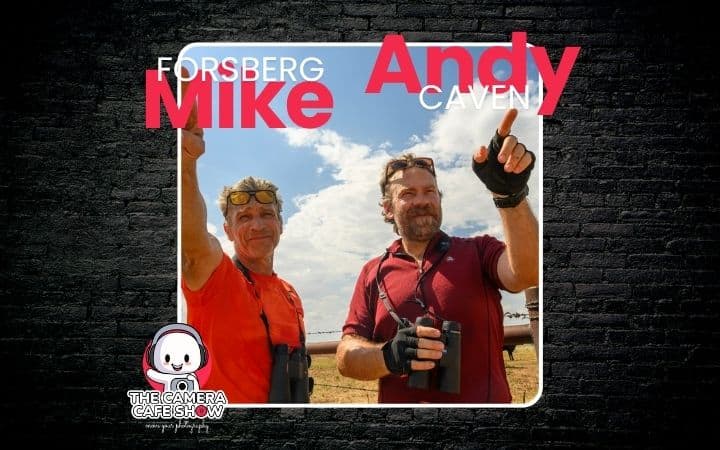
Tom: Greetings and welcome back on the show everyone. You know that sometimes somebody sends me an email and he says, "You should check out this photographer." This was Jim Richardson from National Geographic, I was on the phone with him and he says, "You have to check out this photographer." And then I checked him out and what was happening, he was going to do an amazing thing. So if you feel proud about your long bike journey this week, just lower the bar a bit because I'm going to talk to two guys who are doing a 2,500 mile bicycle tour from Texas all the way up to Canada to following the whooping cranes migration route. Mike and Andy, it's a pleasure to have you on the show.
Mike and Andy: It's great to be here. Thank you. Absolutely. forward to talking to you
Tom: Yeah. So Mike, you are a conservation photographer, a filmmaker, storyteller, and you spent actually years documenting the whooper cranes. We will be only touching a little bit about your photography on this podcast, and I'm looking forward catching up with you after summer and we will go deeper onto your photographic career, your magnificent book and the Platte River Basin Time-lapse Project. And Andy, you're the director of the Center of Flyway Programs with International Crane Foundation. So you have, I guess, spent most of your lives with cranes too?
Mike and Andy: Yeah. Yeah. Mike and I met through cranes.
Tom: Okay
Mike and Andy: My role is really long-term research with, plants and birds has been my career, and that led me to cranes and understanding what they need and where it is and, how to conserve it. So that's been my life track and where I encountered Mike on the Platte River. I lived in Nebraska for most of a decade, and that's where I met Mike, and we've stayed friends since and continue to work on projects together. Yeah
Tom: So this is a very big project. Whose crazy idea was this in the first place?
Mike and Andy: I'll point at you and you point at me? I don't know. It it we'll, probably figure that out where you know, idea will become myth and the myth will become legend, and who knows who will decide whose idea it was. But it, regardless, it took shape about three months ago. So this hasn't been anything that's been years in the planning or anything like that. It's something that we decided very very quickly that we wanted to do and then rallied the troops and, here we are. Yeah. Yeah the logistic planning really started in March, and I changed positions. I actually went from being vice president of North America Programs for the International Crane Foundation, which was a leadership post, down to a program post which I had created because I, I thought I could have more impact there, and I wanted to help start this new program. We, we didn't have a lot of time to plan it. I think the idea gurgled up like a spring, like spring water as we were working on different project ideas. I think we first talked about the idea maybe at the end of, 2025 but we really didn't start the logistics planning till a few months out, and I- we've been working on ways to tell the story of the whooping crane migration corridor, which is within this, the Central Flyway, which is within the Great Plains, and like Russian nesting dolls. And, the whooping crane migration corridor cuts right through the heart of this important prairie province that's very transformed, and it's, really under threat right now. And as Mike describes it, it's often like a melting glacier. You don't see it go away like this. You lose it bit by bit, and we wanted to make sure people were aware 'cause it's affecting the whooping crane, and it's affecting a lot of other birds and wildlife as well. And so- And people. Yeah, and
Tom: Yeah, Bill. So you guys, I think now are halfway through South Dakota. How are you feeling mentally and, and physically? All in shape?
Mike and Andy: We're taking a rest day today. The bona fide rest day minus emails and some pop-ins from that we know and such. But yeah I think we're both holding up pretty good. We each have our issues physically. We certainly have our issues mentally. But those are with us all the time, probably. But yeah after f- the, first day when we started, at least for me I was, like, "Man, you're really doing this." And and then the second day was, "Holy crap we're, really doing this." After about
Tom: Yeah
Mike and Andy: or six, you started to get into a rhythm and your body started to accept what you were about to do in your mind. You had to get your mind right and and then you just go day by day or sometimes mile by mile. And I think we've... Andy and I have done some hard things together, so we know each other pretty well and we give each other space when we need it. We give each other support when we need it. But I think this would be a really difficult thing to do alone, but with my buddy here, it's it's very doable yeah,
Tom: Mm-hmm.
Mike and Andy: hard and for me when I was younger, when I was in high school age, I was a track athlete and I was a pretty decent one, and I ran the mile, was one of my best races, and I feel like we're in the third lap of the mile, which was always the hardest one. My splits, I'd always suffer that. I'd go my first two laps I was on pace, and my last lap I always finished strong. But that third lap was holding it together and I think we're about right there in the trip. I think physically we've got a few lingering issues but we're doing pretty good. But the m- the hard part for me mentally has always been that third lap. And I think like Mike said we give each other a lot of grace and, that's the important part. Everybody has a hard day or a couple of hard days, and you just keep trudging forward.
Tom: Mm-hmm.
Mike and Andy: We don't always get the number of miles we want. Some days we get a few more. But we, every day we learn something and we meet interesting people- and see
Tom: Yeah.
Mike and Andy: landscapes and try to tell that the story of the landscape. I feel like that's what we're doing. It's not our story we both wanna tell the story of the landscape. Yeah. These
Tom: Of course
Mike and Andy: tall white birds, these angel white birds that- Yeah. And their story ... that nearly went extinct, everybody had written off in fact in the 1940s except for a handful of people, and they were less than 20 left in the entire world. They have come back to roughly 550 in this self-sustaining migratory
Tom: Yeah.
Mike and Andy: flock. And cranes like anything that migrates, but especially birds they connect that they need up and down their flyways. They also connect people and culture and so forth. And um Andy and I both grew up in the Great Plains. This is where we're from. And- And beating the drum about the Great Plains, a place that is our habitat home for for me over 30 years, and Andy being much not a lot younger, but And nomadic But nomadic, yeah. Yeah. I guess we we've been telling that, that story through these birds, and so in a lot of ways this is a... The cranes are the muse a sense, and it is very much about them, but it also is about something that's much bigger than us that goes across space and time, know? So- Yeah, it's a very inter- interesting information flow, 'cause coming out from us to the community is the story of the whooping cranes. They've already moved through. People ask us why are you going after they move through?" as Mike often says, they live on the edge of winter, and we'd probably have frostbite if we tried to ride this during the crane migration. We could've gotten snowed in, and they occasionally do get snowed in and held up. But we're telling the... We're talking about the story of whooping cranes and the importance of, this migratory pathway, and some of the things we've seen, like them stopping at, in dry lands where there's no wetlands, and coming into big groups where there's no options to roost with a lot of other water birds, where there's disease risks. So we're telling the story of these birds and their recovery, and now habitat loss threatens it. We're listening to community members to learn about their experiences with the land and the birds. So the output is us talking about whooping cranes but the input is us really learning about getting an,
Tom: Yeah
Mike and Andy: snapshot of the Great Plains where they come through, and communities and ecologies. And so both science and story and photography play into that.
Tom: Yeah Yeah. For someone who never saw a whooping crane, what's, what makes it so special for you guys? What's, the first thing you notice when you see them?
Mike and Andy: They are the tallest bird in North America. They're five feet tall, and they are angel white. fact, it-- for me the there's a lot of white birds in the world, right? But it seems like these birds have a kind of light that emanates from inside of them going out like a lamp and,
Tom: Mm-hmm
Mike and Andy: and they have a wingspan of eight feet, is like that of an NBA basketball player, so these are giant birds, and they're very rare. And if you think you might have seen a whooping crane, you haven't seen one. You know when you- Yeah ... when you see one. To, to Mike's point about
Tom: My Q
Mike and Andy: I used to see them from airplanes doing aerial surveys, and they literally pop, there's no other bird that's so white. Occasionally there's some human structure that's white, like a bright white bucket. You might look twice. But they are so white, they're the only-- they pop out more than any other bird from a white color standpoint. Yeah
Tom: , you guys talked, touched a bit before , on the extinction issue. I remember when I was talking years ago with a photographer from Japan, and he was telling me the same kind of story that there were only a few left, and then after the war, people gave them land where they could be, and they start feeding them, and they grow also back to, some numbers. You, you have an idea how they managed to survive again here?
Mike and Andy: Yeah, I'll start and I'll let Andy finish because I'll come at it from one way and you from another, I think. At, its lowest point, these birds were roughly 15 or 16 whooping cranes left in the 1940s, and we were just coming out of World War II. And, at that time, there was a gentleman named Robert Porter Allen an ornithologist of the 20th century in the United States that was hired by the Audubon, National Audubon Society to try to figure out these last handful of whooping cranes that were showing up on the Texas Gulf Coast in one location the newly formed Aransas National Wildlife Refuge were coming from. They didn't know-- They knew they showed up there in the winter handful of these birds, but they didn't know their pathway. They didn't know where they nested or anything like that. And so they hired Robert Porter Allen who was stuck with it for nearly a decade to try to uncover the story of these birds. And one of the things that he did, besides being an ornithologist and a great scientist studying them very, specifically down there on the Texas Gulf Coast, was also to move up the Great Plains in a way that, that we really are emulating and talk to people
Tom: Yeah
Mike and Andy: and ask them if they've ever go into small towns, small communities, rural areas and ask people if they have ever seen these birds. if you had, me about them. If you do someday, please fill out this little report card here that I've got you." So he talked in churches and community centers and schools and cafes, and basically anybody that would listen, and walked that all the way up to Canada. Eventually, they through that effort and others around him, they were able to reconstruct where these birds were coming from and going to. Eventually found their nesting grounds in far northern Canada, the last stronghold clear up in Wood Buffalo National Park in the Northwest Territories. But it was very incremental work. You can't care about something that you don't know, and you have to
Tom: Class
Mike and Andy: name first, right? For it to be something to
Tom: Yeah
Mike and Andy: And then when it becomes personal whoever that person is then all of a sudden you have this capacity to care. And, so I like to say that despite us and because of us over these last 80 years or so, these birds have been allowed to come back. But there's been a lot of trigger points in that 80-year period through policies and new scientific knowledge and and, research that has helped as well. Yeah. It's the, interesting-- It's a-- Somebody actually did a dissertation or master's thesis, I forget, on comparing the recovery in Japan of the red-crowned crane and the whooping crane in the US.
Tom: Mm-hmm.
Mike and Andy: And they're a little bit different in the red-crowned cranes in Japan. They're non-migratory, and those feeding stations help, boost that population
Tom: Yeah
Mike and Andy: Something we never did in the US. And actually that population's grown a little faster for that reason, but there's also the risk of disease and everything else. These birds have had to figure it out on their own to recover from a foraging and diet standpoint. But there's a lot of landmarks start in obviously in, in North America. We had the Dirty Thirties, the Dust Bowl, and Great Depression leading up to World War II, and that's when a lot of birds hit their lowest points. In fact, there's reports natural history reports from the Dust Bowl of big dust storms and birds literally were falling out of the sky dead. So these dust storms would blow through, and birds would just fall out of the sky dead, so I think it's no coincidence whooping cranes were at their lowest point after that 'cause a lot of poor folks too were, subsisting on wild game at that same time. And so the 1940s marks the beginning, late '30s, of the recovery efforts. The refuge system really ramps up late '30s. Their wintering grounds are partially protected 1937 with Aransas National Wildlife Refuge, and the refuge system built from there up through their migration path. So those refuges were a big part of the story. It was federal refuges in particular like Salt Plains National Wildlife Refuge in Oklahoma or Quivira National Wildlife Refuge in Kansas or the protection of the Platte River through multiple agencies later and organizations. But the habitat protection was part, and then the cessation of hunting them and penalizing for it, right? To-- We had the Migratory Bird Treaty Act just 1918, I think that was, and the Endangered Species Act much later, 1973 was the final act. But many other things throughout that time period that related to land, conservation and, farming practices and, everything else. And so the habitat conservation came into place. People quit shooting them, and they have recovered by their own merits. There's been reintroduction efforts to start separate populations, but they have not grown nearly as quickly as this remnant population. There's currently about not even 140 at this point in the wild in the two reintroduced populations. So this r- remnant population, even though people thought it was gonna go extinct, this is what has succeeded by their own resilience, which is a interesting story. Yeah And I think it's important for people to understand that in the, Great Plains of North America it's a big temperate grassland traditionally. It's like the Mongolian steppe or the African veld or the Pampas of Argentina or the the Kazakh steppe. These are also though our bread baskets, our energy pumps, and they are the high- most highly altered ecosystems arguably on Earth, and so here in the Great Plains, if you were to take its roughly million square mile geography, which is what it is, there's about 23 million people that live in the Great Plains. That's not very many. You consider 23 million people live in the Los Angeles Basin alone.
Tom: Yeah
Mike and Andy: mean that this place is not highly developed. It's one of the most altered, human-altered landscapes on Earth, like most of these grasslands are. And so if you have that as your backstory and your stage, and you understand that, most state and province that we're moving through is, in private ownership, not public ownership like a lot of the public lands out to the West, that creates a different kind of set of challenges in the conservation space because you're not dealing with governments as much
Tom: Yeah
Mike and Andy: with people, right? Yeah. Yeah. Yeah. It's-- Cut, cut us off if we go on too long here, but then you want to insert a question. But the we can ride for days, in telling this story and updating it we can ride for days without seeing a high quality remnant wetland or prairie. We've, ridden 30 miles in a row without seeing any wetland or prairie. We enter South Dakota recently, and for days we're mostly riding through bromus inermis smooth brome fields where there is grass, which is actually a European grass that's come over here. We've sent you our goldenrod and that's here too. But, Bromus inermis is very invasive here. and it took till about the middle of South Dakota till we hit a really high quality remnant prairie, and then it was lights out. The birds it was incredible. And we rode through a few of those, and we've already ridden out of them, so these last vestiges, mostly on private lands, mostly on ranches, are really, important. And we hope to tell that story. I don't think the fate of a, an ecosystem has ever been so tied to the fate of an economy in ranching the way it is now 'cause ranchers are also having a hard time, and they're the ones keeping the grass the Grass.
Tom: Because I think it's the most, well, most fascinating part for me because normally when you hear the word conservation, guys, people think about saving a species, but you guys are also a lot about protecting entire flyways and habitats, not only the whooping crane. So I think I it, I think it's a fascinating thing you are doing there, yeah?
Mike and Andy: Thank you. Yeah, thanks. We in, in our country and in Canada, we've basically laid out a grid of straight lines on a map to delineate political boundaries and borders great idea by Thomas Jefferson, but it doesn't work great in the natural
Tom: Yeah. Mm-hmm.
Mike and Andy: and
Tom: No
Mike and Andy: So we try to completely ignore these straight lines because they are political boundaries that we have to work in within a policy framework
Tom: Yeah
Mike and Andy: so forth. But there's, other ways to delineate landscapes and, through rivers in the sky that are our flyways and the watersheds that here in the Great Plains mostly run from mountains to plains, as Andy often describes, rungs on a migratory ladder. Those are, the most compelling physical attributes of all, and they are-- you can build community around that, too, so I may live in Nebraska and somebody else may live in North Dakota. We may be separated by hundreds of miles maybe even a thousand miles, but we're in the same flyway. And that's really the power of cranes in a lot of ways. In
Tom: Yeah.
Mike and Andy: We have the largest gathering of cranes anywhere in the world in March, where you have over a million birds come to the Platte River for four to six weeks, and most of them are sandhill cranes, but we also get most of the whooping cranes, too. you have a second migration that happens then, and that's not the migration of birds, but it's a migration of people coming from all over to come and
Tom: Yeah.
Mike and Andy: birds too together. And
Tom: Yeah.
Mike and Andy: from everywhere and they're bound together then by that shared experience that they have. and it doesn't matter where they're from and these cranes have a a very, They mark time for us in, our lives when we see them, when we hear them call. They bring us together in, in community, and they help us define flyways and watersheds in a really beautiful way that seems to strike at something that's very, deep within the hearts of, all of us. And maybe that's because they're such an ancient species. 15 crane species in the world on five continents and they're long-lived, they can live 30, 40-plus years in the wild. they have two kids a year. They don't reach sexual maturity till they're five. They, they tend to stay together if things are working out for the pair for very long lengths of time. And they are symbols in cultures and religion and, in,
Tom: Yeah
Mike and Andy: So many layers. And there's just something very special about them. So they again provide us a good through line Yeah. One weird thing about cranes, if you look at extinction risk for species in general, for vertebrates in general, the sandhill cranes and cranes in general are not outliers in a way in that their survival without changing has been above average for a vertebrate in recent epochs. And cranes as a lineage can trace their ancestry right to the original radiation and diversification of birds post dinosaurs. You can trace the Gruiformes roots back to 64 million years ago, and you can trace modern forms of the African crowned crane to 25 million years ago. And the grouse cranes to 12 million years ago in, in similar forms. The sandhill crane is relatively unchanged in that 12 million years. so they're really ancient, which is pretty neat. And they've outsurvived most other things, and they may outsurvive us. But we're making it a little bit hard on them.
Tom: And then of course, Mike, the most fascinating thing is that you guys are on bicycle, but with roadmaps and GPS, and they don't have nothing of this. How did they do it, Mike?
Mike and Andy: How do they do it?
Tom: Yeah
Mike and Andy: I-- so the thing about cranes is that they, when their chicks are born they learn most everything from their mom and dad, and they're with them that entire first year of their life. whereas some birds are hardwired for migration their first year, these birds are not. This is a generational transfer of knowledge mom and dad and others in their flock to that next generation. That's really fascinating because you wonder what those conversations are, as they're teaching their young one to fly. So when these birds leave Wood Buffalo National Park way to the north in the boreal forest when they're about roughly four months old they're making this epic migration with mom and dad, and they're learning the landscape. They're learning to what to eat, to drink, what to be afraid of how to be a crane, basically. And they stay together for that first year of life and then, that's it. Then they have-- Then they split and dad after that first year, and for the next three to four years, they're others that are in the similar predicament. Like teenagers, if you will, that That are trying to figure out how to live their lives without really much responsibility until they become sexually mature and can pair up and then raise kids of their own. So if you consider a 40, 40-year-old bird that has made, making this migration for since adulthood, you're thinking about a bird that has maybe traveled 200 plus thousand miles across the same geography. And then you consider that, that if, she has raised 10 or 12 generations of chicks within that timeframe, just imagine all of that knowledge that she has imparted to all of those that then are turning around as they become adults and are, imparting that knowledge to others. It-- I, think Andi and I think about both of those things in our head quite a bit as we're doing our own migration north. So
Tom: Because now how the numbers, how many there are left now?
Mike and Andy: Yeah, technically in the world we're in the 8- 830 to 840 range, including captivity. So it's about 560 individuals, give or take 10 to 15 in the remnant population we're going with traveling the path of. In the reintroduced eastern migratory population, which goes from Wisconsin to the southeastern United States they're at like 60, 65 right now, but they just had a good crop of chicks, so they could be doing a little better soon. In Louisiana, non-migratory population, which has only been going about 15 years now they are at about 75 individuals. And then there's the remainders in captivity. So there's just about 700 and change in the wild, and then 130 or so in captivity And the captive birds are used to continue to maintain the genetics, so they really think about pairing those birds and maintaining the genetics as a, as a default or safety population that we hope never is necessary, but the thing is that you have-- if they only have two chicks a year, and usually only one survives to fledge, then they don't have a lot of to fail as these populations slowly continue to climb. geese, um, they reach sexual maturity much younger than cranes, and they have lots of them, right? You may- Big clutches ... you may
Tom: Yeah. Yeah.
Mike and Andy: ducks or geese- Yeah, 10, 12 eggs. Yeah ... and they may
Tom: Definitely, yeah
Mike and Andy: they may re-clutch a couple different times if they fail the first time. Cranes just typically don't do that. Yeah, same with grouse. Anything. Cranes are the archetypal K-selected species in ecology, right? The R and K strategies. Cranes are a lot like elephants or or- Whales ... chimpanzees, whales- Yeah ... Great apes in general. Very K-selected. The demographic success of the species is incumbent upon high adult survival. If the adults don't survive at 92% to 96% a year, the population won't do well. You need to have 95% adult survival. And when we make it hard on the adults to survive because they don't have enough habitat or there's a lot of threats to them, that's when-- that's why illegal hunting was so hard on them. Each time you remove a, an adult from the population, you lose a lot of cultural information. In fact, they used to breed in many more areas, but as the birds that got hunted out of those areas were gone and the habitats transformed the, existing birds just haven't gone back and bred there. Those were cultural lineages passed on about migration routes and foraging areas and breeding areas that, that are gone now, and maybe some will reestablish at some point, but it'll be slow. But they still currently breed and winter in the same spots. We see those teenagers explore some areas- and, maybe in the next couple decades we'll see some ex- expansion of the breeding range, but it remains to be seen. Got to have habitat. Got to have habitat first. To do it, yep. Yeah, and that's still going
Tom: Yeah, of course. Let's stay positive. Guys, go-- let's go a moment to both of you. Halfway the journey now what's a typical day like for you both when you're on the road?
Mike and Andy: He's looking at me, so he wants me to start. We- You do, more than I don't know about that. Yeah. We wake up we we try to get to bed not too late wake up and it's a little bit of physical maintenance. Mike and I both wake up early, but it doesn't mean we're on the road early there's, some physical maintenance and and gear maintenance and packing in the morning get some breakfast in get, We're moving all the time, so we're often-- It's an exercise in packing, unpacking and packing the Sag Wagon, and wherever we ended up, oftentimes we're staying at a, Somebody's putting s- putting us up, like a kind rancher like Jim and Carol Faulstich recently in South Dakota, or we're at a hotel or maybe on, on occasion we can camp. But we, get packed up. The Sag Wagon, which is driven by our, friend and colleague, Ethan, he will drive us to where we left off the last day and, we hop on the bikes. But we don't go that far usually for our first bout 'cause we stop at the first wetland or prairie that, that's in good condition, and we do a biological survey of plants and birds. We take those notes and then we, get back on the bikes and kinda start making miles for the day. And about every 10 miles they'll check in on us and say "Hey, how you doing?" We'll get maybe water and some snacks and plow through the day, but if we see something cool we stop a lot. You, see a rancher who's out on his land and the land looks good, we're gonna pull up and talk to him. Or if we need a bathroom and we drive into a gas station, we'll probably talk to somebody it's, Every day is an an relatively unplanned adventure. The course was set with a bunch of important areas for whooping cranes, about 44 areas and then we kinda filled in the gaps. But there's times where the route doesn't work and we get stuck,
Tom: Yeah.
Mike and Andy: ' cause there's a gravel road underwater or a private road we can't pass or something of that nature, and then we have to get back to the maps and replan our route so I don't know. Is
Tom: Угу.
Mike and Andy: That's an Overview.
Tom: Ага
Mike and Andy: Andy's doing the science along the way and and I'm, doing the photography. And helping with the science. He's very helpful. I s- I see stuff, but yeah, and and I'm, just using... This was a really, big reach for me, to just use a phone, and I figured that I would use the the, camera that I had in my hand, I think it would be nearly impossible to do anything with... If I had a bag of cameras with me, I just wouldn't be able to do it, and I just wanted to focus on one thing, and I wanted to focus on one tool that I knew everybody used Because like this trip of ours Andy's a great athlete and I'm well enough, but we're s- we're two regular guys- Yeah that are doing this trip. We haven't been training for years for this. We're not super athletes so I wanted to maintain that same sort of idea. It's "Look, you can do this too." And and maybe you're not gonna go the whole way, but you can go part of the way. And I'm gonna document this with a tool that I know that just most everybody on the face of the planet these days is walking around with which is a phone. And I feel naked a lot of times, and there's times that I wish, it's man, I wish that I had my telephoto right now, or this or that. But Andy's in the same boat as a scientist. All of his books and keys and all that sort of stuff, and so we are experiencing this. It's stretching us both, I think, a lot professionally,
Tom: Mm-hmm.
Mike and Andy: Creatively. But I'll tell you that, over halfways in, it's been one of the most freeing experiences as a photographer that I've ever had in my life. And that doesn't mean that I, wanna run around with the phone the rest of my, career. But you learn how to see and what this thing can do you can use it, then I've really dialed that into the, few things that I do then on a daily basis. So when Andy is doing his plant surveys, and I'm no good at plants I know a flower from a grass and a grass from a tree, that's about it. But I'll be looking around and I'll be looking for the pollinators that are on the flowers or the small live insects, because with this, phone, I can shoot really, close and I can shoot macro stuff in a way that I can't with my other phone. anytime we meet somebody, I'm using this phone to take their portrait and I'm trying to take the same kind of a portrait every time so it's like assemblages, right? And so I've maybe made 60 different portraits from this phone. I'm also taking photographs of bird that has been run over by a, vehicle that is, flattened on the, road that looks like a, leaf pressed in a book. and documenting the diversity of bird life 1,500 miles up the Great Plains so far. ... And then just our clouds, out here the clouds are our mountains they're always changing. And so those cloudscapes are always different and they look different depending on where you are in the geography. So can do that with this and so that's, the way I've tried to work or, have been challenged and have figured out some solutions. Now I have no idea what it's all gonna look like at the, end, but it'll be fun to go back and look at the body of work and see what's to reacting to Mike there I'm a, big... In conservation it's interesting. I've, been in the conservation community in Nebraska- And in any big event this c- you can tell the quality and meaning of somebody's work by, the venues in which their work comes up. And if there's a, retirement or a, or k- an award or something in the conservation community in Nebraska, the first person they often go to is Mike to say, "Hey, we would really love one of your photos to, to honor this great person's career," or something of that nature. He's-- I love his work. I've loved it for a long time. And I've seen some of the photos he shot with his phone, and I, got one that I think is one of my favorite photos I've ever seen of his, and it's, really abstract and I'm in love with it. So anyways I think he's doing some super cool stuff with his phone. I love that one photo. I do. Thanks, Andy. The, whole part of this trip is to be relatable. Yeah. And, I think the thing is, a bike is relatable, right? Yeah, it's really hard what we're doing. We've done hard stuff before. Most publicly it, was actually staying in a blind together, not moving for many days and change. This is all movement, as Mike has been pointing out. We-- neither of us can slow d- slow down enough to take in everything we want. If I stopped for every bird I saw on the side of the road we would, be in Kansas and it's all about making choices about where to come down. Everything's a choice, if you stop, it has to be worth it. You have to keep moving. But everything about this is relatable, both existentially to the cranes- And how they have to make decisions. Can they come down? Can they not come down? And to the people, 'cause people can do what we're doing. There's, nothing... Like, Mike said, we're not super athletes and we're we're, not, Yeah. We're just two, two dudes. So, this is all doable. I'm using new tools as well. I prefer my ta- taxonomic keys, but I've been using my phone a lot more too. I've been using some of these new AI tools to if I don't know what a plant is or I have a guess, see what the AI says. Now, the AI is terrible at grasses and sedges, but luckily that's one of my specialties. But it's pretty good at flowers. If I see a flower I don't know, I can shoot it on there and say, "I think that's a linum. I think that's a flax, but I don't know which one." I can use that, the AI,
Tom: Mm-hmm.
Mike and Andy: it'll give me a guess of, oh, it, it's 50% linum this, 30% linum this, and then I can look pictures on the internet and confirm. So we both had to pare down and work in new ways. But Mike, I think Mike's cha- been, one, more, more pure about it. I stole a key in Nebraska that I've been- I'm gonna use for multiple states. He's been more pure about it and I think the quality of what he's done is really interesting,
Tom: Because I had this scene in my head with both of you on the bicycle, Mike seeing something. He says Andy, let's stop. I have to take a picture of this." And Andy seeing some new grass and he says, "Mike, I have..." And both of you are rolling the eyes in the end and says, "Oh, come on, let's go. Let's get going." But it, it's not like this. You're actually very consistent about, things.
Mike and Andy: No, I think that happens Too.
Tom: Okay.
Mike and Andy: I think every day what you described is, it's always a conversation and it's based on oftentimes how tired you are and where you're at in the day, and how many more times do we have to stop and take a picture of a flower? How many more times do we have to stop and look at a, bird that we've seen before? But yeah, it's-- But I think those decisions each day when we're traveling, we're making all kinds of, decisions just like the birds are. So imagine a bird on migration, a whooping crane on migration, and every day they wake up and they decide if they're gonna fly that day based on the weather and everything else, and how they're feeling. And then if they decide to go, you they don't know how far they're gonna go necessarily that day. But they are gonna have to make decisions along the way. How high do we fly? What are the roads in the sky gonna be like? Are we gonna have a lot of turbulent weather? Are we gonna have smooth sailing? What's that gonna be, and what's, what pathway is that gonna lead us on? And, where are we gonna come down to drink? Where are we gonna come down to eat? Where are we gonna come down to sleep, and who's gonna feel good that day and who doesn't? Like, when we take off in the mornings, usually within the first 10 miles, we look at each other and say, "Okay, what hurts today?" Because almost every day there's some consistency each day, but there's also things that that you don't expect. And I imagine those conversations among birds, among a family of cranes or a, duet of cranes is, very similar. know, you may start together and you may end together but, maybe along the way you may separate you may do things differently, or you may decide to not go as far as you, you want to one of them, because the other one just can't go any further. So that's been a fascinating thing about, being on a bike. And one of the brilliant things that I think Andy has always talked about is w-we want to feel the weight migration and obviously we're not birds, obviously we have a safety net we are doing this all under our own power and, um- that's been a, really eye-opening experience. A- and you can really feel the distance between these beautiful places, you know- Yeah ... that these remnant places. Like I
Tom: Yeah
Mike and Andy: ' cause I'm a biologist and he's a photographer, we get excited when we get to a gorgeous grassland, and sometimes it's a long pedal between them, or a gorgeous wetland. And the other thing we, wrestle with oh, we have to stop again, by giving each other a lot of flexibility. We ride 40 to 60% of the day pretty close together, and then another the other half of the day we might separate a bit, and it's no big deal 'cause sometimes you have to ride to your body and people ride different and we have different bikes and different bodies and d- different approaches at times. But if, Mike's getting a shot of a bird on the road, he doesn't always expect me to wait. And if I stay... The other day I was staying. I'm like, "I gotta watch this lark bunting sing a little bit more." They took off. It's no big deal. He knows I'll work to catch up. And we give each other a lot of flexibility, and that way we don't necessarily hold each other back, 'cause there's times one of us is gonna wanna stop and the other's not, but there's a lot of times where we wanna stop together. The other day heard a couple calls and some grassland birds were going down. They were pretty big, and I was like, "Ah, shit, I missed them." And Mike was behind me, and he's done a lot of work with burrowing owls. He's "Burrowing owls." I was like, "Oh, heck, that's, that was, those were burrowing owls. We gotta get on those." And we found them pretty quick. Mike has great eyes, and he's "There they are," so we got a look at these burrowing owls and we both enjoyed that. And that's kinda we... A lot of times it's what we're doing together. Sometimes it's I might be like, "I'm gonna stop and look at this grass for a while," and Mike might pedal, or he might be taking a photo that, and he lets me keep pedaling 'cause your body can get in a rhythm. And you, you have to you have to be conscious of how often you break it if you stop too much. I feel better riding 10 or 12, if I ride four every four miles and get off, I'm gonna slow down 'cause at the fir- the next half mile, getting my legs back into a rhythm is always sore. You kinda... It's really a cost to come down. It's kinda like flying. You're gonna, you're gonna pay something for every stop, sometimes you have to stop. And so it's a really interesting story that way
Tom: And you guys pass also through a lot of small towns and, and communities. How the people responded when you talk to them?
Mike and Andy: They've been great. And I don't think I expected them not to be. They're just curious, when you go through a small community and here's two dudes coming by on bikes with that obviously aren't from there there's there's an awareness. We have-- I don't know how many connections we've had with people, but it's, been a lot, and it is always met with curiosity. First they may not know what a whooping crane is. Some people do some don't. They're always curious about the bikes. They're always curious about the journey. Then they start asking questions and, maybe more than anything else, though, what's been important is that, uh, Andy and I, in our own work and our lives we've learned that working in the Great Plains of North America, one of the, most critical things that one can do is to listen. to tell people what
Tom: Yeah.
Mike and Andy: to think or how they ought to run their land or anything else, but just listen to them and hear their story. oftentimes we're asking the questions not telling them all about what we're doing, but then that provides a doorway of conversation. And we've talked to kids that have been as young as nine years old and, people as old as, 90 years old. And they've all got a story to tell. And a lot of them, if you spend enough time with them, they've got a story that, that they're very proud of about their land, about their heritage about their about their family and sometimes about these birds. Just a couple days ago, we ran into a a woman that was a retired postmistress in this tiny little town called Gann Valley in South Dakota, population 60 or something like that. And she remembered when she was in her little country school back in 1955, when she was nine or 10 years old, they had 14 whooping cranes land outside their school At the wetland that was nearby. there were maybe 30 or low 30 number of whooping cranes left in the world. So they had half of the world's population of whooping cranes land outside, and she never forgot that. In fact, she told me the three times that she saw these birds in her life. how did that happen? Andi was at the courthouse visiting with a couple folks, and I was just pedaling my, bike, wasting some time waiting for Andi to come back, and she comes tooling down in her, fancy blue pickup truck and asks what we're doing, and 10 minutes later we have this amazing, woman telling us this amazing story, and very proud of it. And that more than anything else that's, what we're doing here. We've talked to schools and we've had some formal at different nature centers and such, but it's, that,
Tom: Yeah
Mike and Andy: touch points are most important at all, of all, y- yeah, it's fascinating. Mike, I had to double, I had to check the old Google 'cause I was like, "I thought the town was even smaller." And Gann Valley, the official census was 10 people. Oh, 10? 10. Wow. 10. Okay. And I think we actually met- There you go ... we actually met six people. Six of the 10. We met six people, six of the 10 people in Gann Valley. And um the thing about the, Gann Valley was fascinating 'cause it was the smallest county seat in South Dakota for Buffalo County, and the smallest county seat in the whole United States, the smallest population for a county seat. And that town used to be bigger, of course, but a lot of these towns have had hard times and aren't what they were in terms of population anymore. But there's all these interesting towns we've passed through, right? Whether it's Tura in Kansas, Red Cloud, Nebraska, Gann Valley, South Dakota that we, had these really interesting experiences meeting people and hearing their stories and telling them about cranes, and they were excited, really excited to have us. I think- Yeah ... just getting attention to their town, they were like, "Wow, somebody cares about my-
Tom: Mm-hmm
Mike and Andy: little town. That's neat." Yeah. And that's that first step to conservation. It's always appreciation Right?
Tom: Yeah, of course
Mike and Andy: able to, you gotta be able to care, and oftentimes that starts with a sense of pride.
Tom: And if people want to join you guys for a few miles, they can do this?
Mike and Andy: Yeah. Yeah, they got-- they have to go through our gatekeeper, Mariah Lundgren. Mariah is Mike's right-hand person. She's actually in the hallway right now. She is serving as the contact for the trip. Mostly because Mike and I are biking, we can't answer things, and we're barely keeping up with our normal life duties as is. I think Mariah's probably barely keeping up with her normal life duties as is too, but she's doing her best to shepherd us and make sure that we organize it a little bit. So we, tend to do bigger rides from certain places if So some folks who come out with us we've had a lot of people join for a day or two. But what we try to do to get bigger groups out is have some kind of coordinated rides out of particular areas where more people wanna join. And I think there'll be one coming up, from what I understand, in North Dakota leaving Bismarck. We're gonna have a number of people join. Is that, correct, Mariah? so. She says yes So thank goodness for
Tom: So Jim Yes, and she's very good in answering emails also. We, finally made it work.
Mike and Andy: We're both horrendous. I'm worse than Mike
Tom: So Jim Richardson, he didn't join you on the bike?
Mike and Andy: He did not join us on the bike, but the man is a superman. He he came out for
Tom: Yeah
Mike and Andy: the day for half a day and he... It's fun to watch Jim 'cause the guy's got endless energy and boundless enthusiasm and, Um, he's a very young 70-something. I don't know how, he does it, but he's, running all over the place, getting different angles and shots, getting clear down low- He's wide, yeah and way up high. He's he's everywhere. he's he's like Flash. And Jim's such a, been such a wonderful mentor and a wonderful friend. It was fantastic to be able to introduce him to Andy. and he's just another one of those treasures along the, Whooper Highway. And Jim actually also gave me-- I had a crash course in iPhone photography with Jim before I
Tom: Okay.
Mike and Andy: on this trip. We took a, we took about an hour to help, me understand some of the nuances of the, of how the camera works, and it's been a big, it's been a big help, so
Tom: I will, give him a phone call now when we finish talking. But guys, what's one luxury item that you are missing the most on the trip?
Mike and Andy: I think we're both pretty basic. Like we both camped and roughed it. In fact, we even have a Segway and that carries a fair amount of gear. It's more we almost didn't for part of the trip, and we had all the saddlebags and stuff to go unassisted and a water pump to pump out of streams. It would've been a lot slower and a lot less comfortable. But having the Segway again has pretty much answered... I miss my best friend, my dog, Bruno. Bruno is an old dog. He turned 16 in May, which is very, old for a big dog, and he's a black mouth cur, and he's my best buddy. And aside from him I'm doing okay, but I miss Bruno. Yeah. I think that's a good answer. I think the luxuries of home, you know- Yeah ... and being able to wake up when you wanna wake up and, watch your birds in the backyard and be with the people that you love and the animals around you, all of that stuff. But yeah, Andy and I are pretty basic people, so we- we're comfortable being uncomfortable to a point. Um, but yeah I, don't know.
Tom: Yeah.
Mike and Andy: know. We've, still got a
Tom: But
Mike and Andy: to go, so when you-- if you ask that que- that question again later we may
Tom: After summer I will do
Mike and Andy: have a better answer back. Yeah.
Tom: Guys, what's one thing in the other half still left to come? What's one thing you definitely are looking forward to?
Mike and Andy: I've-- I am just looking forward to more of what we're just getting into now, so there-- we have this vast prairie pothole country in the northern plains that, that is these rolling hills with glacial erratics, old rocks that were left in the last glaciation that created these shallow depressions where water sits and there's so much bird life in these places. And I have spent a lot of time over my career working in the prairie potholes but getting to them in a vehicle in a truck, and then sitting for one great length of time, maybe working out of blinds or using remote cameras to show something, uh, different that people haven't seen before. I'm really looking forward to moving through this landscape because on a bike, what you don't get in a car or you don't get in a plane is all of your senses are on. So it-- you're not just seeing a landscape slower, smelling it, you are hearing it, and if you eat enough bugs, you know you're tasting it too, right? It's just a, it's a s- really visceral kind of experience that I didn't expect. And so moving into the prairie pothole country that we're getting into now, and the further we go north, I think the more experiences we'll have perhaps like, yesterday is something that I'm really looking forward to. And then of course, I'm looking forward to the end. Yeah. Yeah, surviving it. One of the goals is to finish, right? I'm looking forward to I'm keeping track. I said my-- and Mike's doing this with me, is keeping track of the birds as we go. And we haven't seen a couple of these pothole birds yet that I'm excited about. I really like little birds. I love sparrows and short birds. And two little sparrows I'm excited to see are the lecontes and the Nelson's sparrows. Both are little Ammodramus sparrows is the genus Ammodramus, and they have orange on them. The leconte has this little purple flecking on the neck. They're these beautiful little sparrows, and I'm excited to see them. And they both like the, transition though. And a lot of the birds that have suffered in our modern landscape are the birds that like transition zones 'cause what we've done is we've impounded and drained wetlands you get a wetland and then it goes straight into cropland. We don't have a lot of these transition zones where it goes open water, marsh, wet meadow, wet grassland. And a lot of the coolest birds like that transition zone, and both those birds I just mentioned do. So I'm hoping we see some good populations of them to the north. We're just getting into the country where you can see them breeding and I'm looking forward to both of those species hopefully. Yeah.
Tom: I was hoping you guys were going to tell me that people coming out of their houses with homemade baked pies for you guys to take away, something like this
Mike and Andy: There's a place next door that has b- a very homemade place, and they, apparently have pies. Mike just got a slice. He got me a cookie,
Tom: See.
Mike and Andy: yeah. I have a chocolate cream pie and we have homemade oatmeal raisin cookies from the cafe next door on the house, So
Tom: You
Mike and Andy: happening. I think we're actually gaining
Tom: Excellent.
Mike and Andy: Mostly muscle in our butt and abs, but-
Tom: Mike, Andy, thanks so much for having this little conversation with me, it's been great hearing a bit the adventure, the story about the 2,500 miles going. It sounds, to me like a reasonable thing now to do. I wish you all the best for the second half of the journey, and may the winds be at your speed. And flat ti- how many flat tires you guys had?
Mike and Andy: A couple. Mostly my bike And mine fell off the rack as we were going down the highway We had to fix his brakes, my tires. We, we've-- We're holding it together though. Yeah. tape
Tom: Okay. Okay. Then you guys have safe travels. And Mike, I will talk to you after summer. We will want to hear a lot of more stories, and we will talk about your photography, the whooping cranes, your book, and everything else. Gentlemen, thanks again. It's been a pleasure talking to you tonight here on the show.
Mike and Andy: It's been our pleasure too. Thank you ... been our pleasure to be on the Camera Cafe show. Take care. Peace.
Tom: I see you guys around on Instagram.
Mike and Andy: All
Tom: a great day still there. Bye.
Mike and Andy: too. Thank you.
Tom: Bye
Mike and Andy: Evening. Bye