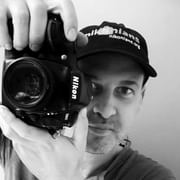



“I see it this way, you know, like the mountain gorillas, 400 left in the world, only 400 left and we cannot put them in a zoo because they have no immunity. In the zoo, what you see is a low-land gorilla, it's a different species. So, if we don't do something about that, if we don't participate, like when we go and okay, people say, Oh 600 US dollars per person, that's a lot of money for 45 minutes. Yeah, for sure, it is. But this 600 US, it's for each worker that are looking after them 24 on 24 during 365 days of the year to protect them. And I think this, it's priceless. It doesn't matter how much it's going to cost you to go to see them. It's priceless."
Intro:
Dave: Spanning the globe to bring great photographers and their experiences directly to you. It's 8 p.m in Japan, 1 p.m in Spain, and it's 7 p.m in tonight's guest's home in Margaret River, Australia. That means it's time for the Camera Cafe Show, brought to you by the photographers Macro Magic Man, Tom Jacob and Mr. 24 millimetre man, Dave Payne. Hello there. Macro magic, man. Would you like to welcome our special guests and introduce her to our listeners?
Tom: I think it's the best intro I heard until now, Dave, you're improving a lot. Thanks for that. So let's get things rolling today with our special guest so, so far away for me, at least, sitting there on her porch in the Western Australian Outback looking over 500 new trees she planted in her garden to observe wildlife. But then when she gets up from her porch, well then I think Dave, she's unstoppable and she roams all over the world to get the most amazing travel images as we can see on their social media accounts.
It's our pleasure today to have with us an amazing female travel photographer, Dalida Innes. Dalida won multiple photography awards in international photo competitions, like the National Geographic Travel Photographer of the Year, and be ready to hear some amazing travel stories later on in our interview. Let's get rolling.
Tom: How are you there today Dalida?
Dalida: Hello, Dave and hello, Tom. I'm going very well actually and I'm pleased to do this with you today.
Tom: We are pleased Dalida, thank you for coming on the show. It's an honor to have you here.
Dalida: Well, thank you guys.
Tom: I was wondering, just as an opener today, as we are talking to real human here that can make real human decisions.
You travel a lot Dalida, and I know when I travel, I sometimes made some pretty silly mistakes. I remember one very vividly in China. Had you ever had that moment where you were out and you say, Oh boy. I have no clue how to get back to my hotel?
Dalida: Not really, because all the time, I was only sometimes by myself. I have been in trouble, but not what you will think it has been, but because I am a woman by myself. Um, how do you say this...Like men trying to do things, you know, and yeah, I got scared, but lucky not otherwise. When I go like on a safari, you have always a guide. And so, no, I haven't been in trouble like that.
Tom: I remember when I was in China and I, from the excitement, I just got in the hotel room, dumped my bag, took the camera, went out with no map, start walking and got totally lost because nothing was in English and nobody spoke English. And it was really funny to find my way back to my hotel room.
Dalida: I imagine! Lucky not, no, the first time I went to Sydney by myself, which was my first big city when you come from a small village in southern France, I was having a map on my hand from the hotel, so I knew where to go and what to do! And at the time when you don't have iPhone and GPS.
Tom: Exactly. Dalida, tell me a bit about yourself and how you decided to walk into this world of being a travel and wildlife photographer.
Dalida: Actually, it all started when I was quite very young. I had a really, really difficult childhood, right? I don't want to go into this, but most of the time I was sick and in the hospital when I grew up. And my mom was very passionate about wildlife, she was always watching this kind of documentaries from National Geographic on TV. So she introduced me to this and when I started to grow, I remember I used to play with a camera that was broken. Of course, I wasn't going to make any pictures, but I was in my imagination just thinking that I was taking pictures of animals. And then from there, when I started to work and I started to buy my first, I don't know if you do remember, you remember this, JVC video camera?
Tom: Yes.
Dalida: Right. So you could do movies and things like this. They were quite big and I bought one like this and I say, Oh, yeah, I'm going to be a documentary person, you know, but of course, you know, your parents are not going to pay for school for you to do anything like this. Because they can't understand it.
And so I tried to do things with the pets in the street, in the village, you know, when you have dogs and cats, because in France there are a lot in the street. So I used to try this, but I could see I wasn't good. That's it. It wasn't my thing. And then I bought another one and another one and another one. But, wildlife was always something I wanted to see, and I always said to myself, I want to go one day to Africa. And I had to make a choice at the time when I was going to travel you know, the choice was, do I go to Africa by myself or do I go to Australia? This is where my life changed completely.
I decided to go to Australia because I thought it was safer for me to go in Australia than to go in Africa by myself. And I met my husband and he's like me, he loves wildlife, he loves all these kind of things. And we started to travel a lot, and we went many times to Africa, and India, and the rest of it. So, yeah, it comes from this. But I still had a small camera, the first time I went to Africa, I was still having this kind of, it was still I think the same JVC, but it was a bit smaller at the time. And I went there and, and my husband bought me the Nikon D5000. I don't know if you do remember the Nikon D5000?
I was still filming and I was taking pictures, but I wasn't interested to take pictures. I wanted to take actions. I wanted to do exactly the same as what I was watching on TV. But then from there I was like, okay, you're not good at it. My videos they were not good at all, but I took pictures and from there I start to get more interested in pictures.
I say, okay, pictures, you don't move, you know, you freeze the moment. And from there, I just say, okay, I go on photography. And it looks really good.
Tom: And you did very well Dalida, because look all the Awards you gathered in the meantime.
Dalida: Yeah, but in the beginning I wasn't good of course. I started to look up about Wildlife photographers, I start to buy books and I started to read. The only way to learn from composition and how to photograph an animal was to read because you need all this information to get the right picture. But another thing is that I was in animal care in France. So this did help me as well to first to observe the behavior of the animal and then to try to take the picture.
Tom: Yes. Very true. I think many people, I think when they start in nature photography, they miss this part a bit of learning the animal you're going to take pictures of, to know how it behaves. It's very important.
Dalida: Yeah, definitely. That's the most important, I think. First of all, you look at the behavior, you observe, and then you think, okay, I can get closer or I cannot get closer. That will depend on the animal itself, but the best way to take the picture is to let the animal to come to you.
Tom: Dalida, I want to pick a bit further on something that you mentioned in the beginning. You are a woman photographer in world that is sometimes, and sadly, not safe for women to be by themself and go wherever they want to make pictures. I think we all know this.
Dalida: Yes.
Tom: Could you talk a bit about that? What advice would you give to aspiring female travel photographers, because I know you wrote a blog post about it.
Dalida: Yeah.
Tom: Which is an amazing post by the way.
Dalida: Yeah. It's...difficult for a woman to be a wildlife or travel photographer depending which country you go. Some countries are more dangerous than others, and I would say probably most of this countries where you want to see wildlife, I mean, you know, the big five and, and all these kind of animals. The best way to do it is to do your research and to respect the country where you are going, and not to attract anything unwanted, you know, all the men, you're not going to dress like you're going to the beach. So there is no way you can do this in a country where women are not dressed this way.
Other things to do is probably to go with a group. Okay. You know, a group of women, if you are like five friends, who want to go to the same country, that will be the safe way to go to the country. Or go with your husband, like I do. But even with my husband some countries, particularly one country, actually, I didn't feel safe. Not because of my husband, but because I was with my husband, and surrendered by 10 men and I didn't feel comfortable at all because anything could have happened. And, like I mentioned in the blog post, always be sure to have network signal on your phone and a number where to communicate and to say where you're going. But then even so, if say, when you're in the jungle, you don't know where you are and you don't know what can happen to you.
It did happen to me in Indonesia. I was excited in the beginning, but after six days, not seeing one other person and be surrounded just by men, I didn't feel safe at all because I didn't know where I was. I didn't know we were in the middle of the jungle or anywhere, so yeah, it's scary even if you have a male friend coming with you.
Tom: I understand and sometimes I don't realize this when I travel alone as a man. I think Dave, it's a good topic issue we can work on for another podcast maybe.
Dave: I was thinking the same thing, as people get out as photographers get out now that COVID is slowly receding to the back of our existence, it's probably going to be a good idea for us to put together an episode on traveling safe and shooting safe.
I think it could be really good. And listening to what the Dalida is talking about, I just jotted down a couple of notes real quick. That's something that almost everybody could use, male or female. I think it's a good idea, Tom, let's add that to our list.
Tom: We'll work on it.
Dalida, if I ask you to think of two or three things, that you say would really be important requirements for someone to be successful as a travel photographer, what you would pick?
Dalida: For me, the first thing will be probably to respect the animal you have in front of you. A lot of people do not, unfortunately. And accidents happen, as we saw in South Africa, when people tried to go really close to an elephant. And at the end of the day, they will kill then the elephant, not the humans. So respect that boundary, you know, there is a line and you cannot go any further. If the animal chooses to come to you, which did happen to me, even I was far away from it, but the animal came very close but nothing happened. By the way, it was a great experience. It happened twice, but it was a great experience for me. So that's the first thing to do is to observe and to let the animal choose if he's curious or not. If he's not, well, but don't try because you want to have the super shot, don't try something you shouldn't probably, that will be my first advice if you want to become a wildlife photographer.
Tom: I totally agree, and most of the nature photographers we do interviews with on our podcast, they also say the same thing over and over again.
Dalida: Yeah, because we saw it so many times! When you go to Africa on safari, you see all these wildlife photographers and they know the spot where to go because we know where to go to get the best shots. But then when you see some of them nearly fighting just to get the right shot, that's ridiculous. And you stress the animal more than anything else. This is what you are doing. So for me, these people know nothing about animals and they get a photography award because they took the right shot, but they did it in the wrong way. That's the way I see it personally.
Dave: That's a great point. They got a great shot, but they did it the wrong way.
Dalida: Yeah, I saw wildlife photographers asking guides to run after a giraffe. To get out of the car and asking him to make the giraffe running for him to take the shot. I mean, it's shocking when you think about it, a giraffe can still kill you. I don't know if you know, but a giraffe can be very powerful. I couldn't believe my own eyes. So those things, you know, don't make sense to me.
Dave: Is there another important requirement that comes to your mind?
Dalida: Well, I would say to study the animal before to go. If you decide to go to see, I don't know, let's say polar bears. So, you just don't go, well...if you go just for a trip to, you know, some people they just go, take a shot and that's it, you know, they are happy, they saw it. But if you go for a purpose, you need to study the animal first, try to find any books you can, and today there is internet anyway, and try to find the most you can about the behavior before to jump and to say, Oh yes, I can get close and take a shot!
I don't know if you understand what I'm saying, because a lot of people do not do any research. Like mountain gorillas, that's the same thing when people go to see mountain gorillas. You have not too much choice then to do it with a group, this is how it works. And if you want to do it in private, you need to pay for the full group. So if this is 10 people, you're going to pay 600 US dollars per person, just for yourself. You have to replace that money for the Rangers because they look after them.
So, you go in a group and you can see people following the gorillas, you know. And you say to yourself, okay, between those two branches, I can grab a nice portrait if we go there, but no, the rangers don't do this, you just try to follow the gorillas. If not you just put them more in stress than anything else, even if they are used to seeing humans, because humans are around them all the time to protect them.
Another thing is that this is still a 200 kilos gorilla in the front of you, and you have to be very careful not to stress them or because animals, they don't understand what you're going to do. They don't have this thinking, 'Oh yeah they are tourists that's okay. I can sit here and with my little branch.' No, it doesn't work this way. And that's why I always say to people, just study the animal first and then go and take the shots you want without hurting them.
Dave: So it's interesting because listening to you talk and with our conversations before we've shared, it seems like it's almost like the three Rights.
You've got to have the right research.
Dalida: Yeah.
Dave: You've got to have the right equipment. And to be successful you've got to have the right mindset.
Dalida: Exactly. I really do believe this like what you see right now on my Twitter or Facebook at the moment, the birds that I'm photographing, I am inside the house. I'm not outside and they are on the other side of the garden. I'm lucky to have the right lens to photograph them, but if I start to go too close, they will just go to hide inside the bush and I cannot get the right shot. So I just wait for them. As soon they come, they don't come often, but when they come, this is when I'm going to grab the camera and shoot the most pictures I can, depending on the behavior.
But I am inside the house. I'm not super close trying to get a few shots. I studied them. When I say this is the male and female, this is the Red Wing, or this is the Splendid Fairy. It's because I did study them as soon as I arrived where I live right now, because we don't have them in Sydney, they are just in this area. So as soon as I arrived, I studied them when on internet. Learn which one is a male, which one is a female, which was very difficult in the beginning. I just want to say to people, I'm not that close at all. I'm not. I respect the distance and I just wait hours and hours for them to come.
Tom: So Dalida, now you touched the topic of gear, and I know many photographers enjoy the topic of gear and what you use. What's your favorite setup, I think you shoot Nikon, no?
Dalida: Yes.
Tom: Ok. So if you go out, let's say you go to Nepal, you go to make some pictures of an animal that is elusive maybe. What is in your camera bag?
Dalida: Depends on the animal that I will shoot. If it is a very shy animal like the snow leopard in the Himalayas, in North India, that was 600mm and 400mm and I still had a x1.4 teleconverter for reach. Sometimes it isn't necessary, 400 mm is enough, but it depends where the snow leopard is.
But for a mountain gorilla, because you can come close enough, a 70 to 200mm was plenty, or even a 50 mm sometimes was enough for me. But there I carry always two cameras. You're not going to carry one camera and change your lenses, you don't have time for this. Because with the mountain gorillas, you have only 45 minutes. After 45 minutes, the rangers they ask you to leave.
Right now, the birds you see on Twitter, this is a 600 mm from inside my house just through windows all around the house. I can see from the backyard to the front yard and depending where they are, I setup my camera.
Tom: And you're using a Nikon DSLR or you went to mirrorless, Dalida?
Dalida: No, I didn't go to mirrorless yet because I invested so much money in cameras and lenses. I'm using a Nikon D5 and the D500 Nikon for underwater photography, which I'm not crazy on to do it, but okay.
Tom: One second Dalida, did you say underwater photography?
Dalida: Yes! Because for the whales, when I shoot pictures of them, I use the Nikon D500 with a wide lens in the underwater housing that I have for it. In the beginning, I thought to use the D5 when I started or my D4S but then I changed my mind. The D500 came out and I thought 'Well, the D500 is okay'. The only negative point is the ISO, I don't like so much noise in my pictures. That's one thing I hate. It's the noise. I really hate it because it really disturbs the picture. So the D500 is only for underwater, or really, if I go just around here, and I will put the 70 200 on it, because this is a DX camera and I've got the reach for a few small birds around Margaret River. That's perfect.
Tom: Let's go back a little moment to the whales because it's very interesting. I have been scuba diving for over 35 years but I never saw a whale still because I never was in the right place at the right time!
Dalida: So the humpback whales, we are talking about the humpback, not the blue whale, I haven't done the blue whale. That's my dream, the blue whale, but it's more difficult to swim with them. But the humpback whale, if you don't try to chase them they are very curious animals and they will come to see you very close and it's like a 37 ton animal in front of you. It's impressive, very impressive. I've done it many times now. I've done it first time like four years ago and I used to go like two weeks over there and doing three morning and three afternoon dives. And I think the last year, just before COVID, I went there and there were more people going to the spot where I was going and I didn't like it. Four years ago we were the only two and then it just became more and more a tourist attraction.
I could see the whales were not staying because the people, this is again about animal behavior, they just jump in the water. You cannot jump, you have to go very nice and slowly if you want to be with the whales. People jump and try to swim very fast and trying to reach the whale, but the he would just swim away. But the last day, I remember because I hurt myself, I had a fracture in my rib and I couldn't swim. And I thought, well, no one is going to stop me on my last day, but I will go just alone with a the guide and my husband. I said, I want no one else in the boat. When we entered the water, we had a female that she came very, very close and I couldn't get away from her. She was coming up, but the male was following her. And she's came so close, like a 12 mm lens would fill the frame, I couldn't fit her in my lens view. I took a lot of shots and she stayed around us for probably 45 minutes. I couldn't believe that, 45 minutes, and then more males came, and we understood that the heat run was about to start, and she started to swim away, and had seven males coming behind her.
That was just fantastic to see it. But here where I live, you cannot swim, I mean, you cannot follow them. They go so fast. You can't follow them.
Tom: I'm coming to visit you. I have to see them!
Dalida: You have to do it because it's another world when your head is under the water. I mean, you know this already, but being in contact with whales is amazing. It's just like this enormous animal that is moving from right to left and she's watching you and it's like she's smiling at you. It's just amazing. I can't explain it to people because they say, Oh, it's dangerous. No, it's not.
Tom: For dangerous we can go to see the great white sharks.
Dalida: Yeah. Okay, let's go!
Dave: Just before you get committed to an asylum for trying that you both!
Listening to this brief recap. I mean, you've shot from fairy wrens to eyeball to eyeball with whales, a snow leopard to a mountain gorilla. All of these things have a big question mark in my mind. You know, we just talked with Will Wilson a short time ago and with Jamie Smart, and listening to them talk about animals.
The thought about nature conservation comes to mind for me. How many more photographers are going to lose that chance if they don't get involved seriously with nature conservation? How important do you see that being a photographer? And is there some group or some effort that you're personally active in for conservation?
Dalida: Yes. For example I gave a lot of pictures to a conservation group in Tanzania. When I was in Rwanda National Park, this woman contacted me, she's British and she lives there, I don't know if she's still living there, but she saw my pictures and she said, 'Oh, I will be interested if we can have them'. You know, I have no problem to give my pictures for what they need if it is for research or anything like this. It's only pictures, you know, if they need them, yeah, fine. And then there is this other person, she fights for the Orangutans and she has a few pictures I gave it to her.
But, unfortunately, and I'm going to be honest here, famous Wildlife photographers rarely will give or participate to anything. Some do, I'm not saying all of them, but most of them they always want to be on the top of the pyramid. And it really annoys me because we don't do something collective, if we don't do something today, tomorrow it can be gone. In a near future maybe, you can take your camera and try photograph, let's say a polar bear. If you find one, you will be lucky. I see it this way. You know, like the mountain gorillas, 400 left in the world. 400! And we cannot put them in a zoo because they have no immunity. In the zoo what you see is a lowland gorilla, it's a different species. If we don't do something about that, and if we don't participate like when we go there and people say, oh 600 USD per person, that's a lot of money for 45 minutes. Yeah, yeah, for sure. It's, but this 600 USD it's for each worker that they are looking after them 24 on 24 during 365 days of the year to protect them. And I think it's priceless. It doesn't matter how much it's going to cost you to go to see them. It's priceless.
Dave: And that 45 minutes can change your life.
Dalida: Oh, completely. I did it many times and I always enjoyed it. It's an incredible experience. In the beginning I didn't want to go because I remember my husband say, 'Oh, what do you think if we do the mountain gorillas?' And I said, Oh, I don't know, it's only like large monkeys in the mountains. What for? I want to see lions! But ok, let's do it, all right. And then when I realized how they were and behaved...that was, you know, completely different from what I thought it would be. Amazing.
Dave: It became a memorable experience for you and one that pushed you forward, which let me ask you a different question.
You've been out on a number of, I guess you'd call them group shoots or where you go out with a group of people. Could you share with our listeners, maybe some of the most memorable personal moments you witnessed when you were out shooting wildlife?
Dalida: Yeah, one day that was really, I wouldn't say the word shock, but it make me realize life is really short. It was this woman, we were following a snow leopard, she was from Japan and she was 97 years old and we are 5, 600 meters. She wanted absolutely see this snow leopard. That really, you know, touched my heart so much. She couldn't afford to go before, but she could afford it now at this age in her life. And here she was with a walker and she did all the trip from Japan just to see the snow leopard.
I mean, sometimes people say, 'I can see it in a zoo'. But the lion in the zoo and the lion in the wild, it's got nothing to do with each other, it's not the same at all. Can you imagine yourself at 97 years old and thinking, oh yeah, I got to see it, I want to see the snow leopards or the mountain gorillas, you know, and make all that trip. I mean, it was amazing to meet her.
Dave: So she's almost a hundred years old and using a walker to get around. Did she see a snow leopard?
Dalida: Yes, she did. And she was very lucky that morning. The snow leopard made a kill down the river, he killed a very huge Ibex. She arrived a little bit later than us, we started before 8am, she arrived there I think at 9.30am and we told her there's a leopard down there! You still needed like binoculars to see it but she was just so happy to see it. She was just happy. If she had come before she would never have seen it. Like a few days before, she didn't get that chance to see it because we had to hike the mountains through the snow to see it and she wasn't going to do that. It was very deep snow to go to the edge of the mountain valley to go to see the snow leopard on the other side, a mother with cubs, so she couldn't do this. But now that snow leopard was on our side of the village it was along the road, so you had just to walk four steps and you take your binoculars and you could see it! Or you could take a long lens and take pictures. I was so happy for her...I was so happy for her.
Tom: Dalida this snow leopard...is it the same one we saw footage of in the media, who killed himself chasing an Ibex?
Dalida: Yeah, yes, that's the footage you see on my website too, the video of it and some shots as well. That's the same snow leopard. The week after I left, I received pictures when they did the funeral ritual and incinerated him. He was a very famous snow leopard in the village, apparently people that knew it, said he was at least 10 years old. That video I made after he killed himself. He hunted along the valley and he fell all the way down with the Ibex and they rolled into the river. And then the snow leopard tried to grab it and kill it, and he did kill it, but then he stayed there still. We knew he was going to stay there, but it was too far away to get the right shot even with a long lens. I said to myself, okay, I'm going to set up the camera from the top, I have no choice, and I'm going just to do record a video with it. You know, you couldn't take a good shot, there was no way that day.
Dave: Amazing.
Dalida: You can see on the video that the tail is not moving. And afterwards the guard, my guide from there, sent me a picture. He said, we found him dead due to the injuries from the fall. The killing he made today, when you were here, was his final one.
Dave: Dalida, there's one last question that I'd like to end our conversation today with. For those people who are already into travel and wildlife photography. From your experience, and as we've heard, you've got a lot. What is the one thing you'd recommend to them they should start doing, one thing they should stop doing, and why?
Dalida: Yeah, start doing I would say, do your research and respect the culture where you are. Remember it's not your country. Never forget that. Be respectful to everyone around you, including the animals that are in front of you. You can start by doing this in the first place.
And the stop doing, that's a big one, is maybe to stop to being selfish. I think that's the biggest one for me. Stop to be selfish and thinking just about yourself because you just want to get that shot. There are other people, there are other photographers around you and they want to take a shot too. And it doesn't matter because the shot will still not be the same as yours, you understand what I'm saying? If someone is next to me and there is a lion in front of me, I'm going to take it a certain way and you are going to shoot it in a certain way. So you don't need to push people and you don't need to be at the front always. To try to take the picture and leave space to others too.
Dave: Okay. I got that.
Dalida: Yes
Dave: Photography is such a magical experience that like you, I understand the drive to get a truly memorable image. But you got to remember the life around you, the wildlife around you and the other photographers.
Dalida: Oh, yeah, definitely.
Dave: Great. Excellent. Well, this is this has been wonderful. Is there with everything that we've covered, is there anything else you'd just like to add in closing?
Dalida: Yes, I just want to say that for me, wildlife photography is not just about taking your camera and shoot what you see. It's also an art to create a beautiful picture from the subject itself. That's the way I see it. I will choose. You know, the lights, everything is so important in the picture and I just want to make aware the people to, you know, use the light, use the shadows, use the lines, make sure you get a good shot and enjoy photography! This is, I don't know, it's just a beautiful thing for me personally.
Tom: Very well said Dalida. Thank you so much and I think we can talk two hours more here with you!
When we do an episode about conservation, we will give you a call.
Dalida: Yes!
Tom: Thank you for being our guest today.
Dalida: Thank you for having me. I really did enjoy it. I have much more to say, but the time frame, I understand that! Thanks to Dave, and thanks to you. I will be happy to do it again.
Dave: That's wonderful. Dalida, thank you so much. It's been a real pleasure and we're going to look forward to hearing you again. Thank you.
Outro:
Tom: Wow. Dave, don't tell me now you have the urge to get a backpack, hang two cameras around your neck and go explore the world?!
Dave: No, I was thinking actually about how I can get my walker to 5, 000 meters up the Himalayas to get a shot like that.
Tom: I was thinking underwater.
Dave: Oh, underwater would be wonderful!
Tom: It would be amazing Dave.
Dave: Dalida is really amazing from stories running to giraffes to swimming with whales. Wildlife photography is just amazing, and listening to her, you can tell the passion that she feels for what she's doing and what she's get to see.
Tom: You can hear the passion in her voice when she starts remembering stories or when she remembers animals and special occasions. I really love that. I really love that. And also, Dave, I really enjoy inviting amazing woman photographers now like her, because you know, the world is changing slowly in photography, but it still has a way to go. I hope also with a podcast like this and a future podcast that we do about women photographers, we can slowly make a change of how all these big photo companies are hiring their photographers.
Dave: You know, Tom, that's a really strong point. We're already talking about a conservation round table or forum episode. It might be really equally interesting, and I think helpful, if we did a women in photography round table where we invite, you know, two, three, maybe four of the folks we've met and talked with and really get their views on it. I think it would be helpful for women who are considering getting into photography. And it would also be helpful for men who are photographers out there to, to hear a side that maybe they've not thought about before.
Tom: For sure.
Dave: It sounds like we've got two really good round table possibilities.
Tom: Yes. It sounds like we have some work to do, but we will make it happen.
Dave: Absolutely.
Well, listeners, we hope that you've enjoyed this episode as much as Tom and I did.
We'd like to leave you with a quote from the photographer Steve McCurry, who said: 'Travel and photography have always been intertwined. I think we have such a brief amount of time in this world that I can't think of a better use of it than to travel to photograph the world and to experience life in different places.
Thank you so much for listening. Now pick up your camera, get out there and create some memories.