

Sometimes the biggest adventures begin with the simplest decisions.
For Ian Berry, it was buying a one-way ticket and leaving England as a teenager to see the world. He could never have imagined that decision would eventually lead him to Magnum, a lifetime behind a Leica, and more than six decades documenting people, places, and some of history's defining moments.
In this episode of The Camera Café Show, Ian looks back on an extraordinary career that has taken him across continents, through conflict zones, and into the lives of people from every walk of life. Rather than chasing headlines, Ian has always been drawn to the human story behind them—an approach that has shaped both his photography and the way he sees the world.
We talk about his early years in South Africa, what it was like joining Magnum, and his encounters with Henri Cartier-Bresson, one of photography's greatest legends. We also explore several of Ian's books, the lessons he has learned after decades on the road, and why curiosity has remained one of his greatest strengths as a photographer.
And because this is The Camera Café Show, the conversation naturally wanders into some unexpected places. From why finding a decent hotel might be the first rule of photographing a conflict, to motorbikes, or the remarkable story of how one of Ian's photographs found its way onto an album cover of Bob Dylan, there are plenty of moments that reveal the person behind the camera.
More than anything, this episode is a reminder that photography is about far more than cameras or famous photographs. It's about getting lucky, saying yes to opportunities, and allowing life to surprise you. Ian's journey shows that sometimes the greatest adventures don't begin with a carefully planned career—they begin with a young boy who simply wanted to see the world.
So grab a coffee and join us for this wonderful conversation with Ian Berry.
*****
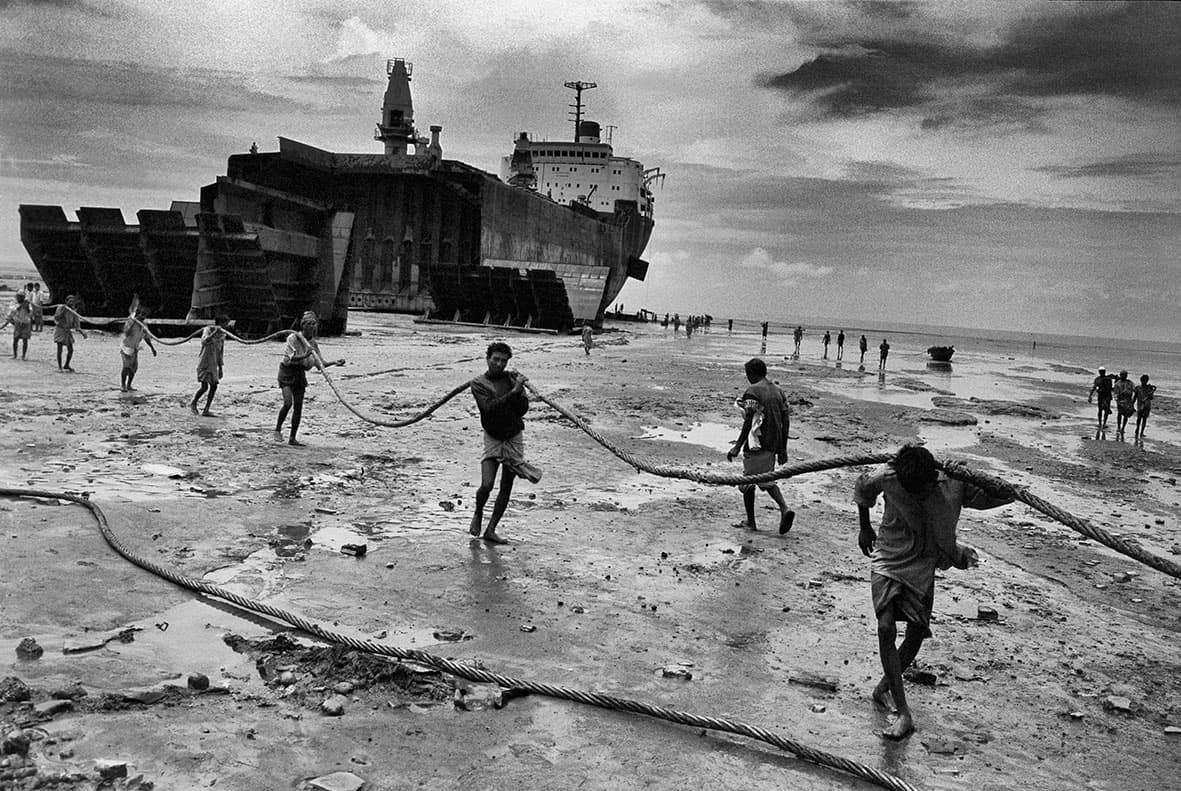
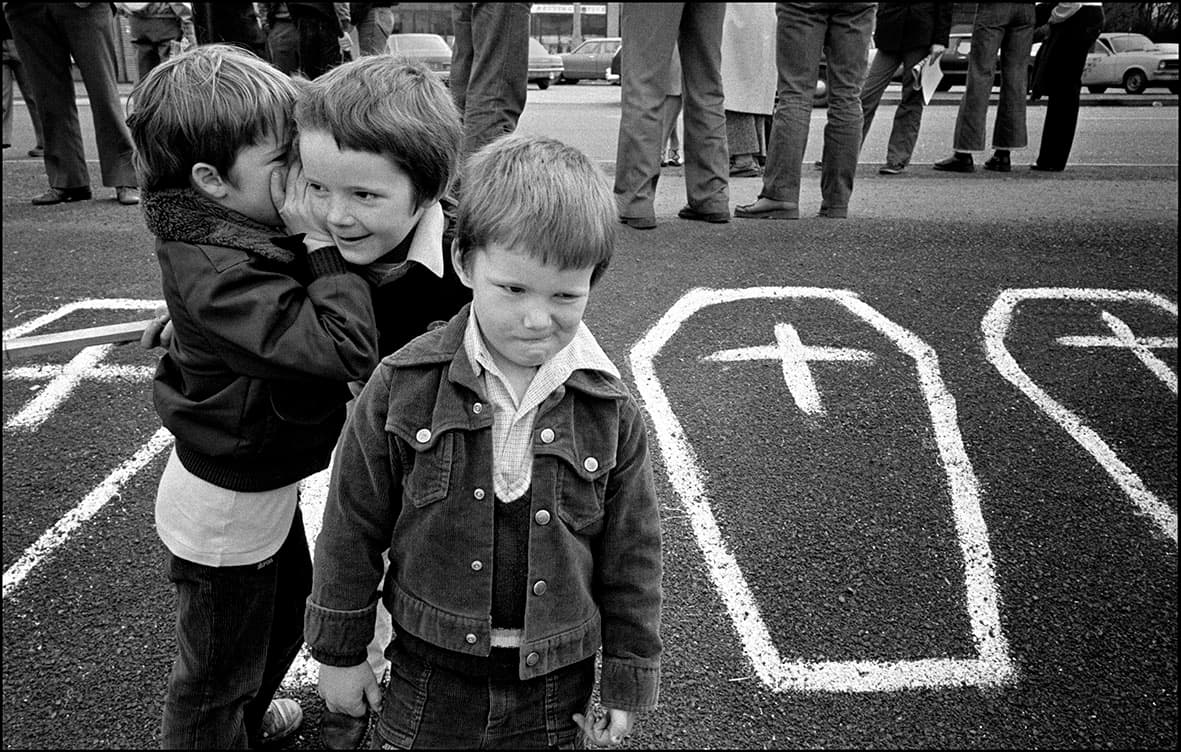
📸 See more of Ian Berry's work:
https://www.ianberryphoto.com
*****
🎧 Got any questions? Email us
Thanks for listening and look out for our next episode! 🚀
[00:00:03] Actually, Magnum, New York contacted me. And they then contacted Paris, contacted Cartier-Bresson, they contacted the then bureau chief in Paris. I contacted him and he said, talk to the other photographers. They looked at my pictures. They said, okay, but before you can be admitted, you've got to talk to Henri Cartier-Bresson. So he fixed up an appointment with me and I went
[00:00:32] along to meet him in the bistro just down below the office. And I thought I'd better be a bit French and I ordered coffee. Henri ordered tea. I showed him my prints and he flipped through them like that and left. I thought, what's happening? So I went down to the office and the guy said,
[00:00:58] what did you do? He hates you. So I told them and they said, oh goodness, no, he doesn't want to see prints. He wants to see contacts. He wants to see how you think, how you react from friend to friend. So they fixed up another appointment. Greetings and welcome back to the show. Sometimes all it takes to
[00:01:28] change your life is buying a one-way ticket. For some, it means leaving England as a teenager to see the world, joining Magnum a few years later and spending the next six decades documenting history. I'm Tom Jacob and this is the Camera Café Show. Today folks, I'm joined by Magnum photographer Ian Berry, whose life has traveled the world for more than 60 years now. From remote villages and bustling cities to some of history's defining moments,
[00:01:55] his curiosity has taken him across continents in search of the people and stories that connect us all. Together today, we will travel from Africa to South America, the United States and back to the English countryside while talking about his books, his encounters with Henri Cartier-Bresson and what joining Magnum has meant throughout his remarkable career. And because, of course, this is the Camera Café Show, you also hear why finding a decent hotel might be the first rule of
[00:02:22] photographing a conflict, how one of his photographs ended up on a Bob Dylan album, his love of motorbikes, and some wonderful advice for young photojournalists dreaming of seeing the world through camera. Grab yourself a coffee, settle in, and enjoy my conversation with the wonderful Ian Berry. Welcome back everyone on the show. Tonight we have someone who has spent more than six decades traveling the world, meeting people, witnessing history, and telling stories through
[00:02:49] photography from Africa to China and beyond. But as you will hear tonight in our show, he has always been as interested in people as in making pictures. Ian, it's a real pleasure having you on the show tonight. Thank you. Delighted to be here. Ian, how's been, is June now, how's been the weather in UK? You had already a chance to take out the shorts and tan your legs? The weather in the UK is like it
[00:03:15] always is. One day it's raining, the next day the sun's shining. At the moment we're having a lot of rain, a lot of wind, and it's pretty cold. But that's life, isn't it? I thought of moving to France frequently, but then I would really have to learn to speak French well. Most people understand me here.
[00:03:38] Now, speaking of France, you told me that in September we can't meet up at the Visa Pour l'Image festival because you're off to Tahiti, which sounds a pretty good excuse not to go to a photography festival. No, I like Perpignot. It's, for me, the best photography festival. I think Jean-Francois is
[00:04:06] terrific in getting it together. I say that having had three exhibitions there at different times. But for a photojournalist, it's the best place. Ian, you don't eat fish, you go to Tahiti. Surrounded by seafood restaurants, what will be on the menu?
[00:04:29] I'm a typical Brit. I eat anything and anyone except fish. I don't know why I'm allergic to it, but I always have been. And I grew up as a boy on the coast, the northwest coast of England, and the staple diet was fish. I don't know. It's the only thing I'm allergic to.
[00:04:55] I'm not allergic to cameras. I wasn't allergic to film. So it's okay, really. It works out. Yeah. Ian, before we dive a bit into your younger years, when I listen to you, you often say that luck plays a huge role in life or in your life. Looking back now, you think that luck
[00:05:23] sometimes found you or you just have a habit of putting yourself in the right place where interesting things can happen? I think I've always been lucky. I've always happened to be in the right place at the right time when I've needed to be. I've always managed to talk my way into the
[00:05:43] places that I needed to. And somehow I've always met the right photographers when I was younger who were very helpful. I met the magnum photographers when I was still young. But that was because when I was 17,
[00:06:07] I went to South Africa. It seemed to be the most exciting place. I thought there would be lions on the main street. And I worked for a newspaper there to start with, and then a magazine for Africans called Drum.
[00:06:26] And I was really lucky in that a guy who had been editing Picture Post. Picture Post was a magazine like Perry Match or like, I think you're too young to remember it. Actually, so am I. But the guy who edited it
[00:06:49] was coming out to edit this magazine Drum. And I thought this was a terrific opportunity to learn about magazine photography rather than newspaper photography. And when he arrived, I pestered him to give me a job. I was working for the Johannesburg Sunday Times at that time.
[00:07:18] And he gave me a job. And that was a terrific influence for me. I learned a lot from him about magazine work. But at the end of the day, he got fed up with the magazine. I got fed up with the magazine for reasons I
[00:07:40] won't go into it. But he then introduced me to Magnum. Because he'd used Magnum photographers when he worked at Picture Post, when he edited that. And so that was an easy intro to Cartier-Bresson. And that was my first or second or third or whatever,
[00:08:08] a lucky break. And I'd kind of figured on that sort of thing happening ever since. Let's go back a moment to South Africa. What made you go? A boy from Preston in the UK, what made you go to? Only for the excitement?
[00:08:25] I wanted to travel. I had earlier thought I'd like to be a journalist. But I realized early on that I was a bit too stupid. I couldn't really write my own name. And photography was much more interesting.
[00:08:46] The reality is that as an independent freelance photographer, instead of working for one editor, you're working for 50 editors. So in some ways, it's trickier, but suits me better. More variety.
[00:09:10] And at that time, as a Brit, you could go to Canada, but mainly Australia or New Zealand, as what was called a 10-pound pom. Essentially, you could go for free. But I kind of thought they're all Australia, New Zealand. It's rather a long way away.
[00:09:39] And I didn't want to disengage from my family totally. North Africa sounded more exciting. In retrospect, having now spent time in both New Zealand and Australia, Australia. Maybe I should have gone there. But maybe my luck would have been different. And
[00:10:03] Africa was an interesting place. And I learned quite a bit about life there. I have never been personally very political. But it's hard in South Africa not to be political, or to become political, political, if you like. Even working for the white Sunday Times paper, I didn't have enormous amount of
[00:10:32] contact with the Africans. But then joining this African magazine changed the world for me. I was working with African journalists. And when we traveled somewhere, they had to drop me off at night at a white hotel.
[00:10:56] They had to go and find somewhere to sleep in the local township. We couldn't even go into a cafe and have a cup of tea or a cup of tea or a drink together. They were always pretty badly treated. I was treated with some
[00:11:15] suspicion. As a Brit, I'm pretty weedy. My hair is slightly longer than South African. I don't look like a springbok, but I'm pretty much more than a cup of tea. But I'm pretty much more than a cup of tea. So, I always had more trouble from the white cops than I had from the Africans. And the Africans, looking at me and
[00:11:44] listening to my accent, realized that I wasn't white South African. And I don't know why, but maybe they assumed that I was on their side. Which to a degree I was because of my association with the magazine. So, it was an interesting time.
[00:12:10] The man who took you under his wing there was Roger Madden? Yeah, he was a good guy. You had to get someone to vouch for you if you went to South Africa as a young guy. And the only person my family knew or happened to know of was this guy, Roger Madden.
[00:12:34] And he very kindly offered to put me up for a year. And he was a pretty good photographer. He had just come back. He was a South African, but he'd just come back from America. And he'd been working as an assistant for Ansel Adams.
[00:12:58] And so, the year I spent with him was kind of interesting. It was all shooting 4x5 film. Mostly shooting corporate advertising work. And working in the darkroom for him. And he taught me an awful lot about darkroom work. I don't know.
[00:13:26] South Africa was more leaning to the American field in photography at that time, rather than the European field. And they were already using papers like Dupont-Vergam, multi-grade papers. I learned how to use. And that was long before I came back to Europe.
[00:13:51] So, I got a good education with him. But I knew that this was not really the sort of photography that I wanted to do. But he taught me an awful lot about lighting and that type of photography. The Sharpfield massacre in 1960, Ian, you didn't know you were heading to an event that would become like almost a turning point in South African history, no?
[00:14:21] No, I didn't. And in fact, I was working for this magazine, Drum. And I got a call early in the morning from the editor, Tom Hopkinson, saying that a guy had been killed, an African had been killed at this township. Would I like to go and have a look and see what was happening? Which, of course, I did. This was early morning, 6 o'clock in the morning or something.
[00:14:50] And I went there with the assistant picture editor, who was a white South African. We got to the gates. In those days, in the same way that Africans had to have a permit to be in a white area, a white had to have a permit to enter an African township. Of course, we didn't have a permit.
[00:15:18] There were a lot of foreign photographers there. It's a life, Black Star, AP, all these guys. But the chap who had been shot, of course, had long since been taken away. And we were standing around there talking to each other, as journalists always do and nothing's happening. And there's a lot of people on there.
[00:15:43] It was a real time when this convoy came along of armoured vehicles and turned into the township. So we all followed. But we'd only gone a short way into the township when the officer in charge turned round
[00:16:05] and said, you better clear off or you'll all be arrested. So three cars stayed, of which we were one. We went a bit further and the guy stopped again and said, look, you better get out. I'm not warning you again. So the other two cars left. And we thought, sod it, we'll keep going. And so we followed them into the township.
[00:16:35] Humphrey, the journalist with me, I told him to go around the back of the police station and stay in the car just in case, in case we needed to make a quick getaway. And I walked amongst the crowd and nobody bothered me. I walked right up to the wire which surrounded the police station.
[00:17:03] Nobody cared. I chatted to people and I thought, there's really nothing going to happen here. And I'm wasting time, might as well go back. So I walked around the back of the police station and as I got to the other side, the police station had a great open field around it. As I got to the
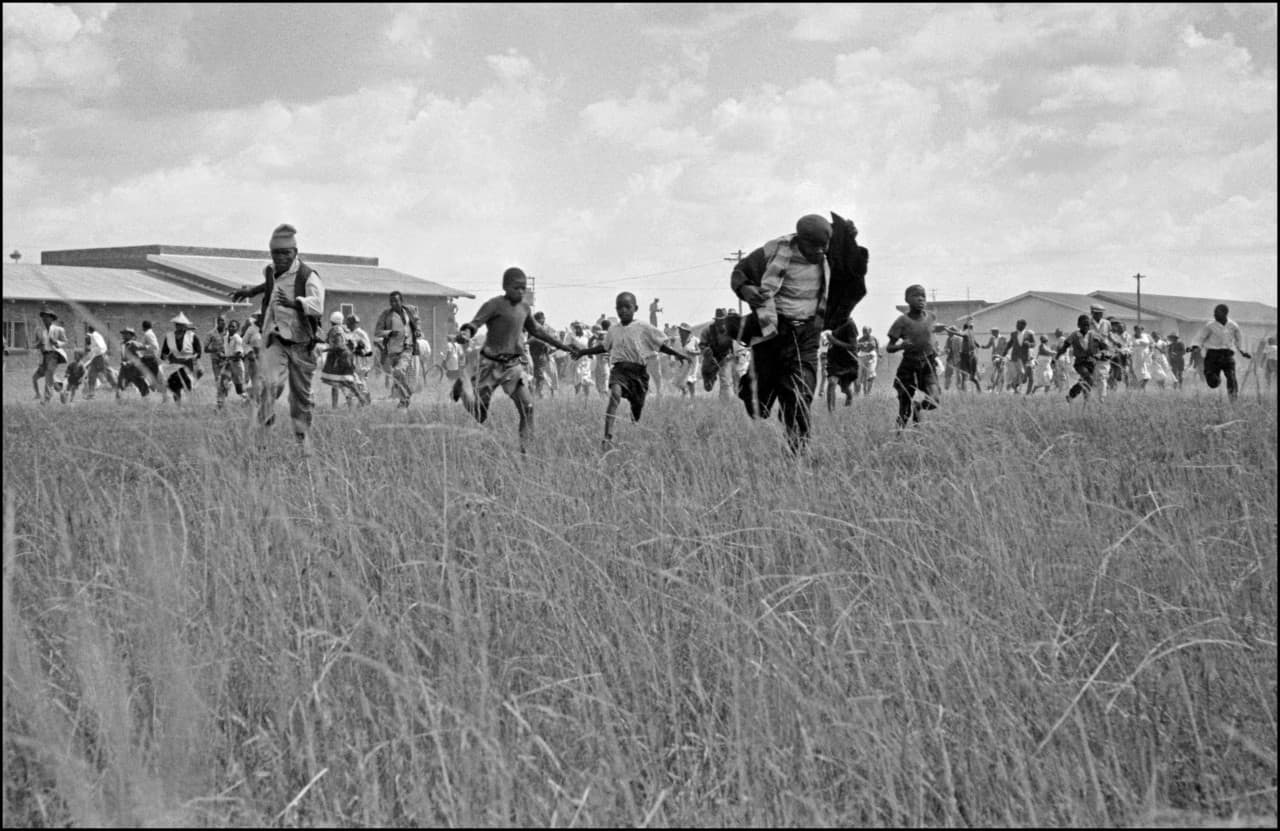
[00:17:28] other side, the shooting started. I assumed they were either shooting blanks to scare people off or shooting in the air. It was only when a guy standing next to me got shot that I realized they were serious. And in those days, I just had a couple of Likas with a wide angle 35 and a 50.
[00:17:55] And I'd been shooting using the 50. And I was almost out of film. Film in those days, obviously. So I got down in the grass and all I could do was to shoot people coming towards me. And then I realized they were falling around. They were shooting seriously. The shooting stopped briefly.
[00:18:25] And I lay there not wanting to be seen, actually. And then they started shooting again on the few people still standing around. This became important at the trial. The people who were not shot, there were 70-odd people killed. Those who were not shot or not there and had not run away,
[00:18:53] were being shot in the back as they were walking away. So at the inquiry later on, I was the only white witness because I was the only white guy there. And because I was white, I suppose,
[00:19:15] the judge took my word for it against the police. Because the police had said they'd only fired once. And I had pictures of cops standing on top of the armored vehicles, reloading their weapons.
[00:19:41] And of course, I had pictures of them firing from up top. So the pictures were crap, essentially. They were just pictures of people running towards me or dying bodies around. But the only good thing was that the people who were shot and ran away and some of them were caught and collected by the police,
[00:20:11] they, I don't know what the word is, they were let go. They weren't charged with an affray, or they had been charged with an affray, but they were released. So that was it, really. I had a lot of time. But one of these occasions when really a newspaper scene rather than a magazine scene.
[00:20:35] I'd shot a few pictures before. Anyway, the pictures ran around the world. And as a photographer, you get a reputation sometimes for the wrong reasons. They weren't great photographs, you know, they just weren't. There was only one picture of a group running towards me. And the small kid was holding his jacket over his head as though to protect himself from the bullets, which was kind of
[00:21:04] interesting. But basically, not very. Anyway, Humphrey and I ran back to the car because I was the only person standing there. And we took off, but neither of us knew the township. So we were a bit nervous that the Africans might not take kindly to a couple of whites, having heard all the shooting. But the people
[00:21:32] we stopped to ask were great. They just said, yeah, you take this road, that road, and you get out. We didn't hang around. Ian, this was the first time you got shot at? Or you saw actually people dying? Or you saw this before already? It was the first time I was shot at. Prior to that, the young policemen, often if you were in a township,
[00:22:00] would say, clear off or shoot you. But they never did. And so that was the first time. And you remember what went through your head at the time, Ian? Actually, very little goes through your head. Everything is more or less instinctive.
[00:22:22] I think if you have a camera, you're thinking about the pictures, not what's going on. Except, of course, as a professional photographer, you're aware of what's going on. But I've had a lot closer shades after that.
[00:22:44] So Ian, then after your time in South Africa, let's jump to Paris. You moved to Paris and eventually joined Magnum. What could Magnum do for a young photographer at that stage of your life? I was, at that time, the best agency. I thought it was the best agency, as did many other people.
[00:23:14] And I went to them. But I realized when I was still in South Africa, I was trying to free lounge around Africa. But in those days, there were no flights or there was one flight a week. Pan Am flew from East Africa to West Africa. But otherwise, you had to fly back to Europe, either London or Paris, and then fly back
[00:23:42] to West Africa if you wanted to go there, which wasn't really very practical. That's when Tom Hopkinson suggested I contact Magnum. Which I did. I contacted Magnum Paris, but I got no reply from them.
[00:24:05] Afterwards, I discovered the reason was that the bureau chief, Magnum bureau chief in Paris, there was an ex-Perrymatch journalist, but he didn't speak any English. So he ignored my letters in English. But I discovered this later on, and actually Magnum New York contacted me. And they then
[00:24:30] contacted Paris, contacted Cartier-Bresson, they contacted the then bureau chief in Paris. I contacted him and he said, talk to the other photographers. They looked at my pictures. They said, okay. But before you can be admitted, you've got to talk to Henri Cartier-Bresson. So he fixed up an appointment with me.
[00:24:57] And I went along to meet him in the bistro just down below the office. And I thought I'd better be a bit French and I ordered coffee. Henri ordered tea. I showed him my prints. And he flipped through them
[00:25:21] like that and left. What's happening? So I went down to the office, or up to the office. And the guy said, what did you do? He hates you. So I told them and they said, oh goodness, no, he doesn't want to see prints. He wants to see contacts. He wants to see how you think, how you react from frame to frame.
[00:25:48] So they fixed up another appointment. And of course, being a Brit, I didn't tell him that I admired him or anything like that. In those days, the Brit didn't do that. That only came in from America later on. So I went back and I ordered tea. I showed Henri my contact sheets. I told him that I thought he was a
[00:26:16] great photographer, which I did. And he was. At that time, he was really the doyen of photography. I went back upstairs and they said, great, you're in Magnum. That's how it was in those days. Crazy, really. And actually, Henri was something of an Anglophile. And we got on very well. And I had a great time in
[00:26:44] Paris. I spent a lot of time with him, walked around with him, got a lot of good advice. And it worked well. I suppose what I should have said that in the meantime, not having heard from Magnum, I decided to go to Paris anyway.
[00:27:08] And the guy who had been bureau chief, who didn't speak English, had left Magnum and set up his own agency called Visa. And we were four photographers, a Swede, a Dane, a Hollander, and myself. And a German lady working on the desk.
[00:27:33] And that was it. That was the total outfit. And I suppose, I didn't immediately recognize it, but it was one of the best periods of my life. And I kind of thought, I'm doing okay here. What I only realized later was that this guy, Michel Chevalier, was actually pointing me in the right direction. He was the great guy, not me.
[00:28:03] He was telling me where things were going to happen, what was going to happen. He was an ex-Paris Match journalist, and he knew everything. And so I joined him with these three other guys. And we had a great time, but a great couple of years. But then I got this indict from Magnum, and I was flattered. And
[00:28:32] subsequently, I regretted in a way that I had left Visa because he was killed in a car crash just after I left. And of course, the agency folded. So again, someone else's bad luck, but my good luck, that I joined by. Anyway, that's life.
[00:29:00] When you walked around with Cartier-Bresson, you were eager to learn from him, Ian? Or Yeah. You were so young that you thought you knew already a few tricks about photography? I remember on one occasion Henri said, we'd looked at a situation that was developing.
[00:29:20] Henri said, look, I think I'm lucky if I get one good photograph a year. And I thought, smart kid, I thought, I can take a good photograph every week. But he was right. I'm at the moment editing
[00:29:44] for retrospective. And when I look back, even though I've been around for a hundred years, he was pretty well on the ball there because I don't have that many great photographs. But I learned a lot from him how to walk, how to act, how not to be seen when you're shooting on the
[00:30:13] street. It was a great time. How to imagine this, Ian, when you walk around with him? You talk about photography all the time? Or you guys also talked about life, politics, wine or food or anything? Yeah, we talked about everything. He really, I really learned from him how to,
[00:30:35] I really learned from him. And I learned from him how to think for myself. And I must say, since then, I've always preferred to work, walk alone when shooting. I hate traveling with journalists.
[00:31:04] Some of them are great. Some of them aren't. But if you want to get into a situation, you have to be by yourself. It's my feeling. Yeah. When I think of Henri Cartier-Besson, he looks always so serious. You remember a moment when he made you laugh, Ian? Well, it wasn't that lighthearted. Yeah, we had...
[00:31:35] I then, after a time in Paris, I moved back to London. Whenever I was back in Paris, I became vice president in Paris. We always had dinner. And his wife, as was a photographer, and he by this time had more or less stopped shooting. He was drawing. But she'd go off in the kitchen
[00:32:05] and he'd look around and pull out a photograph. What do you think? Have I still got it? So, he had a considerable sense of humor. And his English was better than mine. Better than your French. Better than my English. Okay.
[00:32:33] Henry used Laika like almost an extension of his own. You went on to shoot with Laika due to Henry, or you were already shooting with Laika before? I was already shooting with Laikas. I started out in South Africa with Nikon rangefinder cameras.
[00:32:56] I entered some photographic contest out of Tokyo. And I got first and third prize. And I got two bodies and about three lenses. And they were great cameras. And they were, at this time, becoming very popular with American photographers
[00:33:20] working in, working around the world in Vietnam and so on. And I was using those to start with. But they stopped making them. And I thought I'll never get them repaired. So I went to Vetzlar. And they'd stop making Laika MPs. But I think it was Bob Schwalberg who worked then for Laika.
[00:33:50] Took an M3 and had it converted for me to an MP. And then as I also picked up an M2 at that time. And they were great. And the 6s came along, M7s and so on. And I just went on using a couple of Laikas.
[00:34:14] And they were always reliable. They never let me die. I remember in the Congo once, in the middle of a gunfight. A life photographer was sitting on the curb with a screwdriver, trying to repair one of his cameras. Not a Laika, I should add. So I've kind of stuck with them.
[00:34:40] Now you talk about Congo. This was a time you were nearly executed. What happened there? Yeah, it was a funny old war. Katanga, the southern province, which has all the... What's the generic word? But anyway, they had all the mining and so forth. They seceded from the Congo.
[00:35:06] So there was a war between Katanga and the Congo. And the UN, for their own reasons, decided to step in. And they sent a lot of UN troops of different nationalities, like the Moroccans, Indians, Irish,
[00:35:28] Swedish, Swedish, who were on the side of the Congo. The UN was on the side of the Congo. Katanga had a lot of mercenaries, Rhodesians, Germans, South Africans. I went along first time for independence and got to know
[00:35:49] it a little bit. Then it was a rather weird war, actually. Because the Africans didn't know... Because there was a mix of white photographers at the UN, white photographers with Katanga. And the Katanga's soldiers really didn't know who was what.
[00:36:12] I was... I had been out for a morning, photographing the fighting that was going on, and came back to the main hotel, the Léodur Hotel, where all the journalists stayed. And just arrived at the place,
[00:36:33] and a German mercenary came out, and he had his own Jeep and half a dozen Katanga soldiers. And he was pretty drunk. This was just after lunch. And he just opened fire on us, just sprayed us. Whether he was too drunk or whether he deliberately fired over our heads, I don't know. The two guys
[00:37:02] with me took off. I kind of thought, I'm just going to photograph this guy. Anyway, he got into his Jeep and took off. But a load of Katanga soldiers down the street saw what had happened and assumed that
[00:37:23] because this guy had fired at us, we must be UN. And they came and chased us. And I followed the other two, and we went into a block of flats, occupied by Belgians. No one would let us in. Finally,
[00:37:43] we came down and thought, better to go and talk to the soldiers, which we did. And sometimes soldiers in those days, Africans got very excitable. And they decided that we were UN and stood it up against a war.
[00:38:09] And I kind of thought, this is not good. And a Rhodesian mercenary turned up, passing by, and saw what was happening. And talked to these guys and persuaded them to let him take us to see the president, which they said, okay, I think they wanted us off their hands, really. So we went to see
[00:38:38] the president, who had a good laugh when we told him what had happened. And we had tea and biscuits with him. And a lot of laughter, bit of a joke, really. But there was one, there was a nasty moment when they, because they were really excitable. However, that happened.
[00:39:05] Or it's your luck again, Ian. Yeah, yeah. I've been lucky pretty well. What's, as a photojournalist, Ian, what's the first thing you do when you arrive in a country that is in conflict? When you arrive in a country that is in conflict? What's the first thing you do?
[00:39:27] Find a decent hotel. I don't know. Sometimes it's tricky. When the Russians, for instance, invaded Prague, I again was very lucky because we knew that potentially something was going to happen there. Politically, it was obvious. So I got a visa. And I got a call early in the morning from our
[00:39:56] then Magnum Bureau Chief in Paris, Russ Moucher, and said, the Russians are on the move. Do you want to go? Don McCullen, I've already spoken to him, and he's already on his way. And I, yeah, Don's on his way. I've got to be there. You know. At that time, Don was briefly a member of Magnum. He was a member for, or he was an associate,
[00:40:23] actually, but he was with Magnum. And he stayed about a year. But I went into London. As soon as the Czech embassy opened, I got a visa. Went to Heathrow. The flights to Vienna, which was the obvious place to go from, were four. And I ran into a BBC journalist friend, and he said,
[00:40:53] give it a go from Munich. You have a chance. I hired a car headed for Munich. And on the way, I picked up a copy of a newspaper which existed then, the Herald Tribune. And I read it, and I saw that there was an architectural conference going on at that time in Prague. I got to Munich,
[00:41:20] and by this time it was dark and it was unpleasant because I was in a German registered hire car. But it wasn't so serious because at that point where I crossed over had previously been German, not until the end of the Second World War. So I was going, tanks were coming towards me all the way. Got to the
[00:41:48] border, and a crowd of journalists standing around there as always, and they said, forget it, we've tried to get in, we can't get in. The Czechs are turning everyone back. I've come this far, you've got to try. So I drove up, and the Czechs knew what I was. I had a bag on the back seat of the car. The border
[00:42:14] post had just been taken over by a Russian officer. And I think he wanted to show his authority over the Czech border people. And he asked me what I was doing, and I said I was going to this architectural conference. And he looked at me and said, go ahead. And so I was the only guy
[00:42:43] to get into Prague that day. Don, everybody from Vienna was turned back. And it was kind of interesting. There was one other photographer, a guy called Hilmar Parbel, I don't know whether you know him. He was a stone photographer. He was there working on a movie they
[00:43:03] were making just outside Prague. And as I was shooting there, I came across this crazy guy who had a couple of, what was the East German reflex camera? A Dixer or something like that.
[00:43:26] And he was just walking up to the Russians and shooting. If he can do it, I can do it. And he turned out to be Joseph Goodelker, who in later years joined Magnum. The worst thing was that all the restaurants,
[00:43:48] the, I was staying in the biggest hotel in Prague. I had shut down. I had a room. I was able to drink water, but no food. And I don't know how these people who starve themselves make it because after about three days, my guts were going in and out like that, just existing on water.
[00:44:15] And I was like, oh, I'm sorry. But it was interesting. You could go up to the Czechs or their tanks and photograph them quickly, and they would shoot over your head and chase after you. And the Czechs crowd would form up around after you'd run to stop the Russians facing you. And you went 100 yards
[00:44:43] and someone in a house or shop would open the door and drag you in, out of hands of the Russians. But it was kind of interesting. The only snag was that I was really after about four days repeating myself,
[00:45:07] the French friend, and the French friend, hiding under a seat in the train, had been found, and they'd taken his cameras off him. At that time, I was shooting with a couple of Leicas and a Nikon reflex camera with a long lens. And so I left my Nikon with him and thought, time to go really. And I knew I had a deadline for Perry Match.
[00:45:34] So I set off at night, absolutely exhausted, went to sleep at the wheel in this hired Volkswagen Beetle, drove into a ditch. And at night, I'd put all my film, of course, inside the hubcaps of the W,
[00:45:59] and the door panels and so forth, all over the place. And I was there stuck in a ditch, but a farmer came along in a tractor, hauled me out. And I set off, went like hell for me to catch a late flight from Munich airport.
[00:46:19] Got there just in time, ripped off the hubcap, the door padding, the headlights, I put a couple of films in the headlights. Rushed in, caught the flight, dumped the car, which was an Avis rental. And I never had a word from Avis,
[00:46:41] so I've used them ever since. And a couple of times I've been lucky with really damaged Avis cars. So I stick with them. Ian, this sounds almost like a good James Bond movie, hiding your fear in your car. Not really. It's, again, you're just lucky. It's a funnier life, but it's better than working.
[00:47:09] You actually spoke to Koudelka when you were there, or you told the story later when he came to live in London? No, I only realized when he was, when he came to Paris and joined Magnum. And I saw his face, and I realized in the background of a couple of my photographs, was this guy who I thought was a lunatic.
[00:47:37] But he was a lot braver than me and a damn good photographer. You also tell that people around the world are remarkably different, but also remarkably similar at the same time. After spending decades documenting humanity now at its best, at its worst, your faith in people has increased or decreased?
[00:48:02] I listen to politicians. I don't want to be rude on your podcast. I, wherever you go. And I spent a lot of time in Russia and in China. People are great. You know, they really are. On a one-to-one basis. I love working in China because
[00:48:32] you know, you could do a lot of things that I certainly couldn't do in this country. And certainly not in America today. But the first book I did when I came back to live in England was on the English. And I got a grant from the Arts Council, which was great. It's enabled me to travel around and
[00:48:54] photograph the English. And during the whole time I shot on that book, I didn't have one person say anything to me against photography or what have you. A couple of years ago, I had a publisher approach me and that you want to update it. And I thought about it. I said, I don't want to know.
[00:49:20] I'm going to do fun shooting in this country now. And you wouldn't dream of photographing a child. Now, there's somebody 100 yards down the road would be screaming, pedophile or something at you. And with the result, actually, even after I left Paris,
[00:49:45] I came back to England. I spent five years with a contract with the Observer magazine, which I had a great time. They were pretty good. And so came the moment when a financial guy decided that they wanted to keep copyright. And I'd always kept copyright during that five years.
[00:50:09] And that was me out of the door straight away. Because I never gave up. I've never given up copyright. Early on when I joined Magnum, whenever there was another photographer traveling through Paris, I'd go and have a meal with him or coffee or something to help him to learn more about Magnum and life and work.
[00:50:41] And they were all terrific. And one guy said, if you're in Israel on a Friday night, the best place to pick up a girl is... So that's a mix of advice, you know. And some very practical. And then I got Elliot Erwitt. He thought about it for a bit. And he said, never give up your copyright. Whatever you turn,
[00:51:10] give up your copyright. And that was probably the best bit of advice I've actually ever had. And luckily, that was the start of my time at Magnum. So... I can't remember why I started rumbling on about that. You must have asked me something.
[00:51:32] Yes, but let me pick up then about your book, The English. What's, Ian, what's the most complicated part of capturing something uniquely English about the way that people behave? Without, in a way, making fun of them? That's a good point. You can always...
[00:51:58] You could always photograph, you know, the working class, middle class, okay, as long as your accent was okay. But the upper class, very difficult, unless there was a horse in the background.
[00:52:21] I got to them by going to horse events. And that was about it. But basically, at that time, the Brits were okay. Sadly, they've changed. But I guess probably everybody's changed, and I'm just more aware of it, being a Brit. There's still a lot of good people, but...
[00:52:47] How long time you worked on the book, Ian? Actually, not that long. I should... In retrospect, I should have spent a lot more time. At the same time when I arrived, I got this deal with The Observer, and... which got me around quite a bit, and got me access to politicians and so forth. But luckily,
[00:53:15] the Whitechapel Gallery, which at that time was a gallery for painters, artists, sculptors, decided that Whitechapel is in a working class, then a working class area. And all the customers were from outside
[00:53:35] of the area. So, the then curators of the gallery thought it would be a good idea to have a photographic exhibition. So, they invited me to photograph Whitechapel. And that got me into a lot of places,
[00:53:55] hospitals, hospitals, and so forth, that I would have had trouble getting into by myself. That, with the Arts Council grant, and doing stuff for The Observer, got me into some places which I would have had trouble. So, I suppose I spent maybe three, four months on the book. I don't really even hanging about.
[00:54:28] But then your latest book, Ian Water, you spent longer than three or four months on it. I've spent a lot of time on that. Partially because, as photojournalism has changed radically, and Magnum has changed radically, I've got a little bit older.
[00:54:49] I've got a little bit older. And so, I had to do something to entertain myself, really. And I had been lucky in that, at one point, a Spanish photographer, Delmi Alvarez,
[00:55:08] invited me to join working with him on a book on Spanish fishermen, on the Spanish fishing industry. Which was great, except that ironically, when I came to Vigo, they invited me to dinner. The people
[00:55:34] organizing the book, backing it, if you like, invited me to dinner. I was invited to this fish restaurant. When I got there, and they realized I didn't eat fish, I could see them looking at each other and thinking,
[00:55:54] why have we invited this crazy Englishman who doesn't even eat fish to work on this book for us? But they were nice about it. Anyway, during travels around the world, I've been to most African countries and so on, I've seen a lot of the water problems
[00:56:19] in the world, and people suffering because of bad water. Not just in Africa, but in Central America, Mexico, other parts of Guatemala. And to start off, the UN invited me to go and do a shoot
[00:56:40] report on all the Central American countries on the refugee camp that they were running for an exhibition at the UN building. They were going to have some sort of conference on refugees. And so I had quite a bit of
[00:57:01] a lot of material. And it had, over the years, started to fascinate me, the problems of water around the world, which most people don't appreciate. And then I got an assignment to photograph Greenland. And I'd had photographed Alaska quite a bit. So I really started work on it and spent a lot of time
[00:57:31] doing it. And I got pictures in that book that I shot in India 15 years ago, and pictures that I shot a couple of years ago. I enjoyed doing it. I wasn't dependent on Magnum at all. And in fact, I wasn't dependent on anybody except myself. So it was rather an expensive shoot. But I think one worth doing.
[00:57:59] Mm-hmm. And quite a complicated also, I think, no, Ian? Because water shortage will be, in a way, easy to show in pictures. But there are other issues with water that might be very difficult to get over in a picture. Ah, don't tell me. What do you think about in America to illustrate
[00:58:22] how, apart from the obvious, how farmers are using enormous amounts of water, and that whilst the city nearby has a lot of trouble with water. They are doing things, they are salinating seawater now. But I
[00:58:47] really, I don't think I got a really good picture of water in America. I spent time in New Orleans and I sailed up and down the Mississippi, I photographed Louisiana and so on. So I got quite good stuff on the French-speaking Louisiana fishermen and so forth. But not one great picture. However,
[00:59:15] it was worth doing, I think. Yeah, of course. Ian, what's your connection with Bob Dylan? How did your photograph end up on the cover of this Ruff and Rowdy Ways album? Nothing to do with me at all. Our guy in New York had, Bob Dylan, apparently, I didn't know, had
[00:59:36] previously come to Magnum looking for photographs for the cover of some of his previous records. And he, the same thing happened, he came to Magnum in New York. And our guy who deals with that sort of thing had this idea to show him these particular, this particular set of pictures, which I had
[01:00:08] originally shot in England when I was working for the observer, to photograph this nightclub, which was essentially a black nightclub with a few white girls in there. And I thought this is going to be dodgy. And so I went along, it was in a basement. I walked down and I looked around and it was an all-black scene
[01:00:37] apart from half a dozen white girls. And so I just thought, what the hell, started to shoot. And actually, to start with, they were great Africans. They weren't Africans, they were West Indians and they were great. And I got some not bad stuff. Until, this is always the case, there's always one guy.
[01:01:04] This one guy objected to me taking photographs. So I kind of thought, I've got some quite good stuff, time to leave. And they had crates of beer bottles emptied at the bottom of the steps leading into the club.
[01:01:27] And as I started to go up the steps, the bottles started to follow me. And I got to the top and there were more guys chucking bottles out of it. But it was a pretty good shoot and the guy in New York remembered it. And Bob Dylan thought it would suit him. But I, to be honest, I've been interviewed by
[01:01:52] radio programs and how passionate was I about Bob Dylan. I'm pretty well-turned-deaf. I have no interest in music at all. And I'd heard of his name, of course, but never photographed him. Ian, this is a bit of a letdown. I had hoped you had said that you had a few beers with him and he looked through your contact sheets.
[01:02:19] No, I've never met him. But I was very grateful both to him and the guy in Magnum who remembered the pictures I shot. Magnum has changed so much now that most of the people working there are young girls who obviously have no idea what anybody shot years ago.
[01:02:46] Which is, for me, rather sad. But that's life. Mm-hmm. You're the oldest member now there in Magnum, Ian? I'm still a member, yeah. People of my age are either dead or they have become contributors. And as a contributor, you don't have to,
[01:03:11] if you sell a picture, you don't have to give a share to Magnum. It's very tempting. Mm-hmm. But there are still some great photographers there. Of course, yeah. You have to set me up with talks. I will write you an email to ask your help. Oh, yeah, yeah. Ian, so 92 now, what's one thing you're hopelessly bad at still now? Hopelessly bad at?
[01:03:42] At 92? I'm still pretty awful at languages. I still mainly only use rangefinder Leicas and short lenses. Sometimes I regret it that I miss having a long lens. Let's say cooking. You're a good cook, Ian? I can boil an egg. That's about the limit.
[01:04:10] My wife was a cookery editor at one of the two magazines in this country still existing. So I'm well-fed without having to bother messing around with cooking. When we first met, I'd been working in Nigeria and God knows where, what's the best way to do?
[01:04:36] I'm a cookery editor at the time of the Biafra Wars, and she was paid to go out and in different restaurants and write about them. We would go out, and after a few glasses of red wine, I would start being critical about wasting money on food like this when people were starving in Biafra.
[01:05:03] I've never been a good drinker. And finally she gave up on me taking me out to dinner. But we married and have lived ever since. I'm lucky in that respect. Yeah. Now you make me think when you talk about your wife, there was an assignment maybe you wanted to do,
[01:05:26] was Ukraine. But once you tell you cannot run so fast anymore, and second, your wife doesn't let you go. Certainly I can't run as fast. That's really true. I don't know what the second one is. No, the second one was that your wife would not let you go there, I think. Oh, yeah. It's like everything when you get older. I've ridden motorbikes all my life.
[01:05:50] And when I got to the middle eighties, my wife got a little bit fed up with me riding motorbikes, which I was very sad about because when I was vice president in Paris, I could get from my home in London then to the office in, magnum office in Paris, faster than either by plane or by boat,
[01:06:21] going by motorbike. Because in those days they had the hovercraft, which was very fast, faster than the ferry. You could always get on there at any time with a motorbike. It's more than the main space. So I regretted that. I still regret that. It's the best way to get around. When you go to Tahiti, your wife will make the suitcase so you don't forget the shorts?
[01:06:50] Yeah, I think so. Shoulder the research. It's interesting because it's a cargo boat and it goes around that whole area. Yeah. Could be fun. Yeah. I'm expecting a postcard, Ian. Yes. Yeah. Ian, this has been an absolute pleasure. Thank you for sharing your stories tonight with me,
[01:07:20] your humor. I love you have a bit of good British humor and your reflections. And remember, if something happens and Tahiti doesn't go through, I want to see you here in Visa Pour l'Image. And we can have a tea and you can show me your old contact sheets. That would be maybe a great time. I would love to do that. And as I said before, give my best to Jean-Francois. I will do. Ian, thanks so much. Again, it's been wonderful spending time with you and I will see
[01:07:49] you around. Yeah. Thanks very much. I enjoyed it. No problem. I see you, Ian. Bye. Cheers. And that's a wrap, folks, for my conversation with Ian Barry. Sometimes your biggest adventures don't always begin with a carefully laid out plan. Sometimes they begin with a bit of curiosity and the courage to see where life takes you. Looking back, it's remarkable to think that one decision he made as a teenager would eventually become more than six decades of photographing people
[01:08:19] places and history itself. Whether he's telling stories about how Lee Cateri-Person, photographing a conflict zone, riding motorbikes, or trying to find a decent hotel, there's always a quiet sense of humor and a genuine love for people behind it all. If you would like to see more of Ian's remarkable work, be sure to check out his website, pick up one of his wonderful books, and if you ever get a chance to see one of his exhibitions, don't miss it. You won't be disappointed. As always, the links are all in our show notes.
[01:08:49] And of course, folks, if you enjoyed this episode, have a look at our website and don't forget to subscribe, leave us a review, and follow us on any podcast platform or YouTube. Until next time, keep shooting and keep on moving your own photography forwards. I'll see you next week here for another wonderful conversation about photography and life. Adios!