
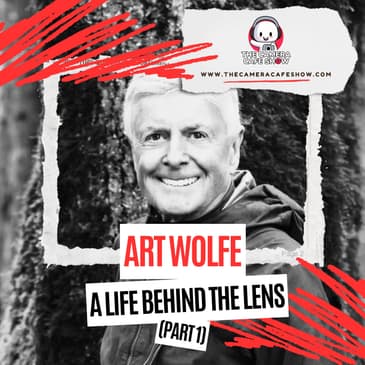


Welcome back to The Camera Cafe Show! This week, we’re joined by the legendary Art Wolfe for a deep dive into his incredible photographic journey—because if there were an Olympic sport for boundless energy and constant exploration, Art would be a reigning champion.
From his childhood escapades in the forests of Seattle to scaling mountains with a bulky 4x5 camera from his dad (because, of course, he had to make it harder for himself), Art’s career is a masterclass in relentless curiosity and artistic evolution. In this first installment of our conversation, we explore his early influences, the leap from painting to photography, his National Geographic days, and the globe-spanning adventures that have shaped his work. Naturally, we also touch on his deep passion for creating books—and the many people it takes to create one.
But it’s not all smooth sailing—Art shares his less-than-ideal experience in Russia and China, the heart-pounding moment a rhino nearly ended his career in Nepal, and how teaching middle school students made magazine editors seem like a breeze to handle.
Of course, we couldn’t let him go without some gear talk. Art discusses his approach to packing light (as in, he now prefers not to carry a mountain of lenses), how switching to digital was an instant game-changer, and his stance on camera brand rivalries (spoiler: just use whatever works!).
Ever wondered how someone manages to travel nine months a year, publish over 120 books, and still find time to design a Japanese-style garden at home? This episode will leave you both in awe and slightly exhausted just hearing about his schedule.
And this is only the beginning! Next week, in Part 2, we dive even deeper into Art’s process—his television work, his friendships within the photography world, and the philosophy that keeps him constantly pushing forward.
So grab your coffee—or tequila, if you want to match Art’s pace—and enjoy the episode!
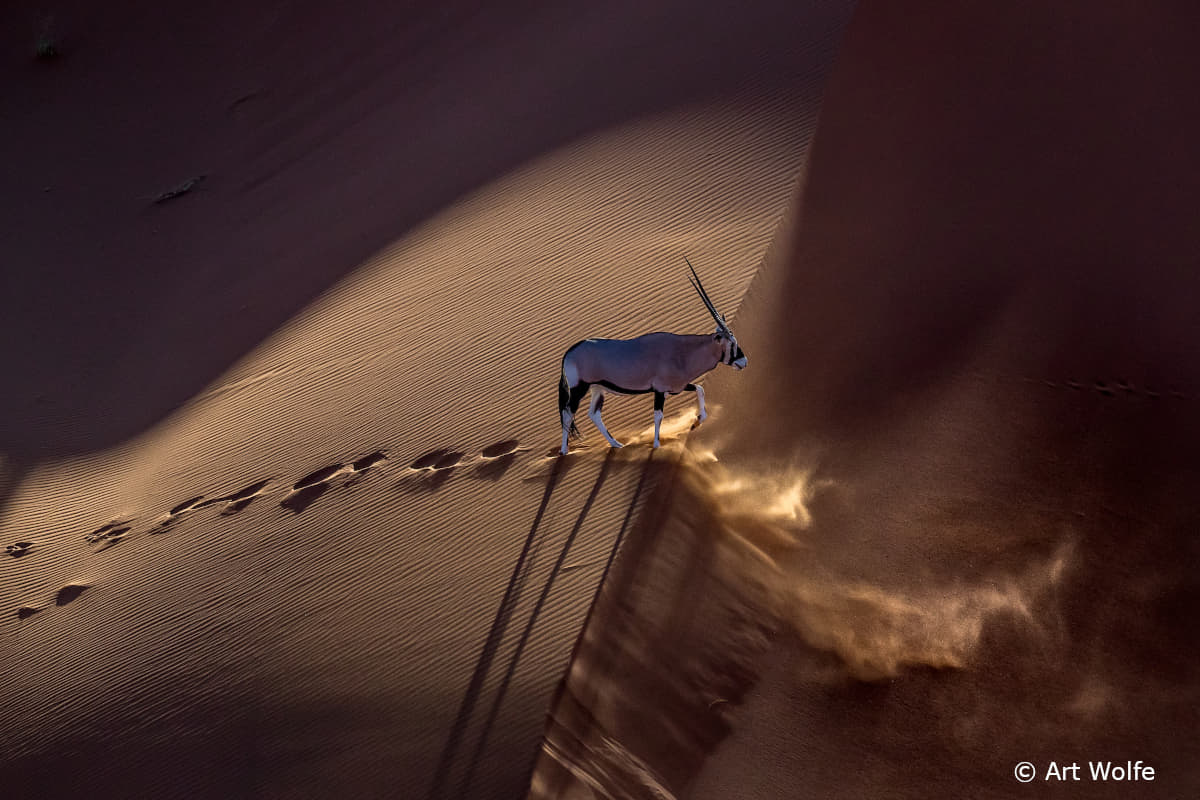
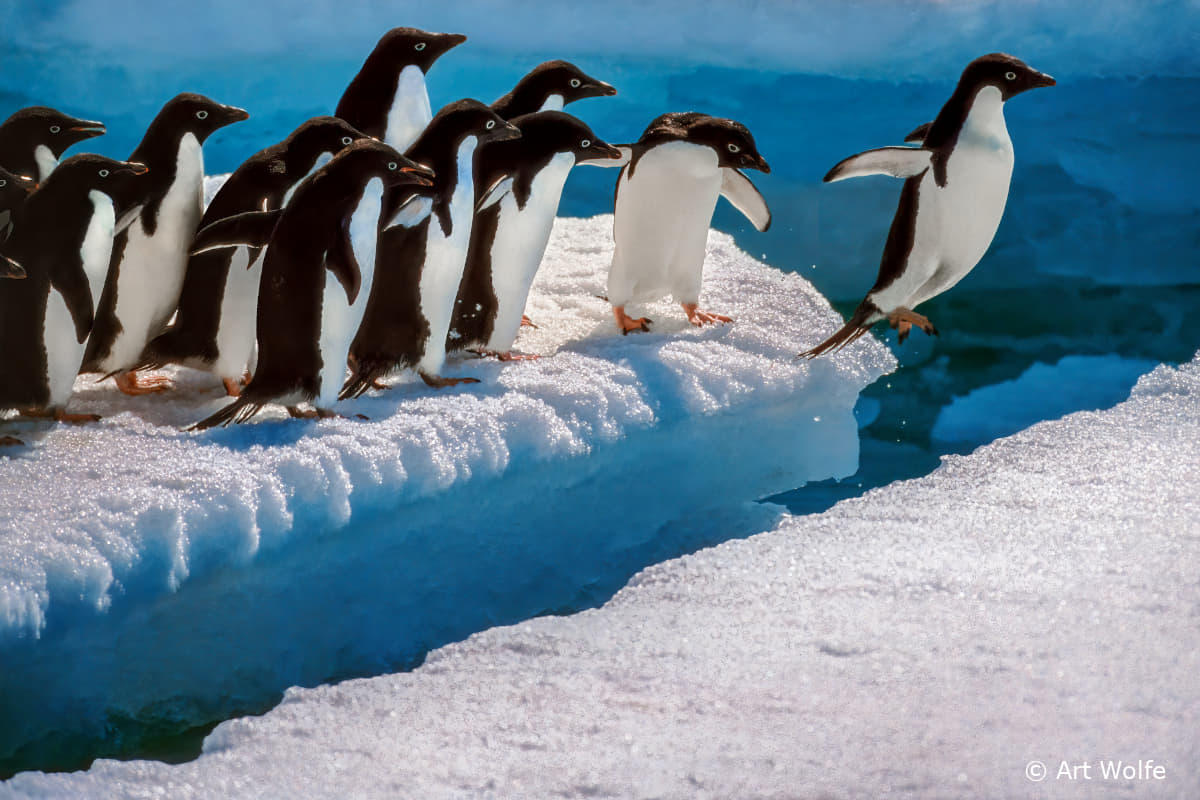
Check out more of Art’s work:
Website: https://artwolfe.com/
Instagram: https://www.instagram.com/artwolfe
Facebook: https://www.facebook.com/art.wolfe.photography
Follow us for your Dose of Photography Inspiration:
BlueSky: https://bsky.app/profile/thecameracafeshow.bsky.social
X: https://x.com/CameraCafeShow
Facebook: https://www.facebook.com/thecameracafeshow
YouTube: https://www.youtube.com/channel/UCgwLbH5yWiYYd-dFeu1s_vQ
ot any questions? Email us: hello@thecameracafeshow.com
Thanks for listening and look out for our next episode!
[00:00:00] In terms of fear, I'm not wired to be fearful. And in fact, it can be a bad thing because a certain amount of fear can keep you sharp and aware of other things. But several years ago, I was doing a book called The Living Wild and we were nearly killed by the largest of the rhinos, the one great one horned Indian rhino. And that was in Royal Chitwan National Park in southern Nepal.
[00:00:27] And it attacked us. We were on foot with two walking, two guides with walking sticks, but that's all we had. And the only thing that saved our lives was the type of tree that we were able to get to. And it had roots above the ground. It was a fig tree, a banyan tree. And they're almost like a fence or a barrier to an animal like a rhino because they can't jump over it.
[00:00:52] We were fearful because these two animals, the mother and his full-grown calf were trying to kill us, literally trying to kill us. And later we found out that in this national park every year, 20 people are either severely injured or killed by these rhinos. Greetings and welcome to The Camera Cafe Show, the podcast where we blew up inspiration for your photography journey. As always, I'm your host, Tom Jacob.
[00:01:20] And I'm Richard Clarke. And behind the scenes, Tatiana Malavana, all making sure this episode is a great experience for all the photographers under you. Today we have an absolute legend joining us, one of the most influential photographers of our time. He's travelled and seen the farthest corners of the world, capturing breathtaking landscapes, wildlife and cultures with his signature artistic vision.
[00:01:44] He has been picking up his camera for almost six decades now, published over an astonishing 120 books. He is to name a few, a member of the American Society of Media Photographers. He is an honorary fellow of the Royal Photographic Society, a fellow of the International League of Conservation Photographers, a member national of the Explorers Club and has served on the advisory boards for the Wildlife Conservation Society and is a canon legend.
[00:02:12] Of course, I'm talking about none other than Art Wolf. In this first part of our conversation, full with a bit of good humour of course, we dive into Art's life before photography, how his incredible journey began and his relentless travel and workshop schedule that keeps him on the move, which also includes how he packs his bags. We also discuss the gear he's using today and, most importantly, his passion for bringing out books, his true legacy to the world and for us to marvel over.
[00:02:41] This is an inspiring and eye-opening conversation you just don't want to miss. And don't worry, this is just part one. We're airing the second half of this conversation next week, where we dive even deeper into his creative philosophy and experiences, his travels to the Ed Show, memories of good photography colleagues or friends along the way, and a talk about being a photographer in the world right now. So grab your coffee, settle in, and enjoy this incredible conversation with the one and only Art Wolf.
[00:03:12] Welcome, Art Wolf, today on our podcast. Art, it's a pleasure having you today for a little talk about photography. Tom, the pleasure's all mine. Thank you for having me. And before I forget, Art, you see this nice cup we have of the podcast? You know what is here inside? Coffee. Tequila. Tequila. Don't fool you. If the interview gets too strong, I'll have a sip.
[00:03:41] But I think it's too early for tequila there in Seattle now. It is. It is. But only by a few hours. Okay. They always say it's always six o'clock somewhere, so. That's exactly right. I tell myself that every time I get out of the bed really early to go to the airport, somewhere around the world, everybody's having dinner, having a great time. So it helps me get out of bed knowing other people are already up and enjoying life.
[00:04:11] Art, how would you describe your career, like in one sentence, to someone who doesn't know you or your work? I would say it's restless. My whole career has been evolving and changing subjects. And I always got that from my instructors in the University of Washington School of Painting. It is that they kept on goading me or encouraging me not to rest on my laurels.
[00:04:36] In other words, never just be happy with one genre or one style. Otherwise, you'll die of boredom. Now, that wasn't true for a lot of the painters I studied. But in today's world, where last week there's a new technology and next week there's a new thing, I'm just broadening my perspective on subjects and photographing things that I wouldn't have considered even five or six years ago. Art, how old are you now?
[00:05:07] 73. 73. If your birthday comes up, Art, you are the person who gets a bit reflective or you just look straight ahead and go on? Yeah, I tend to not be reflective. I'm just moving on to the next project. In fact, I've got three books nearly completed that are waiting to be published. And now I'm thinking about where to go next. So I never look back.
[00:05:37] I am only looking forward. I'm in denial, in other words. Mm-hmm. I guess that's a good thing to do, Art. Now, let's walk a bit back, Art. Okay. I think when you were six or seven, you got a book about animals. You studied it avidly. And you developed your fascination there for it. You were always an outdoor kid when you were young. Yeah.
[00:06:04] I was that kid in the forest back in the 50s in Seattle. Where I live now, I'm surrounded by houses. Although I've got, I planted 500 trees around my house. So I can't see any other houses. But where I grew up was one mile from here. We had horses, sheep, chickens, all around. Everybody in the neighborhood had some sort of farm animal. And today, it's modern part of the city. But back then, there were wooded ravines.
[00:06:33] And I would just go in and be gone all day long, kind of rooting around and getting dirt under my fingernails and all those kind of things. But you're right. I had a little bird book, mammal book, tree book. And I studied them and became an expert on identifying the local plants, all the birds, mammals. And so I was a naturalist at seven without even understanding the word naturalist.
[00:06:59] And I think your father was a photographer and your mother a painter, right? That is true. My father was working off an aircraft carrier in the South Pacific. He had one of those old box cameras with bellows. And my mom, when he met my mom, they got married, of course. And she took a correspondence course in painting and illustration. And I, as a little kid, were watching her and emulating what she was doing.
[00:07:27] So from an early age, painting was part of my history. I never got into wedding photography, as did my dad after World War II. But he gave me his camera when four by five cameras were obsolete for weddings. And so I started climbing mountains with these old four by fives, you know, black cloth over the head. The image was upside down. You would have to load your holders. But that was great training and discipline for me.
[00:07:54] Was that your gateway into photography? Because did you study art originally at university or college? Yeah. My original inspiration was to be a painter and then maybe have galleries represent me. But as I was in art school, my friends that I played with in the forest became climbers.
[00:08:17] And then I got to climbing classes and I started going up the volcanoes and the glaciers in and around Seattle. And my allegiances shifted much the way Tom history was. I switched from conjuring up a meaningful painting to taking pictures because it suited my temperament. And I could create original photos much faster than a painting. So that's when the career shift happened.
[00:08:46] It was probably my fourth year of college. And so I graduated with a fine art painting degree and an art education degree, which meant I had to learn how to speak in front of an audience and take speech classes and all those. Because I, like most people, was petrified to get up in front of a group of peers and talk. But I broke through that fear really quick when I was one year as a substitute teacher in the school district.
[00:09:16] You enjoyed that time teaching to kids in school? I hated it. I hated it. I thought I was going to go to jail because I wanted to punch some of these kids. They were so mouthy and, you know, they were kids. But I wasn't that much older than them. But I learned how to use my voice to catch attention. It's almost like a cat or a wild cat or a wild dog being cornered. You either fight or die.
[00:09:45] And so I learned how to stand up and really take command of the class. And that was a big mental breakthrough. That gave me the courage and the confidence a couple of years later to go to National Geographic, to Audubon, Smithsonian, these national magazines or international magazines, and actually sell stories to them. Had I not had that degree in art education, I suspect I wouldn't have been able to do it.
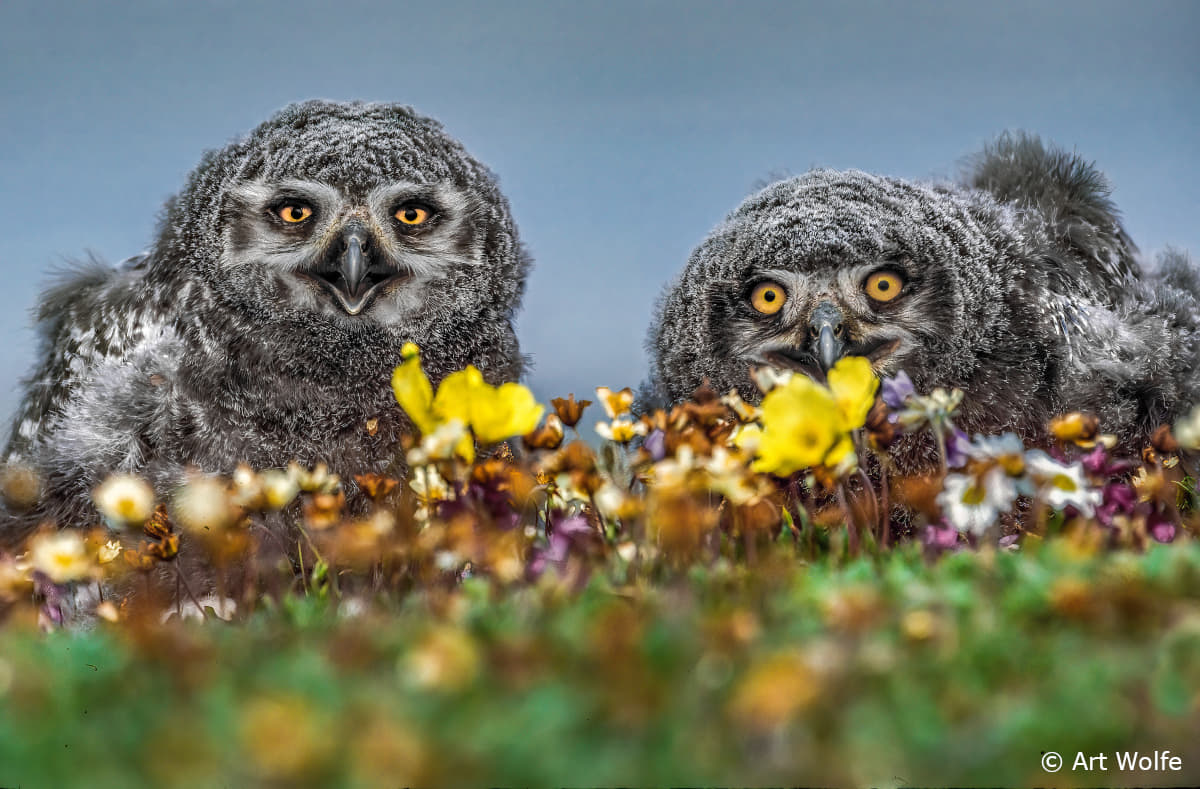
[00:10:14] Now, you mentioned art, National Geographic. You remember the first assignment you had to do for them or you did for them? Yeah. On my very first trip to Washington, D.C., I had some photographs of owls. And they liked the idea. I went back, shot the story, and it replaced an existing story that they weren't really that crazy about in the magazine.
[00:10:39] And so I still had the record from the time the subject was shot to the time it was printed in the magazine. And that was back in the late 70s, I believe, or early 80s. And how was National Geographic in that time? I mean, they give you just a bunch of rolls of film or...? Yeah, it was a great time, actually, to be a photographer for Geographic because then I did a story on swans.
[00:11:07] Then I had a book project in the Soviet Union where I was to document all the biospheres and natural areas that were closed off to the average person I was able to get into and do. And yet, back in those days at National Geographic, whatever they published, they owned the copyright. And that went directly opposition to what I was trained in art school. Whatever you created, you owned the copyright.
[00:11:37] So I quickly did two stories and a book for them. But then I moved on and started doing fine art books. And five decades later, I think there's over 115 books that I've worked on. And so with the training as an artist, you want your photos to appear in a beautiful book rather than a magazine that was on stands for less than 30 days. Mm-hmm.
[00:12:06] Then your friend, Franz Lanting, I think he's working already for many, many, many years for National Geographic. I think he started exactly at the same time I did. But he stayed with National Geographic, whereas I started working on books. We're good friends and we're the same age. And I think he and I were aware of each other's work from the beginning. And so in many ways, we were competing for page space in periodicals.
[00:12:35] And that made me a better photographer and made him a better photographer. Because, you know, if there's nobody out there doing the same thing, you kind of easily could get lazy, I think. So a little bit of competition keeps you moving forward and keeps you, you know, driven a bit. And I'm definitely driven. You mentioned a moment, Russia before art.
[00:13:01] Can it be I read somewhere someday that you say that the only negative experience you had in your life on the travel was in Russia? Now I can add China as well. Yeah. In Russia, I was in there was a magazine being published in the Soviet Union called America and not spelled like America, but America. And they did a profile on me.
[00:13:26] And then the Soviet government invited me to come to Siberia to photograph the wonders of Siberia in February, which is cold and dark. And I actually got a couple of shots that I love, but there was no food at the time. And my interpreter would leave at four o'clock and I would stay in a dimly lit room watching TV that I couldn't understand. And there was no socialization and it was demoralizing.
[00:13:56] And I just thought this is not a place for me. And two weeks later, I was in Australia and Sydney at the height of the summer looking at Mardi Gras. And it was just so different that I just didn't want to go back to the Soviet Union. And about four years ago, I was going to lead a tour to Tibet because I was on the first Western expedition allowed into Tibet by the Chinese government.
[00:14:21] And I wanted to go back, you know, 40 years later to photograph Mount Kailash, which is a sacred mountain for both the Hindus and the Buddhists and lead a tour as well. But the Chinese government would not issue me a visa to come into Tibet because they get on the Internet and they check you out. And if you're a photographer, they find more reasons not to allow you to come into Tibet because they
[00:14:50] always assume you're going to do a negative story on the Chinese invasion of Tibet. So all my participants, some 10 people were in Lhasa waiting for me and I could not get into Tibet. So it was a disaster, though they went on the tour with a local Tibetan guide. They knew the difference. And so both China and the Soviet Union are not my favorite places to travel. They're not on your list. No.
[00:15:19] But then you go to Bhutan next year again. Yeah. I love Bhutan because Bhutan is one of those countries that put great value on natural beauty, the forest. It's illegal to cut a tree in Bhutan. They value tradition. So most of the people are walking around in their traditional dress and it's just a beautiful country.
[00:15:46] Whereas neighboring Nepal, which I also like Nepal, but they've cut so much of their forest that they are dealing with erosion and loss of habitat. And it goes on and on and on. There's a lot of trouble in Nepal with their natural scenery and health, you know. But Bhutan was ruled by a succession of kings and they closed it off to the outside world for the longest time.
[00:16:15] And oh, some 20 years ago, they started opening it up and I started traveling there and I had a great experience. Hmm. I've never been, but I saw on your website, you have still two places left to go. Well, there's two places I'm going to this year that I've never been to. One is Saudi Arabia and the other one is Uzbekistan. So I'm always, every year I want to find a few new locations to explore.
[00:16:43] And so I'm being invited to come to Saudi Arabia and go to the Red Sea where resorts are being built. Well, the Prince of Saudi Arabia is rapidly trying to turn it into a tourist location. And the sister of a close friend of mine has been hired by the Prince to make that happen. You never thought Saudi Arabia was opening up, but it really is.
[00:17:10] You have any idea how many countries you've visited throughout the years? No. You know, I don't keep track of the number of books, the number of countries, the number of days. I'm not wired that way. You know, some people travel to every country on earth just so they can brag that they've been to every country. I go back to Japan 25 times or prior to the Tibet incident in China. I've been in China probably 15 times.
[00:17:37] So Africa 60 times over five decades. And that's just a guess. That's just a guess. But I'm not traveling just to say that I've been to every country. I'm not motivated by that. I'm motivated by the subject that I find in these countries. Is there like a destination that feels like a second home for you? For this, I was asking it.
[00:18:04] Well, you know, I just led two tours with my long-term assistant, Gabriel Giacon, who's from Romania. And we led two tours down to New Zealand. And New Zealand and the mountains are very familiar to me. They have a coastline right next to the mountains, which is very familiar to me. It's pretty, pretty easy to travel. So I could see actually living in New Zealand if I ever was kicked out of America.
[00:18:33] Everywhere I go, I find lovely people and great subjects. So other than the Soviet Union, I'm sure the people in the Soviet Union are very nice people. It's the government, of course, that is always a problem. That's true with a lot of countries around the world right now. There's really terrible leaders that are fighting and all that. But we'll keep this positive.
[00:19:01] We won't go into a political discussion. But what has been your most challenging experience? What do you say, chapter, and how many troubles? Oh, that's an easy one. Thanks, Richard. I once petitioned the Falkland government to allow Gabriel and I to stay camping on South Georgia Island for 10 days.
[00:19:25] And so they gave us permission because they were overseeing South Georgia, which is 400 miles southeast of the Falkland Islands or Malsinas. At any rate, we got dropped off by a Russian icebreaker and picked up by our German passenger ship 10 days later. And during those 10 days, there was just this terrible storm.
[00:19:49] And in fact, the Russian icebreaker tucked into a harbor probably 10 miles away and stayed there for about three days, waiting out huge waves and turbulent seas. But we were trapped in this bay. We had thousands of seals, but millions of penguins around us. And the seals got in under our tent and wouldn't leave. These are baby seals.
[00:20:14] But I would say that that was the most challenging because to get out of the tent and to stand up was difficult. And we were trying to do a film there, which later was used to encourage Microsoft and Canon to sponsor a TV program that's aired around the world, including Spain. So it was called Travels the Edge.
[00:20:36] But those early days, we were trying to get film of me trying to talk amongst millions of flamingos, millions of penguins. And it was windy so much that it was hard to hold the camera steady. So I think, Richard, that was a real challenging trip for me. But I've been on many where I've gone into the Karakorm Range to K2. You know, I lived for three months on the Northeast Ridge of Mount Everest.
[00:21:03] All of those were challenging, but I was a younger person back then. And I had those climbing skills, but they were still cold and difficult to do. So were you ever scared at all or were you safe within your team again? Well, you know, if you're really trained in mountaineering, you are aware of the unintended consequences of an avalanche in the big Himalayas.
[00:21:31] And in fact, I lost a really close friend in an avalanche, never to be found again. Over the years, I've lost a couple other friends to climbing accidents. So the mountains, as they say, really don't care. In terms of fear, I'm not wired to be fearful. And in fact, it can be a bad thing because a certain amount of fear can keep you sharp and aware of other things. But several years ago, I was doing a book called The Living Wild.
[00:22:00] And we were nearly killed by the largest of the rhinos, the one great one-horned Indian rhino. And that was in Royal Chitwan National Park in southern Nepal. And it attacked us. We were on foot with two walking, two guides with walking sticks. But that's all we had. And the only thing that saved our lives was the type of tree that we were able to get to. And it had roots above the ground. It was a fig tree, a banyan tree.
[00:22:29] And so they have what they call buttressed roots that are above the ground. And they're almost like a fence or a barrier to an animal like a rhino because they can't jump over it. And so we were fearful because these two animals, the mother and his full-grown calf, were trying to kill us, literally trying to kill us.
[00:22:51] And later we found out that in this national park, every year, 20 people are either severely injured or killed by these rhinos. And it's mainly the reason is it used to be the hunting grounds for the former kings of Nepal. So the rhinos passed down this memory of humans being something to kill rather than just look at.
[00:23:18] And so the rhinos have it in their DNA to stomp or to gore people that get caught out in the forest of Royal Chitwan National Park. So fear is something I don't live with. But after a couple of incidences like that, you are a little more aware. I'm leading walking tour to walk with polar bears next year. I feel very confident doing that.
[00:23:47] And every year, Gabrielle and I take a group of 10 people up and we put them really close to brown bears and cubs. And I know the bears. And there's probably 100 bears that use this area during the summer months when the salmon are running. But these bears are full of salmon and they have reconciled and are comfortable around humans. And by the end of my tour, people are really comfortable around brown bears.
[00:24:13] And when I say close, they can come within a meter and a half of you with their cubs. And you just stay there. You stand there and they'll just walk right by you. You can reach out and touch them. So it's a pretty great experience. Or maybe you're the one that can run the fastest in your group, Art. I don't think at 73 that that's true.
[00:24:38] Art, with being out of your house, I think nine or 10 months in a year, how you pack your luggage for trips that involve such different climates and situations? Oh, what a perfect question that is, Tom. Right now, I'm leaving in less than 10 days for an Indonesian dive trip, which will be tropical.
[00:25:05] Then I'll go up to Bangkok for about three or four days. Gabriel Jakkan lives in Thailand, in the north of it. He'll fly down to Bangkok. We'll fly into Delhi, India. We have a tour that will take people out looking for tigers. And then we end that tour with the Kummela, which is the biggest gatherings of Hindus along the Ganges. And it happens every 12 years. So we've got tropical seas.
[00:25:33] We've got really cold conditions early in the morning in open-air jeeps looking for tigers. And then it's pretty cool in the mornings at the Kumm with mild afternoons. So that's fairly easy. It's cold clothing and warm clothing. But in a couple of weeks after that is really a difficult trip because I'm first going into Germany to give a talk at an opera house on the border of France and Switzerland and Germany.
[00:26:03] Then I'll fly back down to Bangkok and Gav will come down to Bangkok and then we'll fly up to Tokyo. And we lead a wintertime tour in Hokkaido. And from there, and that's really cold clothing to pack for. And from there, I fly into Saudi Arabia, which in early March will still be quite cool.
[00:26:27] And then from there, I go into Tanzania for another 12-day tour, which should be a little wet but warm. So all those different trips require perhaps different clothes and different gear. That's a 46-day tour. And I'm really not looking forward to it. But this opportunity to go into Saudi Arabia came during what normally would be my downtime. And so I'm conflicted.
[00:26:56] I really want to go. And yet it would have been nice to have that downtime. But I'm going. That opportunity won't arise again, I'm sure. So I'll take advantage of that. But that was a great question. It's packing for really distinct, different destinations or even the kind of lenses or whatever you bring is really tied to the specific part of that trip. As you know, Tom.
[00:27:22] But then, of course, you have a great little team behind you that can remind you to bring extra trousers, Art. It is true. I have a staff of about four, actually five people. And two of the women have worked for me for over 32 years. Gabrielle Jacon has worked side by side with me for over 30 years. I've got a couple other people that are 15 years. So I am very loyal to the people that work for me.
[00:27:50] But more importantly, when I'm traveling so much, they run the ship. And they have the rights to initiate projects or sign contracts and do those kind of things. So I think not micromanaging a group of people ensures that they are happy. And when I'm gone, they're probably even happier. And so it's a good team. You know, when you know somebody so well, they understand who you are and the good and the bad of that.
[00:28:21] And the bad, I don't know if there's anything bad about working for me, but I'm sure they would have a few things to say about that. If you keep the tequila flowing, they'll be very happy team. Yeah, you know, tequila gets to the point really quick. That's my favorite drink because I'm not a beer drinker. I only feel bloated and twofold. But tequila, you know, for type A people, which I am, a little self-medication, whatever form it may be, is not a bad thing.
[00:28:51] But yeah, thanks for bringing that up. I was going to a little gear question, but I wanted to do a shout out to, I think she's called Deirdre, the one who replies your email. Yeah, Deirdre. Deirdre. She's very, very good. She answers straight away and she seems a funny girl too. I was going to ask a little bit of gear question, Art. Not too much because in the podcast, we prefer to discuss other things than other topics than gear.
[00:29:18] But I think she was the one who told me that you should Canon now, but you started with Nikon and then you switched. And she says, maybe there is a story there. Well, you know, the time I've gone from Canon to Nikon to Canon to Nikon to Canon. And in between, I've had Pentax.
[00:29:40] I shot an entire body of work called The Human Canvas in studios with a Leica system, which was beautiful, you know, a very large format. But she probably laughs because I'm not a gearhead. I'm not a geeky, you know, I'm more about the animal and the natural history than the technology used to capture it.
[00:30:04] But I'm very happy with Canon, but I'm also aware that Nikon and Sony and other systems are brilliant as well. So I never kind of get into that, you know, argument, which is better. It just seems useless energy for me. It's all about the subject and how you use your camera that's important. What made you jump from film to digital? Well, the people on my staff said, when are you going to switch to digital? And I said, I don't know.
[00:30:32] They said, well, if you don't switch now, you'll be a dinosaur tomorrow. So they were trying to goad me on. And I was waiting until digital was on par with the slide film that we're shooting at the time. And it was probably around the time that it became a 12 megapixel camera that I took to Antarctica along with 500 rolls of film.
[00:30:55] I had never used a computer and knew I didn't know how to download, but I was trained by my staff. So here I'm on a ship on my way to Antarctica. I went out with a digital camera and photographed beads of water on the railing of the ship in miserable conditions. But within five minutes, I'm looking at it on a computer. And that connection, that reward, that verification instantly, all 500 rolls of film came home unused.
[00:31:26] It was just like a meat cleaver and a film beginning of digital. It was just no two ways about it. I was hooked on it because I could validate what I was shooting, which allowed me to move on to a new subject. Whereas with film, you couldn't tell for months. Like if I was on Everest for three months, it would be four months before I'd see the photos I took prior. And so I love digital because of that.
[00:31:54] And of course, it's only gotten better and better and better and better. And now at 73 Art, you were happy to pack lightweight or you still carry all the stuff and all the gears to make the shot? Well, did Deirdre give you this list of questions to ask me? Because they're really good questions. You know, on this trip that I'm heading, I've got underwater housing, of course, for the dive trip.
[00:32:22] But when I'm on in India, I'll only have one camera and one lens probably in my lap. And that would be a R5 Canon with a 1-500. And that's really all I need for tigers in the field. And I'll have a backup camera wrapped in bubble wrap in my duffel bag. I've got also a wide angle for when I go to the coom and photograph people.
[00:32:52] Have you been to the Kumela incident? Okay. So, you know, if you're walking around, you get invited into sadhu tents and a wide angle to show the sadhu, but also the background is important. Yeah. So, I'm very judicious on what I bring. And it all goes on my back. And I don't have a little wheel carrier. And so, when I'm walking through airports, people look at this white-haired old man carrying a backpack.
[00:33:20] And it confuses them because maybe I should be using a walker rather than carrying a backpack. But at any rate, yeah, you absolutely got it right. The newer equipment is lighter. Everything gets lighter for the aging boomers, which I am. And so, I'm not begrudging that. I'm happy with lighter things on my back.
[00:33:43] And I think to that point, Tom, I think that a lot of people starting out feel that they have to have every Nikon lens or every Sony lens. And they buy everything. And they get weighted down really quick. I see that all the time when I'm teaching workshops or leading international tours. They bring too much stuff because they're not that familiar with what these lenses can do. And surely, they must have everything.
[00:34:13] And I always say, you know, pare it down to the minimum. And you can always walk forward or walk backwards to make up for two or three of those lenses that you're bringing along. It's like, Art, when I look at your pictures, I don't think of, wow, Art's new 800 millimeter lens really can do the job. No, I think of how you took the moment, saw the light and make the shot. And that's what interests me. But we need to discuss gear because people have to start somewhere, of course. But it's right.
[00:34:42] You don't have to buy too much in the beginning because then you get really lost. You don't know what to do anymore. Yeah, it is all about how you use the camera that's in your hand. And so people, you know, when I give lectures, a lot of times I'm walking through museums in Europe with an iPhone photographing famous paintings that I incorporate into my lectures. And so some people are surprised that I'm even using an iPhone.
[00:35:10] But in fact, they're good for a certain use for pictures on, you know, the Internet or where a bigger camera might garner a lot more attention from museum officials. You know, it's the iPhones that started popping up everywhere that actually opened up museums because they couldn't control it. And so now you can go into fine art museums and photograph. And as long as you're not using a flash or a tripod, you're good to go.
[00:35:38] And I think they don't understand how good a quality the images I'm getting. And if it's not the iPhone, it would be R5 with a 24 to 70 millimeter lens. And I'm getting ones that are actually better than in the books in the gift store at the base of the museum. So it's been a great evolution of cameras.
[00:36:01] You know, Tom, when I first started out, I was using ISOs of 25, then 50. And if you ever entertained ideas of photographing wild animals, you know, that animal had to be asleep or dead to get in focus because it was such slow film. So I'm always happy with where we are now photographing the heavens and stars and everything else that were only a dream.
[00:36:29] You know, 15 years ago, now they're a reality. You can capture beautiful photos of the Milky Way and you don't have to put it on a machine that rotates with stars in the sky. And it's really a great advance in technology. Art, I think you are the one that you will prefer a wild angle lens than a long lens. You're the one who likes to put a lot in the frame so that the viewer can look around and use the foreground and the background.
[00:36:58] Yeah, I mean, I've done a couple of books. Well, I haven't done. I've done probably about eight or 10 books on international wildlife. And everyone had a very distinct style. Migrations was an ode to M.C. Escher, this Dutch artist that did beautiful patterns. So that was a book of patterns. Rhythms from the Wild was inspired by Claude Monet, as earlier I mentioned.
[00:37:26] I did a book called Vanishing Act, which was hiding the animal in plain sight. And that's where what you're suggesting, I really use smaller lenses to incorporate more of the environment. And I didn't want the animal being obvious. So I try to hide it with the complexity of the environment. And then The Living Wild was a wide angle study of animals in their environment. But the animal was prominent. But then it was a wide angle.
[00:37:56] So I got really close to a lot of animals to incorporate that wide angle. Otherwise, the animal would be too tiny in the frame. And more recently, I just did a book called Wild Lives, where it was a little bit of everything. It was portraits. It was action. It was camouflage. It was a little bit of every trick I've ever used when I was working on a book. Let's talk about books then. Okay.
[00:38:21] I think I saw you once saying that you cannot die while you do photography books. Yeah, that's probably why I'm still doing this. I've got three or four books. Well, three books that I have finished and several more in my mind that I'm working on. And I had a 92-year-old gay book editor in New York who would take a train in from Fire Island.
[00:38:49] And I did about eight books with this really old, bent-over man. And he would always say, Art, what's our next project? And then I would suggest, okay, we haven't done a book on wild cats. And he said, okay, I'll have a contract. And then I realized he was using me to stay alive. And more importantly, I had so much respect for the publisher that never retired him.
[00:39:16] You know, at 92, he was still valuable in the office. But I think he was keeping me busy because he had to stay alive to, you know, see these books to their end. And so I took from that a valuable lesson that as long as you have projects, you have reason to get out of bed. When you don't have a specific project or you're just shooting random images, it's less of a motivation.
[00:39:43] So I always had a target to shoot for. And it helped focus my attention when I'm in the field, but also a reason to get out of bed. So photo books are your fountain of eternal youth? Yeah. If you look at me and you think I have the secret of eternal youth, then I don't think our connection is that clear. How do you manage with all your time? Because you travel so much, like nine months of the year, your photography, your projects. And how do you write your books as well?
[00:40:12] I mean, it blows my mind, to be honest. Well, you know, I don't write. I will occasionally write the introductions, but I find really good writers that are perfect. Right now I'm finishing up. And the reason I'm going to the Coombe is I'm finishing up a book called Act of Faith. And this is, in fact, why I was in Barcelona and then Sevilla was photographing the promenade, but, you know, all the crazy Catholic traditions of their pointed hats.
[00:40:42] And so Act of Faith is not only a look at all the major religions around the world, but also voodoo, shamanism, tribal beliefs. It's what people believe. So faith is not necessarily just religion. It's what people believe. And so I have just found a writer that I'm going to call later today who has done a lot of studying on religions and how they're related.
[00:41:11] He's a professor in Houston, Texas, and that's his bailiwick. That's what he likes to write about. So finding writers that can write the text for all the various books has been a great challenge. But Deirdre in my office, I've got an able staff that pay attention and read a lot.
[00:41:32] So between the family here and then a publisher that also has good connections, who's down in San Rafael, California, he has connections to writers. So it takes a village, Richard, to do a book. But the inception of an idea generally starts with me. Where do I want to go? What kind of a story do I tell? And more importantly, has it been done by me before or by a lot of other people?
[00:41:59] So I like to surprise my audience just when they think, oh, I know Art Wolf, he's the wildlife photographer. Out comes a book on fate. So I love to surprise the audience and keep them tuned in. Art, I'm right in thinking that with all the traveling you do, you're not just concentrating on one book while you travel. You are concentrating on multiple books already. Yeah, I have very little talent for a lot of other things.
[00:42:26] The things that I excel at are gardening, Japanese-style gardening. So I've got a beautiful Japanese-style garden that I created, and I work in the trees bonsai-ing every year. The other thing is I think I'm good at is compartmentalizing projects when I'm in the field. Like my mind can switch over from shooting something for faith to something that could be for another book, and that could be for another book.
[00:42:54] I can divide my brain and keep it free enough to take advantage of the serendipity, the things I would not have predicted seconds before are unfolding. And I said, that would be perfect for this book. So I'm really good at doing that and organizing. I make lists of everything I need to do. There's three notepads right here, and each one is for the next day, the next day, the next day.
[00:43:21] I am not reliant on my memory, so I write things down and I stay focused because I'll be home for 10 days and I'll be gone for three weeks and home for two weeks and gone for five weeks. And so you have to be organized. I'm organized and I pack, you know, the day I get back from a long trip.
[00:43:41] If it's not crazy late at night, I'll wash the clothes, repack, repack my travel bag so that when I'm home, I have at least the time to go out to dinner with friends or see a movie or whatever it may be before I'm on the road again. So I maximize the time very judiciously so that I don't forget something on the road or I don't get overwhelmed with a very busy schedule.
[00:44:09] Talk me a bit about your latest book, Wildlives. What was the initial for this book? You know, we live at a time of terrible politics. And well, I don't have to tell you around the world. There's a lot of conflict. We top that off with COVID internationally, top that off with climate change that's affecting all of our lives. And if you turn on the news, it's all negative.
[00:44:38] You know, if it bleeds, it leads. And so I wanted to remind people that there's animals out there that are thriving even with climate change. There's more whales in the ocean now than there has been since 1950. There's more mountain lions in North America than the last 200 years. Animals are surviving because they're just as tenacious as humans.
[00:45:03] Some species like polar bears are really being affected by the receding ice in the Arctic. But other species are thriving because there's more krill in the warmer waters down in Antarctica. So the animals that eat krill, penguins and whales are exploding in populations. And snow leopards are holding strong tigers in India are growing in numbers by 10 percent a year.
[00:45:31] Mountain gorillas are growing by 10 percent a year. So those positive stories, I think, need to be told to keep people tuned in and uplifted a little bit so that they don't just give up on whatever. And so I've always been that way. The books I've worked on were intended to inspire, educate and uplift rather to demoralize people.
[00:45:57] And certainly there's enough things out there that can make people depressed. And so that's what I want to do. That's my contribution to the art world, but also natural history and natural elements. So that's what keeps me going all the time. How do you see your role of photography, like photography books in particular, faring in the digital age? How do you see it progressing?
[00:46:26] Well, we have a very good printer just outside Hong Kong. You know, the Chinese are good at emulating technology and then improving on a lot of that technology. And when it comes to printing, the Chinese are as good as any other place around the world. And so I see my books being presented in a stronger, more graphic, better paper, better inks, more longevity way. And that's a great trend.
[00:46:55] And those books that I do are a legacy that I leave behind when I'm gone. I don't have children. I don't have a lot of things that an average family or person would have. But what I have is a great life. And so the legacy would be the books rather than anything else. Yeah, the trees that I've got in my yard, which I've taken care of for 35 years, will grow up into big trees when I'm gone.
[00:47:24] So I don't look at those trees as being a legacy, but the books can. And so we all kind of want reminders that we existed at one time or the other. A lot of people have children and grandchildren that will be a remembrance down the road. Other people use artwork on walls to make their chicken scratch. And that's universal.
[00:47:49] Wherever I go, I'm photographing people and walls that are just covered with people's need to write their name or have a heart or something. And so someday that could actually be a book. And so everybody wants some sort of thing they leave behind that will remind people that you actually existed at one point. What would you like to be most remembered for with your photography work in particular?
[00:48:17] Amongst my colleagues, I think I do enjoy when one of my colleagues that I've never met reaches out and says that they've paid attention and they like your work. I think I pay more attention to people that take pictures professionally. And when they give me credit for this or that, that means a lot to me. I never enter contests. I've never entered a photo contest. But when an honor is bestowed upon you, I think that means a lot to me.
[00:48:47] And so having awards coming out of nowhere mean a lot to me as opposed to trying to be judged by somebody else. And that's a wrap for part one of our conversation with Art Wolf. What an incredible journey, folks, from his early days before photography to his dedication to books as a lasting legacy. His passion for storytelling through imagery is truly inspiring. But we're not done yet.
[00:49:15] Next week, we'll be back with part two, where Art shares even more insights into his creative vision, his experience in the field, and some unforgettable stories from his career. You don't want to miss this. As always, folks, if you enjoyed this episode, make sure to check out our website, subscribe to the podcast, and leave us a review. It really helps us bring you more amazing conversations with the world's top photographers. And don't forget to follow us on your favorite podcast platform so you never miss an episode.
[00:49:42] Until next time, keep shooting, keep exploring, and keep on moving your photography. This is Tom Jacob, Tatiana Maravana, and Richard Clarke, signing off for today. See you next week for part two with Art Wolf. Adios!