
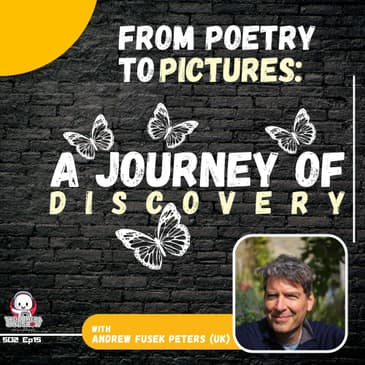

In this episode of the Camera Café Show, we sit down with celebrated wildlife and landscape photographer and OM System Ambassador Andrew Fusek Peters (UK) to explore his incredible journey from a poet and renowned children's author to a leading figure in British wildlife photography. Andrew shares how his passion for nature, coupled with his artistic eye, has shaped his career behind the camera, and the pivotal moment that transformed his love for the outdoors into a lifelong photographic pursuit.
Andrew has published several successful books, including “Butterfly Safari”, which documents all 59 UK butterfly species—a project that took years of dedication and travel across the country. He offers insight into the process of bringing such a book to life, from capturing rare species to going through thousands of photos, all while balancing his creative vision with the demands of the publishing world. He also gives practical advice for photographers looking to get their work published in magazines, drawing from his extensive experience with many national and international media outlets like BBC Wildlife Magazine, Country Life, The Times, The Guardian, Daily Mirror, Amateur Photographer, Digital Camera and an ongoing list of 600+ published pictures. For Andrew, persistence, originality, and storytelling are key to getting noticed.
As an OM System ambassador, Andrew shares how using the OM System technology has helped him capture breathtaking moments in nature, like his latest iconic image of a dragonfly against the Milky Way, shot in a single image. He offers tips for wildlife photographers, from the importance of patience and understanding animal behavior to the technical aspects of working with high-speed cameras. Andrew also reflects on his battle with cancer and how it reshaped his approach to photography, making him more appreciative of the beauty found in everyday moments—whether it’s photographing ruby-tailed wasps in his own garden or capturing the Northern Lights up a hill.
The Transcription of Andrew's Episode is Available on our Website.
Enjoyed our show? Support us with a $2 coffee! :)
Check out more of Andrew's work:
Website: https://www.fusekphotos.com/
Instagram: https://www.instagram.com/andrewfusekpeters/
Facebook: https://www.facebook.com/andrewfusekpeters
Books: https://www.fusekphotos.com/10495180-books
Connect with The Camera Cafe Show. Follow and Subscribe:
Website: https://thecameracafeshow.com/
Twitter: https://x.com/CameraCafeShow
Facebook: https://www.facebook.com/thecameracafeshow
YouTube: https://www.youtube.com/channel/UCgwLbH5yWiYYd-dFeu1s_vQ
Got any questions? Email us
Thanks for listening and look out for our next episode!
[00:00:00] I don't have a choice where my photos get published. What I do know is that if I'm adding a positive story and there is some potential to raise awareness for species, then I can only be doing something good, if not very small. Am I making any difference? I've got no idea.
[00:00:16] If you're going to be a really, really, really good wildlife photographer, but you don't care about conservation, then you're not a really, really, really good wildlife photographer.
[00:00:26] And we live in a dark place and dark times, you know. And I'm of the thing, I don't have much hope for humanity. I think we're sad. I think there's amazing kindness and love and there are good people in the world, but I see that the bad people and the evil people and the politicians want to just destroy everything for their own, I don't know what it is.
[00:00:45] And wildlife is very low on the agenda. So I try to carry message everywhere I go. I try to raise awareness because even selfishly, I want the species to be around something photograph and when I'm old and grey. But it's, God knows, you know, start times, isn't it?
[00:01:01] Greetings and welcome back to the Camera Café Show, the podcast where you brew up inspiration for your photography and inspiring you to take your passion to the next level.
[00:01:15] I'm your host, Tom Jacob, and on the other side of the room, we have Tatiana Malovana and Rich Clark steering this podcast in the right direction.
[00:01:22] Today, we have a wonderful special guest from the UK, renowned nature photographer and OM system ambassador, Andrew Fusek-Peters.
[00:01:31] Andrew's life journey is nothing short of fascinating, from his beginning as a poet and renowned children's author to then capturing breathtaking images of nature we can see daily on his social media.
[00:01:43] Andrew has mastered this craft of storytelling through photography and on the way has published several acclaimed books, including Butterfly Safari.
[00:01:52] And his stunning images have been featured in national and international newspapers and top magazines.
[00:01:58] He's here today to share how he turned a passion for nature into a successful career, with practical tips for photographers who want to see their work published too.
[00:02:07] From navigating personal challenges to the challenges of wildlife photography to becoming an OM system ambassador,
[00:02:14] Andrew's story is packed with insights that will inspire you and to push your creative limits.
[00:02:19] So, grab your coffee, sit back and join us for a journey of discovery into the wild world of photography with Andrew Fusek-Peters.
[00:02:26] Let's get rolling.
[00:02:29] Good evening, Andrew, there in the UK.
[00:02:32] How have been the past days there?
[00:02:35] They've been good.
[00:02:36] We've had an amazing late summer.
[00:02:38] And we've also had late butterflies and late aurora, which has been amazing.
[00:02:44] So, I've had my best ever Northern Lights experience a few nights ago, which was great fun.
[00:02:50] Since we last talked, Andrew, a lot of things happened.
[00:02:53] Because now suddenly you are nominated in the British Wildlife Photography Awards.
[00:02:58] And you have that amazing picture I suddenly saw from a dragonfly against the Milky Way.
[00:03:04] Yes.
[00:03:05] You shot in one single image and it got also picked up by the BBC.
[00:03:10] Yeah.
[00:03:10] What gave you that idea to try this out?
[00:03:14] Well, it started when I was shooting Canon some years back.
[00:03:18] And I was fascinated by the problem that lenses have.
[00:03:23] That a macro lens can shoot close up and all you see is the close up thing, but you don't see the background.
[00:03:30] And then Lauer brought up and brought that amazing 15mm macro lens out.
[00:03:35] And then you suddenly got habitat and landscape behind the object, the dragonfly, whatever it is, which creates a very interesting, because it's how the human eye sees.
[00:03:43] And I was looking at these lenses and studying this dragonfly and going out and capturing this dragonfly roosting at dusk and at night.
[00:03:51] And I was thinking, well, I should really try and work out how I can photograph the dragonfly close and the Milky Way in the same shot.
[00:03:59] Because all the competitions, Wildlife Photographer of the Year, British Wildlife Photographer of the Year, you're not allowed to do double exposures.
[00:04:06] You can do in-camera double exposures, but that strikes me as it's all a bit geeky.
[00:04:11] But I just thought, okay, if we're not allowed to do that, I'm going to do it in one photo.
[00:04:15] I'm going to work out how to do that.
[00:04:16] I'm not going to give it all away.
[00:04:19] But I will say, if anybody is into filmmaking, they will know exactly what I did in terms of pull focus.
[00:04:25] And I can't say anything on that, because I spent seven years working on that technique.
[00:04:31] And it's something where everything can go wrong.
[00:04:34] Your dragonfly has to be in exactly the right spot.
[00:04:36] You've got to get the focus on the dragonfly and then the focus on the Milky Way.
[00:04:42] It's just mental.
[00:04:44] But for me, as a photographer, I like to do things that haven't been done before.
[00:04:49] That's the challenge.
[00:04:51] And whenever I give my talks or I don't do very much tuition because I just want to go out and take photos,
[00:04:56] but I say to people, think out of the box.
[00:04:58] Do your own thing.
[00:04:59] Don't just copy what everybody else has done.
[00:05:01] If something hasn't been done, work out why it hasn't been done and then do it.
[00:05:05] I think we're going to hear a lot of this still in our talk tonight.
[00:05:10] Andrew, let's walk a moment some years back.
[00:05:13] You had quite a journey from being really a poet and children's author to now being a celebrated and published wildlife photographer.
[00:05:22] Tell me a bit how this transition happened.
[00:05:26] In the strangest of ways, I wrote books, children's books and books for young adults with my wife for 25 years.
[00:05:33] We were very successful.
[00:05:35] I was pushing myself very hard and my goal was to get with the editor who signed J.K. Rowling, who wrote the Harry Potter books.
[00:05:41] Because I heard him give a talk at a conference once and he said,
[00:05:44] when I receive a manuscript, an unpublished manuscript, I want to read the first page and I want the hairs on the back of my hand to go up.
[00:05:51] And then I know I'm going to be publishing that book.
[00:05:53] So I heard him say that and I thought, I'm going to do that.
[00:05:56] I'm going to do that.
[00:05:57] And I wrote a novel called Ravenwood and I did and I got a two book deal and it was published in 17 countries, including in Spain and all over Europe.
[00:06:05] But there was a cost and the cost was when you write a hundred thousand word novel and it's 250,000 words in the rewrites and it's a two book deal.
[00:06:14] And you have to put on a show as well.
[00:06:17] And you've got to go and give talks all around the country and abroad.
[00:06:20] It wasn't me.
[00:06:22] And I basically broke down.
[00:06:24] I just got very, very ill.
[00:06:27] And that was kind of, that was almost like a door that shut and that was the end of that career.
[00:06:32] And when I got better, when I kind of came through that and I knew I didn't want to go back to doing children's books.
[00:06:37] I mean, most people would dream of getting a children's book deal and would see that as the height of creativity.
[00:06:42] So it's really interesting that I got the thing I wanted and I was very, very unhappy.
[00:06:47] It wasn't me.
[00:06:48] So when I came through that, when I got some help and I was just starting to recover and then I was going back to what I did as a young man, which is being in nature.
[00:06:57] And we didn't call it wild swimming in the 1970s.
[00:07:00] We called it swimming.
[00:07:00] So I did a lot of swimming and lakes and pools and rivers.
[00:07:03] And I started writing, nature writing.
[00:07:06] And I read a book called Dit that was very successful.
[00:07:09] And then around about that time, I picked up a camera and I never knew one could have a whole lifetime's obsession starting in my mid-40s.
[00:07:17] But from the moment I stood on Westminster Bridge in London and I saw people with their tripods and their long exposures doing the camera, the trails of the buses and the cars and painting with light.
[00:07:32] It was like my eyes just went, oh yeah, that's for me.
[00:07:37] But I didn't live in London and that's not the thing I was going to do eventually.
[00:07:41] But for about a year, I was at the Shard as it opened.
[00:07:45] It was called a soft opening.
[00:07:47] And I took photos at night there of London from the room we were staying in.
[00:07:50] And they said, oh, come back and photograph for us.
[00:07:54] Not everybody was a photographer then.
[00:07:55] It was still a thing.
[00:07:56] But I'm very glad that I live in the countryside because suddenly I realized that there were barn owls and dragonflies and mice and badgers and hares.
[00:08:07] And they were very difficult.
[00:08:09] And it was a level of difficulty just like doing children's books.
[00:08:12] There's no shortcuts.
[00:08:13] You've got to put the time in.
[00:08:15] And for my mid-40s, I just went for it.
[00:08:17] I just thought, okay, this is the thing.
[00:08:19] And the biggest difference I can think of between my novel Ravenwood, which was set in mile-high trees with ravens with a 30-foot wingspan, was that the nature I was photographing was real and was as miraculous as the imagined worlds I was writing about.
[00:08:35] If anything, more miraculous.
[00:08:39] I've had plenty of people say, oh, you Photoshop that.
[00:08:41] You make that up.
[00:08:42] And I'm going, no.
[00:08:43] By the way, Photoshop is not an insult.
[00:08:45] For God's sake, grow up, folks.
[00:08:47] I mean, really.
[00:08:47] Photoshop is a very useful tool.
[00:08:49] But nature, we don't need to.
[00:08:51] Why do we?
[00:08:52] Nature is there already.
[00:08:53] It's doing it for us.
[00:08:54] We just need to be observant and work hard.
[00:08:59] And then amazing things can happen.
[00:09:01] Can it be that we talked before that you started out with doing like time-lapses animation with your son or stop-frame animations with your son?
[00:09:11] So my son was getting into stop-frame animation.
[00:09:15] And for that, you need a DSLR.
[00:09:17] You need a camera.
[00:09:18] And so I bought a Canon 650D with the kit lens.
[00:09:21] And we did this really good stop-frame animation.
[00:09:23] We worked on it for about three or four months.
[00:09:26] And then he moved on to other things.
[00:09:28] And I had the camera.
[00:09:30] And that's when I went to London and saw all these night trails.
[00:09:34] And that was when I was walking around the back of our house.
[00:09:37] I saw a dragonfly.
[00:09:38] I went, oh, wow.
[00:09:39] And then I worked out very quickly that a 16 to 55 lens is not very good for wildlife.
[00:09:46] So my wife agreed I could buy a lens for 250 pounds.
[00:09:51] We're 170 pounds.
[00:09:52] That's right.
[00:09:52] The Canon 55-250, which is an awesome little lens.
[00:09:57] And my friend pointed out a barn owl hunting by day in the snow in March because it was hungry.
[00:10:02] And I got lovely photos.
[00:10:03] And I was shooting raw already.
[00:10:05] And I so quickly worked out that a 700-pound camera and a 170-pound lens wasn't going to do it.
[00:10:13] And I had some savings.
[00:10:15] And I said to my wife, I said, I'm going to do this.
[00:10:17] And I think I'd already been published in Amateur Photographer.
[00:10:20] And I'd been shortlisted in British wildlife photography.
[00:10:23] I hadn't got any further, but I used that as an excuse.
[00:10:26] I said to my wife, I said, I'm having a midlife crisis.
[00:10:29] I'm going to go for it.
[00:10:30] And I want to spend some money.
[00:10:32] And she said, how much money do you want to spend?
[00:10:33] I said, I want to spend 18,000 pounds.
[00:10:37] She just burst out laughing.
[00:10:40] And I bought the 1DX.
[00:10:41] And I bought the 7D.
[00:10:43] And I bought the 500F4.
[00:10:45] I bought the whole, you know, the 7200.
[00:10:47] I bought the holy grail at the time of what was available.
[00:10:51] And I suddenly had this huge camera and huge lens in my hand.
[00:10:54] I had no idea what to do with it.
[00:10:56] But I learned.
[00:10:56] And I carried on.
[00:10:57] So that was a great start.
[00:11:00] Because I suppose once you spent that money, that's a real commitment.
[00:11:03] And so I wanted to learn.
[00:11:05] And then I quickly worked out that the thing that was of interest to me was where I lived
[00:11:09] in South Shropshire was really interesting.
[00:11:12] And there was a lot going on.
[00:11:14] And then when I took a, I think I took a photo of a pheasant displaying just, and bits of
[00:11:20] pay were flying everywhere.
[00:11:21] It was a nice little action shot.
[00:11:23] I can't stand pheasants.
[00:11:24] I hate the hunting industry.
[00:11:25] But a press agency saw this photo on Facebook and said, I think we can get you in the national
[00:11:31] papers, Andy.
[00:11:32] And again, another light went off in my head.
[00:11:34] And I went, oh, what people want to read in the newspapers in the morning or look at is
[00:11:40] something spectacular and colorful and beautiful and different.
[00:11:44] And then I was with that agency for four years.
[00:11:47] And I got in all the national papers and I got on the cover of the Times.
[00:11:50] And it was a, you know, it was the beginning of a, each time something like that happened
[00:11:55] and someone had faith in me, it gave me the confidence to say, right, I'm really going
[00:11:59] to just, I'm going to, you know, go further.
[00:12:01] And then my first major commission was the National Trust.
[00:12:06] And there was a very big National Trust Nature Reserve called the Longman that is very near
[00:12:09] us.
[00:12:10] And it's a beautiful upland.
[00:12:11] It's full of wildlife.
[00:12:13] And they said, they said, we haven't had a photographer before.
[00:12:15] We want you and we'll pay you.
[00:12:17] And I said, okay.
[00:12:18] I said, but what do you want me to photograph?
[00:12:20] And they said, we want you to photograph everything.
[00:12:22] And I was like, no.
[00:12:25] And they went, yeah, yeah, we do.
[00:12:26] And I then really spent the next five years every, you know, going out to photograph
[00:12:32] curlews and the Milky Way and dragonflies.
[00:12:35] And I mean, you name it.
[00:12:37] I was just up there.
[00:12:38] And so, yeah, it's been a, that was the beginning of my journey.
[00:12:41] It's amazing because most men in midlife crisis, they buy a Zippy red sport mobile and you buy
[00:12:49] a Canon.
[00:12:50] Andrew is a wise decision, I think.
[00:12:53] Yeah, I think it was.
[00:12:54] Yeah, it was, it was a wise decision.
[00:12:57] And when I found my groove, which I think I found fairly early on, probably around 2014,
[00:13:03] 10 years ago, I was, I was flying.
[00:13:07] And in fact, the manager of the National Trust on the Longman, he said, when I tell you, Andy,
[00:13:10] when I tell you about a bird, like a wind chat or a, or a hobby or, you know, and I tell
[00:13:16] you where you might find it, you're like an exocet missile.
[00:13:20] I just aim you in the right direction and you go and you get the shot.
[00:13:24] And it was a great compliment.
[00:13:25] I thought, yeah, that's what I do.
[00:13:27] And somehow, no, I don't know how, I think it is obviously hard work is a lot to do with
[00:13:32] it, but there is, there is grace.
[00:13:33] I do think in the universe there is grace.
[00:13:36] And I have had those moments where I've been in the right place at the right time.
[00:13:39] And then it happens.
[00:13:40] And I think it's because I care deeply and I do write about conservation issues as well,
[00:13:45] but I have an artist's eye.
[00:13:47] And that's the difference between me and some, not knocking other wildlife photographers, but
[00:13:52] most wildlife photographers just want to get the rare thing.
[00:13:55] Oh, it's the rare, lesser spotted, and they go to this place where nobody else knows where
[00:14:00] it is and they get it and they put the picture up and you go, but that's all it is.
[00:14:04] It's just a picture of the rare thing.
[00:14:06] I'm more interested in all four corners of the frame, in beauty, in light, in color,
[00:14:11] in, you know, in the decisive moment as our great photographer, hero of mine, whose name
[00:14:16] I've now forgotten is pathetic, isn't it?
[00:14:18] But I've got no memory at the age of 59.
[00:14:20] But yeah, decisive moment.
[00:14:22] Who was he said the decisive moment?
[00:14:24] Castiel Misson.
[00:14:25] That's the one.
[00:14:27] He really understood that.
[00:14:28] And I think that can apply for a street photographer, a wildlife photographer, a wedding, doesn't
[00:14:33] matter.
[00:14:33] So I'm all about light and color.
[00:14:36] I think that goes without saying.
[00:14:39] And what's very interesting is in the 1970s, when I was a skateboarder and skating in California,
[00:14:44] my favorite color was orange.
[00:14:46] And I just think, yeah, I had everything orange.
[00:14:48] I had orange shorts and orange t-shirt.
[00:14:50] And I look at some of my photos of dragonflies at dusk or ruby-tailed wasps and the color just
[00:14:56] explodes.
[00:14:57] And I'm just going, yeah, that works for me.
[00:14:59] When I get in the papers, people go, oh my God, Andy.
[00:15:02] I want them to have a visceral feeling in the heart.
[00:15:06] Because that's it, isn't it?
[00:15:08] And to go further with that, it is now the reason, I think, when we live in such dark
[00:15:13] times and there's such horrible news and fake news and all that.
[00:15:16] I, in the last really year, and I checked this with my agency, I am literally the most prolific
[00:15:21] wildlife publisher working in the national papers at the moment in the UK.
[00:15:26] Okay.
[00:15:26] And I'm showing off.
[00:15:28] I am going, yeah, it's a bit of showing off, but it's really cool.
[00:15:31] But I've worked out why that is.
[00:15:33] And that's because the newspapers are desperate for happy moments because there's so much unhappy
[00:15:40] stuff.
[00:15:40] So if I send in a beautiful aurora or a ruby-tailed wasp or two bramblings having a fight, male
[00:15:49] bramblings having a fight, then they're just going to, oh yeah, that works.
[00:15:56] That'll do.
[00:15:57] That's our slot field.
[00:15:58] They have a slot.
[00:15:59] Every paper has a slot, even the more down market papers, because they need good news and
[00:16:05] people respond emotionally to that.
[00:16:07] Yeah.
[00:16:08] I mean, the BBC, the one, as you said, where I got shortlisted for the British Wildlife
[00:16:13] Photography Award.
[00:16:14] I don't even know how much it's done on the website, but I know just on their Insta, it's
[00:16:18] done 220,000.
[00:16:20] I've beaten Beyonce.
[00:16:21] I mean, nobody can say that.
[00:16:26] That is an ego joke.
[00:16:28] I never thought I'd get numbers like that, but that's all irrelevant.
[00:16:31] I know it's just here today, gone tomorrow, but it's really nice when you do something really
[00:16:36] beautiful and you work really hard and you get a really good response.
[00:16:38] Of course it is.
[00:16:40] Andrew, can I talk a bit, a moment about changes in life for you personally?
[00:16:47] I know you've been open to your battle with cancer and how it affected your photography.
[00:16:54] How did that period change your perspective on your work and your life?
[00:16:59] That's a good question.
[00:16:59] Thank you.
[00:16:59] It's a great question.
[00:17:00] And it's really good to think about that because there were so many strange things that
[00:17:06] happened at that time.
[00:17:07] I went to, I had a mountain guide and I climbed one of the big mountains in Wales and I slept
[00:17:13] there overnight.
[00:17:13] I got Milky Way Panorama, but as this guide was amazing, she carried all, and I was still
[00:17:18] shooting Canon.
[00:17:20] So she carried my 5D4 and the Sigma 14 1.8.
[00:17:25] Now, I don't know if you know that lens, but it weighs over a kilo.
[00:17:27] It's insanely heavy, but I was really tired.
[00:17:31] I just kept, I was just really tired going up this mountain, really exhausted.
[00:17:35] And I kept going to the doctor and the doctor kept saying, it's your IBS because I had my
[00:17:40] gallbladder out some years ago.
[00:17:42] And then finally, I think it was like August of 2018.
[00:17:47] The doctor at my surgery, one of the doctors said, you look really pale Andy.
[00:17:51] I don't like that look.
[00:17:52] And, and I know you're really tired.
[00:17:54] Let's do a blood test.
[00:17:57] The blood test was really bad, really bad.
[00:18:01] And then, right, let's get you on the fast track.
[00:18:04] And the fast track is the NHS where everything happens within six weeks.
[00:18:09] I didn't want to wait.
[00:18:10] I just wanted to know straight away.
[00:18:12] So I got, I got the, what's called a colonoscopy and I had a tumor the size of a gold ball in
[00:18:17] my guts.
[00:18:18] And it was, life stops.
[00:18:22] It really stops.
[00:18:23] And I'm waiting for surgery and I'm sat in my garden at home.
[00:18:27] We've got a tiny garden, but it was like this late summer.
[00:18:30] Now it was even more.
[00:18:31] And there were butterflies just nonstop everywhere in our little garden.
[00:18:36] And I couldn't go further because I was so tired and so ill.
[00:18:39] And I'm shooting Olympus by then.
[00:18:42] As, as you know, Olympus has all the way back to the M1 Mark II, which is what I was shooting
[00:18:47] with.
[00:18:48] It has ProCapture and ProCapture is like, is the TARDIS of photography.
[00:18:52] It's time travel.
[00:18:54] They did it before anybody else.
[00:18:57] 60 frames per second, full size raw, buffering.
[00:19:01] And I'm thinking, we've got this technique, got these butterflies.
[00:19:04] Why is nobody photographing butterflies in flight?
[00:19:07] And there was a photographer in the 1980s who'd done it.
[00:19:10] But what he'd done is he'd got a big tank in a studio and filled it full of flowers, put
[00:19:15] the butterflies in there, used triggers and lasers, all sorts of stuff to show flight,
[00:19:20] which was amazing, and flash, high speed sync flash.
[00:19:24] But it was artificial.
[00:19:25] And I suddenly thought, I think the technology is ready to get butterflies in flight.
[00:19:31] And nobody's done it yet because they haven't really thought it through.
[00:19:34] And I thought it through.
[00:19:36] And then there was a small copper I got in flight.
[00:19:39] There was a painted lady.
[00:19:40] In fact, there was a painted lady flight sequence that then came second in the butterfly category
[00:19:46] of close-up photography of the year.
[00:19:48] So these photos had an impact almost immediately.
[00:19:51] When I got the...
[00:19:52] So the difficult thing about that is you can have all this buffering and it's high speed
[00:19:57] and that's all great.
[00:19:58] But the butterfly will go in 50 different directions.
[00:20:00] How do you keep the butterfly in focus when it takes off?
[00:20:02] And the answer is brute force, not against the butterflies, but you just keep shooting
[00:20:09] over and over and over.
[00:20:11] And eventually, the butterfly will take off in the right direction.
[00:20:14] So it's a war of attrition.
[00:20:17] There had been one other photographer who'd worked with very small sensor camera, which
[00:20:21] meant he had amazing depth of field.
[00:20:23] And he had produced some very nice...
[00:20:26] I'm not the first.
[00:20:33] But I did something different.
[00:20:34] I was really coming at it as an artist photographer and the eye has to be sharp and it's all got
[00:20:43] to work.
[00:20:43] And so I threw away tens of thousands of photos, but I started to get flight shots.
[00:20:48] But bear in mind, I'm waiting for my surgery and I don't know what's going to happen.
[00:20:54] And then I get these shots and then I have my surgery and then I come around and it's just
[00:20:59] terrible.
[00:21:00] It's terrible.
[00:21:00] I wouldn't recommend it to anyone.
[00:21:01] It's horrible.
[00:21:03] Recovering from that, then I had to do chemo.
[00:21:07] But by that time, I got together some of these butterfly in flight shots.
[00:21:11] I sent them to my press agency and the national papers went mad for them.
[00:21:17] I mean, mad for them, as did magazines like Amateur Photographer.
[00:21:20] So I sent something very exciting.
[00:21:23] And as this happened, a publisher that I'd worked with previously, a book on the Longman
[00:21:27] and Stiper Stones, actually approached me and said, we can see all your butterfly photos
[00:21:31] in the media.
[00:21:32] Do you want to do a butterfly book?
[00:21:34] And I said, oh, yes.
[00:21:36] And then my wife said, oh, you've got plenty of shots.
[00:21:38] Just do the book now.
[00:21:40] And I thought about it.
[00:21:41] I thought there's only sort of 59, 60 species in the UK.
[00:21:44] Why don't I set myself the impossible goal of getting all of them?
[00:21:47] Not all of them in flight, but getting a really nice book of all the UK butterflies.
[00:21:52] And then as I came through my chemotherapy, which is worse than the surgery, I had a purpose
[00:21:56] in life again.
[00:21:57] I didn't know what my future held, but there's something about the fragility of butterflies
[00:22:02] and their very short lives that resonated with me.
[00:22:06] Because suddenly my life was uncertain.
[00:22:08] My future was uncertain.
[00:22:10] But if I could focus on these beautiful little creatures, that's a good thing.
[00:22:14] And then followed a two-year safari, which, by the way, unlike birders, oh, God, I really
[00:22:20] should be careful what I say here.
[00:22:21] There are lovely birders.
[00:22:22] I will say that.
[00:22:23] And there are some really horrible birders out there.
[00:22:27] And you ask them, well, where's the thing?
[00:22:29] And they go, oh, no, no, not even if you pay.
[00:22:31] I'm not going to tell you where the thing is.
[00:22:33] Butterfly nerds are really lovely.
[00:22:35] And they say, oh, you go to this little spot here.
[00:22:38] Here's the grid on the OS map.
[00:22:40] And you turn up at 9.30 in the morning.
[00:22:42] And there's good numbers at the moment.
[00:22:44] And just go to that corner of the field.
[00:22:47] So I made some amazing friends during my odyssey.
[00:22:50] If anything, that was probably the best part of the book.
[00:22:53] And I got all 59.
[00:22:55] There are a couple that now there's a butterfly called the long-tailed blue.
[00:22:58] And there was one nerd who said, oh, you didn't get the long-tailed blue, which I got later.
[00:23:02] But, you know, just get a life, folks, honestly.
[00:23:05] I didn't.
[00:23:07] And I got many very rare species in flight for the first time in the world.
[00:23:12] Nobody done that.
[00:23:13] So that was, again, just a thing of going out there with my soul and all my craft and my art to do this.
[00:23:21] And as a result, when the book came out, it just had an incredible response.
[00:23:28] Cover of BBC Wildlife, cover of Country Life, cover of Amateur Photographer,
[00:23:32] two-page spreading in the Guardian Weekend magazine.
[00:23:35] I mean, on and on and on TV, you know.
[00:23:37] So it was just...
[00:23:39] And what's really interesting is literally as it came out and everyone went, oh, this is fresh, this is new.
[00:23:46] A bunch of people worked out, not just with OM system cameras, but other...
[00:23:50] Like, oh, yeah, we can do butterflies in flight.
[00:23:52] He's done it.
[00:23:53] We're going to do it now.
[00:23:54] And so now it's very interesting.
[00:23:56] It's when people put up a shot of a butterfly in flight on social media.
[00:23:59] Nobody says anything anymore.
[00:24:01] It's been done.
[00:24:01] Mm-hmm.
[00:24:02] So it's really interesting.
[00:24:04] So I just felt like I plowed a really interesting furrow there.
[00:24:09] And I would say that was one...
[00:24:11] You can't say that helped heal my cancer, because you can't, because you only get healed with chemo and doctors and surgeons.
[00:24:17] And, you know, but emotionally and mentally and spiritually, yes.
[00:24:22] It was to be...
[00:24:24] To see my professional life go up four or five stages with that book was really exciting.
[00:24:30] Andrew, you think when you're normally used to travel a lot, to take pictures everywhere in the UK, and suddenly you cannot move so much anymore and you have to concentrate on an area closer to home, your pictures, they change in any way?
[00:24:48] Or your vision of photography changes in any way?
[00:24:50] Yeah.
[00:24:51] So, yes, absolutely.
[00:24:54] And it's very interesting.
[00:24:55] I've been now working for two years on this book of garden wildlife.
[00:24:58] I'm coming around to the answer, don't worry.
[00:25:00] And I have traveled quite a lot for it all around the UK.
[00:25:03] But I do meet photographers who, they travel the world and they do the lions and the tigers and the seals and the puffins and all the very exciting.
[00:25:13] And I don't mind them doing that.
[00:25:15] That's great.
[00:25:15] What I do mind is where they then turn around and look down their noses at me.
[00:25:20] Oh, you're just doing stuff around your garden and up on the long men and all around, you know, like it's less that.
[00:25:28] And my journey through, if you want to say it that way, I can say it through cancer and having to be close to home, then chimed in with my kind of mission statement, which is what's under your nose is really interesting.
[00:25:41] If you look, I didn't know ruby-tailed wasps existed.
[00:25:45] I didn't even know they were a thing.
[00:25:46] I've got them on the wall of my chapel where I live.
[00:25:49] They are multicolored Fabergé jewels that never stop moving and are very challenging to photograph.
[00:25:57] They're stunning.
[00:25:58] So I think what I do and what's around me and what's in my vicinity and in my neighborhood and in my friend's gardens is as important to think about, to photograph, to celebrate, to try and save because we're seeing such decline in so many species.
[00:26:15] And it's easy to focus on Africa when we're losing all our curlies and we're losing all our lapwings and we're seeing butterflies just fall off a roof in terms of numbers.
[00:26:30] So, yes, what I do is incredibly, feels incredibly important and is easily good enough.
[00:26:38] So I just get a bit bored by all that showboating because there's only so many pictures of bloody zebras being mauled by a tiger that I can take over breakfast.
[00:26:49] Thank you very much.
[00:26:51] You can win your world award with it.
[00:26:53] That's fine.
[00:26:55] I mean, let's take the example.
[00:26:57] This is so interesting.
[00:26:58] My friend in our village just died, a close friend.
[00:27:01] We're getting ready for the funeral.
[00:27:03] I've got my setup of my garden feeders in the garden.
[00:27:06] I'm shooting through the kitchen window.
[00:27:08] I get these beautiful fight shots between bramblings and siskins and goldfinches.
[00:27:13] It's January.
[00:27:14] It's early morning.
[00:27:15] The sun has just risen.
[00:27:16] So the sun is shining straight through the bird's wings.
[00:27:20] And something happens in a split second where the angle of the sun is just right.
[00:27:27] And when their wings flare, they literally turn into rainbows.
[00:27:33] And I'm looking at the pictures on the back of my camera, the raw pictures, because I'm testing the OM-1 Mark II at that time.
[00:27:40] It's not even out yet.
[00:27:41] I'm an ambassador.
[00:27:42] And I'm testing it.
[00:27:43] And I'm going, is there something wrong with the camera?
[00:27:46] What is going on?
[00:27:48] And then I see that there's a guy in America who's done it with hummingbirds.
[00:27:52] And I go, ah.
[00:27:54] And then I meet a physicist who tells me that this is to do with the light, the infinite light of the sun hitting the small structures of the wing called the barbules and the barbs and breaking up, which is called a diffraction grating.
[00:28:09] And it causes a rainbow effect.
[00:28:13] And so suddenly the commonest bird that people can't stand, they don't want to see a photo of a blue tit.
[00:28:19] But now it's got rainbow wings.
[00:28:21] And it goes mental on social media and on the BBC News and in the national papers.
[00:28:28] And it's in my back garden.
[00:28:31] When's it going to be good enough?
[00:28:32] When am I going to be good enough?
[00:28:33] It's crazy, isn't it?
[00:28:35] Like, oh, and three of those images have been shortlisted for British Wildlife Photographer of the Year.
[00:28:41] Knowing my luck, it won't go any further.
[00:28:43] But I just hope they will kind of go.
[00:28:47] And actually, I read all the lovely comments on social media.
[00:28:50] And of course, there was someone there going, yeah, that's not natural.
[00:28:53] You Photoshop that.
[00:28:54] And I think, how would I Photoshop?
[00:28:55] How would I do that?
[00:28:57] But there's always, my wife said, don't respond to them.
[00:29:00] I could go around the house and kill them.
[00:29:02] But that was, no, it's not the workers.
[00:29:04] Just know that you've done that work and that moment.
[00:29:08] But here's the difference between me and someone who's just kind of a hobby as a photographer.
[00:29:13] The moment I saw that effect, I thought, right, how am I going to do that?
[00:29:16] How am I going to replicate that over and over and over and over again?
[00:29:19] And for four weeks, I did.
[00:29:21] And I got a green finch.
[00:29:23] And I got a long tail tip.
[00:29:25] And just got some amazing shots.
[00:29:27] And my goal this winter, I want to get a perfect fight between two birds, but with all the wings turned to rainbows.
[00:29:35] That would do it, wouldn't it?
[00:29:36] So I've got, yeah, I'm setting myself quite a high goal.
[00:29:39] But, you know, you've got to think, you've got to dream big, haven't you?
[00:29:42] Yeah, I have to dream big.
[00:29:44] I think this will be the cover of your next, next book then, Andrew.
[00:29:48] You touched already the subject one moment.
[00:29:50] Oh, I'm ambassador.
[00:29:52] How came that to be?
[00:29:55] So my lovely friend, Jeff, who's assistant editor, amateur photographer, I hassled him for a few years at the photography show.
[00:30:03] You need to use my photos in your magazine, Blubber.
[00:30:05] And he called me a professional irritant, which I loved.
[00:30:08] I just thought it was the funniest thing.
[00:30:09] You were really good friends.
[00:30:11] And I'm very persistent.
[00:30:13] I don't give up.
[00:30:14] And sometimes people respond to that.
[00:30:15] Sometimes they don't.
[00:30:17] And LOM system, which was Olympus at the time, I was in touch with Mark Thacker, who's now retired, but he used to run the ambassadors.
[00:30:24] And I just kept persisting.
[00:30:26] And eventually he said, oh, let's have a conversation.
[00:30:29] And I think he saw the fact that I was getting so much media and that I talked a lot about the equipment I used.
[00:30:34] And I was achieving things.
[00:30:36] And what I was doing was taking the computational assets of this LOM system and saying, right, well, why has nobody done this with it?
[00:30:43] Let's do that.
[00:30:43] Let's stretch it.
[00:30:44] Let's do something new.
[00:30:46] So I came on board, I think, January two years ago.
[00:30:50] And they've been great.
[00:30:51] And what I like about OM systems, they're a bit left field.
[00:30:54] And people, again, it's that same thing.
[00:30:56] People are slightly snooty about them.
[00:30:58] And oh, they're going to fail.
[00:30:59] This small sensor is rubbish.
[00:31:01] And I just think, yeah, the OM-1 and the OM-1 Mark II and even the OM-1 Mark III, I was shooting at 6,400 ISO.
[00:31:08] Now I shoot at 12,800 ISO.
[00:31:09] It doesn't matter.
[00:31:11] We've got PureRAW these days, Deoxo and all that stuff.
[00:31:14] It's just the other life, folks.
[00:31:16] You know, maybe it's not pinprick.
[00:31:18] I don't know what you want.
[00:31:20] But, you know, I've had them printed huge.
[00:31:23] I've not had a national paper editor yet say, oh, it's not good enough quality.
[00:31:28] If anything, what's been happening in my relationship with national papers, they started off by printing my pictures quite small.
[00:31:35] And now they're printing them bigger and bigger and bigger.
[00:31:37] And I've had half pages.
[00:31:39] I've had full pages.
[00:31:41] Recently, I've had double page spreads.
[00:31:44] I got a double page in The Scotsman.
[00:31:46] I got a double page in The Daily Star.
[00:31:47] I mean, it's crazy.
[00:31:50] So the quality is good enough.
[00:31:53] And I love being with them.
[00:31:54] They're great fun.
[00:31:54] And, you know, they're not moving as fast as the other.
[00:31:57] You know, they might not have all the resources.
[00:31:58] But the kit is really good.
[00:32:00] And for what I do, wildlife.
[00:32:02] And also for portability.
[00:32:04] And when I'm out walking all day, I want something lightweight.
[00:32:07] And the image stabilization, you know.
[00:32:08] And I do a lot of night stuff with it.
[00:32:10] It's great.
[00:32:10] I mean, maybe there'd be a stop or two better noise on the latest Sony.
[00:32:15] But, oh, God, I don't care.
[00:32:17] You know, that's fine.
[00:32:18] Do that.
[00:32:18] But it works for me.
[00:32:21] And the results and the papers and the media and the magazines and the book and the endless book contracts I'm doing speak for themselves.
[00:32:29] But what made you jump from Canon to pick up the OM system, Andrew?
[00:32:34] It's quite fun, though.
[00:32:35] So I was, again, at the photography show.
[00:32:38] And I went to the – I was chassing to Claire Harvey May on the Olympus stand.
[00:32:43] But I was chassing to her in this arrogant way that – because I was a full framer.
[00:32:47] And I said, it's like, I'm full frame.
[00:32:49] I would – I'll have a look at your stuff.
[00:32:51] And she said, oh, you know what?
[00:32:52] We'll give you a pro loan because it's what you do for a living.
[00:32:54] And then you just try it for a few weeks.
[00:32:56] But she said, but what I can guarantee, at the end of six weeks when we take it back off you, you're not going to want to give it back.
[00:33:02] And I was like, yeah.
[00:33:03] I mean, really, I'm really ashamed of my behavior.
[00:33:06] But I had it for six weeks.
[00:33:09] And then I didn't understand it for the first two weeks.
[00:33:13] I just didn't get it.
[00:33:14] Then pro capture hit and the super fast shooting.
[00:33:19] And then I just went, oh, I get it.
[00:33:23] And I started to get all these flight shots and all the things, action moments that I really love.
[00:33:28] And I've been sold on it ever since.
[00:33:31] Size and weight are the biggies, particularly for travel and for walking and being out all day.
[00:33:38] Yeah.
[00:33:38] And then they have some areas that they also specialize in.
[00:33:42] And macro is one of the ones they're literally famous for.
[00:33:45] And the 90 mil macro is in a league of its own.
[00:33:49] In a league of its own.
[00:33:51] And I finally worked out with the Cygnus Tech diffuser and lighting and all that stuff.
[00:33:55] I've worked out how to do stacking and how to do single shots.
[00:34:01] And so that's opened up a whole world for me of models and close-ups and all sorts of interesting, very, very close-up areas.
[00:34:09] I think I see myself with macro somewhere in the middle.
[00:34:11] I don't go that mad micro kind of, you know, get some bugs from the Natural History Museum.
[00:34:18] And you spend five years just photographing one bug.
[00:34:20] I can't.
[00:34:21] I just like to take a photo.
[00:34:22] And I think OM System is really exciting that because it will do that for you.
[00:34:26] Oh, there's a butterfly not moving.
[00:34:28] It'll give you a stack of 15 photos and give you the result in the camera.
[00:34:32] And you just go, oh, man, that's really good.
[00:34:35] Because you've just done it.
[00:34:36] So, yeah, it's interesting.
[00:34:38] I'm faithful to the system.
[00:34:40] I would say that now.
[00:34:41] I couldn't go back.
[00:34:42] You know, I would struggle to go back.
[00:34:45] Yeah.
[00:34:46] You talk a lot about the Pro Capture feature.
[00:34:50] Sell me this feature, Andrew.
[00:34:51] You think it's the technique that helps you get this crisp mid-air shots?
[00:34:58] Well, yes, I would think that.
[00:35:00] And that's a very simple reason.
[00:35:01] And what's very interesting is since the OM-1 has come out and now the M1 Mark II, it'll do 50 frames per second with autofocus in that buffering thing.
[00:35:11] So what I can say to you is that you've got the bird not really doing very much.
[00:35:15] Is it going to take off?
[00:35:16] Is it going to take off?
[00:35:16] Well, now in the old days with Canon, you know, it takes off and you go, oh, it's taken off.
[00:35:21] Then you press the shutter.
[00:35:22] It's too late.
[00:35:23] Yeah?
[00:35:23] Unless you're one of the top wildlife photographers in the world, then you might occasionally get it in time.
[00:35:28] This week, you never miss that moment.
[00:35:30] And also, people go, it's just way too many frames per second.
[00:35:33] It's not.
[00:35:33] Yes, you've got to wade through 5,000 photos maybe at the end of a photo shoot.
[00:35:38] But is it worth it for that one moment, which is the gem?
[00:35:42] Because, you know, it also does 120 frames per second with fixed focus, which is very useful if the bird or the butterfly takes off in the plane to focus.
[00:35:52] And they're full-size raw.
[00:35:54] Now, every camera system has now come in on the ride and go, oh, we're going to do that.
[00:35:58] And yet, they do a very limited version.
[00:36:01] They're really at the top of their game with that.
[00:36:03] And yes, for me and my type of shooting, that's a game changer because it's the moment of action.
[00:36:08] And like any wildlife photographer, yes, I can pan when a bird is doing it.
[00:36:11] And I'm just doing normal shots of catching it as I'm panning.
[00:36:15] I have that skill.
[00:36:16] But a moment of takeoff or a moment of landing is very interesting.
[00:36:21] And you're going to catch moments that the human eye wouldn't see.
[00:36:24] So when the bullfinch was feeding on this log in my garden, there were some seeds hidden in the log.
[00:36:30] You can't see the seeds, a little bit of magic.
[00:36:33] Yeah.
[00:36:33] Oh, it just looks pretty pleasant.
[00:36:35] The blackbird comes in.
[00:36:37] There's a fight.
[00:36:38] But you can't see the fight because it's a blur.
[00:36:40] But because you use pro-capture, when you look at the one shot, which it is, you can see that the blackbird, with its beak, is plucking the wing of the golfing.
[00:36:51] Nobody's ever seen that in the world.
[00:36:52] That's never been recorded before.
[00:36:55] So I live for moments like that.
[00:36:58] Or when two bramblings, male bramblings, came in at the end of this last winter, and I've got my little branch, and I've hidden all the seeds, and they're both wings up, and they're both fighting.
[00:37:09] You know, you don't want to miss that, do you?
[00:37:12] And if you're just trying to do that with your finger shutter button, you're not going to get it.
[00:37:15] So high-speed shooting is, you know, you do get these nerds, these snobs who go, why do you need 50 frames a second?
[00:37:23] Why do you need 120 frames a second?
[00:37:25] I use those features all the time.
[00:37:28] I'm just imagining now sitting behind your computer with the 5,000 files.
[00:37:34] And, you know, you talked about your book publisher, that the hair goes up on your hand.
[00:37:38] Yeah.
[00:37:39] You have the same when you see this image, I suppose, if you see this image out of the 5,000.
[00:37:44] And actually, so that's where Lightroom's very good.
[00:37:47] You preview the whole lot, and I'll probably import 30 or 40 photos.
[00:37:52] But before I've even imported them, and if I've been on a good shoot, in my heart and my mind, I know which was the shot, because I've had a quick look on the back of the screen.
[00:38:01] And even though I import 30 or 40 images, I'm always going to go straight to that shot.
[00:38:06] And then every once in a while, which isn't every shoot, obviously, but it's maybe once every two weeks or something like that.
[00:38:12] It's not a bad hit rate.
[00:38:42] I just go, oh, yeah.
[00:38:44] It's also a curse, because it means I'm never – my wife says, you've just got to be content.
[00:38:48] I don't know.
[00:38:48] You know, stop worrying.
[00:38:50] Andrew, let's talk a bit about books.
[00:38:53] You already mentioned that you wrote some books, and I want to come back a moment on the Butterfly Safari book.
[00:38:59] Yeah.
[00:39:00] It got a lot of great reviews.
[00:39:02] I was reading through them.
[00:39:04] It says, it's a book to light the eyes and feed the soul.
[00:39:06] Each page reveals magnificent images of these amazing creatures, as well as some fascinating facts.
[00:39:13] I mean, taking pictures from butterflies in your garden and then getting the idea of going all around the UK to shoot and to find every butterfly there is.
[00:39:25] And then, you know, when you came up with this idea.
[00:39:28] So I didn't.
[00:39:29] My publisher did.
[00:39:30] So I had no idea of it at all.
[00:39:32] And then, because I'd worked with this publisher before, and they said, well, why don't you do a big book?
[00:39:36] Because they do do some big books, which is – you can see the size of the book.
[00:39:39] So every time I've had a commission or a contract, not only has it been good for my confidence, but it's been good for my photography.
[00:39:47] Because I go, oh, they believe in me.
[00:39:50] I can now go and do whatever I need to do to make this the best book I can make it.
[00:39:55] And at that point of getting the contract, they didn't – they weren't bothered whether I had all 59 butterflies.
[00:40:00] But I just knew, because I was getting involved in the butterfly world, that 59 was doable.
[00:40:06] I didn't know if I could do it, because it's actually quite hard, because there's some very rare ones there.
[00:40:12] But I'll just share one of my little safaris, because it wasn't one of the most magic ones.
[00:40:17] Somehow I found out about a private estate in Scotland on the Scottish borders that was having an open day, and they have a butterfly called the Scotch Argus.
[00:40:24] So I got in touch with them.
[00:40:26] I booked the accommodation, and I booked to come up the day before.
[00:40:31] And it's a huge estate, so it's a very wealthy landowner.
[00:40:34] And he says, you can just want – you can do what you want, wander around the estate, whatever.
[00:40:38] And I met the local conservationist, and she took me in, and I saw this butterfly for the first time in my life, the Scotch Argus.
[00:40:45] And then she said – and she stayed for half an hour.
[00:40:47] She said, I'll leave you now.
[00:40:48] And I was alone in the middle of a landed estate in Scotland with this rare butterfly and the midges biting me, obviously.
[00:40:58] In fact, one of the photos then made the cover of BBC Wildlife magazine.
[00:41:02] So this, for me, was the height of – and even better, as I drove off the estate, it was the River Tweed ran alongside it, and I jumped in the water and had a swim.
[00:41:13] I was really happy.
[00:41:16] So it's very interesting when you get a commission or a contract.
[00:41:19] It really has given me confidence.
[00:41:21] And so working on this garden book, I knew I was very low in mammals.
[00:41:25] And I put the word out on Facebook, and I said, oh, red squirrels, red squirrels.
[00:41:29] And a friend got in touch and said, oh, I've got red squirrels in my garden on the Isle of Wight.
[00:41:32] And I went, hey.
[00:41:34] So I went to the Isle of Wight for red squirrels.
[00:41:36] So I got to really travel, and I got to kind people inviting me to show me their wildlife.
[00:41:43] I went on a farm in North Shropshire where they have breeding little owls.
[00:41:47] Little owls are magical owls, gorgeous creatures.
[00:41:50] And I got to hang out in this guy's hide next to where the baby owls were and just photograph.
[00:41:56] You know?
[00:41:58] So on a good day, it's a thing of wonder because you're always seeing something new.
[00:42:05] You're always having adventures.
[00:42:07] And I've just long may it continue.
[00:42:08] So after this garden book comes out, I'm doing a book on dragonflies.
[00:42:11] So, you know, I'm busy for the next two or three years.
[00:42:14] It's good.
[00:42:15] I think you're always busy with something, Andrew.
[00:42:18] I think it's something your wife also tells you every day.
[00:42:21] Yeah.
[00:42:23] Andrew, if you decide for people that maybe want to bring out a book, from the moment you
[00:42:29] decide I want to bring out this book, or from the moment a publisher tells you, maybe do this.
[00:42:36] Until it's finished, how long a time span we are talking here?
[00:42:41] I can only speak about the books that I've done.
[00:42:43] So I would say there was a process with the Butterfly book.
[00:42:48] Also bear in mind through COVID and through my cancer surgery.
[00:42:52] So that was probably five years, but that was interrupted by all the events in the world, obviously.
[00:42:58] You could say that I'm going to be doing this garden book within a two-year frame, but that's
[00:43:02] actually wrong because I've been photographing garden wildlife since 2014.
[00:43:07] And so I'm able to go back through my portfolio of 120,000 photos and go,
[00:43:12] that story is really interesting.
[00:43:15] Oh, that's really good.
[00:43:17] And pull out the best of those shots to put in and then find gaps and then work on those.
[00:43:23] So I really can't, I don't think one can give a timeframe because every book is different also.
[00:43:28] And some books are more writing, less photos.
[00:43:31] So now with this garden book, I do little chapters of 300, 400 words because I've got to the point,
[00:43:38] I hate the way people call themselves visual storytellers on the social media.
[00:43:42] It drives me mental.
[00:43:43] But I now know that my pictures tell the story.
[00:43:49] And therefore, all I need to do with my words is just a little nudge, a little, look at this.
[00:43:55] This is very interesting.
[00:43:56] Here's the conservation thing.
[00:43:58] I went there.
[00:43:59] Maybe a little couple of poetic images, but you're using it as a gateway to the pictures.
[00:44:05] So in that sense, I've become a visual storyteller.
[00:44:08] My main conduit, my main road out into the world is through images, which suits me fine.
[00:44:17] And Andrew, you would say your words, they come inside your head before the picture,
[00:44:23] when you take it or when you see them on the screen?
[00:44:27] I'd say a bit of everything.
[00:44:29] But with these chapters, I am writing in response to the pictures.
[00:44:33] And then I'm looking stuff up.
[00:44:35] And there might be bits of writing from other books from a long time ago.
[00:44:39] So yeah, it's an interesting way around.
[00:44:41] Considering for 25 years, me and my wife, we wrote over 100 books.
[00:44:45] That was the words all the way.
[00:44:48] And now less is more.
[00:44:50] So I just tell little short stories.
[00:44:53] But you have to frame the pictures.
[00:44:55] You have to give them a backdrop or a background so that it's a complete package.
[00:45:01] So people can thumb through and go, oh, I didn't know that about bank files.
[00:45:05] That's very interesting.
[00:45:07] So you're hoping that people will learn something and they'll think about conservation as well.
[00:45:12] Yeah.
[00:45:13] Let's jump a bit from books to magazines, Andrew, because you've been published in
[00:45:17] countless magazines, national newspapers, inside on the covers.
[00:45:23] For people or for photographers, maybe starting out, how do I get my image in a magazine?
[00:45:30] So I got my first images in a magazine in amateur photographer do something called reader portfolio.
[00:45:37] And I think they still accept submissions for that.
[00:45:39] And that's when someone's starting out or starting to get somewhere.
[00:45:42] So they were the first to kind of publish my images.
[00:45:45] And then I'm talking about the UK, obviously.
[00:45:48] The photography show is really, really important because you can go out and chat to people in
[00:45:51] the magazines.
[00:45:52] Sometimes they're friendly.
[00:45:53] Sometimes they're not.
[00:45:54] But I did chat to people in amateur photography.
[00:45:57] I then chatted to people at Digital Camera World, a guy called Ben Brain, who's a big,
[00:46:01] big cheese in the photography world now, and started doing work for them.
[00:46:06] And so I would say bring an iPad or something that shows what you're doing and shows that
[00:46:14] you're doing something really well or really different or really exciting.
[00:46:17] If you're just showing something that everybody else has done before, no one's going to be
[00:46:21] interested.
[00:46:22] I would say persistence.
[00:46:23] I would say people are always looking for stories, but it's not as easy as that.
[00:46:27] So for a magazine like BBC Wildlife, which is pretty much the National Geographic for the
[00:46:31] UK, I would say it's a really important magazine.
[00:46:36] I kept approaching them over and over again.
[00:46:38] In fact, one of my very early images of the Dragonfly against the Milky Way, they did a
[00:46:41] double page spread.
[00:46:43] But I kept pitching nothing, nothing, nothing, nothing, nothing until eventually the Butterfly
[00:46:48] book was ready with a PDF.
[00:46:50] We sent them the PDF and they went, okay, we're going to go for this.
[00:46:54] And then they got back to me and said, it's going to be a 13 page story and it's going to
[00:46:57] be a cover.
[00:46:58] And I'm like, oh, it doesn't get better than that.
[00:47:02] I've tried National Geographic.
[00:47:04] I haven't got anywhere.
[00:47:04] There used to be National Geographic UK, but I think that that's gone.
[00:47:07] So I think there's been huge cuts at National Geographic.
[00:47:10] And I think maybe my work is too domestic for them.
[00:47:13] I don't know.
[00:47:13] They just want something on a much grander scale and the UK is not grand.
[00:47:18] But I do think the rainbow birds are very interesting.
[00:47:22] So, you know, I'm always pushing.
[00:47:25] But I'm sorry, but to say to people starting out persistence, but do something different.
[00:47:29] Do something different.
[00:47:31] I would say also in terms of newspapers, the agencies are always looking for new photographers.
[00:47:37] But if you're going to send in a photo which you have to explain to them, it'll never get
[00:47:42] published.
[00:47:43] Literally, they have to look at a photo and go, ah, I get it.
[00:47:47] Oh, wow.
[00:47:48] Oh, they have to go, oh, wow.
[00:47:49] It has to be spectacular.
[00:47:51] And that's not me being arrogant.
[00:47:53] It's just because I work really, really hard.
[00:47:55] It's actually about work.
[00:47:56] And there's no shortcuts.
[00:47:57] You can't think your way into it.
[00:47:58] You can't affirm yourself into it.
[00:48:01] But you can hassle and you can contact magazines.
[00:48:05] RSPB asks for reader photos.
[00:48:07] I mean, I'm never even submitted to that.
[00:48:08] I ought to.
[00:48:09] So there's all sorts of ways in, but go to the photography show as well and talk to people.
[00:48:14] You know, talk to the brands.
[00:48:16] If you're using a brand and you're doing amazing things with that brand, talk to the brand.
[00:48:22] If you've got an incredible following on Insta, talk to the brand.
[00:48:24] They'll be interested in you.
[00:48:26] I've got a tiny following.
[00:48:28] I've got like 4,700 on Insta.
[00:48:31] And I know the macros become a thing, isn't it?
[00:48:33] There's a guy who's a fellow ambassador.
[00:48:35] He's got 187,000 followers.
[00:48:38] I just don't get it.
[00:48:39] So I'm cramped.
[00:48:40] But I do reach hundreds of thousands, if not millions of people through the BBC and through all my media work.
[00:48:48] So I have a very large audience.
[00:48:50] I'm pretty sure Beyonce is now even following you, Andrew.
[00:48:54] Oh.
[00:48:59] Let's talk a bit about creative processes.
[00:49:01] I was going to ask you, Andrew, what's the most difficult wildlife picture you ever took?
[00:49:08] But maybe it's the one from the dragonfly with Milky Way.
[00:49:12] Yeah, I would definitely say that.
[00:49:14] Just technically, there's so many things to do with lighting and the behavior of a roosting dragonfly and nighttime and the weather and the wind.
[00:49:24] And focusing both on the dragonfly and also on the stars is just got to be the most difficult.
[00:49:33] I've started doing some camera trap photography, and I hate it.
[00:49:37] I hate it.
[00:49:38] So I got myself a collaborator.
[00:49:41] So I find that immensely difficult.
[00:49:45] Anything that can go wrong, you know, you've got the extra batteries, and you've got the everything's waterproof, and you've got the motion sensor, and you put the food out for the badges.
[00:49:53] There's all the, you hope to get the otter in the garden.
[00:49:56] And I got all my shots this year, but it's, oh my God, it's no fun because you're not there, you know.
[00:50:03] But if you want really, really shy creatures.
[00:50:05] So my next goal is to get the Pine Martin, which we now know is resident in Shropshire, and get a decent shot of that.
[00:50:12] So yeah, we'll see.
[00:50:15] Then tell me the most amazing place in the UK you've been to shoot pictures, Andrew.
[00:50:21] Well, I'll say it's where I was on the Stiper Stones three nights ago to get the Aurora at Diamond Rock.
[00:50:26] It's magical.
[00:50:27] It's high up.
[00:50:28] It's beautiful.
[00:50:29] Rock formation.
[00:50:30] There was nobody there.
[00:50:32] And yeah, that would do it for me.
[00:50:36] Or my back garden.
[00:50:38] Today I've had ruby-tailed wasps.
[00:50:40] So I'll just say, yeah.
[00:50:41] So really my favorite places at the moment is our front patio because the end of the summer is on the wall and the wall is warm.
[00:50:50] And so all the butterflies and the bees and everything, they're just going, oh, that's nice.
[00:50:53] And I'm getting some lovely, I got an amazing flight shot of a small tortoiseshell butterfly today.
[00:50:58] So yeah.
[00:51:00] Andrew, how important is for you nature conservation?
[00:51:05] You think as photographers with taking pictures we can change anything in a certain way there?
[00:51:13] I don't know.
[00:51:14] I mean, people say to me, oh, you allow your photos to be in all the right-wing papers.
[00:51:18] And the problem is every single paper in the UK is right-wing apart from the Guardian and the Mirror.
[00:51:23] I don't have a choice where my photos get published.
[00:51:25] What I do know is that if I'm adding a positive story and there is some potential to raise awareness for species,
[00:51:33] then I can only be doing something good, if not very small.
[00:51:37] Am I making any difference?
[00:51:38] I've got no idea.
[00:51:40] If you're going to be a really, really, really good wildlife photographer, but you don't care about conservation,
[00:51:47] then you're not a really, really, really good wildlife photographer.
[00:51:51] And we live in a dark place and dark times, you know.
[00:51:55] And I'm of the thing.
[00:51:56] I don't have much hope for humanity.
[00:51:58] I think we're sad.
[00:51:59] I think there's amazing kindness and love.
[00:52:01] And there are good people in the world, but I see that the bad people and the evil people
[00:52:05] and the politicians want to just destroy everything for their own, I don't know what it is.
[00:52:11] And wildlife is very low on the agenda.
[00:52:13] So I try to carry a message everywhere I go.
[00:52:16] I try to raise awareness because even selfishly, I want the species to be around something photograph
[00:52:21] and when I'm old and gray.
[00:52:23] But it's, God knows, you know, start times, isn't it?
[00:52:29] You also like, if I remember well, you like to play squash and you like cooking, Andrew.
[00:52:35] Both those.
[00:52:36] How you manage your time to do those because you seem like somebody who is 24 hours a day
[00:52:43] with a camera walking around.
[00:52:44] And no, if I, no, because the good thing is that the light is rubbish in the UK and think
[00:52:49] about it, you know, we don't get much sun.
[00:52:51] So when things are happening, it's not much of the time.
[00:52:55] And I would say that I'm a bit like the seasons.
[00:52:59] It's up and down.
[00:53:00] So I, you know, I like to stay fit.
[00:53:02] So I play squash two or three times a week.
[00:53:04] I'm the cook at home.
[00:53:05] So I do all, my wife will do the odd meal if I've been away, but I do all the cooking.
[00:53:10] I love cooking.
[00:53:12] I love food.
[00:53:13] So yeah, those are kind of joyful things to do.
[00:53:16] And I love the fact of 59.
[00:53:17] I'm still getting faster as a squash player.
[00:53:19] So, you know, I think it helps with, you know, but today we went on a five hour walk
[00:53:25] up on the Longwind, me and my wife.
[00:53:26] I didn't take a camera with me.
[00:53:28] So I can not, I'm getting better at that because I thought there's not many birds around.
[00:53:33] I don't care.
[00:53:34] I've done all the birds on the Longwind.
[00:53:36] And I saw one Kestrel and I thought, I've got a lot of shots of a Holver in Kestrel.
[00:53:40] Do I care?
[00:53:41] No.
[00:53:41] Just walk and enjoy and be spiritual.
[00:53:44] So yeah, there's a time and a place.
[00:53:46] And as we now get into the autumn, that time and place will be less and less and less.
[00:53:52] But everything has a season.
[00:53:53] So then there's a salmon season or the deer season or the winter bird season coming up.
[00:53:58] I'm about to set up the feeders in my garden.
[00:54:00] But now I'm writing the book.
[00:54:02] So I've pretty much finished shooting the photos.
[00:54:04] So I'm not, I'm not rushing around anymore, rushing around the country.
[00:54:07] I pretty much got everything.
[00:54:09] I didn't get any weasels.
[00:54:11] That would have been nice, but you can't have every mammal in the world.
[00:54:14] So, but I got, I got an otter on a camera trap in a garden in the middle of the night.
[00:54:19] So that is pretty, you know, so I got some amazing moments.
[00:54:23] In our village, we have one of the rarest birds in the UK called a firecrest.
[00:54:28] I got that.
[00:54:30] So I'm still the exocet myself who aim me at the species and off I go.
[00:54:36] So yeah, it's going to be a great book, hopefully.
[00:54:38] And what's your most famous dish to cook?
[00:54:42] Oh, a Wiener Stitzel.
[00:54:43] The best.
[00:54:44] Breaded, a breaded chicken, really, really hammered flat.
[00:54:48] That nice and thin, cook it fast with panko breadcrumbs.
[00:54:52] Because I'm Czech, Andrew Fusek Peters.
[00:54:55] So, you know, that was one of the dishes my mom used to cook.
[00:54:57] And every, every good Czech person knows about Wiener Stitzel, every Austrian.
[00:55:01] But also I think in Spain, you would, you know it, don't you?
[00:55:03] Breaded chicken.
[00:55:05] Restaurants know how to do that.
[00:55:06] So that's my favorite.
[00:55:08] I'm going to be doing that later this week for my son.
[00:55:10] So yeah, I'm not a fancy cook, but I'm a good cook.
[00:55:14] So if we meet up one day, you'll make this for me, Andrew?
[00:55:17] I will, I will make you Wiener Stitzel, yeah.
[00:55:20] That's a promise.
[00:55:20] Okay.
[00:55:21] To round this interview off, Andrew, anything new and exciting we can await from you in the next year?
[00:55:30] Well, in the spring, if all goes well, the 208 page book, the same size as Butterfly Safari called Garden Safari will be published.
[00:55:40] I've got a terrible fear that the media would go, oh, we did a butterfly book.
[00:55:43] We don't want to do anything with this one.
[00:55:45] But hopefully they won't because it's really special.
[00:55:47] There's some really special photos in there.
[00:55:49] And then I start on my Dragonfly and Damselfly book.
[00:55:52] And then because our son is leaving home, me and my wife hopefully can do a bit of travel.
[00:55:57] So I might not do too much photography for a couple of years.
[00:55:59] I don't know.
[00:55:59] We'll see.
[00:56:01] I'd like to win Wildlife Photography of the Year, but I wish I hadn't said that now.
[00:56:05] Because, you know, just that's a difficult one, isn't it?
[00:56:08] It's difficult, but you might get it maybe if you get the lion with the zebra.
[00:56:12] The lion with the zebra.
[00:56:14] They'll all love that.
[00:56:15] Or the lion playing piano, you know, that would do it, wouldn't it?
[00:56:20] Andrew, thanks a lot for this talk.
[00:56:22] I had a really enjoyable time.
[00:56:24] I love your energy.
[00:56:26] I love your pictures.
[00:56:27] They are amazing.
[00:56:28] They are an inspiration.
[00:56:30] I might try it one day, but I think I have not enough time to try everything.
[00:56:34] What I want to do is just watch yours.
[00:56:37] So they are amazing.
[00:56:38] Thank you.
[00:56:39] Thanks a lot.
[00:56:40] Have a great evening still.
[00:56:42] And we keep in touch.
[00:56:44] Okay.
[00:56:45] I see you around.
[00:56:46] See you.
[00:56:47] Thank you so much.
[00:56:48] Take care.
[00:56:48] Bye.
[00:56:50] Bye.
[00:56:51] And, folks, that wraps up today's episode of the Camera Cafe Show.
[00:56:54] We hope you found Andrew's journey inspiring.
[00:56:56] From his innovating photography techniques to a deep passion for nature and going out of
[00:57:01] your way to make new exciting shots.
[00:57:03] There is so much to learn from Andrew's story from today.
[00:57:06] Whether you're just starting out or looking to refine your craft, we hope this conversation
[00:57:10] motivates you to explore new creative possibilities.
[00:57:14] If you enjoyed this episode, have a look at our website.
[00:57:16] And don't forget to subscribe, leave us a review, and follow us on any podcast platform
[00:57:20] you listen to for more insights and story from the world of photography.
[00:57:25] We've got more exciting episodes coming your way.
[00:57:27] We've got a calendar now booked with talks until February 2025.
[00:57:32] So great podcast times coming up.
[00:57:34] And some very big names in photography world would sit down with us.
[00:57:37] So stay tuned.
[00:57:38] Until next time, keep shooting and keep on moving your photography.
[00:57:42] This is Tom Jacob, Tatiana Malavana, and Rich Clark signing off for today.
[00:57:47] See you next week.
[00:57:48] Adios.